Inside the Historic Saffronart Auction
1. A Night That Rewrote Indian Art History
On the evening of 1 April 2026, the Saffronart Spring Live Auction room in Mumbai moved from polite murmurs to an almost electric hush as Lot 12 appeared on the screen: Raja Ravi Varma’s Yashoda and Krishna. Bidders in the room sat forward, online paddles blinked to life across continents, and for seven concentrated minutes, the familiar image of a mother and child became the focus of intense global attention. For many Indians watching the live stream, this was a yashoda and krishna painting they had grown up seeing in calendar art, framed prints and prayer rooms that was suddenly recast as the star of a blue-chip auction.
What unfolded next already belongs to market lore: the opening bids quickly leapt beyond the presale estimate of ₹80–120 crore, as at least two determined bidders drove the price relentlessly higher. When the hammer finally came down at ₹167.2 crore (about 17.9–18 million USD, including buyer’s premium), Yashoda and Krishna had become the most expensive work of Indian art ever sold at auction, rewriting price expectations for historical Indian painting in a single evening.
2. The Winning Bid: ₹167.2 Crore and a New Global Benchmark
The record had only recently been set by M.F. Husain’s monumental Untitled (Gram Yatra) which fetched around ₹118 crore at Christie’s New York in March 2025, signalling a new high for modern Indian art. Yashoda and Krishna did not merely edge past that figure; it surpassed it by roughly over 40 percent, establishing a fresh global benchmark for Indian art and decisively breaking the ₹150 crore psychological barrier.
Commentators were quick to point out that this is an entire ecosystem finally catching up with the cultural weight of an artist like Raja Ravi Varma, whose images have long lived in the Indian imagination even when his originals were undervalued compared to Western blue-chip names. In that sense, the Raja Ravi Varma yashoda and krishna record is also a referendum on how Indian art is now being priced, collected and narrated on the world stage.
3. The Collector: Dr Cyrus S. Poonawalla and a "National Treasure"
The winning bidder was Dr Cyrus S. Poonawalla, founder of the Serum Institute of India and one of the country’s most prominent collectors. In his post-sale statement, he described the acquisition as both a privilege and a responsibility, explicitly calling the painting a "national treasure" that should be made periodically available for public viewing - an unusually public-spirited stance in a market that often moves masterpieces into private, unseen vaults.
Poonawalla’s decision sits in a wider pattern: from healthcare philanthropy to cultural patronage, his gestures tend to frame ownership as stewardship and a mindset that treats art as both cultural duty and serious financial asset.
Art ArtFlute where we constantly think about how people encounter images online, in homes, in museums - this auction feels less like an isolated spike and more like a recalibration. It suggests that the emotional familiarity of a work does not diminish its value; if anything, for Indian collectors, it deepens the desire to keep such pieces within the country’s visual and cultural commons.
Visual Analysis: A Symphony of Maternal Love
1. Yashoda, Krishna and the Quiet Drama of Everyday Divinity
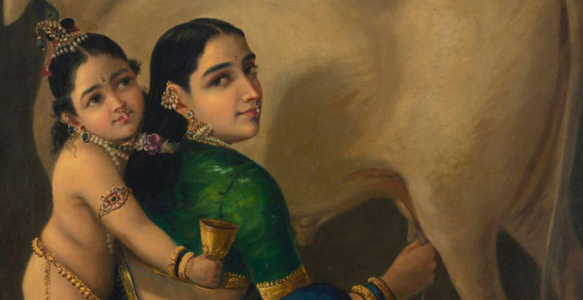
In Yashoda and Krishna the scene is deceptively simple: Yashoda is shown seated, milking a cow, as the infant Krishna approaches her, demanding his share of the milk. The cow, relegated to the background yet rendered with quiet dignity, stands as Kamadhenu, the wish-fulfilling cow, a symbol of nourishment and abundance that deepens the painting’s themes of care and sustenance.
Krishna leans in, his small body pressing against Yashoda’s lap, tugging gently at her attention; his gesture gives this yashoda krishna art its pulse. The domestic intimacy of the moment: metal pail, taut flank of the cow, rustle of Yashoda’s sari never loses its cultural charge: this is everyday divinity, rendered as a tender interruption in the flow of work
2. Academic Realism, Chiaroscuro and the "Mona Lisa of Indian Art"
Ravi Varma paints the figures with the full vocabulary of European academic realism he had absorbed from prints and from observing European painters like Theodor Jensen: muscular modelling of form, careful anatomy, and an almost portrait-like specificity of expression. Strong directional light falls on Yashoda’s face and Krishna’s rounded cheeks, pushing the darker background into shadow and creating a chiaroscuro that art historians have long associated with Baroque and Renaissance painting.
Indian critics and dealers have since called this canvas the "Mona Lisa of Indian art" because of its iconic status and the way it encapsulates a whole visual language of sacred motherhood for modern India. Like da Vinci’s portrait, the Raja Ravi Varma yashoda and krishna image has circulated so widely in reproduction that encountering the original produces a strange double-vision: both utterly familiar and shockingly alive.
3. Scale, Medium and Detail: Looking Closely at the Canvas
Measured at approximately 35 x 28.25 inches (about 89 x 72 cm), the oil on canvas has a presence that photographs rarely convey; it is intimate enough to feel domestic yet large enough to command a wall. Up close, the brushwork reveals itself in the glint on brass bangles, the wet shine of the cow’s eye, the soft gradient of Krishna’s blue-tinged skin.
The composition gently pulls the viewer inward: Krishna’s gaze drifts outward, while Yashoda’s eyes seem to meet ours, a device that makes the spectator feel implicated in this moment of maternal negotiation. Among the many yashoda krishna ravi varma paintings, this one distills his project most succinctly by bringing gods into human proximity without stripping them of aura.
For those who know the image mainly from prints or phone wallpapers, the original is a reminder that reproduction flattens not just texture but also time. The painting holds a kind of suspended stillness; it slows the viewer down long enough to notice how divinity, in this visual universe, is inseparable from work, care and touch. By making the gods look as tactile and proximate as a family portrait, Ravi Varma collapses the distance between icon and viewer, something that later modernists like Amrita Sher-Gil or M.F. Husain would complicate in very different ways.
Historical Significance and Provenance
1. Painted in the 1890s: Ravi Varma at His Peak
Yashoda and Krishna dates to the 1890s, a period widely considered the height of Ravi Varma’s career, when he was producing some of his most ambitious mythological canvases alongside celebrated portraits. By this time he had already achieved fame at princely courts and international exhibitions, and his particular blend of Indian themes with European technique had become a touchstone for modern Indian painting.
The painting’s recent history includes a long residence in a private Delhi collection, punctuated by high-profile exhibitions such as the "Disha" show at the Red Fort in New Delhi and at the NMACC in Mumbai, where it was viewed by large public audiences before returning to the market. That curatorial visibility before its record sale helped frame the work less as a rediscovered rarity and more as a known masterpiece finally being priced at its historical weight.
2. From Easel to Millions of Homes: Chromolithographs and "Milching a Cow"
If the original was destined for an elite patron, its image was always meant to travel further. In 1894 Ravi Varma established the Ravi Varma Press in Bombay, using chromolithography to reproduce his paintings for a mass audience. This image first appears in S.N. Joshi’s 1911 publication Half-Tone Reprints of the Renowned Pictures of the Late Raja Ravi Varma where it is titled Milching a Cow.
A chromolithograph derived from the painting was subsequently printed by the Ravi Varma Press under the title Yashoda Krishna ensuring that variants of this krishna yashoda art reached thousands, perhaps millions, of homes across the subcontinent. Over time, the specific catalogue title mattered less than the scene itself, which became a kind of shorthand for maternal devotion in popular visual culture.
For a generation that grew up seeing this image on puja-room shelves or as a slightly faded print above the television, tracing its path back to a specific oil painting in the 1890s is a powerful exercise. It underscores how technologies of reproduction do not merely copy an original; they can also retroactively amplify its cultural charge.
There is a temptation to think of reproductions as somehow diluting the aura of the original. In the case of Raja Ravi Varma yashoda krishna imagery, the opposite may be true. The print in a modest rural home and the museum-quality canvas now commanding nine-figure bids are part of a single ecosystem, one in which devotion, aspiration and aesthetics constantly circulate between mass image and singular artwork.
Why This Painting Broke the Record
1. Non-Exportable National Treasure: Rarity and Cultural Weight
Raja Ravi Varma is one of India’s designated "National Treasure" artists, part of a list of nine Navaratnas whose works are legally non-exportable under the Antiquities and Art Treasures Act of 1972. In practical terms, this means that masterpieces like Yashoda and Krishna cannot leave the country, even when they change hands, concentrating demand within India while simultaneously limiting supply in global circulation.
Commentators have underlined that this painting is both a registered antiquity and a non-exportable national treasure, a combination that heightens its rarity and its symbolic value for Indian collectors keen to keep such works on home soil. When a work also carries the informal tag of "Mona Lisa of Indian art", its market trajectory becomes almost inevitable.
2. The Poonawalla Effect: Art as Cultural Duty and Financial Asset
Poonawalla’s public language around the acquisition emphasising privilege, responsibility and public access, has resonated strongly with a domestic audience that often worries about masterpieces disappearing into private collections. At the same time, as one of India’s wealthiest industrialists, he also signals to peers that acquiring such works is both a statement of cultural commitment and a sophisticated allocation of capital.
Financial media have read this as part of a larger pattern in which ultra-high-net-worth Indian collectors increasingly treat top-tier art as a serious asset class alongside real estate and equity, particularly when the works in question are legally bound to remain within the country. In this sense, the "Poonawalla Effect" is not just about philanthropy but about anchoring cultural value and financial value in the same object.
3. What This Sale Signals for the Future of Indian Art
The leap from ₹118 crore for Husain’s Gram Yatra to ₹167.2 crore for Yashoda and Krishna is not a marginal uptick; it is a re-rating of the entire upper end of the market. Analysts suggest that such a result will ripple outward, affecting how other major works by National Treasure artists such as Ravi Varma, Amrita Sher-Gil, Jamini Roy are valued and how international institutions approach loans, insurance and exhibition programming for Indian art.
Equally important is the genre: a devotional mother-and-child scene, long associated with domestic piety rather than avant-garde experimentation, now sits at the very apex of price charts, challenging assumptions that only cutting-edge or conceptually radical works can be treated as "blue-chip".
For collectors and enthusiasts who track both Raja Ravi Varma’s popular paintings and post-Independence modernism, this sale makes the map more continuous. It asks us to see devotional realism, abstract modernism and even Indian contemporary art as part of a long arc of value-creation in Indian visual culture, rather than siloed moments.
FAQs About Raja Ravi Varma’s ‘Yashoda and Krishna’
1. Why did Raja Ravi Varma’s ‘Yashoda and Krishna’ sell for such a high price?
The price reflects a convergence of factors: Ravi Varma’s status as a National Treasure artist whose works cannot be exported, the painting’s art-historical significance, its iconic subject matter and the rarity of such a major canvas coming to market. Added to this are the competitive dynamics of a live auction, strong pre-sale interest, and the presence of a determined buyer like Dr Cyrus P. Poonawalla, who framed the purchase as both cultural stewardship and investment.
2.What is the story behind the Yashoda and Krishna painting?
The composition draws on a passage from the Bhagavata Purana in which Krishna approaches his foster mother Yashoda while she is occupied with milking the cow, demanding attention and his share of the milk. Ravi Varma transforms this scriptural vignette into a tender domestic scene, using realism and light to highlight the emotional bond between mother and child.
3. Is Raja Ravi Varma’s ‘Yashoda and Krishna’ a national treasure?
Ravi Varma himself is listed among India’s nine National Treasure artists, whose works are deemed non-exportable under the Antiquities and Art Treasures Act. In addition, commentators and the buyer alike have referred to this specific painting as a national treasure, underscoring its symbolic importance beyond market value.
4. How is the original oil different from the common prints and murals?
The original is a hand-painted oil on canvas from the 1890s with unique material presence, surface detail and documented provenance, whereas common prints, posters and murals are reproductions at varying levels of quality and fidelity. Those reproductions form part of the image’s cultural afterlife, but they do not carry the same art-historical or financial weight as the single easel painting sold in 2026.
