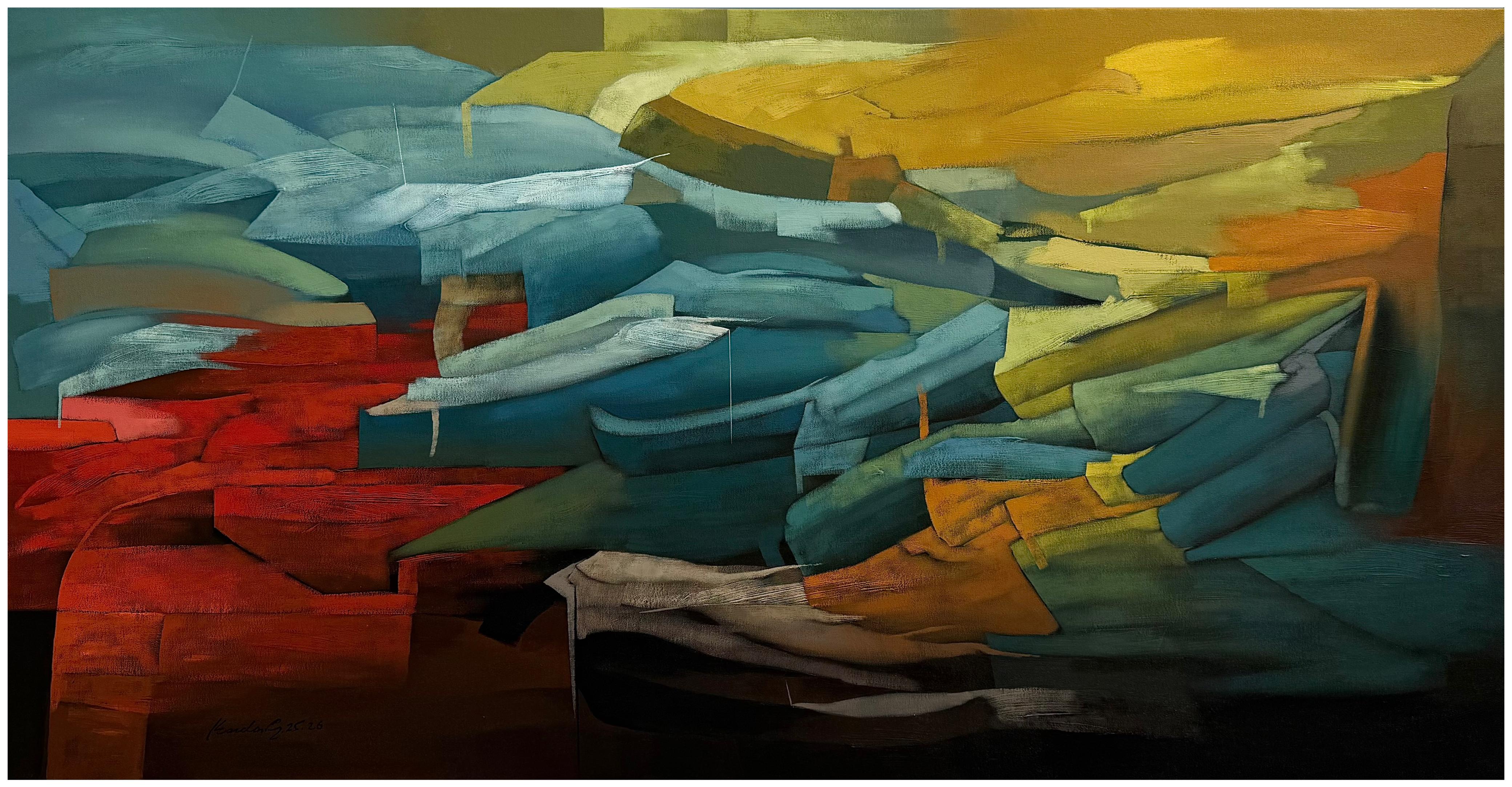
What is an Abstract Art?
Abstract art is a form of visual expression that prioritises emotion, intuition, and inner experience over realistic representation of the visible world. Instead of depicting objects as they appear, abstract painting uses colour, form, line, and rhythm to communicate states of mind, feeling, or spiritual reflection.
Vasudeo S. Gaitonde, one of India’s renowned abstractionists believed painting began in silence. “Everything starts from silence, the silence of the brush, the silence of the canvas,” he once said. For Gaitonde, abstraction was a meditative act; each canvas functioned as a silent prayer, seeking inner stillness rather than visual description through restrained colour and floating forms.
This inward turn lies at the core of abstract art globally. Wassily Kandinsky, one of abstraction’s earliest pioneers, argued that copying nature interfered with art’s deeper purpose. He described colour and form as a musical language, capable of setting the soul vibrating.
Jackson Pollock rejected illustration in favour of direct emotional release, insisting he wanted to express feelings rather than images. In India, S H Raza placed bhav, the emotional essence, at the centre of abstraction, likening his paintings to poetry that alters the viewer’s inner atmosphere.
Mark Rothko’s fields of colour sought to evoke fundamental human emotions. Of tragedy, ecstasy, silence, turning the act of viewing into a deeply personal, wordless encounter.
For many emerging collectors and art enthusiasts, abstract art is elusive and thrilling. It stands as both invitation and challenge: what is abstract painting if not a window into emotion, movement, and intuition? Throughout this article, we unspool the lineage, contradictions, and practical entry-points into the vibrant world of abstract painting history-rooted in India, connected to global currents, and lived in the artist’s studio and the collector’s home. For those curious to explore how these ideas translate into real works, you can view a curated selection of abstract art paintings that reflect diverse emotional, material, and philosophical approaches.
History and Evolution of Abstract Art
It began in the early 20th century, when artists across Europe and Asia were growing restless-yearning to break away from the boundaries of figuration. Wassily Kandinsky in Munich heard music in color; his 1911 'Composition V' didn’t depict trees or faces, only motion, feeling, and time itself.
Meanwhile, Indian pioneers such as V.S. Gaitonde probed the spiritual and mysterious, layering translucent inks till his works pulsed with an inner radiance, changing how indian art could move beyond direct representation into pure feeling.
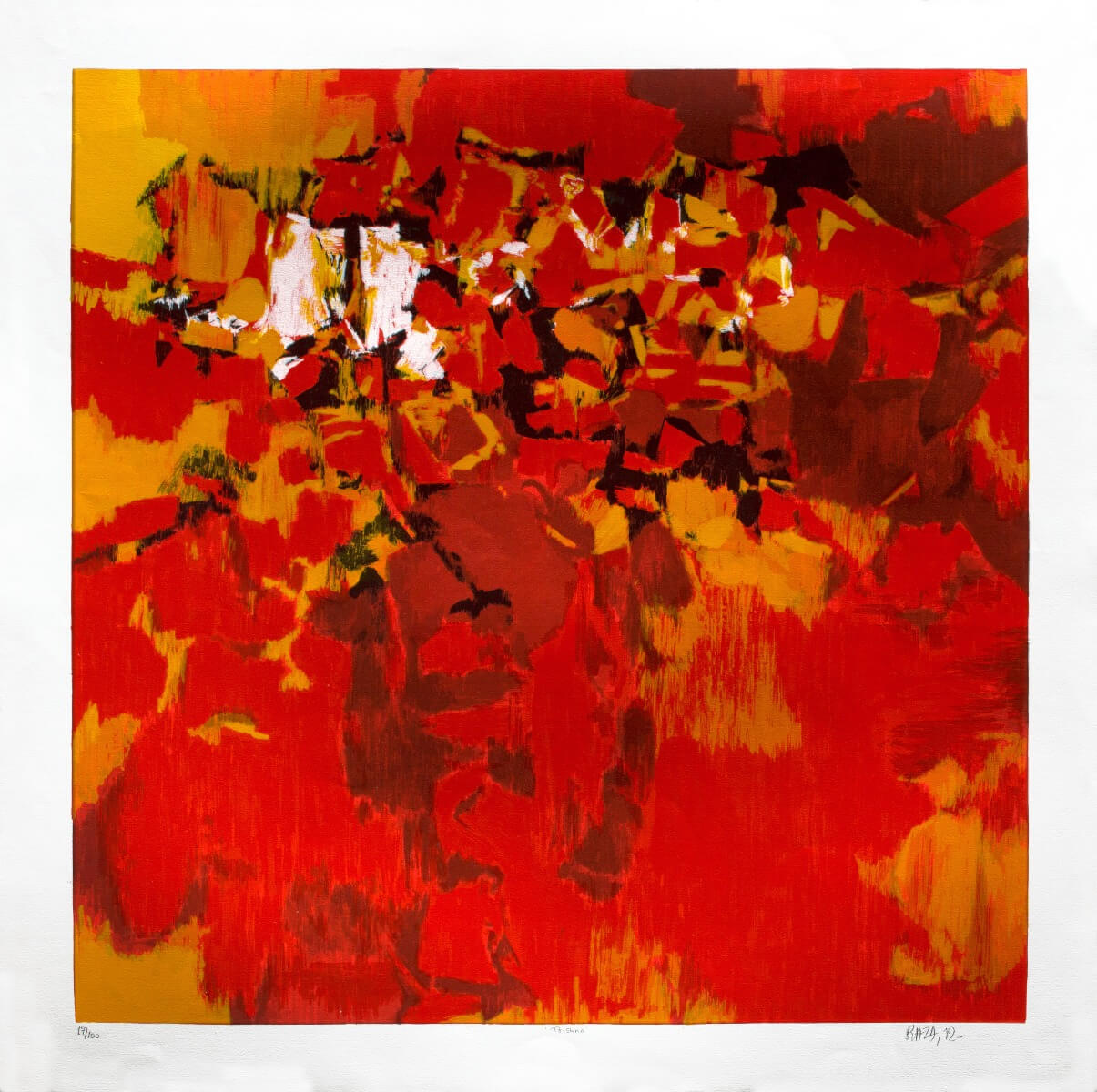
As decades unfolded, the meaning of abstract art changed - minimalists like Agnes Martin pursued the serene grid, while post-partition artists in India like S.H. Raza blended tantric geometry with cosmic symbolism. Abstract art origin cannot be pinned to one geography or philosophy. It grew from early experiments in Paris, New York, Tokyo, and Mumbai.
Exhibitions such as Gaitonde’s landmark retrospective at the Guggenheim, or Nalini Malani’s multimedia abstractions at Tate - have cemented the evolution of abstract art: sometimes spiritual, sometimes rebellious, always attentive to new media and materials.
Key Characteristics of Abstract Art Paintings
1. Emotional and Expressive
For many abstract artists, emotion is the starting point, not the outcome. Artist Ram Kumar spoke of abstraction as a way to distill lived experience. The loneliness, displacement, memory into visual states where form carries feeling without narrative.
On the other hand, curator and collector Aparajita Jain has noted that abstract works often create their strongest impact when they “mirror something unresolved in the viewer.” What collectors respond to, she suggests, is not recognition but emotional alignment and an unspoken sense that the work is holding a feeling they already know.
2. Experimentation
Abstract artists often allow process to lead meaning. Julie Mehretu describes her paintings as accumulations of marks, erasures, and revisions, almost like records of thinking rather than fixed images. The work evolves through trial, interruption, and chance, with experimentation functioning as both method and meaning.
Collectors and curators frequently value this visible risk. Curator Hans Ulrich Obrist has spoken about abstraction as a space where uncertainty is preserved rather than resolved. For many collectors, traces of layering, hesitation, overpainting is a sign of authenticity, revealing the artwork as a site of inquiry & questions that are probably sitting with them as well.
3. Subjective Interpretation
Abstract art resists singular meaning by design. Artist Agnes Martin insisted her work was not about symbols but about states of calm, joy, innocence, meant to be felt rather than explained. The absence of imagery creates space for viewers to enter the work on their own terms.
From a collector’s perspective, this openness is precisely the appeal. Art patron and museum trustee Kiran Nadar has often spoken about collecting works that continue to unfold over time. Abstract paintings, she suggests, reward repeated engagement, often revealing different meanings as the viewer’s own experiences change.
Let yourself be wrong. Let yourself be overwhelmed. Abstract painting isn’t a code to crack, but a mood to inhabit.
10 Key Tips to Keep in Mind Before Buying Abstract Art
1. Choose Colors That Complement Your Interior
Color is often the first emotional handshake between an artwork and a space. Before buying, observe the dominant tones in your room of your walls, upholstery, flooring. Ask whether the painting should harmonise quietly or disrupt deliberately. A restrained interior can come alive with a bold abstract work, while already layered spaces may benefit from nuanced palettes, as seen in the meditative tonal shifts of Shrikant Kadam.
This is especially important when selecting living room paintings , where it becomes the focus of the space.
2. Explore Different Styles and Techniques
Abstract art is a constellation of approaches. From gestural and lyrical abstraction to geometric or layered mixed-media practices, each technique produces a distinct emotional rhythm. Exploring varied styles helps you understand whether you are drawn to movement, structure, or psychological depth, much like the contrast between the spiritual geometry of S H Raza and the introspective surfaces of Gayatri Deshpande.
3. Check for Framing and Display Options
Framing alters how the artwork breathes within a room. Heavy frames can overpower delicate works, while floating or shadow gaps often enhance contemporary abstract works. Large, immersive artworks such as those by Suresh Kumar & Kandan G often work best with minimal framing so the scale and surface remain uninterrupted.
4. Think About Long-Term Value
While budgets matter, abstract art rewards long-term emotional engagement more than immediate justification. Consider whether the work will continue to reveal itself over time through layered meanings, or evolving personal interpretations. Works rooted in strong conceptual foundations, such as H R Devulapalli’s Vaishvanara series or Ekta Sharma & Uday Goswami’s philosophical explorations, often sustain lifelong relevance rather than momentary appeal.
5. Prioritize Authenticity and Artist Background
Abstract art can appear deceptively simple, making authenticity crucial. Look for verified provenance, artist statements, and clear documentation. Understanding the artist’s journey - why they paint abstractly, what drives their visual language - deepens your connection to the work, especially with introspective practices like those of Madhuri Bhaduri.
6. Consider space and size
Scale dramatically alters experience. Smaller works invite intimacy and close looking, while large canvases demand space and physical distance to fully appreciate the work. Before buying, measure your wall and imagine how you will encounter the painting daily - whether it should blend with the space or command attention upon entry.
7. Theme And Motifs
Many abstract artists return to certain visual ideas - bindus, spirals, fragmented grids, or rhythmic waves - as anchors of meaning. Ask yourself whether these motifs resonate personally or philosophically. For instance, Kandan G uses fractured urban forms to reflect modern life, making his abstractions feel grounded yet contemporary.
8. Look for quality
Quality in abstraction reveals itself through material intelligence - layering, pigment density, surface tension, and intentional mark-making. Whenever possible, view the work in person or request high-resolution images to observe these details. Subtle surface variations often distinguish enduring works from visually flat compositions.
9. Set a (thoughtful) budget
Setting a budget helps narrow choices without overwhelming decision-making. Emerging abstract artists often offer compelling works starting around ₹50,000, while established names command higher ranges. A clear budget allows you to focus on resonance and quality rather than compromise or impulse. Serigraphs also offer easy access points.
10. Seek Professional or Curatorial Guidance When Needed
Abstract art does not always explain itself immediately and that’s its strength. Curators, gallerists, and experienced advisors can help contextualise works, clarify doubts, and align your choice with both space and sensibility. At ArtFlute, we’ve guided collectors toward works that balance spatial presence, artistic depth, and verified provenance.
Styling Your Space with Abstract Art
During our design consultations with collectors and work with Interior designers, we discovered that great spaces feel curated rather than purely decorated. Let the artwork’s mood set the tone for how you live and gather.
1. Start with a Focal Point
Let an anchor piece lead the way, whether by its scale, color, or story. And abstract art makes an excellent focal point. A well-placed large piece can draw the eye, anchor the space, and even set the room’s mood and palette. Designers note that an oversized statement artwork adds exceptional interest to a room, often anchoring the design as a whole. In practice, choose one standout abstract (like a big canvas or bold sculpture) to build your decor around. For example, a vibrant painting above a sofa (or in a chic office lobby) can act as the visual anchor that ties together colors and furnishings. Even in contemporary Indian interiors – which span minimalist to eclectic styles – a single striking abstract piece helps unify the space and gives it personality.
2. Consider Lighting and Surroundings
Lighting dramatically affects how art is perceived – glare, shadows, and daylight each alter an artwork’s appearance. Professionals often use a 30-degree angled light to illuminate paintings, which minimizes glare and reflections. If you’re lighting an oil painting or textured acrylic, adjusting the angle slightly (about 25°) will accentuate the brushstrokes while still avoiding harsh glare. Also be mindful of natural light: sunlight can make colors glow, but excessive direct sun (especially in India’s bright climate) can fade pigments over time, so it’s wise to use UV-protective glass or LED lighting that avoids UV rays. In the evening or darker corners, add accent lighting like track lights or picture lamps to highlight your art – a well-placed picture light can complete the display and even “punch” up the artwork’s rich colors at night, transforming the mood of the whole room. Finally, think about the surroundings: the wall color and nearby décor should complement the art. A neutral or softly colored wall offers a timeless backdrop that ensures the artwork remains the focal point, and aligning the piece with furniture (centered above a sofa, mantel, or console) creates a harmonious, intentional look within the space.
3. Think Beyond the Wall
Art isn’t confined to just hanging frames – explore creative placements. For example, leaning a large abstract canvas against a wall or on a mantel can give your room a cool, casual gallery look. This approach is both contemporary and flexible, letting you easily move or swap pieces as your style evolves. Likewise, think in three dimensions: abstract sculptures, installations, and art objects can live on tabletops, shelves, or floor pedestals to open up new viewing experiences. Placing a sculpture at eye level (on a console or plinth) invites it to “observe and be observed,” making it an interactive part of your daily decor. These off-the-wall displays encourage people to engage with art from different angles – a leaning piece invites close-up appreciation rather than just a quick glance. Such ideas work in any space, not just homes: an abstract sculpture in a lobby or a mixed-media installation in a café can become a memorable conversation piece that guests walk around and enjoy, creating a sense of a curated environment rather than a static display.
4. Play with Scale and Placement
Don’t be afraid to experiment with the scale of artworks and how you arrange them – it can dramatically change the feel of your space. An oversized abstract painting hung alone makes a bold statement, preventing it from feeling empty, whereas a grouping of smaller artworks can have equal impact if arranged thoughtfully. By clustering a series of small or medium abstract pieces together (a gallery wall), they collectively act as one visually interesting ensemble rather than a lot of tiny decor items – the eye reads the cluster as a single curated statement. Conversely, one big canvas placed solo can create a clean, museum-like focal point that immediately draws attention. Also, consider juxtaposing different styles or mediums for rich contrast. Diversity in art – mixing various genres, eras, sizes, and textures creates depth and intrigue on your walls. In practice, you might pair a modern geometric abstract with a softer vintage piece, or mix bold and subtle artworks side by side. Such contrasts make a room feel truly curated and dynamic. In many Indian interiors, for instance, it’s not unusual to see a contemporary abstract painting alongside a traditional sculpture or textile; done intentionally, this blend of old and new adds character and tells a story, elevating the space beyond a standard showroom look.
FAQs About Abstract Art Guide
1. What should I look for when buying abstract art online?
Look for authenticity, provenance, artist reputation, and surface quality. At ArtFlute, we recommend verifying that each original abstract painting comes with a signed Certificate of Authenticity detailing the artist's origin, medium, and creation date. Ensure the artist's signature is present on the piece, and request high-resolution images or video calls with artists before purchase.
2. What are the most popular styles of abstract art?
The most popular styles include Gestural Abstraction, Color-Field Painting, Geometric Abstraction, Minimalism, and Multimedia forms .
3. How do you know if abstract art is good?
Quality reveals itself through technique, emotional resonance, and provenance. Examine the artist's brushwork consistency, layering of colors, and the intentionality behind composition. Assess whether the artwork evokes a genuine emotional response and connects with you personally.
4. How do I care for and maintain my abstract painting?
Maintain stable humidity and indirect light to preserve your artwork's integrity. Avoid hanging paintings in direct sunlight or humid areas like bathrooms, as UV exposure causes color fading and moisture can lead to mold. Regularly dust your framed art using a soft, lint-free cloth without harsh chemicals.
5. Is it okay to mix abstract art with other art styles?
Absolutely, contrasts enrich interiors and spark dialogue. Mixing abstract art with figurative, landscape, or cultural pieces (such as Pichwai paintings) creates visual interest and encourages deeper conversation about diverse artistic perspectives and help express your individual personality.
6. What size of abstract art painting should I buy?
Assess both spatial volume and intended visual impact. Large-scale abstract paintings (often 4–6 feet or larger) create dramatic focal points and command attention in expansive living areas or office spaces. Medium-sized pieces (2–4 feet) work well for standard rooms, while smaller works suit intimate spaces or gallery-wall arrangements.
7. Should I choose original abstract art or prints?
Originals offer unique surface texture and long-term; prints suit rotation and budget constraints. Original abstract paintings are one-of-a-kind creations with distinctive brushstrokes, layered textures, and emotional depth that cannot be replicated. Limited-edition prints (such as ArtFlute's serigraphs of masters like S.H. Raza) are a middle ground between regular off the shelf prints and originals, providing affordable access to celebrated artists' work.
