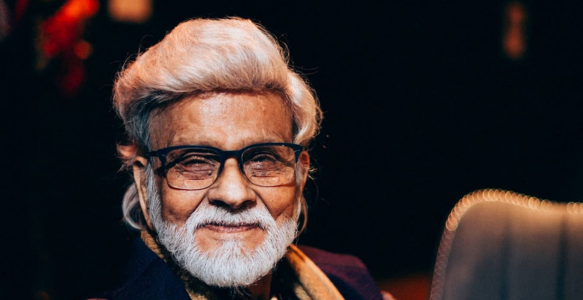
Who Was Satish Gujral?
In the summer of 1947, as Punjab burned with Partition violence, a twenty-two-year-old artist worked as a volunteer rescuer in Lahore. He moved through streets thick with ash and blood, pulling strangers from rubble, carrying children across border checkpoints, witnessing daily massacres that would yield over a million deaths across the subcontinent. His family's home had become a refugee camp. At night, he sketched what he had seen - the distorted faces, the enlarged hands reaching for help, the collapsed architecture of civilization itself. These drawings would become the foundational work of an extraordinary artistic life.
Satish Gujral was born deaf. At eight years old, a swimming accident near Pahalgam Kashmir rendered him voiceless in both literal and social senses. Rather than diminish his prospects, this profound isolation became his creative forge. For sixty-two years he inhabited silence as space for radical attention. "My beginning as an artist was partition," he would say decades later, conflating the historical rupture with his personal one. When he finally underwent cochlear implant surgery at sixty-two in 1997, restoring hearing after decades of silence, he discovered that sound felt like alien noise. He abandoned the experiment within months, returning to his familiar quiet. Much of what defines his life and work, often reduced to basic information about satish gujral, cannot be separated from two formative forces: his hearing loss and the collective trauma of Partition.
This convergence - deafness, Partition, artistic mastery - defines why Satish Gujral achieved legendary status across Indian modernism. He was not merely a talented painter or architect or sculptor. Gujral, the artist, insisted that all mediums spoke the same language. Across seven decades, he worked in painting, sculpture, murals, ceramic, burnt wood, bronze, steel, and architecture - always exploring. He refused European modernism's abstraction and Indian nationalism's nostalgia, carving instead a third path: modernism rooted in trauma and transformation and the universal resilience of artistic creation.
Artistic Journey of Artist Satish Gujral
1. Partition Struggles & Expressionism
What can be considered Satish Gujral's first painting emerged directly from these sketches - raw, uncompromising images born not from formal ambition but from the urgent need to record human devastation as it unfolded before him. What happened to Satish Gujral between 1947 and 1950 shaped not just his art but Indian modernism itself. Unlike artists who experienced Partition as abstraction or historical inevitability, Gujral witnessed it as daily carnage. He saw families separated at railway stations, villages burning in systematic sequence, the mathematics of ethnic cleansing unfold in real time. He chose to remain in Lahore while others fled, helping transport refugees across the new border until the last person had crossed.
When finally he left for Shimla and later Delhi, he carried within him the visual memory of devastation. The paintings that emerged - the Partition Series - refused the safety of distance or abstraction. Here were distorted human figures enlarged beyond natural proportion, their hands monumental and darkened, their bodies twisted as if the canvas itself could barely contain their anguish. The color palette screamed: deep reds like dried blood, blacks that suggested burnt earth and charred homes, occasional metallic tones that caught light like flames. Symbolism saturated every surface - broken wheels for collapsed civilizations, shattered architecture, empty fields. Yet these weren't symbolic decorations. They were responses to what the artist had actually witnessed.
At first glance, one might assume this expressionist violence emerged from training. But Satish Gujral's painting style was crystallized through trauma, not technique. Around 1952, he received a scholarship to Mexico City, to the Palacio de Bellas Artes, where he studied under Diego Rivera and David Alfaro Siqueiros - masters of the Mexican muralist movement who had also used art to process revolution and suffering. In Mexico, his Partition paintings were exhibited at the Galleria de Arte Moderna to international acclaim. The world recognized what Gujral understood: that personal suffering, when rendered with formal sophistication, transcends geography. A woman's outstretched palm in Lahore speaks to loss everywhere.
The deeper truth about his expressionist artwork: it emerged from fidelity to experience. He had seen what expressionism could accomplish, as a testimony. The distortion of faces became the only accurate visual language for emotional truth.
2. Multi-Medium Exploration & Mastery
Returning to India in the mid-1950s, Gujral rejected the conventional artist's trajectory. Most painters find a medium, master it, and spend a lifetime perfecting technique. Gujral did the opposite. He remained restless, driven by a philosophical conviction that: each material possessed its own language, and the artist's responsibility was to listen deeply and respond with integrity.
His approach to materials was almost alchemical. In the 1950s and early 1960s, while his famous paintings continued the Partition investigation, he began experimenting with sculpture. Steel and copper, painted in bold enamel colors, yielded forms that resembled machinery - tubular shapes and geometric abstractions that anticipated his later architectural thinking. Ceramic work followed, permitting large-scale murals. He also worked in stone, exploring granite's monumental grey tones and how varying carving depths could generate visual rhythm.
Observing the pink and red embers of burning logs during Lohri (the Punjabi winter festival), something shifted in him. Here was a material that held layers of meaning: fire's destruction and creation simultaneously, charring that revealed interior forms, ash that could become beauty. He began carving deities from blackened timber, punctuating them with vermillion and gold that caught light like smoldering fire. The burnt wood series became iconic because it was philosophically perfect. Destruction and transcendence converged. The medium mirrored his artistic project: transmuting historical trauma into formal beauty.
Why does material choice matter more than style? Because it determines what truths the work can tell. A bronze cast would lie about burnt wood's nature. Polished marble would falsify granite's power. Gujral understood this with almost religious intensity. His later work in bronze, where he experimented with patinas and the serendipitous emergence of color, revealed how even late in life he remained open to what materials demanded. He approached each medium not as a vehicle for predetermined vision but as a conversation partner, something to learn from.
3. Artistic Influence on His Architectural Ventures
The turn toward architecture seemed accidental, emerging not from formal training but from accumulated artistic conviction. At Mayo School of Art in Lahore, where Gujral studied under John Lockwood Kipling, students learned that all visual disciplines - drawing, script, design, craft - participated in a unified artistic vision. This principle, absorbed young, would resurface decades later.
In the 1970s, commissions for a house and hotel turned his artistic instincts into spatial conception. When Belgium's Ministry of Foreign Affairs invited him to design a new embassy in New Delhi in the early 1980s, he almost declined. He submitted drawings "more to please diplomat Roland Burny than in hope of winning." He won. Between 1980 and 1983, the Belgian Embassy emerged - a red-brick fortress-like structure with sculptural arches and organic curves that resembled Roman ruins or fragments of Caracalla Baths. It looked nothing like conventional embassy architecture. International juries recognized its significance: among 1,000 buildings constructed globally in the twentieth century, it ranked among the finest. Gujral became the only non-Belgian architect ever to receive Belgium's Order of the Crown for architectural achievement.
What matters about this triumph is what it revealed: architecture could be sculptural, space could embody artistic vision, functional buildings could possess profound spiritual presence. His subsequent designs - the Indian Islamic Cultural Centre in New Delhi, institutions in Mauritius and Kathmandu, structures in Riyadh - extended this thesis. They proved that an artist's conviction about integrated practice could reshape the built environment itself.
The same philosophical conviction - that materials possess inherent language, that artists listen rather than impose, that spiritual and functional concerns merge - animated everything he created. The embassy's interior spaces embody the same textural sophistication and play of light that characterize his sculptures and paintings.
Characteristics of Satish Gujral Painting Style
1. Expressionism and Abstraction
Satish Gujral's commitment to expressionism artwork was distinct from European expressionism. Where German expressionists pursued subjective distortion for aesthetic intensity, Gujral's exaggeration emerged from documentary witnessing.. The distorted figures, the enlarged hands and feet, the contorted mouths - these weren't aesthetic choices but ethical necessities, the only visual language adequate to historical horror.
Over successive decades, his practice absorbed abstract art paintings without abandoning the emotional core. Space paintings of the late 1950s featured tubular forms and mechanical shapes that created hybrid language - figuration rooted in memory, abstraction emerging from formal exploration. A painting of Satish Gujral emerged from a specific historical moment yet spoke universally because the formal language was rigorous.
2. Texture and Layering
Across every medium, Gujral pursued texture with obsessive intensity. Nothing in his work was smooth or decorative. Burnt wood sculptures featured uneven chipping that caught light unpredictably. Ceramic murals employed layered tiles creating dimensional variation. Even canvas works accumulated multiple applications, generating impasto effects that made paintings physically present, impossible to contemplate from distance. The viewer's hand instinctively reached toward the surface.
This texturing served purpose beyond aesthetics: it demanded engagement. His incorporation of cowrie shells and knotted leather ribbons into charred wood created unexpected relief within darkness. These weren't embellishments but integral to meaning - small moments of visual surprise that rewarded close looking. In his sculptural practice, he discovered poor artisans who created textured metal by grinding scrap into powder and melting it onto tin plates, generating patinas of extraordinary complexity. He adopted their technique. Every Satish Gujral artwork insisted on tactile presence, on materials that resisted smooth viewing.
3. Symbolism
Satish Gujral's symbolism never descended into illustration. In the Partition paintings, recurring motifs carried meaning: broken wheels symbolized civilizational collapse; shattered homes represented rootlessness; burning fields depicted agricultural devastation. Yet these emerged organically from observed reality. A woman's open palm with darkness in its center conveyed both individual grief and existential emptiness. The same gesture, when rendered as a man's clenched or hidden hand, communicated masculine dignity facing powerlessness - revealing how trauma inscribes itself differently across gender.
His later work, particularly in spiritual artworks like the Meera Bai series, "Sita's Agnipareeksha," "Draupadi's Disrobing" - demonstrated sophisticated engagement with Indian symbolism. These recontextualized ancient narratives within contemporary suffering. Draupadi's mythological violation became a meditation on present-day violence against women. Sita's trial by fire illuminated modern dowry deaths. His symbols operated on multiple registers: historical, personal, universal, spiritual. They required the viewer to think.
4. Material Versatility
Perhaps no Indian modernist demonstrated that material versatility constituted philosophical commitment rather than technical skill. Gujral's career was sustained exploration of what different materials could express. Oils on canvas permitted gestural intensity of Partition paintings. Burnt wood conveyed destruction and transcendence simultaneously. Steel and copper, painted in enamel, created mechanical forms speaking to industrial modernity. Granite's grey tones and carved depths generated primitivist power. Bronze allowed subtle color variations through patination.
Each material generated distinct meanings. The violence in his charred wood "Untitled Ganesha," created during anti-Sikh riots, couldn't have been expressed in polished bronze. The spiritual yearning in granite works required that material's monumental earthiness. Ceramics permitted color-form integration impossible in oil painting. Each Satish Gujral sculpture, each Satish Gujral art piece, matched to its ideal medium had a fidelity to material authenticity that distinguished his practice.
Satish Gujral Famous Paintings and Artworks
Together, these Satish Gujral works span more than seven decades and reveal an artist who treated painting, sculpture, and material exploration as a single, unified practice rather than isolated disciplines.
1. The Partition Series
The Partition series stands as Gujral's most historically significant body of work. Created from 1947 onward, these paintings constitute an artistic record of one of history's most catastrophic events. Unlike official historical narratives that reduce Partition to political abstraction, these canvases insisted on irreducible humanity of suffering.
The figures tower monstrously - bodies twisted and enlarged, faces contorted in anguish the canvas barely contains. Color screams: deep reds suggesting dried blood, blacks evoking burnt earth, ochres of dust and displacement. There exists no beauty here, no aestheticization of tragedy. Instead: witnessing. The artist's testimony to what he had seen and to survivors' resilience. Through these paintings, Gujral demonstrated that artistic mastery and emotional devastation could coexist.
2. Political Portraits
Beginning in the 1950s, Gujral created portraits of India's political leadership - Jawaharlal Nehru, Indira Gandhi, Maulana Azad, Krishna Menon - that fundamentally reconceived portraiture. Rather than celebrating power, his paintings humanized these figures. They appeared as ordinary people, marked by responsibility's weight, rendered with expressionist brushwork and psychological intensity applied to Partition works.
Several paintings hang in Parliament, serving as enduring records of India's formative era. What distinguished these artworks from conventional state portraiture: refusal to flatter or monumentalize. They insisted on the subject's vulnerability, on the toll history exacts even from great figures.
3. The Serpent and the Rope
Painted in 1977 in mixed media (122.2 x 122.2 cm), "The Serpent and the Rope" captures Gujral's mature engagement with abstraction and symbolism. Interlocking forms suggest movement, tension, spiritual struggle. The title invokes ancient Indian philosophy - the rope mistaken for serpent as illusion metaphor - and contemporary preoccupations with fear and transformation. The painting operates simultaneously in multiple registers of meaning, integrating traditional Indian thought with modernist abstraction.
4. Trojan Horse
Engaging classical mythology to explore deception, vulnerability, and civilization's price, this work transforms the legendary wooden horse into meditation on how societies collapse from within. Gujral's treatment converts myth into commentary on perpetual tensions between trust and betrayal, between surfaces and hidden truths - themes resonant across historical moments, particularly relevant to his observations of political and social upheaval.
5. The Meera Bai Series
Devoted to the medieval saint-poet Meera - known for devotion to Krishna and transgression of social convention - this series explores themes of spiritual yearning, female autonomy, and devotion's transformative power. The paintings combine spiritual exploration with personal narrative, treating historical Meera as a figure through whom Gujral could examine contemporary questions of freedom and authenticity.
6. The Red Tomb
Created in 1960 (oil on canvas, 25 x 30 inches), "The Red Tomb" constitutes meditation on death, loss, and grief's permanence. The title suggests both a physical burial site and the interior tomb of memory where the dead reside in consciousness. The painting employs Gujral's signature somber palette and expressionist brushwork, but with quieter intensity than Partition works - grief rendered as contemplation rather than anguish. The work marks his transition from explosive emotionalism of early practice toward a more internalized, philosophical approach to suffering.
7. Mourning En Masse
Perhaps the most powerful work within the Partition Series, "Mourning en Masse" captures collective grief of women rendered homeless and bereaved by Partition violence. Enlarged figures of women, their bodies wrapped in cloth, their faces contorted in sorrow, fill the canvas. The composition emphasizes suffering's magnitude - these figures extend beyond painting's boundaries, as if their grief is too vast to contain. The painting's genius: it transforms individual losses into collective trauma, making visible the often-unseen suffering of women during communal violence.
8. Night of the Dead
Part of Gujral's later explorations into spiritual and mythological themes, this work engages Indian concepts of death and afterlife. The painting channels expressionist techniques toward mystical rather than political ends, suggesting realms beyond the visible, presences inhabiting darkness. It exemplifies how his artistic vocabulary remained flexible, capable of addressing both historical trauma and transcendent experience.
9. Burnt Wood Series
Beyond individual titled works, the burnt wood series represents an entire body of artistic practice spanning decades. Each sculpture emerged from Gujral's meditation on transformation - how fire destroys and simultaneously creates, how charred materials hold beauty born from destruction. The series includes deities rendered in burnt wood with gold and vermillion accents, abstract forms suggesting movement and energy, organic shapes echoing natural forms. These sculptures embody his philosophical conviction that art arises from engagement with fundamental materials and forces.
10. The Christ Series
Gujral's later work occasionally engaged Christian iconography, particularly Christ as symbol of suffering, sacrifice, and redemption. These paintings reveal his capacity to move fluidly across religious and cultural traditions, finding in Christ imagery opportunities to explore universal themes of human vulnerability and transcendence. The series demonstrates that his engagement with spirituality extended beyond Hindu and Buddhist traditions to encompass Christianity's contributions to human meaning-making.
Closing Reflection
Satish Gujral died on March 26, 2020, at age ninety-four, having spent his final decades creating with the same intensity that characterized his youth. His ashes were scattered in the Yamuna.
Consider what it means that an artist who couldn't hear for sixty-two years yet created the most powerful artistic testimony to India's greatest catastrophe. Consider what it suggests about attention, about how deprivation can sharpen perception, about how personal trauma and historical trauma might speak through the same artistic language. As contemporary Indian art searches for authentic modernism - neither entirely Western nor entirely traditional - Gujral's example endures. He proved that modernism rooted in specific, witnessed experiences could achieve universal resonance. He demonstrated that materials possessed their own intelligence and that listening mattered more than imposing style. He showed that one artist, working across disciplines with absolute conviction, could reshape how an entire nation sees itself and its capacity for resilience.
His life poses an enduring question for artists and viewers alike: What does it demand of us to look at what he saw and rendered? What responsibility follows from witnessing art born of such a witness?
FAQs About Satish Gujral Painter
1. What is Satish Gujral famous for?
Satish Gujral is best known for his Partition Series paintings, which depict the violence and human trauma of India’s Partition with powerful expressionist intensity. He is also renowned for working across multiple disciplines, including painting, sculpture, murals, and architecture, treating them as part of a single artistic practice.
2. What is unique about Gujral's murals?
Satish Gujral’s murals combine modernist abstraction with Indian visual traditions and are designed to integrate fully with architectural spaces. Executed in materials such as ceramic tiles and fresco, his murals transform buildings rather than merely decorating them, most notably at Gandhi Bhawan in Chandigarh and the Delhi High Court.
3. Why is Satish Gujral important in Indian art history?
Satish Gujral is significant for forging an independent path in Indian modernism that neither followed European abstraction nor relied on nostalgic traditionalism. His work engaged directly with lived history, personal trauma, and spiritual themes while breaking boundaries between fine art, architecture, and design.
4. What awards did Satish Gujral receive?
Satish Gujral received the Padma Vibhushan in 1999 and multiple National Awards from the Lalit Kala Akademi. Internationally, he was honored with Belgium’s Order of the Crown and Mexico’s Leonardo da Vinci Award, recognizing his contributions to art, murals, and architecture.
