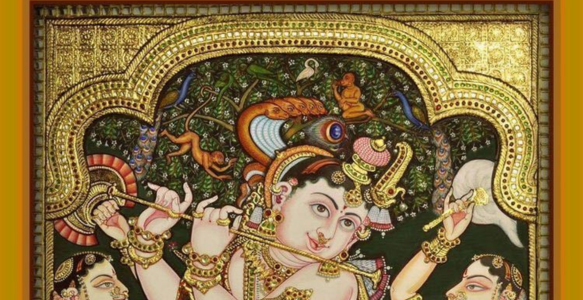
On certain afternoons in Mysuru, the light in old homes does something specific.
It slides past carved rosewood, settles on a single framed image, and suddenly a tiny crown, a nose ring, or the edge of a halo begins to burn quietly with gold. That is often a first encounter with a Mysore painting of Karnataka – not in a museum vitrine, but in a puja room, a palace corridor, a modest hall where devotion and artistry have shared a wall for generations.
This continuity – from Vijayanagara murals to Wodeyar palaces to present-day studios – is what gives Mysore art paintings their unusual combination of restraint and radiance.
While other South Indian traditions, such as tanjore paintings, revel in heavy relief work and saturated colour, Mysore art takes another route: quieter tones, thinner gesso, and a focus on line, anatomy and expression rather than spectacle alone. Think of it as the classical chamber music of Indian painting – intimate, precise, and built to be lived with rather than merely admired from a distance.
What is Mysore Painting?
Mysore painting is a classical South Indian art form that took shape in and around the city of Mysuru, evolving out of the Vijayanagara school after the empire’s fall in 1565. Artists displaced from Hampi migrated to Mysore and nearby centres, carrying with them a mural tradition that gradually adapted to smaller, portable panels and devotional icons. Over time, this Mysore painting origin under the Wodeyar rulers crystallised into a distinct style known for elegance, muted colours and intricate detail.
In terms of period, the style’s foundations lie in late Vijayanagara and early Nayaka times, but its flowering happens under Wodeyar patronage in the 18th-19th centuries, especially during the reign of Mummadi Krishnaraja Wodeyar. It is in this era that we see the codification of the Mysore painting style in treatises like Sritattvanidhi and on the walls and panels of Jaganmohan Palace. Today, when people ask “what is Mysore painting?”, they are usually thinking of these courtly and devotional works – gold-embellished icons of deities, court scenes, and mythological narratives painted on paper or board.
Where many traditions prioritise spectacle, Mysore traditional painting quietly insists on bhava – the inner mood of the figure – rendered through fine linework and careful attention to gesture.
As curators, we often see Mysore art functioning almost like a bridge between domestic ritual and connoisseurship: a panel of Chamundeshwari in a Mysuru home can sit as comfortably beside Indian paintings in contemporary abstraction as it does beside brass lamps and framed family photographs.
Because Mysore painting information is often reduced to technique and gold, we sometimes forget how intimately the style is tied to Kannada literary culture, temple ritual and local court histories – it is as much a visual archive of “Old Mysore” as it is a religious art.
History and Origin of Mysore Painting
1. Origins in the Vijayanagara Empire
The story of Mysore painting history begins in the temple towns of the Vijayanagara Empire, where expansive murals narrated episodes from the epics across pillared halls. When the empire fell after the Battle of Talikota in 1565, many painters lost royal patronage and moved southward and westward, some settling in Mysuru, Srirangapatna and Tanjavur. Their visual language of strong contour drawing, narrative sequencing, and iconographic precision would seed both the Mysore and Tanjore schools.
2. Patronage under the Wodeyar Dynasty
By the 17th-18th centuries, the Wodeyars of Mysore had become key patrons, inviting artists to their courts and temples and commissioning icons, palace murals and manuscripts. Under rulers like Mummadi Krishnaraja Wodeyar, a systematic programme of documentation and revival emerges – including the encyclopaedic Sritattvanidhi, which codifies forms of gods, goddesses and decorative motifs for court painters.
Visitors to Jaganmohan Palace today still encounter this Wodeyar era through portraits of kings, queens, and courtiers, as well as elaborate depictions of Sri Rama Pattabhisheka and other mythological scenes. Standing in front of these works, you can almost imagine the artists – painting under oil lamps while musicians rehearsed in the halls next door.
3. Evolution During British Era
The colonial period brings new pressures and possibilities. On one side, lithographic religious prints and Raja Ravi Varma’s oleographs begin to circulate widely, offering cheaper devotional images and subtly influencing anatomy and realism. On the other hand, palace commissions were reduced after the end of princely rule, forcing many chitrakar families to diversify or abandon the profession.
Yet this is also the era in which Mysore style painting begins to be consciously preserved as heritage rather than simply craft. Institutions like the Chamarajendra Academy of Visual Arts and collections such as those later assembled by R.G. Singh at Ramsingh Museum worked to document and conserve hundreds of works spanning two centuries.
Features of Mysore Art Painting
The features that define Mysore art are embedded in its materials and making. The process is meticulous: prepare the surface, draw the image, build low relief, lay gold, then glaze with soft colours.
1. Gesso Paste (Raised Work)
Unlike the architectural relief of Tanjore, Mysore artists use a finer gesso paste to create subtle elevation on jewellery, crowns and borders. This gesso is typically made from white lead or chalk mixed with binding agents, applied in controlled ridges that, when dry, give just enough depth for the gold leaf to catch light without overwhelming the drawing.
It reminds one of the slow, layered practices of Renaissance tempera painters – a global echo of the same patience.
2. Gold Foil Application
Gold is what most non-specialists notice first. Thin strips of 22–24 carat gold leaf are laid over the gessoed areas with a soft brush, then gently burnished to create a smooth, reflective surface. The Mysore art paintings are known for using gold sparingly yet decisively – halos, jewellery, thrones, architectural details.
Senior artists like B.P. Ramakrishna speak of this stage as both nerve-wracking and exhilarating; once the leaf is down, mistakes are hard to undo.
3. Fine Linework
Beneath the gold lies drawing. Mysore painting focuses intensely on proportion, gesture and facial expression, with extremely fine brush lines defining eyelids, fingers, folds of fabric, and strands of hair. This concern with anatomy emphasised by contemporary practitioners in Mysuru – sets it apart from more stylised schools.
There’s an affinity here with artists like Raja Ravi Varma and, in another context, Japanese ukiyo-e masters: a belief that line is the carrier of character. Many Mysore painting artist lineages train for years on drawing before they are allowed to touch gold or gesso.
4. Soft Color Palette
Finally, colour. Traditional palettes favour soft greens, pinks, ochres and blues, often built up in thin layers to avoid opacity. Natural dyes and mineral pigments prepared from stones, plants and earth were historically used, though many contemporary artists now balance traditional and modern paints.
The effect, especially when set against the glow of gold, is of quiet luminosity rather than glare. This is one reason a famous Mysore painting can sit comfortably in small domestic spaces.
In exhibitions alongside hindu mythological paintings from other regions, Mysore works often read as the “whisperers” in the room – they draw viewers in closer, demanding intimacy rather than distance.
Key Themes Used in Mysore Art
Mysore traditional painting draws primarily on Hindu sacred literature but also on court life, landscapes and, more rarely, Jain themes.
1. Hindu Deity and Goddesses
The most enduring images are of deities: Vishnu in various forms, Krishna, Shiva, Ganesha, Lakshmi, Saraswati, Durga, Chamundeshwari and Rajarajeshwari, among others. Goddesses are often shown seated or standing on lotus thrones, draped in Mysore-style jewellery and textiles that echo the region’s royal aesthetics. The eyes are elongated, the expressions composed, the gestures precise.
2. Epics and Mythology
Narrative scenes from the epics like Krishna Leela, Sri Rama Pattabhisheka, Gajendra Moksha, Girija Kalyana, Dashavatara recur across palace walls and smaller works. Mysore chitrakars translate long episodes into single images packed with symbolic detail. When we look at them alongside narrative works by moderns like Nandalal Bose or S.H. Raza’s Bindu series, the continuity of storytelling feels remarkably intact despite stylistic differences.
3. Royal Portraits
Court commissions gave rise to the rich practice of royal portraits. Wodeyar rulers in durbar, queens in formal attire, musicians, nobles and visiting dignitaries. Palace artist M. Ramanarasaiah, for instance, painted large-scale durbar scenes and portraits of Jayachamaraja Wadiyar that still hang in Jaganmohan Palace. These images are as much documents of costume, etiquette and architecture as they are works of art.
4. Folk Art and Nature
Alongside high courtly narratives runs a rarer current of folk scenes and nature: village processions, animals, stylised trees, riverbank landscapes. R.G. Singh’s Ramsingh Museum even includes rare architectural and Jain commissions, including Tirthankaras and a nineteenth-century depiction of Tipu Sultan’s mausoleum.
Famous Subjects in Traditional Mysore Painting
1. Krishna with Gopi
Images of Krishna with the gopis from playful Vrindavan scenes to the more introspective Rasaleela are among the most beloved subjects. Mysore artists often place the gently smiling Krishna at the centre, surrounded by gopis in Mysore-style sarees and jewellery, framed by riverbanks or palace gardens. For viewers used to printed radha and krishna paintings, these hand made works can be a revelation.
2. Lord Ganesha
Ganesha appears in countless variations: seated with modaks, dancing, writing the Mahabharata, or simply blessing the viewer. The trunk, in particular, becomes a playground for line and curve. A Mysore Ganesha panel, with its fine gesso jewellery and muted background, feels very different from, say, a bold Kalighat rendering – and that diversity within ganesha paintings is something many collectors consciously seek.
3. Goddess Saraswati
Saraswati is typically shown seated on a lotus or swan, veena in hand, framed by arches and festoons. The Mysore style emphasises her calm, scholarly presence, pale garmentsand delicate jewellery.
4. Goddess Lakshmi
Lakshmi, whether as Mahalakshmi or Dhana Lakshmi, is painted with overflowing lotus motifs, coins, and elephants, yet the overall mood remains composed. The combination of gold leaf and soft reds makes these particularly luminous under lamplight, explaining their popularity in homes and among admirers of goddess lakshmi paintings.
5. Rama's Court
Sri Rama Pattabhisheka (Rama’s coronation) is one of the archetypal Mysore compositions: Rama and Sita enthroned, Lakshmana and Bharata flanking them, Hanuman at their feet, and rows of sages and courtiers beyond. The Mysore variant often renders Rama’s skin in a lighter tone than in other traditions, foregrounding royal dignity over martial heroism.
6. Nataraja with Shivakamini
Dynamic images of Shiva as Nataraja, sometimes accompanied by Parvati (Shivakamini), are less common than Vaishnavite themes. The circular motion of the dance, the flame-bearing hands, the crushed demon underfoot – all rendered with Mysore’s fine, almost calligraphic lines – create a tension between movement and stillness.
7. Tirupati Balaji (Venkateswara)
Venkateswara, echoing the famous Tirupati icon, is another cherished subject, often commissioned by devotees who have a direct connection with the temple. Here the mysore painting style brings together strict iconographic rules with regional decorative flourishes in jewellery and arch design.
8. Lord Vishnu with Sridevi and Bhudevi
Depictions of standing Vishnu flanked by Sridevi and Bhudevi, sometimes associated with local Vaishnava traditions, are common in palace and temple commissions. One can see echoes of these triptych-like arrangements in European altarpieces and even in the compositional strategies of modern Indian painters like K.K. Hebbar.
Famous Mysore Painting Artists
1. Raja Ravi Varma
Although not a Mysore-born painter, Raja Ravi Varma’s relationship with the Wodeyar court profoundly shaped how sacred imagery circulated in southern India. Invited by Chamaraja Wadiyar in 1885, he painted portraits and mythological works for the palace, many of which are now in the Jaganmohan Palace gallery. His mythological canvases & oleographs influenced later Mysore artists’ approach to anatomy and realism – a dialogue explored in depth in conversations around artist Raja Ravi Varma.
2. M. Ram Narsaiah
M. Ram Narsaiah (often referred to as Mysore Rama Narasaiah) is remembered as a major twentieth-century guardian of the Mysore tradition. Known for his mythological compositions and work for the Mysore royal family, he combined mastery of both Mysore and Tanjore techniques, as well as painting on ivory and glass. His daughter Chandrika continues aspects of his legacy, teaching and practising in the region.
3. Sri K.S Shreehari
K.S. Shreehari, from a four-generation family of Mysore traditional painters based in T. Narasipura near Mysuru, is celebrated for large-scale works such as Virata Vishwaroopa and Panchanaari-Turuga. A recipient of the Kamaladevi Chattopadhyaya Vishwakarma award and multiple Dasara exhibition prizes, he is often described as a specialist in “pure” Mysore style painting.
4. R.G Singh
R.G. Singh is a crucial cultural enabler – a collector, curator and chronicler of the Mysore school. Through Ramsons Kala Pratishtana and the Ramsingh Museum, he has assembled and conserved some 600 works spanning roughly two centuries, offering an unprecedented overview of the style’s evolution. His writings and exhibitions have also brought attention to the artist lineages and the socio-economic realities they navigate.
5. B.P. Ramakrishna
B.P. Ramakrishna, a senior Mysuru artist with over 35 years of practice, is widely recognised for his anatomical precision and large repertoire of over 200 traditional subjects. His works such as Kalinga Mardana Krishna and tender Yashoda–Krishna works are noted for their balance of classical discipline and emotional warmth.
FAQs About Mysore Painting
1. What makes Mysore paintings unique?
Mysore paintings are unique because of the combination of fine linework, muted colour harmonies and delicate gold relief, creating a devotional intimacy with an introspective visual mood.
2. What techniques are used in Mysore painting?
Key techniques include preparing a cloth or paper support, applying gesso paste for low relief, laying and burnishing gold leaf, and finally shading with soft colours built up in thin layers.
3. What is the step-by-step process of creating a Mysore painting?
A typical workflow begins with surface preparation and drawing, followed by gesso application on select areas, gold leafing, then colouring and final detailing.
4. Who is the famous Mysore painting artist?
There is no single “most” famous artist, but figures such as M. Ram Narsaiah, K.S. Shreehari and B.P. Ramakrishna are widely cited among contemporary practitioners, alongside historic influences like Raja Ravi Varma and institutional custodians such as R.G. Singh.
