Different Styles and Themes of Pichwai Paintings
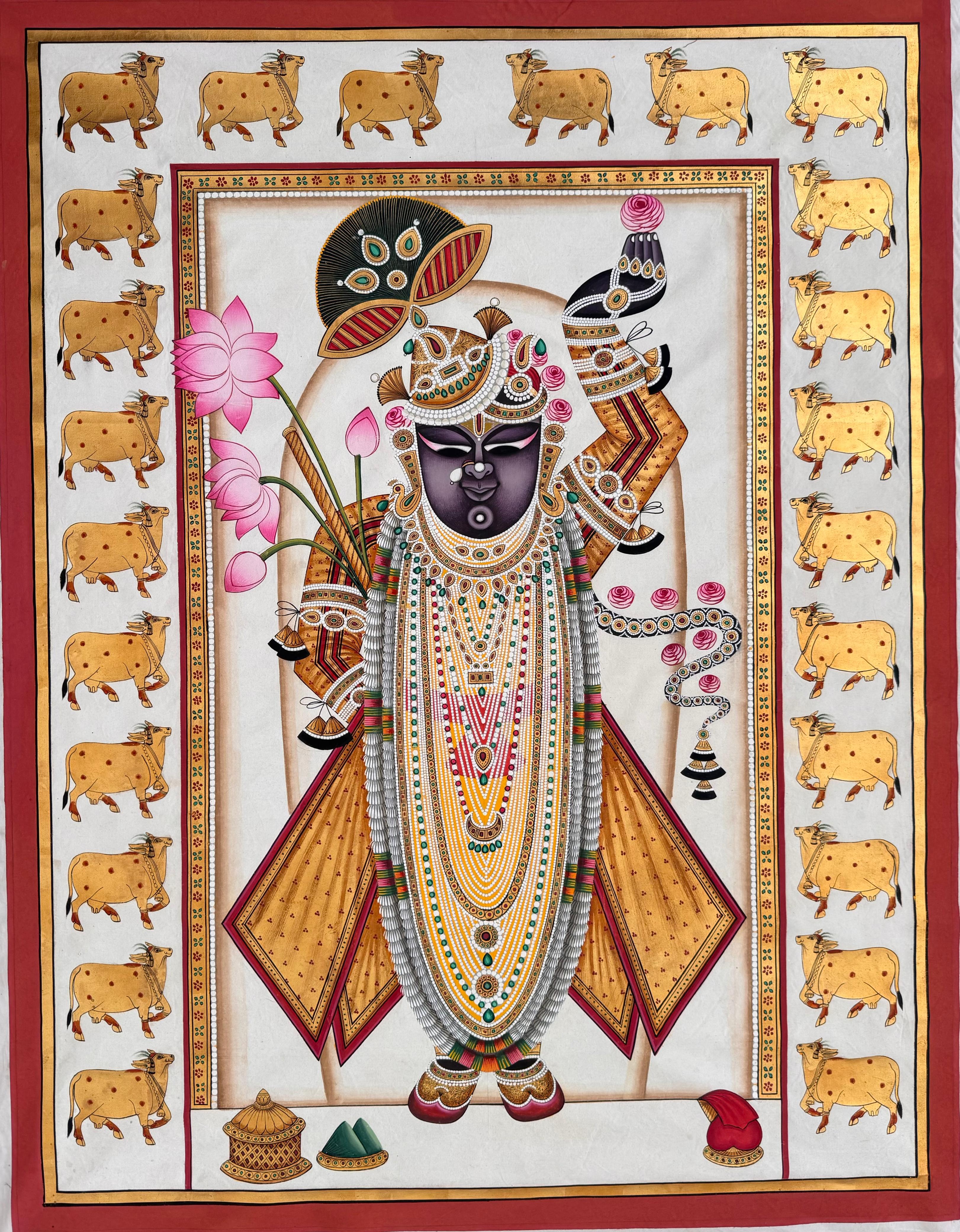
1. Pichwai Paintings of Shrinathji
Shrinathji is the seven-year-old manifestation of Lord Krishna and the deity at the temples of the Nathdwara region.
2. Radha Krishna Pichwai Paintings
Radha & Krishna feature in Pichwai works in the themes of the temple festivals, dances and celebrations of nature. They are usually depicted with lotuses, cows, peacocks and the Vrindavan landscapes as the backdrop. Radha symbolizes devotion and spiritual longing while Krishna symbolizes the divine, joy and loving consciousness.
3. Lotus Pichwai Art
The lotus is used both as a decorative motif and also the primary subject of the Kamal Talai Pichwais which exclusively feature the blooming lotus and its buds. They create an aura of serenity, auspiciousness, and devotion.
4. Cows and Gopis in Pichwai Paintings
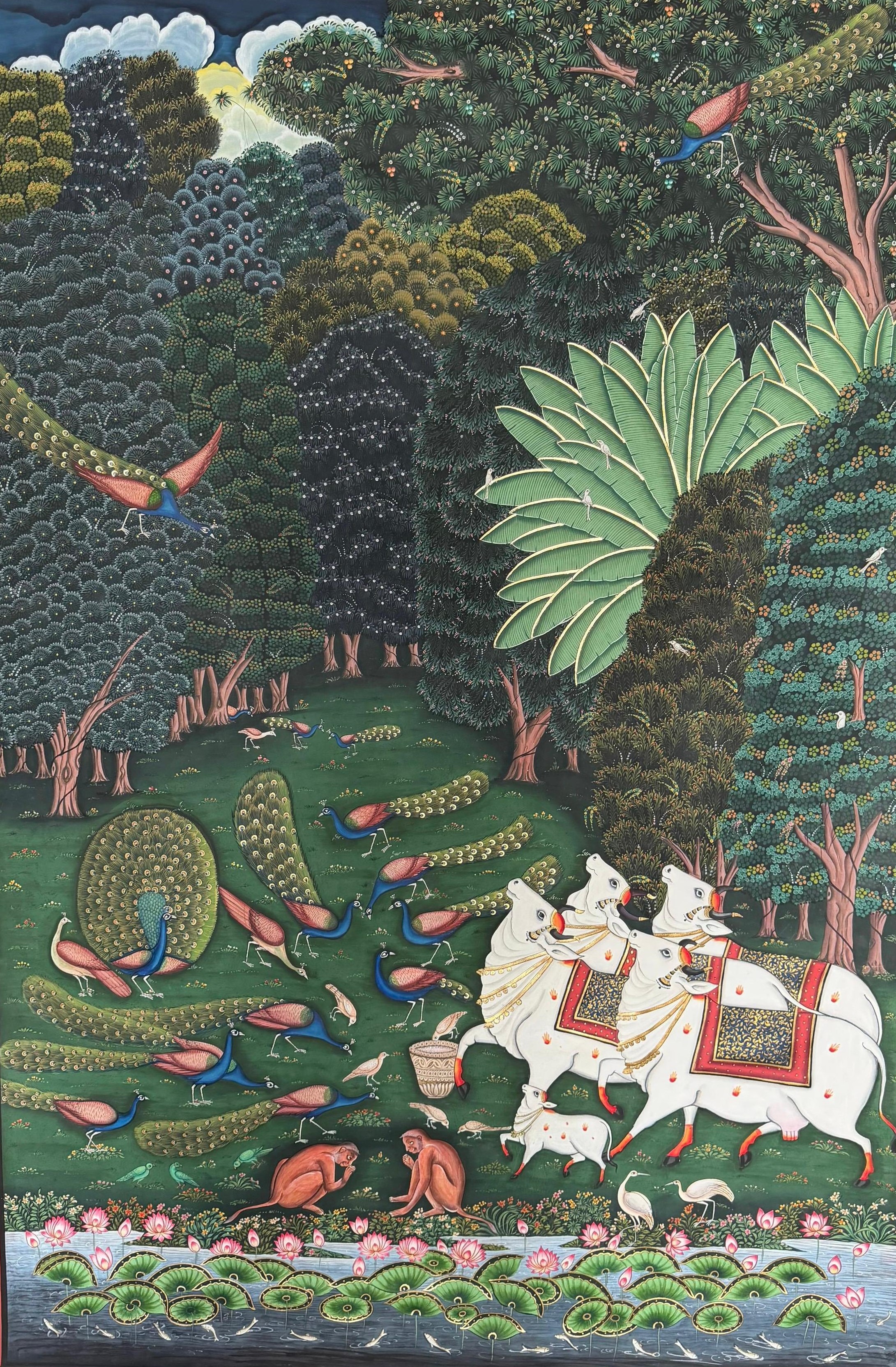
The cows and gopis (milkmaids in Vrindavan) were central to Krishna’s childhood as a cowherd. While they’re often participants in the stories of celebrations, seasons and festivals alongside Krishna, there are also select works where the cows feature as central characters.
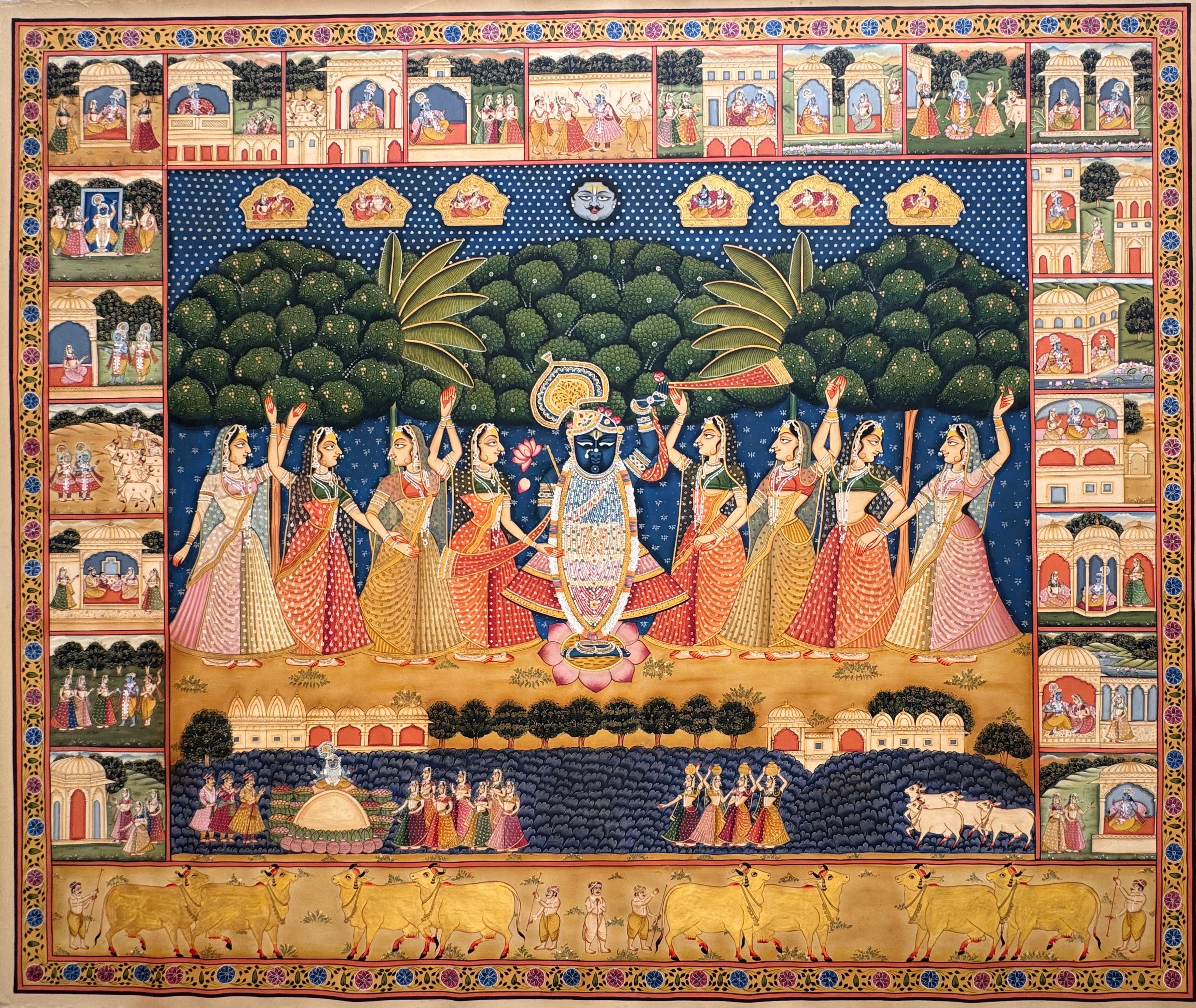
5. Ras Leela Pichwai Paintings
The Raas Leela is a tale from mythology where Krishna multiplies himself to dance with each gopi, representing a fulfillment of each devotee’s personal relationship with the divine. The paintings usually have Krishna at the center surrounded by gopis beneath the moonlight.
6. Miniature Pichwais
Traditionally large-sized works supposed to serve as backdrops to idols, miniature formats are modern Pichwai paintings that focus on specific details such as Shrinathji or the cows without too many background elements.
7. Contemporary Pichwais
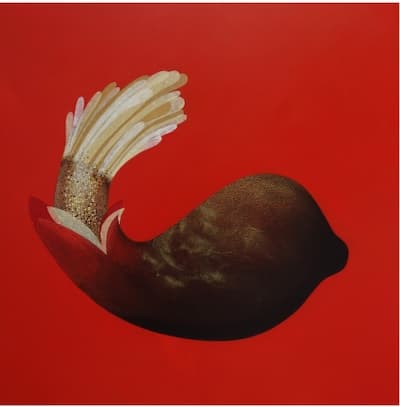
Contemporary artists bring innovation without rewriting traditions, changing media (from cloth to paper/canvas), using mixed media, and exploring minimalist styles. These modern variations retain timeless tales, helping the art form stay alive while appealing to modern homes and collectors.
8. Pichwai Art Depicting Festivals & Seasons
Pichwai paintings traditionally depict Sharad Purnima, Holi, Annakut, and other festivals/seasonal transitions, each with distinctive visual cues and moods.
Gopashtami: Celebrates Krishna's journey to becoming a cowherd.
Janmashtami: Krishna’s birthday, shown with a cradle surrounded by his parents and villagers.
Nand Mahotsav: Follows Janmashtami, depicting Nanda & Yashoda with Krishna and rejoicing villagers.
Sharad Purnima: Celebrates the first full moon after Krishna’s birth, with moonlit dance scenes.
Vasant Panchami: Marks the arrival of spring and pre-Holi festivities.
Govardhan Puja: Depicts Krishna lifting the Govardhan hill to protect villagers.
Dolotsav (Holi in Nathdwara): Shows swinging deities and vibrant colors.
Chhappan Bhog: Features 56 delicacies offered to Shrinathji as part of temple rituals.
9. Elephant Pichwai Painting: Regal Symbolism
Elephants appear less frequently than cows or peacocks but carry distinct symbolism - royal power, strength, abundance. Pichwai artists depicting elephants often employ architectural scale and sculptural precision, rendering tusks, wrinkled hide, and ornamental caparisons with astonishing naturalism.
They are influenced by Pahadi and Rajasthani miniature paintings and often feature in more contemporary Pichwais.
10. Kamal Talai Pichwai: The Lotus Lake
Kamal Talai literally means lotus lake, featuring pichwai compositions dominated by expansive aquatic landscapes. Kamal Talai pichwais take varied compositional approaches. Some, particularly 'Raas in Kamal Talai,' prominently feature Krishna dancing with the Gopis amidst lotus ponds. Others, known as 'Lotus Jaal,' emphasize the intricate botanical network of lotuses themselves, allowing the aquatic ecosystem to carry primary devotional weight. These works celebrate natural beauty as spiritual expression, exploring Pushtimarg's observation of divinity within creation itself..
While we don’t list antique Pichwai paintings (provenance risks), artists like Kuldeepak Soni create antique-finish works using traditional techniques, ideal for contemporary homes. Explore Radha Krishna Painting, Spiritual & Mythological works, and more Indian art paintings on ArtFlute.
Artists Who Are Preserving Pichwai Art Traditions
ArtFlute’s collection celebrates artists who uphold this treasured tradition, drawing from Nathdwara’s ancestral artisan families. Among them, Kuldeepak Soni is admired for his commitment to traditional techniques and creative revival. A third-generation Pichwai artist from Bhilwara, Rajasthan, he follows his grandfather Shilp Guru Shri Badrilal Chitrakaar and father Sharad Soni, both National Awardees. His mastery of traditional Nathdwara style and contemporary renditions ensures timeless vibrancy using natural pigments. His works are collected by Amitabh Bachchan and Radhika Merchant and showcased at the Nita Mukesh Ambani Cultural Centre. He continues the legacy by training and employing local youth in his workshops.
Why Choose Pichwai Paintings Collection?
1. Authentic Hand-Painted Pichwai Artwork
In a market full of machine-printed Pichwai lookalikes, choosing an authentic hand-painted work protects the collector. Hand-painted works reveal themselves through irregular brushstrokes, subtle cloth textures, layered pigment, and the use of real mineral colours and gold or silver leaf.
Prints & reproductions flatten these qualities into uniformity, producing works meant for short-term décor rather than lasting relevance. As with other art forms like Kalighat paintings & Tanjore paintings etc traditions survive only when originality is preserved. By buying an original Pichwai, you are also becoming a patron supporting this 4 decade long tradition. In a market full of machine-printed Pichwai lookalikes, choosing an authentic hand-painted work protects the collector by ensuring what you live with has depth, integrity, and staying power. Hand-painted Pichwai reveal themselves through irregular brushstrokes, subtle cloth textures, layered pigment, and the use of real mineral colours and gold or silver leaf.
Prints and reproductions flatten these qualities into uniformity, creating works meant for short-term décor rather than lasting relevance. As seen with other traditional art forms like Kalighat and Tanjore paintings, traditions survive only when originality is valued and sustained. By choosing an original Pichwai, the collector also becomes a patron supporting a living tradition that continues only through conscious, long-term commitment.
2. Premium Quality & Long-Lasting Colours
The value of hand-painted Pichwai lies as much in materials as in artistry. Natural mineral pigments and precious metals do not fade quickly; they mature, retaining depth for decades.
A synthetic print may resemble a hand-painted work initially, but machine prints and typically dull within 8–15 years. Natural-pigment Pichwai paintings, by contrast, have endured for over a century in temple and museum settings. The labour behind this and months of work shifts the question from upfront cost to long-term value.
3. Perfect for Home Décor, Gifting & Puja Rooms
Pichwai moves effortlessly between devotion, aesthetics, and emotional significance. In puja rooms and meditation spaces, Krishna and Shrinathji themes create a calm, sacred presence. In contemporary homes, Pichwai adds cultural depth that stands apart from mass-produced décor.
As a gift for families and diaspora collectors, a hand-painted Pichwai becomes an heirloom, carrying spiritual meaning and cultural memory that deepens with time.
Materials and Painting Techniques Used in Pichwai Paintings
1. Natural Pigments
Authentic Pichwai uses pigments derived from minerals, stones, and plants: indigo, natural ochres, turmeric, zinc white, and carbon black that are hand-ground and bound with traditional adhesives. These pigments age gracefully and show subtle tonal variation, a key marker of authenticity, unlike the uniformity of synthetic colours.
2. Fine Brushwork
Artists work with ultra-fine natural hair brushes, often rendering details at single-hair precision. This patient, months-long process creates micro-variations in line and texture that machines cannot replicate.
3. Layering Technique
Colours are built through multiple translucent layers, creating depth, luminosity, and atmospheric richness. Each layer is planned in advance, requiring technical foresight and discipline.
4. Gold and Silver Accents:
Pure gold and silver leaf is applied to ornaments, borders, and sacred motifs, adding both visual radiance and material value. The extent and quality of metal work are key indicators of a Pichwai’s craftsmanship and worth.
5. Preliminary Sketching
Every Pichwai begins with a detailed hand-drawn sketch on cloth, establishing proportion, symmetry, and narrative balance before painting begins. Together, these techniques distinguish genuine hand-painted Pichwai from decorative reproductions and explain both their durability and collector value.
How to Style Your Space with Pichwai Paintings
1. Temple & Meditation Spaces
Pichwai is most powerful in a puja or meditation setting, placed above the altar as a visual and spiritual anchor. Soft, balanced lighting allows its detail to unfold during daily rituals. Even a small shrine or bedroom altar gains focus and sanctity when organised around the painting.
2. Living Room Interiors
In living spaces, a large-format Pichwai works as a statement piece. Set against neutral walls and contemporary furniture, it adds depth without clutter. Thoughtful lighting with natural or warm spotlights reveals its layered detail and makes it a natural conversation point.
3. Office & Professional Spaces
In offices, Pichwai signals cultural confidence and refined taste. Displayed in executive rooms or boardrooms, it brings warmth and heritage to otherwise minimalist spaces, offering presence without overt religiosity.
4. Festive & Seasonal Styling
Traditionally linked to the ritual calendar, Pichwai can be rotated seasonally - Janmashtami, Raas Leela, or harvest themes, to keep spaces culturally and visually alive. During festivals or weddings, it creates an authentic, elevated atmosphere without temporary décor excess.
Why Buy Original Pichwai Paintings at ArtFlute?
100% Original Paintings
Only hand-crafted originals curated for art collectors and enthusiasts. Each work carries transparent pricing that reflects artisanal effort and legacy.
Certificate of Authenticity with Every Purchase
Each Pichwai painting includes documents and a Certificate signed by the artist confirming provenance.
Worldwide Shipping & Safe Delivery
Secure packing and logistics bring heritage to collectors globally.