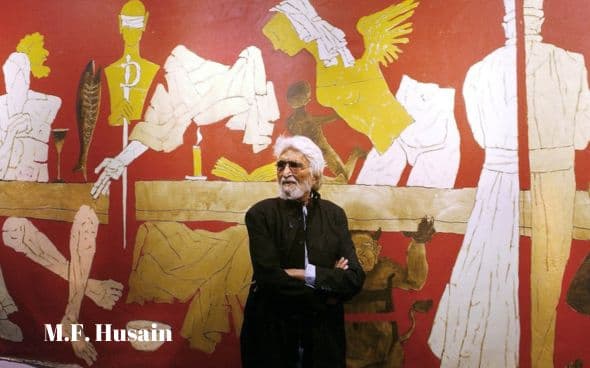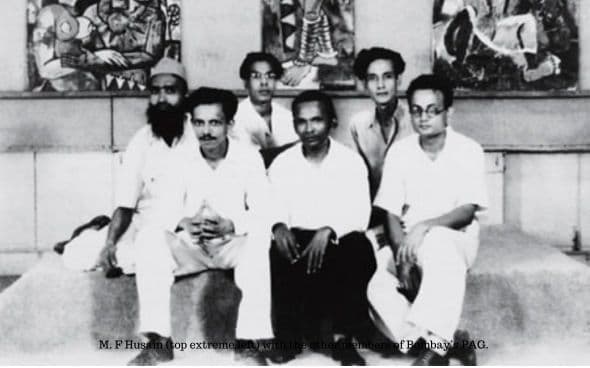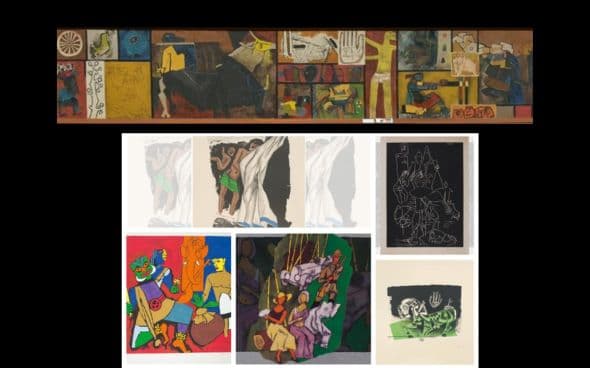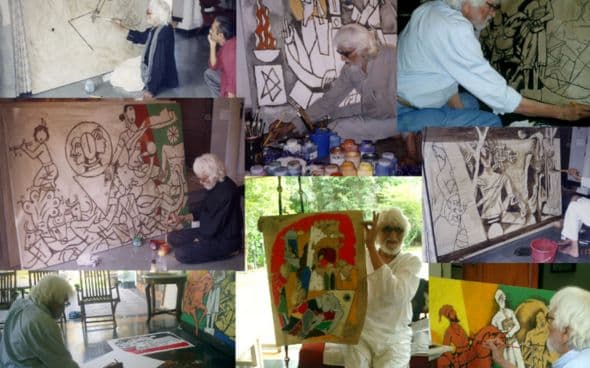

In addition to his paintings, Husain ventured into filmmaking, receiving acclaim for his movies, including "Through the Eyes of a Painter" and "Gajagamini." Recognized for his contributions, he received prestigious honors such as the Padma Bhushan and Padma Vibhushan from the Indian government. Throughout his seven-decade career, Husain broke new ground, pushing the boundaries of Indian art and inspiring future generations. In 2011, the art world mourned the loss of M.F. Husain as he passed away in London, leaving behind a legacy of captivating and visionary art.
M.F. Husain
I have not intended to denigrate or hurt the beliefs of anyone through my art. I only give expression to the instincts from my soul. India is my motherland. Wherever I find love I will accept it.

M.F. Husain
Contemporary Artist
About Artist
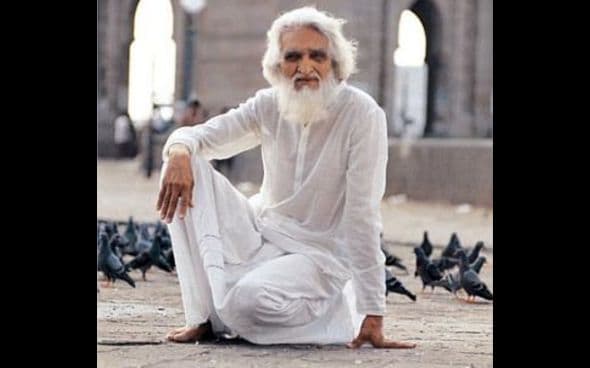
In addition to his paintings, Husain ventured into filmmaking, receiving acclaim for his movies, including "Through the Eyes of a Painter" and "Gajagamini." Recognized for his contributions, he received prestigious honors such as the Padma Bhushan and Padma Vibhushan from the Indian government. Throughout his seven-decade career, Husain broke new ground, pushing the boundaries of Indian art and inspiring future generations. In 2011, the art world mourned the loss of M.F. Husain as he passed away in London, leaving behind a legacy of captivating and visionary art.
M.F. Husain: The Visionary Who Redefined Indian Modern Art
M.F. Husain, one of India’s most celebrated artists, seamlessly blended tradition and modernism throughout his career. Awarded the Padma Bhushan and Padma Vibhushan, his legacy transcended the confines of galleries, spanning thousands of paintings, films, and serigraphs. Husain’s work, influenced by Indian history, mythology, and society, often explored themes of rural life, mythology, and the female form, reflecting a deep connection to India’s identity. Despite facing controversy and exile, his art, marked by boldness and innovation, continues to resonate globally. Husain’s fearless pursuit of artistic freedom and his ability to merge tradition with contemporary themes have left an indelible mark on the art world.
Famous Paintings And Artwork Series of MF Husain
From cinema hoardings in Mumbai to museum walls across the world, Husain's imagery has become shorthand for modern Indian art. His best-known subjects – horses, Mother Teresa, epic heroes, and everyday people – return again and again with fresh energy.
1) The Horse Series: Symbol of Freedom and Spirit
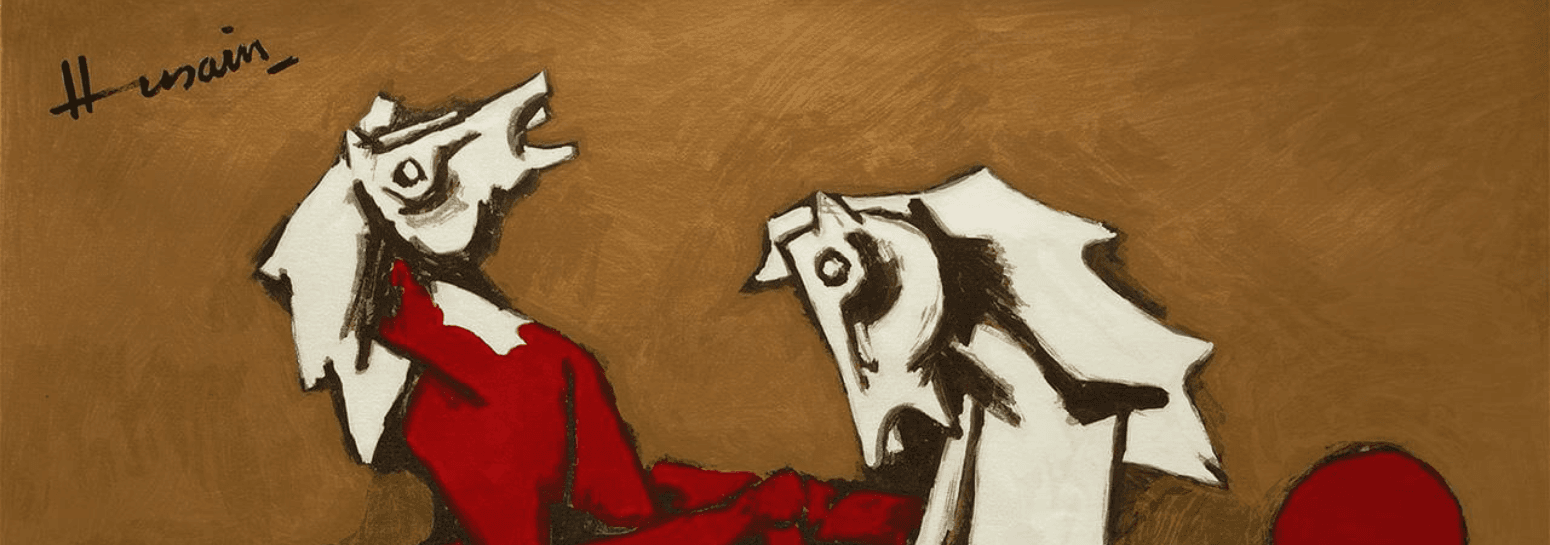
Horses thunder through his career from the 1950s onward. In canvas after canvas, they stand in for speed, freedom, and a raw, unbroken life-force. A single painting of mf husain with a rearing horse can transform a room, bringing in that sense of motion even when the space is still. For many viewers, the famous painting of MF Hussain is a horse and also the clearest expression of an mf husain artwork with bold line and saturated colour.
Price of MF Hussain Paintings
1) Historic Auction Records and Market Ranges
In the last decade, major auction houses in New York, London, and Mumbai have repeatedly pushed mf hussain painting price into multi-crore territory, especially for large, early canvases from the 1950s–1970s. Landmark works with strong provenance – museum shows, important collections, or publication history – sit at the very top of the market and rarely reappear once acquired.
Broadly, the cost of mf hussain paintings today falls into three bands: museum-level early works often in the ₹10–35 crore range, strong mid-period canvases around ₹2–10 crore, and late originals or smaller studies from roughly ₹40 lakh–8 crore depending on subject and scale.
Popular Subjects in M.F. Husain Paintings
1) Horses
The imagery of MF Husain the painter is instantly recognisable with his horses. Husain’s horses are often described as symbols of energy, but the deeper story is how many cultures are braided into this single motif. In curator Susan S. Bean’s account of Husain’s equine imagery, the horse begins in childhood experience in Indore: toy terracotta horses, wedding-procession mounts, tongas in the street, and the annual Muharram procession featuring the symbolic steed Duldul.
That plural origin matters, because Husain doesn’t “purify” the horse into a single tradition, he actually expands it. Bean links a trip to China in the early 1950s to Husain’s encounter with calligraphic painting and with Qi Baishi and the famed horse painter Xu Beihong, an influence echoed in auction research that notes his response to Xu’s monumental horse imagery. On canvas, Husain’s horses are rarely “one animal.” They are built from fractured planes and decisive outlines, as if the body is remembered in pieces and reassembled at speed, an approach that also suits his background in street-scale imagery and bold contour. Movement here is not just a formal effect; it is a cultural sensation you recognise in your body, like a procession passing by. These dynamic equine compositions remain among MF Hussain’s best paintings sought by collectors.
How to Choose the Right MF Husain Artwork
1) Subject, Energy, and Personal Connection
The place to begin is not the market, but what moves you. If you're drawn to velocity and power, the MF Husain's horse paintings may feel like a natural fit. If service, compassion, or spiritual enquiry speak more strongly, Mother Teresa painting by Husain or his Theorama series might be right. Narrative-driven collectors often look first to Mahabharata or British Raj paintings. Over time, many realise that a single painting of maqbool fida husain can mirror a personal story, a family history, or a value they want their space to quietly communicate.
Authenticity & Certification Process
Every MF Husain artwork offered on ArtFlute goes through a careful verification process so collectors know they're acquiring genuine pieces, not copies or reprints.
1) Hand-Signed Details:
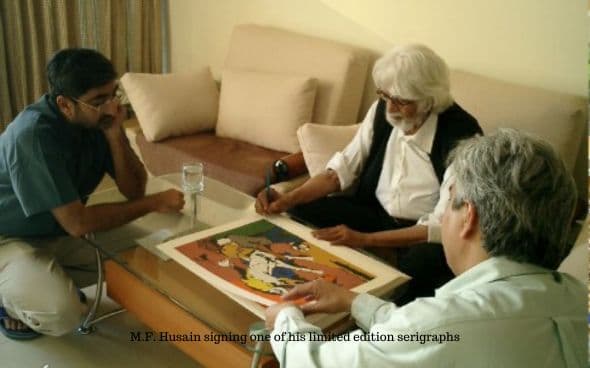
Most Husain serigraphs include his pencil signature along the lower margin — a hallmark many enthusiasts look for when collecting artist mf hussain paintings in print form.
FAQs About MF Husain Paintings
1. What styles did M.F. Husain use in his work?
Across decades, maqbool fida husain moved between figuration and abstraction without ever losing his unmistakable hand: swift, calligraphic line; bold blocks of colour; and a willingness to fracture space in order to tell more than one story at once. Even when influenced by European modernism, he stayed rooted in local myth, cinema, and street life – the everyday textures that give mf husain its particular charge.
2. How much does a Hussain painting cost?
Museum-level originals can reach eight-figure rupee prices and beyond, while more modest originals, studies, and drawings sit in the mid- to high-lakh range and signed serigraphs usually occupy the lower lakhs. Factors such as mf hussain painting price at recent auctions, subject, date, and condition all play a role in setting expectations, as does the broader cost of mf hussain paintings across comparable sales.
3. What are some famous themes in M.F. Husain's artwork?
Horses, goddesses, epic heroes, Mother Teresa, rural processions, urban crowds – these are the images most people associate with mf hussain artist and his generation. Within that, certain compositions have become especially sought after; for some collectors, the best painting of mf hussain is whichever work first made them stop and look twice.
4. What makes M.F. Husain's paintings unique?
Husain's modified Cubist language blends modernist structure with deeply Indian storytelling, drawing from miniature painting, mythology, cinema billboards, and urban life. What sets him apart is the fusion: centuries-old narratives carried through a contemporary hand, executed with the confidence of someone who painted quickly, fearlessly, and with instinctive clarity.
5. What is MF Husain famous for?
Husain is celebrated for his narrative canvases that reinterpret India's histories and icons—Gandhi, Mother Teresa, the Ramayana and Mahabharata, the British Raj, and everyday life across cities and villages. His bold horse motifs and portraits of Madhuri Dixit are also cult favourites.
His market legacy is equally established: works like Voices have crossed multi-million-dollar sales, cementing his position as one of modern India's most globally recognised artists.
6. How many paintings did MF Husain make?
Husain's output is legendary. Estimates range widely from 30,000 at the most conservative, and up to 40,000–60,000 artworks across painting, printmaking, drawing, writing, and filmmaking.
For collectors, this vast production reflects a life fully committed to making, experimenting, and chronicling India through every medium available to him.
7: What materials did M.F. Husain commonly use in his paintings?
Across thousands of MF Husain’s artworks, the artist worked with oil, acrylic acrylic on canvas, but he also created artworks using watercolour, charcoal, and mixed media on paper, alongside lithographs and serigraph prints. Across his career, he expanded beyond painting into murals, drawings, installations, and even film, reflecting a practice that moved freely across mediums.
8: What inspired M.F. Husain’s paintings?
M.F. Husain drew inspiration from Indian mythology, village life, cinema, urban streets, and the energy of everyday culture, blending classical tradition with modern experience. His influences ranged from Indian miniature painting and calligraphy to cinema billboards and global modernism, shaping a visual language that connected ancient stories with contemporary India.
9: Did M.F. Husain paint mythological subjects?
Yes, Indian mythology especially the Ramayana and Mahabharata was a major theme in M.F. Husain’s art, explored through large narrative cycles from the 1960s onward. Rather than illustrating epics literally, Husain reimagined them through modernist forms, symbolic figures, and cinematic composition, making ancient stories feel contemporary.