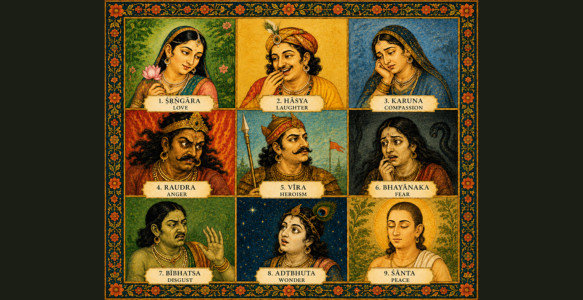
What is Navarasa?
The first time you watch a seasoned Bharatanatyam dancer move through a Navarasa sequence, what stays with you is not just the choreography but the aftertaste - the way a particular glance lingers in your body long after the curtain falls. That lingering flavour is what is navrasa - not the emotion itself, but its distilled, aesthetic essence as experienced by the viewer.
Navarasa literally means “nine essences” or “nine rasas”, a framework that evolved from Bharata Muni’s Natyashastra, the foundational Sanskrit treatise on theatre, dance and music composed roughly between 200 BCE and 200 CE. Bharata originally described eight rasas; later aestheticians added a ninth, shanta or tranquillity, giving us the Navarasa that continues to shape Indian painting and performance today. At its simplest, navarasa’s meaning refers to these nine core aesthetic flavours - love, laughter, sorrow, anger, heroism, fear, disgust, wonder and peace - that art can evoke and refine in the spectator.
In the Natyashastra, rasa is not just a mood but something produced through a specific alchemy: the meeting of determinants (vibhava, such as situation and characters), physical expressions (anubhava), and fleeting psychological states (vyabhichari bhava). This classic formula - vibhava–anubhava–vyabhichari–samyogad rasa nishpattih - makes it clear that rasa is completed in the viewer; the performer or image sets up the conditions, but the experience flowers in the rasika. It is within this larger Navarasa in Indian aesthetics that painting, sculpture, dance and music all participate in a shared language of emotion.
Although the framework was articulated for theatre and Navarasa in classical arts like dance and music, its migration into visual art has been gradual and organic. Temple murals in Kerala, Pattachitra painting scrolls in Odisha, Pahari miniatures, Tanjore painting iconography - all carry scenes calibrated around recognisable rasas, even when artists never name them as such. The more you look, the more you begin to see how a tilt of the head, the density of a cloud, or the exact green in a lotus leaf nudges you gently toward a particular sentiment.
We find it useful to think of Navarasa as a lens for looking rather than a checklist to impose. Once you internalise it, a single painting can feel like a chord of several rasas vibrating together, rather than one neatly labelled emotion.
Why Navrasa Matters in Indian Art?
Stand in front of a 17th‑century Pahari miniature of Radha and Krishna at dusk: the sky is a bruised blue-green, the trees glow with improbable fluorescence, and the lovers barely touch - yet the air is thick with anticipation. That charged quiet is shringara in action, and it’s also a reminder that the nine rasas in Indian art are less about narrative and more about the calibrated temperature of feeling a work holds.
Although Navarasa emerged from theatre, contemporary scholarship and practice recognise its relevance across visual media, from classical murals to experimental video art. Tanjore icons of fierce goddesses pulse with raudra (fury), while a sparse Ram Kumar abstraction leans towards a late shanta - a cooling of form and colour into silence. In indigenous and folk contexts, artists have created entire cycles of nine faces or panels, each devoted to one rasa, effectively becoming didactic yet playful Navarasa paintings for village audiences.
For curators and viewers, the rasa theory in Indian art functions like a backstage map: understanding it doesn’t reduce the mystery, but it clarifies why certain images stay with us. When we juxtapose a Tyeb Mehta figure cleaved by diagonal force with, say, Picasso’s Guernica, both can be read as vibrating between raudra and karuna - different visual languages, similar emotional spectra. It also allows Indian art to converse with global modernism on its own terms, rooted in a centuries‑old vocabulary of feeling rather than borrowing Western psychological frames.
In living practices, Navarasa is not static. Contemporary artists working with Partition memories, environmental grief or queer desire stretch and complicate these categories. A single work might begin in veera (heroism) and slide into bhayanaka (fear) and karuna (pathos) within the same frame, echoing how complex our inner lives are.
When we’re curating a series around mood - say, monsoon works or Radha–Krishna Pichwai paintings - we often find ourselves informally grouping them by rasa. A delicate Nathdwara Pichwai may sit next to a bold contemporary canvas, yet both hum with the same shringara or adbhuta, allowing older devotional languages to speak to newer, more secular ones.
The risk with any system is rigidity; the gift with Navarasa is that it’s porous. We’re most interested in works that sit in the overlap - where hasya hides inside karuna, or shanta emerges only after the storm of raudra has passed.
The Nine Rasas of Navarasa
The Navarasa emotions are often listed as discrete categories, but in practice they feel more like a colour wheel than a filing cabinet. Many artists produce entire Navarasa series, arranging nine canvases or nine masks in a grid so viewers can walk the spectrum, panel by panel, like tuning through a radio of feeling. These cycles are among the most recognisable expressions of Navarasa in painting, but the same sensibility quietly infuses portraits, landscapes and abstract works that never advertise themselves as such.
1. Shringara Rasa
Shringara is the rasa of love, beauty and attraction - from romantic longing to devotional surrender. Classical texts associate it with the colour light green and the deity Vishnu; in art, it often appears in Radha–Krishna scenes, nayika–nayak portraits, or lush courts where glances do most of the talking. Think of Raja Ravi Varma’s heroines, Mughal miniatures of terrace trysts, or contemporary Pichwai painters who load every lotus, veil and cow with a barely contained tenderness.
2. Hasya Rasa
Hasya is laughter, but not always loud; it includes gentle amusement, irony and even self‑mockery. Traditionally linked with the colour white, it surfaces in paintings through exaggerated expressions, visual puns, or absurd juxtapositions. Jamini Roy’s stylised figures with their knowing smiles, or folk scrolls where animals behave with very human foolishness, both inhabit this space. In the studio, artists often speak of “lightening” a heavy series with one slyly humorous work - a small dose of hasya as a pressure valve.
3. Karuna Rasa
Karuna is compassion, sorrow, the ache of witnessing suffering. Its colour is grey and its presiding deity Yama, but in painting it often arrives as a slowness - drooping shoulders, emptied horizons, faces turned inward. Amrita Sher‑Gil’s village women, or Tyeb Mehta’s falling figures, feel saturated with this rasa, as does any canvas that stays with you not because it is tragic, but because it makes you more porous to other lives. I’ve seen collectors stand in silence before a small work about migration, unable to explain why it moved them so sharply; that difficulty is karuna doing its work.
4. Raudra Rasa
Raudra is fury, righteous anger, volcanic intensity. The texts pair it with the colour red and forms of Shiva as Rudra; visually it appears in wild eyes, flaring hair, sharp diagonals, and saturated reds and blacks. Goddess paintings of Durga or Kali, battle scenes from the epics, protest posters and some of F.N. Souza’s more scorching crucifixions all burn with raudra. One artist once told me he paints when listening to news of injustice specifically to “keep the raudra alive, but contained, on the canvas.”
5. Veera Rasa
Veera is courage, steadiness, heroic resolve. Associated with saffron or golden hues and the deity Indra, it is often found in depictions of warriors, freedom fighters, or even everyday people standing firm against overwhelming odds. Posters from the independence movement, murals of local heroes, and certain narrative works by artists like M.F. Husain carry this upright, forward‑leaning energy. In quieter contemporary work, veera might appear in a lone figure walking into a storm, or a single tree holding ground against an eroding coastline.
6. Bhayanaka Rasa
Bhayanaka is fear and dread - the sense that something is not right. The canonical colour is black, and you see it in storm-tossed seas, looming architectures, or shadow‑heavy interiors. Some modern landscapes, especially those dealing with ecological crisis, lean heavily into this rasa: darkened rivers, skeletal trees, skies veined with industrial smoke. I remember a viewer describing a painting of empty swings in a playground at night as “quietly terrifying”; that unease is pure bhayanaka.
7. Bibhatsa Rasa
Bibhatsa is disgust, aversion, the instinctive recoil. Traditionally coloured blue and linked to Shiva, it surfaces in images of decay, violence, or bodily excess. Cremation ghats in Banaras paintings, depictions of polluted water, or raw, expressionist canvases that make you uncomfortable to look at - all participate in this rasa. Many artists working around caste violence or state brutality deliberately court bibhatsa as an ethical strategy: you should feel unsettled; comfort would be dishonest.
8. Adbhuta Rasa
Adbhuta is wonder, astonishment, the childlike gasp. Paired with the colour yellow, it appears in visions of cosmic order, intricate mandalas, miraculous events, or simply the vastness of nature. S.H. Raza’s bindu works, Ram Kumar’s luminous cityscapes dissolving into landscape, even certain Himalayan thangka paintings - all invite that mix of curiosity and awe.
9. Shanta Rasa
Shanta is peace, serenity, the quiet after the storm. Later added to the system, it is associated with perpetual white or pale blue and with Vishnu, and in painting it often takes the form of minimal composition, cool palettes, and meditative figures. Jain manuscript pages with seated Jinas, Zen‑like ink landscapes, or late works by artists who strip away ornament to leave only a few essential forms all drift toward shanta. In many ways, this is where Navarasa in painting comes to rest - not by suppressing other rasas, but by integrating them into a broader, spacious calm.
FAQs About Navarasa
1. What is the meaning of Navarasa?
Navarasa refers to the nine fundamental emotions or aesthetic moods described in classical Indian art and performance traditions.
2 Who introduced the concept of Navarasa?
The concept of rasa was introduced by Bharata Muni in the Natyashastra, with the ninth rasa added by later scholars.
3. What are the nine rasas in Indian aesthetics?
The nine rasas are love, humour, compassion, anger, heroism, fear, disgust, wonder, and peace.
4. What is the difference between Rasa and Bhava?
Bhava is the emotion expressed by a character, while rasa is the emotional experience felt by the viewer.
5. How is Navarasa represented in paintings?
Artists depict Navarasa through facial expressions, gestures, colours, composition, and narrative themes.
6. How does Navarasa influence contemporary Indian art?
Many contemporary artists use the Navarasa framework to explore emotion, identity, memory, and human experience.
