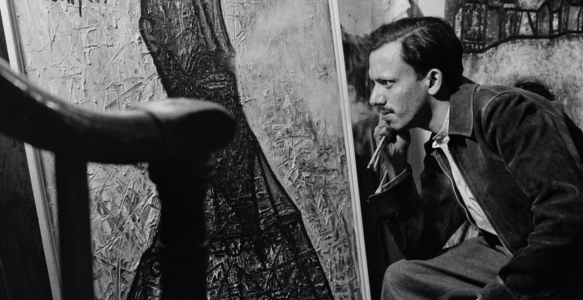
The first encounter with a Francis Newton Souza artwork is not polite. A face erupts in fractured planes, a Christ figure is flayed into jagged lines, a city seems to grind its teeth in thick, clotted colour. You can almost hear the hiss of turpentine and the scrape of brush on board, as if the surface itself were resisting the image that insists on being born. In a century when newly independent India was still searching for a visual language beyond miniature painting and academic realism, Souza stepped in like an iconoclast - part confessor, part provocateur.
He would go on to become the enfant terrible of modern Indian art, feared and revered in equal measure. For collectors and viewers today, Francis Newton souza paintings still feel startlingly raw, psychologically charged, and unafraid to show the uncomfortable seams between faith and flesh.
Who Was Francis Newton Souza?
Francis Newton Souza (1924–2002) was born in Saligão, Goa, to Goan Catholic parents and spent his childhood between this village world and the frenetic port city of Bombay. The early deaths of his father and sister, followed by his mother’s remarriage, created an unstable emotional ground that he later translated into the fractured bodies and haunted faces that populate his canvases.
As a teenager, he was expelled from St. Xavier’s College in Bombay for drawing obscene graffiti in the toilets. This was an early sign of a future artist who would not accept polite boundaries around the body or desire. He enrolled at the Sir J. J. School of Art but was expelled in 1945 for pulling down the Union Jack during a ceremony and participating in the Quit India Movement. Soon after, he briefly joined the Communist Party of India and began articulating a fierce critique of hypocrisy in religion and politics that would remain central to FN Souza’s art.
In 1949, Souza left for London, initially surviving on odd jobs while painting prolifically in modest studios. His breakthrough came in the mid‑1950s when the poet Stephen Spender published his searing autobiographical essay “Nirvana of a Maggot” in Encounter, which, along with his first solo exhibition at Gallery One in 1955, announced him as a major new voice in European modernism. By the time he moved later to New York and continued exhibiting internationally, Francis Newton Souza’s biography had already become a kind of legend. Of a Goan Catholic boy who turned doubt, anger and desire into a visual theology of his own.
F. N. Souza’s Contribution to Indian Art
1. Formation of the Progressive Artists’ Group
In 1947, the year of India’s independence, Souza co‑founded the Bombay Progressive Artists’ Group (PAG) alongside S. H. Raza, K. H. Ara, H. A. Gade, M. F. Husain and S. K. Bakre. This informal collective rejected both the sentimental nationalism of the Bengal School and the staid academic realism inherited from colonial art schools, arguing instead for an unapologetically modern language rooted in India’s lived realities.
Souza was often described as the “rebel” of the group. More aggressive in line, more explicit in subject, and more willing to offend than his peers. His writings and polemical essays became a kind of manifesto for the progressive artists group, insisting that Indian painters engage with European modernism not as imitators but as equals, bringing their own mythologies, cities and anxieties to the canvas.
2. Impact on Indian Modern Art
The impact of Souza’s artwork on post-independence Indian modernism is difficult to overstate. He helped normalize an expressionist, distorted figuration that opened the way for artists like Tyeb Mehta, Akbar Padamsee and even later generations who explored the body in fractured, psychologically loaded ways. His work fused Western Expressionism, Art Brut and Cubist structure with Indian religious imagery and urban experience. Thus proving that modern Indian painters could speak in an international visual vocabulary without losing local specificity.
Crucially, his work was among the first from India to gain sustained attention in London and New York, bridging the gap between South Asian studios and the global art market. M. F. Husain later called him his mentor and “almost a genius”, acknowledging that Souza’s audacity cleared a path for others to be equally uncompromising.
Most Famous Paintings of Artist F.N. Souza
Looking at Francis Newton Souza’s most famous paintings, one thing becomes clear very quickly - he was never interested in making beautiful art in the traditional sense. Even when the subject was love, religion, or family, the result carried tension. Faces looked fractured. Bodies looked uncomfortable. Sacred scenes felt almost confrontational.
That discomfort is exactly what makes his work unforgettable.
Souza painted across subjects portraits, cityscapes, still lifes, nudes, religious scenes but certain works have stayed at the centre of conversations around his legacy. Some became auction landmarks, others became defining visual statements. Together, they help explain why Francis Newton Souza paintings still feel so modern.
1. Birth
If there is one painting people return to again and again, it is Birth (1955).
The work is raw and unapologetic, a childbirth scene shown without softness or sentimentality. For audiences in the 1950s, it was shocking. Even now, it still feels difficult to look away from. Souza did not romanticise the female body here; he made it physical, painful, and immediate.
When Birth sold at Christie’s New York in 2015 for around US$4.08 million (₹26 crores), it became one of the most important auction moments for the artist. But even without the record, it would remain one of the defining works in Francis Newton Souza artwork.
2. The Lovers
At first glance, The Lovers (1960) sounds like it should be tender. It isn’t, at least not in an easy way.
The two figures are close, but the painting feels tense rather than romantic. Their bodies seem pressed together and pulled apart at the same time. That emotional contradiction is classic Souza - intimacy mixed with discomfort.
In 2024, this FN Souza painting crossed approximately US$4.89 million at Christie’s New York, overtaking Birth and becoming one of the most valuable paintings of F.N. Souza ever sold.
3. Crucifixion
Few themes appeared in Souza’s work as often as the Crucifixion.
But his Christ figures were never gentle or devotional in the expected way. They looked exposed, wounded, and almost brutal in their honesty. A 1959 Crucifixion held at Tate Modern is a strong example, the body feels stretched to its limit, stripped of comfort.
Religion, for Souza, was never separate from violence or doubt. That is what gives these paintings their force.
4. The Blue Lady
There is almost a myth attached to The Blue Lady.
Later accounts say Souza painted it around the time he was expelled from art school, using every last bit of paint he had left. Whether the story has been romanticised or not, the work still carries that same energy: bold, restless, and slightly rebellious.
The female figure is stylised, the colours are intense, and you can already see the beginnings of the powerful women who would dominate so many Francis Newton Souza paintings later on.
5. The Last Supper
Souza’s version of The Last Supper does not feel calm.
Where Leonardo’s famous mural holds a kind of balance, Souza’s interpretation feels compressed and uneasy. The table becomes a place of tension rather than peace. Faith and betrayal sit in the same room.
That was often his relationship with Christian imagery, not rejection, but interrogation.
6. Spanish Landscape
Even when Souza painted architecture, it never stayed quiet.
In Spanish Landscape (1958), buildings rise like sharp, stacked forms rather than peaceful scenery. The painting was inspired by Romanesque structures he encountered in Spain, but he transforms them into something almost psychological.
It proves that even away from religious subjects, his line carried the same aggression.
7. Self-Portrait
Souza painted himself many times, but not in the traditional portrait sense.
These self-portraits are not about resemblance. They are about confrontation. Faces split apart, features multiply, symmetry becomes unsettling. He paints himself almost like a problem to be solved.
That honesty makes these works some of the most revealing in FN Souza’s art.
8. The Resurrection
In works like Resurrected Christ (1962), resurrection is not painted as comfort.
The figure feels skeletal, severe, almost haunted. Instead of hope, there is survival. Instead of peace, there is an aftermath.
Souza seems less interested in the miracle than in what remains after suffering.
9. The Holy Family
Even something as familiar as The Holy Family becomes uneasy in Souza’s hands.
The figures are elongated, faces feel mask-like, and the domestic intimacy of the scene is replaced by something stranger. It is still recognisably sacred, but never idealised.
He had a way of making even holiness feel human, flawed, tense, and vulnerable.
10. The Last Judgment
Souza’s judgment scenes are filled with the theatre of Catholic imagination: angels, damnation, moral reckoning, bodies under scrutiny.
But he paints them without moral neatness. There is no clear comfort for saints or punishment for sinners. Everyone looks exposed.
That ambiguity is part of what makes these works powerful.
11. Portrait of Suruchi Chand
Portrait of Suruchi Chand (1984) belongs to Souza’s later portraiture and shows a slightly different energy.
The aggression of the line is still there, but it feels more controlled. The face is exaggerated, but not cruel. There is dignity in the distortion.
It reminds viewers that Souza was never simply trying to shock. Even in his harshest work, psychology mattered more than provocation.
Seen together, Francis Newton Souza's body of work feels less like isolated masterpieces and more like parts of the same argument. About the body, belief, desire, power, and contradiction.
Collectors often ask which single work best defines him. Honestly, there probably isn’t one.
You need Birth and Crucifixion. You need The Lovers and the Landscapes. You need the sacred and the profane sitting side by side. That tension is Souza.
Key Styles & Themes of F.N. Souza's Art
1. Expressionism & Figuration
Souza’s work is often described as essentially Expressionist, drawing also on Art Brut and British neo‑romanticism. Faces are carved out with heavy black contour lines, bodies twisted into impossible anatomies, colour laid on thickly in ochres, crimsons and acid blues that seem to vibrate against each other. For viewers familiar with European Expressionists like Egon Schiele or Oskar Kokoschka, Souza’s paintings feel like a parallel, fiercely local branch of expressionism art.
2. Provocative Subjects
From erotic couples to bishops and popes rendered with satirical bite, his style is deliberately confrontational. He used religious symbolism like Crucifixions, Madonnas, processions as a language of defiance, critiquing both Catholic dogma and social hypocrisy. Essays like “Nirvana of a Maggot” and paintings such as The Butcher and Nude with Mirror made it clear that he had little interest in reassuring his audience.
3. Portraits & Landscapes
Beyond the more notorious nudes and religious scenes, Souza was a powerful painter of cities and faces: London terraces, Hampstead houses, Goan churches, anonymous “heads” built from cross‑hatched strokes. Works like Houses in Hampstead (1962), show how his agitation of line could turn even a row of buildings into something unsettled and alive. For many viewers, these works serve as an unexpected entry point into his wider figurative art practice.
Many enthusiasts ask of Souza - Why so much distortion? Why so many crucifixions? Was he angry? These are really questions about how we allow art to handle discomfort. The most meaningful moments come when someone suddenly recognises their own contradictions in his work and realises that the canvas is not judging, only revealing.
To live with Souza - on a wall, or simply in one’s mind is to accept that art can be both wound and remedy. Artist FN Souza does not offer neat resolutions. Instead, he leaves us with images that continue to argue with us long after we leave the gallery, which might be the highest form of homage paint can pay to life.
FAQs About Francis Souza
1. What was F.N. Souza best known for?
F. N. Souza was best known for his bold, expressionistic paintings of the human figure. His distorted forms and psychological intensity helped shape modern Indian art, and he became one of the first Indian modernists to gain major international recognition.
2. What inspired FN Souza's artwork?
Souza drew from many sources, including Goan Catholic imagery, folk art, Renaissance painting, and European Expressionism. He was also influenced by political unrest, personal conflict, and the energy of cities like Bombay and London.
3. What is the most expensive Souza painting?
One of the most expensive Souza paintings on record is Houses in Hampstead (1962), which sold for more than $7.5 million at Sotheby’s in London. Other works like Birth and The Lovers have also achieved major auction results.
4. Why was F. N. Souza's paintings controversial?
Souza’s paintings were controversial because they challenged religious and social norms. He often mixed sacred imagery with nude figures, distorted bodies, and unsettling symbols, which shocked conservative viewers even as critics recognized his importance.
