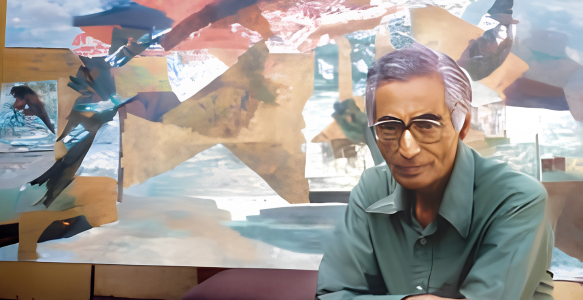
The first encounter with a Ram Kumar canvas can feel like walking into a city you half-remember from a dream. One with terraced houses stacked in muted ochres, a river of light cutting through, and an almost tangible quiet pressing in from all sides. You sense lives, but rarely see a single figure. Instead, colour fields, broken planes and architectural fragments present, holding within them the ache of modern life and the pull of something older, more spiritual.
Born in Simla in 1924, Ram Kumar belongs to a generation of modernists who refused both academic realism and easy nationalism. He carved a singular path that featured brooding figurative works about refugees and street dwellers to vast abstract cityscapes and riverfronts.
What makes a Ram Kumar painting linger is the atmosphere of thin, greyish skies, tightly packed terraces, riverfronts dissolving into mist, and the sense that time itself has slowed down. You’re watching a mind wrestling with urban alienation, and simultaneously reaching for an almost monastic stillness.
Who is Artist Ram Kumar?
Artist Ram Kumar (1924–2018) was a pioneering modern Indian painter and writer, best known for his abstract landscapes and emotionally charged cityscapes that probe the human condition. Trained first in economics at St. Stephen’s College in Delhi and later in art under André Lhote and Fernand Léger in Paris, he absorbed European modernism but consistently painted Indian subjects.
In his early years, he was associated with the Progressive Artists’ Group, sharing conversations and exhibitions with peers like Raza, Souza and Husain, even if his temperament remained quieter and more introspective. While Souza pushed figuration to its acidic extremes and Raza evolved the bindu as a cosmic symbol, Ram Kumar the painter looked to crumbling rooftops, narrow alleys and silent ghats as metaphors for anxiety, dislocation and spiritual search. He also wrote short stories, novels and travelogues in Hindi, which fed directly into the narrative undercurrents of his imagery.
The question “who is Ram Kumar” is, in some ways, inseparable from the story of post-Independence India itself. His work tracks the arc from hope to disillusionment: from portraits of the dispossessed in Delhi’s Karol Bagh to haunted views of Varanasi where human figures vanish but their weight remains. For many viewers encountering modern Indian art for the first time, he becomes someone who makes abstraction feel intimate rather than intimidating.
Seen from today’s vantage point, learning about Ram Kumar is more a portrait of a deeply attentive observer who translated those impressions into an idiom that feels both Indian and globally modern.
If Souza and Husain were the loud, public faces of Indian modernism, Ram Kumar was like its inner conscience, a voice questioning what progress really looks like when seen from the edges of the city.
Artistic Background of Artist Ram Kumar
1. From Writer to Full-Time Painter
Any Ram Kumar biography has to acknowledge that he began as a bank clerk and a writer before he allowed painting to take over. In Delhi, he juggled a job at a bank with evening art classes, while publishing Hindi short stories that were steeped in social realism and existential unease. This literary sensibility of ellipses, pauses, unsaid things - would later surface in his visual art.
A scholarship took him to Paris, where he immersed himself in European modernism, absorbing Cézanne, the Cubists and the École de Paris while working under Lhote and Léger. Yet even there, his sketchbooks were filled with workers, migrants and street scenes that echoed his concerns back home. A brush with leftist political circles, and even a police raid on his apartment, pushed him further toward using art as a form of witness.
2. Transition from Figurative to Abstract Art
Through the 1950s, Ram Kumar’s canvases feature gaunt figures, vacant-eyed families and crowds of refugees in works like Untitled (Orphans) and Untitled (Family) where the gaze is frontal, almost accusatory. Over time, however, the space around these figures grows more complex: rooftops, streets and crammed dwellings begin to demand equal attention, until, as several critics note, the people are “banished” and only the architecture remains.
His turn to abstraction is gradual; as he discovers that his true protagonists are cities and landscapes. Works like The Greek Landscape (1961), inspired by travels abroad, and later the Himalayan and Banaras series, show this evolution. Planes of dusty colour, fragmented yet harmonious, that recall both Mondrian and the silent rigor of V.S. Gaitonde in their restraint. This is where his practice anticipates what many today recognise as abstract art paintings, rooted in place but freed from literal description.
3. Philosophy and Thought Behind His Paintings
Ram Kumar often spoke about the “human condition” as his enduring subject, whether he was painting a lone figure on a street or an entirely figureless cityscape. Even his later non-figurative works, with their stacked blocks, stairways and riverbands, are less about architecture and more about states of mind - crowdedness, isolation, acceptance.
The Banaras paintings arise from his confrontation with mortality and cyclical time in the holy city, where death is seen not as an end but as a passage. Instead of illustrating rituals, he abstracts the sensation of being there: the pull between dense, labyrinthine built forms and the open expanse of the river. Like Raza’s meditative Bindu works or Mark Rothko’s luminous colour fields, Ram Kumar’s art attempts to give shape to emotions that can’t be easily narrated.
Seen alongside other figurative art and modernist experiments of his generation, Ram Kumar’s journey suggests that abstraction in India didn’t arrive as a formal fashion but as a necessity - when faces alone could no longer bear the weight of what he wanted to say.
Ram Kumar’s transition reads more like an ethical decision: when you’ve seen enough suffering up close, you either paint wounds directly or you step back and paint the structures that produce them.
Famous Paintings of Ram Kumar Painter
1. The Vagabond
Among Ram Kumar's famous paintings, The Vagabond (1956) stands out as a key work from his figurative period - a solitary, melancholic figure rendered in sombre tones, embodying the dislocation of post-Partition India. Auction records and critical essays alike have read the work as a psychological portrait of the urban drifter, caught between village memory and city anonymity.
2. Orphans
In Untitled (Orphans), painted around the same time, a cluster of children occupies the canvas with haunted stillness. There is nothing sentimental here; the background is sparse, almost bare, placing all the weight on their faces and posture -Ram Kumar using figuration to indict indifference rather than to tell a neat story.
3. Family
Untitled (Family) (1957) continues this exploration of kinship under pressure, presenting a group of figures bound together more by circumstance than comfort. Here, the seeds of abstraction are already visible: bodies flatten into near-rectangular shapes, and the space between them begins to feel as charged as their expressions.
4. Jeune Etudiant
Painted during his Paris years, Jeune Etudiant (1958) combines European modernist structure with the introspection of a young Indian artist abroad. The student’s figure, rendered in a muted palette, sits against a fractured background - a subtle sign of how artist Ramkumar’s painting often uses environment to echo psychological states.
5. Benaras Scene
By the time he paints works such as Benaras Scene, the figure has disappeared; what remains are stacked houses, temple spires and narrow stairways cascading toward the river. This is not a postcard view but an emotional map of the city - dense, almost airless above, opening into a band of water that suggests release. It sits in the lineage of every great Banaras painting, yet feels unmistakably his.
6. Cloud Shadows
Works like Cloud Shadows show his mastery over tonal variation and atmosphere: planes of earthy browns, greys and soft blues suggesting shifting light over a rugged terrain. These are paintings of landscapes without literal topography, closer in spirit to inner weather than to any single site in Ladakh or the Himalayas.
7. Cityscape Paintings
Across the decades, his untitled cityscapes with terraced structures seen from above, riverbanks sliced by ghats, almost map-like compositions, form the core of the artist Ram Kumar’s artwork that collectors and museums return to. In these works, the city becomes a living organism: crowded yet strangely mute, built from horizontal and vertical bands that echo both Cubist structure and the improvisatory rhythm of Indian streets.
Key Themes in Ram Kumar’s Art
1. Urban Alienation and Human Isolation
From his early refugee portraits to later deserted cityscapes, Ram Kumar returned again and again to urban alienation. Faces become facades; neighbourhoods stand in for individuals. Even when there are no people on the canvas, one feels the weight of those who have passed through. His work sits alongside global explorations of the modern city by painters like Edward Hopper or Giorgio de Chirico.
2. Spiritual Landscapes of Varanasi (Banaras)
The Banaras series marks a profound shift: the city is no longer just a site of congestion but a threshold between life and death, material and spiritual. Blocks of colour become temple clusters, narrow verticals hint at stairways, a horizontal band of pale blue or grey suggests the Ganga, binding it together. Within the larger canon of indian art paintings, these works are among the most sustained meditations on a single city’s metaphysical aura.
3. Nature and Silence
Parallel to his urban works are paintings that draw on mountains, rivers and settlements in the Himalayan foothills or Ladakh. Here the mood is no longer claustrophobic but is contemplative: cool blues, dusty whites and slow, horizontal movements that feel like breath. It is not surprising that viewers drawn to nature art or paintings of landscapes often find in a Ram Kumar painting an unexpected austerity and a harder-earned calm in place of prettiness.
FAQs About Ram Kumar
What is Ram Kumar best known for?
Ram Kumar is best known for his abstract cityscapes and landscapes, especially his Banaras and Himalayan series. Ram Kumar’s art is repeatedly cited as a benchmark for Indian abstraction that remains tethered to lived experience.
What is the style of Ram Kumar art?
His style moves from expressionist figuration in the 1950s to non-figurative compositions in vertical and horizontal planes of colour. While critics often group him with pioneers of Indian abstract art, his work remains distinct from purely non-referential painters like Gaitonde.
How did Ram Kumar get famous?
Ram Kumar’s reputation grew through a combination of early participation in key exhibitions (including the Venice Biennale), association with the Progressive Artists’ Group, and sustained critical attention from writers like Richard Bartholomew. Over time, museum acquisitions, international shows and strong auction performances cemented his status.
What is Ram Kumar’s contribution to Indian abstract art?
Ram Kumar’s major contribution lies in showing how abstraction in India could emerge from social and spiritual realities rather than from experimentation. Using ghats and riverbands, he helped define a language of Indian abstract art, informing everything from contemporary cityscapes to new explorations of figurative art and Indian art.
