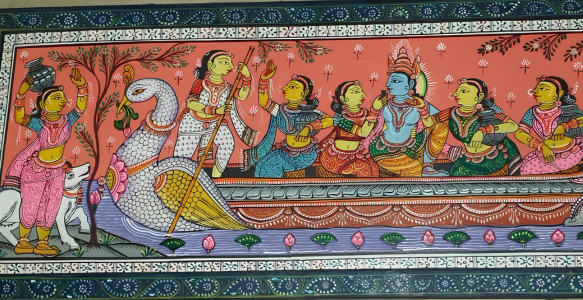
On a humid afternoon in Raghurajpur, a chitrakar leans over a strip of cotton cloth, the air thick with the chalky smell of ground conch shell and tamarind paste. His brush - really a few squirrel hairs tied to a twig - moves in confident, almost musical strokes as the rounded eyes of Lord Jagannath slowly appear. Outside, a group of visitors stand in silence, realising that the question “what is pattachitra painting” is not just about technique, but about a living relationship between devotion, storytelling, and eastern Indian village life
For us at ArtFlute, Pattachitra sits in a fascinating space within Indian art: at once rigorous and folk, regional and yet strangely universal in its graphic clarity and narrative pull
What is Pattachitra Painting?
At its simplest, Pattachitra (or Patta Chitra painting) literally means “picture on cloth”: patta from Sanskrit for cloth or canvas, and chitra for painting or image. Emerging in the eastern regions of Odisha and West Bengal, it refers to a family of cloth- and palm-leaf–based scroll paintings that visualise myths, temple rituals, and local legends in flat planes of colour, bold outlines, and intricate borders.
Traditionally, a pattachitra painting is created on cotton or silk prepared with a mixture of chalk and tamarind seed paste, which dries into a hard, eggshell-like surface ready to receive pigment. Artists grind seashells, stones like hingula (for red) and harital (for yellow), lamp soot (for black), and leaf extracts to prepare their colours - one reason the surfaces feel both matte and luminous in person. These works were first made as ritual objects and temple souvenirs in Puri and other Odisha temple towns, especially for pilgrims visiting the Jagannath shrine.
Over time, pattachitra art expanded beyond strictly ritual use into visual storytelling: epics like the Ramayana and Mahabharata, Krishna’s childhood pranks, village processions, and local folklore all found their way onto these scrolls. In Bengal, the related patachitra tradition grew into a performative practice, where painters (patuas) would unroll long scrolls panel by panel while singing narrative ballads. Today, you’ll find traditional pattachitra painting on temple walls, palm-leaf manuscripts, card decks, textiles, and contemporary design objects, yet the core vocabulary - flat fields of colour, dense borders, frontal deities - remains remarkably stable.
From a curator’s standpoint, the famous Pattachitra painting is rarely just about virtuosity; it’s about how convincingly it holds the tension between folk spontaneity and almost liturgical discipline.
In the larger ecology of different types of Indian paintings, Pattachitra is a useful counterpoint to courtly miniatures or modernist abstraction - it invites us to read an image sequentially, almost like a film strip or raga, rather than as a single frozen moment.
Historical Background of Pattachitra Paintings
1. Meaning and Etymology of Pattachitra
The phrase has been surprisingly stable over centuries: Sanskrit, Odia, and Bengali sources all echo the patta + chitra construction, even as local pronunciations shift to patachitra or pata painting. The term covers both the object (the painted cloth or leaf) and, by extension, the practice, so what is Pattachitra art is as much a question of process and community as of finished artefact.
For historians, phrases like pattachitra origin and pattachitra history are tangled with temple patronage and pilgrimage networks: texts and material evidence suggest continuous practice in Odisha for at least a millennium, with some scholars tracing it to murals in the Puri–Konark–Bhubaneswar temple triangle. That long view makes any neat history of Pattachitra feel more like a constellation of moments than a single linear story
2. Origin of Pattachitra Painting in Odisha
Most scholars agree that the strongest, oldest strand of pattachitra history runs through Odisha, especially around the Jagannath temple at Puri. During the Snana Yatra ritual bath, the deities are considered “unwell” and kept out of public view for about fifteen days in the Anasara period; during this time, painted substitutes known as Anasara Patti or Patti Dian were worshipped instead. This practical ritual need - images that can stand in for inaccessible idols - arguably catalysed a major chapter in Pattachitra origin as a devotional technology.
Villages like Raghurajpur near Puri became clusters of hereditary painter families - Maharanas, Mohapatras, and Chitrakaras - who specialised in these temple-related commissions and later in narrative scrolls for pilgrims. Their work echoes temple sculpture and murals in composition and iconography, making each indian pattachitra painting a kind of portable shrine and visual scripture at once
3. What Makes Pattachitra Paintings Unique?
Several traits make the Pattachitra painting style instantly recognisable: dense decorative borders, flattened architectural spaces, frontal deities with large, expressive eyes, and an almost obsessive care for pattern. Natural pigments and the absence of modelling keep forms graphic and legible even from a distance, which makes sense when you remember these were viewed in dim temple interiors or crowded ritual contexts.
Equally distinctive is the scroll logic: a pattachitra scroll painting may read from left to right in sequential panels or spiral around a central deity, inviting viewers to physically move in order to “read” the image. This seriality places Pattachitra closer to comics, cinema, and performance than to isolated easel pictures - one reason it continues to resonate with contemporary artists and audiences.
When we map the pattachitra painting information against, say, Pahari miniatures or Byzantine icons, what stands out is how unembarrassed it is about repetition and frontalness; there’s a refusal to pretend at naturalism, and that honesty feels oddly modern.
Features of Pattachitra Painting
1. Intricate Detailing
Up close, what you first read as a simple lotus halo reveals fretwork borders, tiny birds, and almost textile-like fills; this micro-level density is central to Pattachitra art painting. Using ultra-fine brushes, artists build up jewellery, textile patterns, and architectural motifs line by line, often over many days.
2. Decorative Borders
No Pattachitra feels complete without its frame; borders can run to several concentric bands of floral creepers, geometric patterns, or miniature narrative vignettes echoing the central story. These frames don’t merely decorate; they contain sacred space, much like the carved frames of South Indian temple doorways.
3. Natural Colors
Traditional workshops still prepare pigments from conch-shell powder (white), lamp soot (black), hingula for red, harital for yellow, and plant sources for green and blue, bound with natural gums. The result is a restrained but rich palette that ages beautifully; older pieces often acquire a soft, fresco-like patina rather than the brittleness of synthetic paint.
4. Mythological Narratives
From Krishna’s playful theft of butter to the cosmic sweep of the Dashavatara, narrative is the backbone of Pattachitra folk painting. In Bengal, this narrative impulse extends into performance, with patuas singing pater gaan as they unfurl long scrolls in village squares.
5. Fine Line Work
Perhaps the most technically demanding aspect is the line itself: steady, elastic, capable of both hair-thin tracery and declarative outlines. The training required - years of copying, grinding pigment, stretching cloth - shows in how effortlessly a seasoned artist can pull a perfect curve for a goddess’s eyebrow or the trunk of Ganesha.
Seen alongside spiritual paintings, Pattachitra’s restraint in colour and perspective often feels almost graphic-design–like - more poster than illusion - yet that flatness is precisely what lets myth feel archetypal rather than anecdotal.
Different Types of Pattachitra Paintings
1. Odisha Pattachitra
Odisha Pattachitra centres on Jagannath, Vaishnava themes, and temple-related imagery, usually on cotton or silk cloth and sometimes on palm leaf. Villages like Raghurajpur are synonymous with this school, whose compositions echo the sculptural rhythms of Puri and Konark.
2. Bengal Pattachitra
In West Bengal, patachitra tends to be painted on handmade paper backed with cloth, with brighter hues and a stronger presence of local folklore and social themes. The patua tradition is inseparable from song; scrolls are props in a performed narrative rather than static wall pieces.
3. Tala Pattachitra
Tala Pattachitra or Talapatra chitra shifts from cloth to stitched palm leaves, where images are incised with a stylus and then darkened with pigment rubbed into the grooves. The resulting panels read like graphic manuscripts - fragile, intimate, and exquisitely linear.
4. Santhal Pattachitra
Santhal Pattachitra, practised by Santhal communities in parts of West Bengal, Jharkhand, and Odisha, uses bold, simplified figures to depict dance, harvests, music, and ancestral spirits. The mood is more celebratory and earth-bound than overtly devotional, but the same scroll logic and natural pigments anchor it within the broader Pattachitra family
5. Kalighat Pattachitra
Kalighat paintings, born around the Kalighat temple in 19th-century Kolkata, adapt the Pattachitra lineage to urban life and colonial modernity. Their sweeping brushstrokes, satire on babu culture, and social realism mark a decisive shift from purely mythological to contemporary concerns.
6. Jhoti Pattachitra
Jhoti or Chita is the Odia practice of drawing white rice-paste motifs on red-ochre walls and floors during festivals, invoking Lakshmi and prosperity. Some contemporary artists translate these ephemeral designs - lotus, creepers, granaries - into more permanent Jhoti Pattachitra on cloth or board, keeping the spare white-on-earth aesthetic within the patta tradition.
7. Durga Pattachitra
“Durga Pattachitra” usually refers to compositions centring the goddess - eight-armed Mahishasuramardini or elaborate Durga Puja tableaux - often produced for festival-season patrons in Odisha and Bengal. Here, Shakta iconography sits inside the same borders, colours, and line work as Vaishnava themes, but the emotional temperature is distinctly fierce.
8. Ganjapa Pattachitra
Ganjapa are circular playing cards from Odisha whose faces are painted with miniature Pattachitra scenes - Dashavatara, courtly figures, floral motifs - turning everyday play into a mobile gallery. A full set, fanned out, feels like a fragmented, tactile narrative rather than a mere game.
9. Chouko Pata
Chouko Pata (from chouko, “square”) denotes standalone square-format images - often a single deity or episode - rather than long narrative scrolls. They read closer to icons or portraits, making them a bridge between storytelling scrolls and later framed pictures.
10. Jorano Pata
Jorano or Jodano chitra refers to long, wrapped scrolls divided into multiple registers, each panel carrying a scene from a larger story like the Ramayana. When fully unfurled, they can stretch several metres, turning the act of viewing into a physical journey through narrative time.
Deities Depicted in Pattachitra Paintings
1. Lord Jagannath of Puri
Jagannath, with Balarama and Subhadra, is the gravitational centre of Odishan Pattachitra - stylised, round-eyed, often placed under an arched shrine or on the chariot of the Ratha Yatra. Images sometimes mirror specific temple rituals or adornments, making them visual diaries of the deity’s yearly calendar.
2. Krishna Leela & Gita Govinda
Radha–Krishna themes, especially episodes from Jayadeva’s Gita Govinda, appear frequently: circular raas mandalas, forest rendezvous, or lyrical depictions of separation and longing. These resonate strongly today, sitting comfortably alongside Radha Krishna paintings in other regional idioms.
3. Lord Vishnu & The Dashavatara
The ten avatars of Vishnu - Matsya to Kalki - often occupy a single composition, arranged in grids or circular sequences around a central deity. Such works function almost like mnemonic charts for theology, compressing an entire cosmology into one frame.
4. Goddess Durga & Shakti Forms
Durga, Kali, Lakshmi, Saraswati, and regional mother goddesses appear in numerous Pattachitras, especially in Shakta regions of Odisha and Bengal. The goddess is frequently shown mid-battle, slaying Mahishasura, or enthroned in full festival regalia, surrounded by attendants and musicians.
5. Ganesha & Saraswati
Ganesha, often in dancing or ten-armed forms, and Saraswati with her veena and swan, occupy a gentler devotional space - auspicious presences for thresholds, study rooms, and beginnings. Their images in Pattachitra align naturally with the ethos of Ganesha paintings and Saraswati art across India.
6. Gajalakshmi
Gajalakshmi - Lakshmi flanked by elephants - appears frequently, her lotuses and overflowing pots echoing the agrarian aspirations of the communities that commission these works. She often overlaps with the Tree of Life motif, making fertility and prosperity literally branch across the composition.
Seen together, these images form a portable theology: a visual index of Vaishnava, Shaiva, and Shakta traditions that can sit comfortably beside other Durga paintings and regional devotional idioms while remaining unmistakably Pattachitra in line and colour.
FAQs About Pattachitra Scroll Painting
1. Which state is famous for Pattachitra painting?
Pattachitra painting is most closely associated with Odisha, particularly the region around Puri and Raghurajpur.
2. What materials are used in Pattachitra paintings?
Traditional Pattachitra paintings use cloth or palm leaves, natural pigments, tamarind seed paste, and plant-based gums.
3. Why is the Tree of Life motif popular in Pattachitra?
The Tree of Life symbolizes fertility, growth, continuity, and the interconnectedness of life in Pattachitra art.
4. Who are the traditional artists of Pattachitra painting?
Pattachitra painting is traditionally practiced by Chitrakara and Maharana artisan families in Odisha and West Bengal.
5. What stories are commonly depicted in Pattachitra paintings?
Pattachitra paintings often depict stories from the Ramayana, Mahabharata, Krishna Leela, Jagannath traditions, and Hindu mythology.
6. How are pattachitra scroll paintings created?
Artists prepare a cloth surface, sketch the design, apply natural colours, and finish the painting with fine decorative details.
