Traditional Styles of Goddess Saraswati Paintings
1. Tanjore Paintings
In a Tanjore Saraswati painting, she sits within a temple‑like arch, surrounded by gesso relief, adorned in semi‑precious stones, and a field of 22‑carat gold leaf. This art form developed in the 16th–17th century Thanjavur under Nayak and Maratha patronage. For those wanting to learn about the art form and its history, ArtFlute’s guide to tanjore painting is a useful starting point.
2. Madhubani/Mithila Painting
A Madhubani or Mithila ma saraswati painting is filled with bold outlines, flat colours, and intricate decorative patterns. The style comes from the Mithila region of Bihar, where such paintings were traditionally created for festivals and family occasions. Fish, vines, and geometric forms often appear around the goddess. Today, a painting of Saraswati Mata in this style is chosen as much for its visual richness as for its cultural significance.
3. Pattachitra
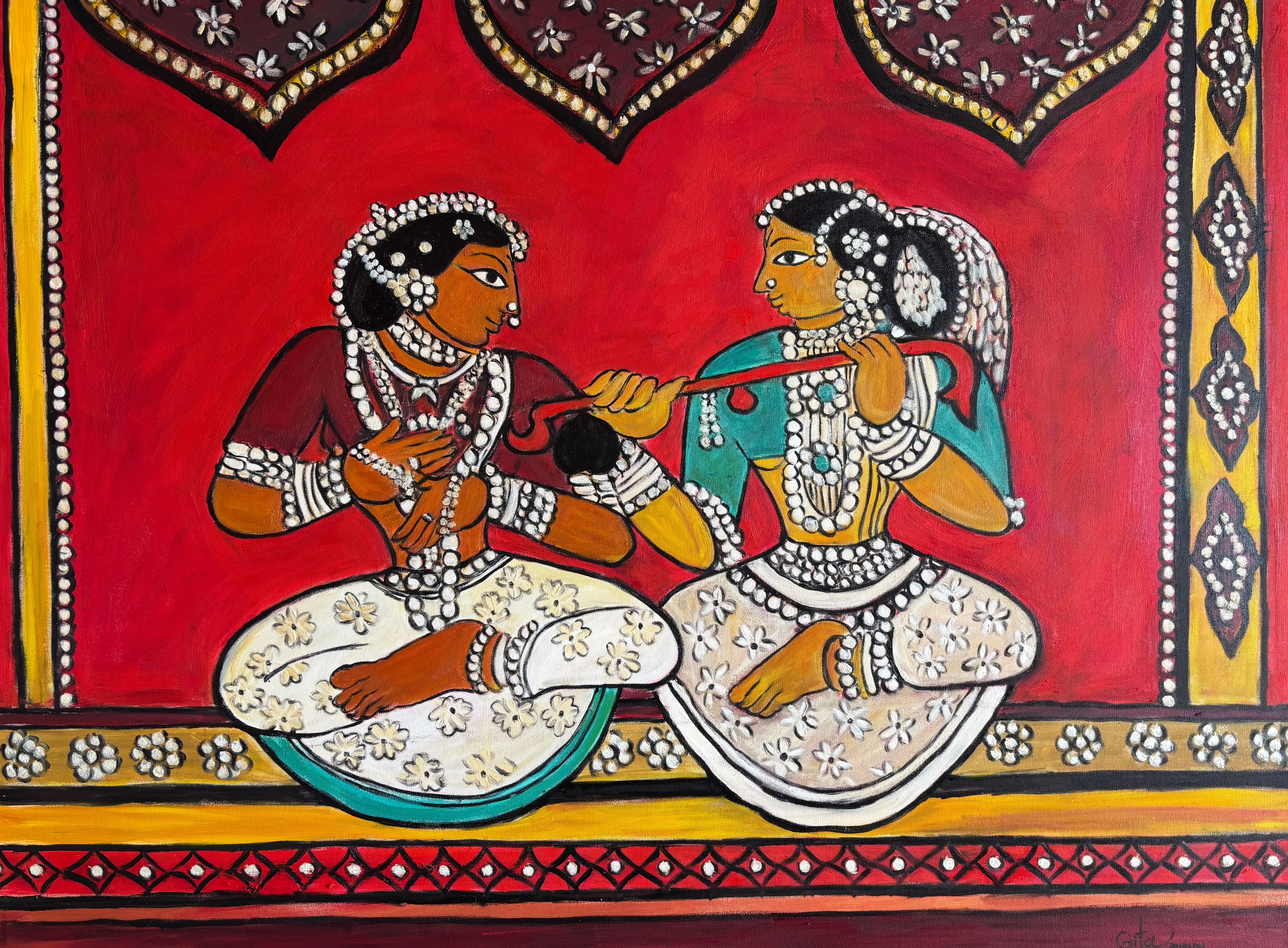
In Pattachitra from Odisha, a Devi Saraswati painting is typically etched or painted on cloth or palm leaf, her elongated features and rhythmic linework echoing the Jagannath temple tradition. Artists incise the drawing onto treated palm leaves creating an object that feels part painting, part manuscript.
4. Kalamkari
A kalamkari Saraswati devi painting is made on cotton or silk, drawn freehand with a "kalam" (pen) and coloured with natural dyes through a laborious process. Originating in Andhra Pradesh and Telangana, the Srikalahasti school in particular is known for narrative temple hangings where deities unfold across scroll‑like formats.
5. Mysore Painting
Mysore paintings use low‑relief gesso and a soft, pastel palette. Emerging from the Vijayanagara legacy and Wodeyar court ateliers, these works are built on cloth‑on‑board with chalk gesso, selective gold leaf, and delicate linework.
6. Miniature Paintings
In the miniature style, Saraswati appears within courtly and romantic landscapes, seated with veena and manuscript amidst flowering trees or palace terraces. These works emphasised calligraphic line, subtle modelling, and narrative details. Miniature works of Saraswati are an easy first pick for collectors.
7. Warli & Tribal Art
Warli painting, from Maharashtra’s Warli community, portray divinity through ritual squares, circles, and dancing figures painted in white rice paste on an earthy ground. A Warli‑inspired painting of saraswati mata might show a community encircling a central motif, turning the goddess into a presence felt through community, rhythm, and geometry.
8. Modern Saraswati Painting
Beyond these classical styles, modern art of saraswati ranges from cubist and abstract renditions to mixed‑media canvases that quote fragments of mantra, notation, or script. Some artists retain only the key icons, letting colour fields carry the emotional weight; others, softened or re‑situated the goddess within naturalistic landscapes and wash techniques. In the ArtFlute collection, a modern saraswati painting sits alongside contemporary indian art paintings of abstracts, cityscapes, or figurative works yet still hold its own.
Renowned Artists Known for Saraswati Paintings
1. Raja Ravi Varma
It is almost impossible to discuss goddess saraswati art without mentioning Raja Ravi Varma’s poised, sari‑clad Saraswati, veena in hand and swan at her feet which circulated widely through his oleographs. By marrying European technique with scripturally accurate iconography, he created an image that many Indians now instinctively recognise as "the" Saraswati. ArtFlute’s feature on raja ravi varma paintings offers deeper context on his goddess imagery.
2. M.F Husain
M.F Husain approached Saraswati from a modernist lens simplifying form, veenas, and birds into sweeping curves and blocks of colour. His nude goddess works, including a Saraswati reproduced in a Hindi magazine in 1996, sparked fierce protests, court cases, and attacks. If this cubist, experimental style speaks to you, ArtFlute's collection of M.F Husain paintings is a good way to understand where Saraswati sits within his broader practice of his Horse series, Theorama series and other works.
3. Yograj Verma
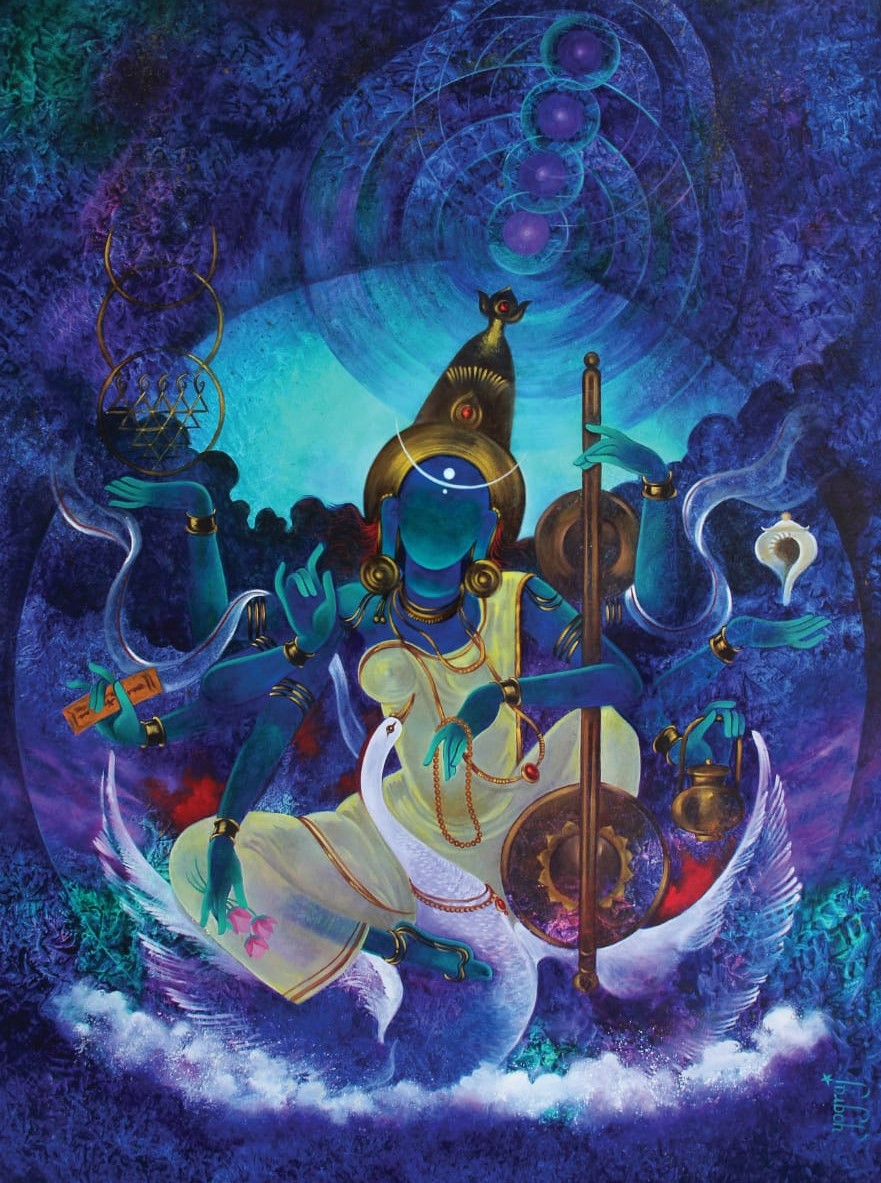
Contemporary artist Yograj Verma often paints Saraswati in his iconic faceless deities style. This allows viewers to project their own understanding of the divine onto a luminous field of colour and simplified form. Works such as "Saraswati’s Serenade with Peacock" or "Maha Saraswati" place the goddess on expansive canvases, where her veena, peacock, and flowing garments become almost architectural shapes. Collectors drawn to his paintings often cite their emotional clarity and the contemporary mysticism that sits well in modern apartments and offices.
Early‑20th‑century artists like Sunayani Devi in Bengal and Baburao Painter in Maharashtra offer two very different versions of Saraswati. Sunayani’s wash paintings soften the goddess into muted colours and introspective gazes. While Baburao’s "Saraswati, Goddess of Wisdom" places her barefoot on a rocky riverbank, recalling her older identity as a river deity.
Once you have seen how each one treats the veena, the swan, or the lotus, you begin to read newer Maa Saraswati paintings with far greater sensitivity.
Common Artistic Elements in Ma Saraswati Paintings
1. Saraswati Playing Veena
The veena is the most consistent motif (even in contemporary works) across almost every goddess Saraswati painting, signifying the disciplined harmony between intuition and structure. She plays seated in a cross‑legged pose, suggesting that learning requires both rootedness and fluidity.
2. Hamsa Saraswati
The hamsa is Saraswati’s traditional vahana, symbolising the ability to separate milk from water, or essence from noise. In many paintings the bird mirrors the goddess’s elongated neck and calm gaze, visually doubling her discerning intelligence.
3. Books & Scriptures
The pustaka (book) in Saraswati’s hand is not tied to any one text; it functions as a shorthand for literature, grammar, and all forms of recorded knowledge. In learning settings, a painting of saraswati devi with clearly rendered manuscripts aligns the space with aspiration and scholarship. Some modern canvases integrate fragments of script or notation turning it into a visual mantra.
4. Lotus Pose
Saraswati is frequently shown seated on a full‑blown white lotus (in padmasana), in stillness within ornate compositions. The lotus signals both spiritual awakening and a mind that remains unstained by the mud of distraction.
5. With Lakshmi & Ganesha
Compositions that pair Saraswati with Lakshmi and Ganesha have become especially popular for home entrances and office receptions, balancing learning with prosperity and auspicious beginnings. Many ArtFlute clients choose to combine a contemporary Saraswati with more traditional lakshmi art) and ganesha paintings, creating dialogue between styles while keeping the triad intact.
Shop Saraswati Wall Painting Online at Artflute
1. Certificate of authenticity
Every original painting on ArtFlute is sold with a certificate of authenticity detailing artist, medium, dimensions, and year, signed by the artist.
2. Premium Quality
ArtFlute’s Saraswati collection features works in the ₹50,000–₹20,00,000 range typically featuring original oils or acrylics.
3. Safe packaging & worldwide delivery
ArtFlute uses layered, custom packaging with corner protectors, moisture‑resistant wraps, and reinforced crates where needed and works with experienced art‑shipping partners for international delivery.
FAQs About Painting of Maa Saraswati