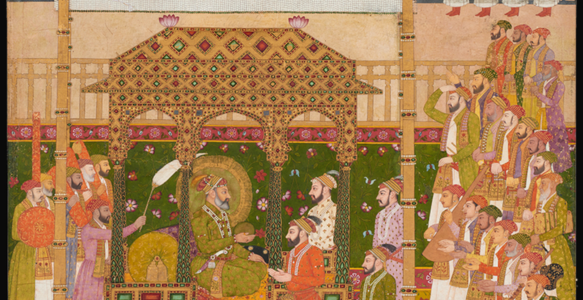
Mughal miniature paintings are often smaller than a modern notebook page, but they can contain an extraordinary amount of detail. A single work might show a royal procession, a hunting scene, or a moment from scriptures, each equally rendered with remarkable precision.
What makes them especially interesting is the mix of influences behind them. Persian painting traditions, Indian storytelling, local flora and fauna, and court culture all found their way into the same visual language. Within the broader universe of Indian Mughal miniature paintings, this art form continues to shape how artists think about narrative, ornament and the politics of looking. It also occupies an important place among the many different types of Indian paintings that have evolved across the subcontinent.
What is ughal Miniature Painting?
If one begins by asking what is Mughal miniature painting, the most direct answer is that it is a courtly style of small-sized painting that developed in the royal workshops of the Mughal emperors in North India from the mid‑16th-18th century. These images were usually painted in opaque watercolour and gold on paper, to be handled, studied and gifted.
The style emerged from Persian miniature traditions that Humayun and Akbar encountered and patronised, and then absorbed the Rajput colour sensibilities, depictions of local flora, fauna and Hindu mythology. Narrative scenes from epics, royal chronicles, Sufi stories and everyday court life sit alongside studies of rare animals, birds and flowers rendered with extraordinary observational accuracy. Many works also drew inspiration from stories that continue to influence contemporary Hindu mythological paintings.
Over time, mughal miniature art came to balance three impulses of storytelling, documentation and aesthetic pleasure. The result is a visual language that feels elegant and codified, yet also surprisingly intimate.
History & Origin of Mughal Miniature Painting
1. Beginning of Mughal Paintings Under Humayun's Reign
The mughal miniature painting origin is usually traced to the reign of Humayun, who spent years in exile at the Safavid court in Persia and returned to India with both a taste for illustrated manuscripts and with the painters to realise them. He invited Persian masters Mir Sayyid Ali and Abd al‑Samad (Abd us‑Samad), laying the foundations of a new court style that would later flourish under his son Akbar. Early works already show a fascination with portraiture and dynastic memory, like in “Princes of the House of Timur”, where generations of Timurid rulers are gathered around Humayun in a carefully staged, almost theatrical family tableau.
In these first miniature paintings of the Mughal period, Persian conventions of flattened architecture, jewel-like colour, standardised gesture still dominate, but Indian details like specific costumes, local landscapes and a different sense of storytelling rhythm seem to creep in.
2. Development of Mughal Miniature Art During Akbar’s Rule
Akbar is widely regarded as the true architect of the mature mughal empire miniature painting tradition. Large illustrated projects such as the Hamzanama, Akbarnama and illustrated translations of the Mahabharata, Ramayana and Harivamsa brought together painters from different backgrounds. Under his patronage, miniature paintings of the Mughal empire works developed a bolder, more kinetic visual language – crowded battle scenes, dynamic diagonals, experimental architecture and vivid depictions of rivers, rocks and stormy skies.
These manuscripts encouraged experimentation. Artists developed more complex compositions, paid greater attention to movement and landscape, and began adapting stories from Indian texts.
3. Artistic Growth and Realism in Jahangir’s Reign
With Jahangir, the focus of the school shifts to a more introspective, observational mode. He himself was a connoisseur who wrote with unusual precision about paintings in his memoirs and he favoured highly finished album pages, single‑subject studies and what we might now call the mughal miniature portrait. Artists such as Ustad Mansur and Abu’l Hasan excelled at almost scientific renderings of rare birds, animals and plants, as well as subtle portraits. Their close observation of the natural world and human likeness helped establish qualities now associated with realism paintings.
Mansur's studies of birds and animals remain some of the finest examples of nature paintings in Indian art history, combining scientific observation with aesthetic refinement.. At the same time, works like The Death of Inayat Khan, attributed to Balchand, extend portraiture into an unsettling meditation on mortality, showing a court official emaciated and near death at Jahangir’s instruction. Mughal miniature painters in this period seemed preoccupied with the tension between worldly splendour and human frailty.
Techniques and Materials Used in Mughal Paintings
Mughal art miniature painting involves an exacting technical process that could stretch over weeks, sometimes months. The physical support, pigments, brushes and finishing methods together shaped what later historians would call quintessential mughal miniature paintings characteristics.
1. Wasli Paper Preparation
Artists worked on wasli, a laminated paper made by pasting together several thin sheets with a starch‑based glue (laeey), often reinforced with copper sulphate to resist insects and fungus. Once dry, the stack was burnished on both sides with an agate stone or cowrie shell to compress the fibres and create a surface that felt almost like polished bone or marble. This preparation allowed washes to sit evenly without bleeding and supported the tiny, repeated strokes needed for intricate pardakht (fine shading).
2. Natural Pigments & Mineral Colours
Traditional palettes relied on painstakingly prepared natural pigments. Ground lapis lazuli for deep blues, malachite and verdigris for greens, cinnabar and red lead for reds, along with plant‑based lakes, carbon blacks and shell gold. The painter would grind the pigment with water and a binding medium, then store colours in small shells, re‑activating and mixing them literally in the palm of the hand before application. Akbar’s atelier is often credited with broadening this palette with intense “Indian” tones such as peacock blue and Indian red, supporting the growing interest in local landscapes and textiles.
3. Fine Squirrel-Hair Brushes
The signature precision of miniature Mughal work depended on the kalam – a brush fashioned from the tail hair of a squirrel, tied to a fine reed or quill. Properly made, it came to a single hair at the tip, capable of drawing eyelashes, calligraphic outlines, patterned borders and the tiny white highlights on an eye or jewel. A good squirrel-hair brush is as personal as a musician’s instrument, shaped over time through use and cleaning rather than factory uniformity.
4. Layering & Burnishing Technique
Once an underdrawing in pale ink or charcoal was fixed, artists laid down flat colour areas, then built up modelling through thin glazes, hatching and stippling. Between stages, the surface could be lightly burnished to meld pigment and paper fibres, producing that characteristic soft sheen, before returning with ever finer brushwork for facial features, textiles and ornament. In some works, actual gold leaf was applied creating an interplay between matte and reflective passages across the small surface.
Famous Mughal Miniature Painters
The story of mughal miniature painters is deeply collaborative but certain names stand out in this sea of anonymous brilliance. Their careers trace shifting imperial tastes, from Persianate elegance to earthy drama to introspective naturalism.
1. Mir Sayyid Ali
Mir Sayyid Ali arrived from the Safavid world and worked first for Humayun, then in Akbar’s atelier, helping to train a generation of Indian artists in Persian techniques. He is associated with early works like Khamsa illustrations and possibly “Princes of the House of Timur”, where the fusion of Timurid genealogy and Mughal ambition is already visible.
2. Abd al-Samad
Abd al‑Samad (Abdus Samad) also moved with Humayun and later headed Akbar’s imperial workshop, guiding the Hamzanama project and other major commissions. Historians suggest that it was under his direction that the Mughal style fully came into its own, moving beyond simple imitation of Persian models.
3. Basawan
Basawan, one of the leading Hindu artists in Akbar’s studio, is praised for his mastery of composition and emotional expression. He contributed to key manuscripts including the Akbarnama and is often credited with expanding the range of figures within crowded scenes.
4. Ustad Mansur
Ustad Mansur, honoured by Jahangir with the title Nadir‑ul‑Asr (“wonder of the age”), became the pre‑eminent animal and bird painter of the court. His works, from the famous dodo and Siberian crane images to Falcon on a Bird Rest, combine almost scientific detail with a keen sense of poise and presence.
5. Abu'l Hasan
Abu’l Hasan, sometimes called Nadir‑uz‑Zaman, was another favourite of Jahangir, known for delicate portraits and richly finished album pages. He appears in royal chronicles as the one who was trusted with intimate commissions that required both likeness and subtle flattery.
6. Govardhan
Govardhan’s career bridges the later years of Akbar, Jahangir and Shah Jahan. He was associated with sensitive portraits of courtiers, ascetics and members of the imperial family. Attributed works such as Abu’l Fazl presenting the Akbarnama to Akbar and paintings from the Dara Shikoh Album showcase his ability to balance ceremonial grandeur and individual character.
Most Famous Mughal Miniature Paintings
When art historians speak of famous Mughal miniature paintings, they refer to folios that crystallise a moment in the empire’s political and artistic life. Many of these have moved into global museum collections, where they are ambassadors for the larger projects they once belonged to.
1. Hamzanama
The monumental Hamzanama, commissioned by Akbar, originally comprised around 1,400 large paintings narrating the adventures of Hamza, uncle of the Prophet. Produced over more than a decade by teams of artists, these folios mark the emergence of a fully fledged Mughal narrative style – energetic, experimental and unafraid of blood, humour and spectacle.
2. Abul Fazl presenting Akbarnama to Akbar
In the celebrated folio Abu’l Fazl presenting the Akbarnama to Akbar, painted by Govardhan, the emperor sits enthroned as his historian offers the bound chronicle of his reign, surrounded by courtiers and dense architectural detail. The work visualises the symbiosis between text and image in the Mughal project of self‑representation.
3. Krishna Holds Up Mount Govardhan
The painting Krishna Holds Up Mount Govardhan to Shelter the Villagers of Braj, from a Persian Harivamsa commissioned under Akbar, shows the blue god lifting the mountain as villagers and cattle seek refuge from Indra’s storm. Here, Hindu myth is captured with Mughal composition and palette, an emblematic example of Indian Mughal miniature paintings engaging deeply with local religious narratives.
4. The Padshahnama Illustrations
The Padshahnama, a lavish chronicle of Shah Jahan’s reign, contains some of the most opulent court scenes in the tradition – processions, marriages and throne ceremonies painted with abundant gold, textiles and architectural splendour. These images helped fix the visual memory of Shah Jahan’s era as the high point of imperial magnificence.
5. Dara Shikoh with his Bride in a Garden
Paintings depicting Dara Shikoh with his bride in garden settings, often linked to the Dara Shikoh Album, combine refined portraiture with an interest in intimate, contemplative space rather than pure ceremony. They gesture towards the prince’s documented fascination with mysticism and companionship over overt displays of power.
6. Jahangir Weighing Prince Khurram
Jahangir Weighing Prince Khurram in Gold, attributed to Manohar, shows the young prince (Shah Jahan) seated in a set of scales as courtiers and holy men witness the weighing ritual. The painting combines precise portrait likenesses with the time’s ritual of charity and legitimacy.
7. Falcon on a Bird Rest
Falcon on a Bird Rest, by Ustad Mansur, focuses on a single falcon on its perch against a plain background, every feather modelled with attention. It highlights the Mughal passion for rare creatures into a quiet, meditative study.
8. Dying Inayat Khan
The Death of Inayat Khan, attributed to Balchand, depicts a skeletal courtier reclining on cushions, his body ravaged by illness, commissioned by Jahangir as a record of his condition. Stark and unsparing, it stands apart from the usual opulence of court scenes, offering a rare image of vulnerability.
9. Darbar of Aurangzeb
Darbar of Aurangzeb presents the emperor enthroned under a canopy, surrounded by courtiers in a formal court assembly, likely painted in the early 1680s. The work has become an iconic image of Aurangzeb’s reign, with its cool blue sky and controlled austere grandeur.
10. Princes of the House of Timur
Princes of the House of Timur painted on cotton rather than paper, is often cited as the earliest large‑scale dynastic painting of the Mughal school, with later overpainting incorporating Akbar, Jahangir and others around Humayun. Its complex history of additions mirrors the dynasty’s ongoing effort to re‑narrate its own past.
Mughal Era Miniature Paintings FAQs
1. Which Mughal emperor started miniature painting in India?
Miniature painting in the Mughal court is usually linked to Humayun. He brought Persian painters Mir Sayyid Ali and Abd al-Samad to India, and Akbar later helped the tradition grow into a major court art.
2. What are the key characteristics of the Mughal style of miniature painting?
Mughal miniature paintings are small, detailed, and carefully built up. They are known for fine line work, rich colour, gold accents, and scenes painted on wasli paper.
3. What themes were commonly depicted in Mughal paintings?
Mughal paintings often show emperors, courtiers, battles, hunts, and life in the palace. Many also illustrate stories from Persian and Indian texts, along with animals, birds, and plants.
4. Why are Mughal miniature paintings important?
They matter because they record the Mughal world in remarkable detail. They also shaped the course of miniature painting in India.
5. How did Mughal painting influence other Indian art styles?
Mughal painting influenced Rajput, Pahari, and Deccan styles. Artists in these regions borrowed its realism, portrait style, and courtly finish, then made it their own and are still be seen in many forms of original Indian paintings created today.
