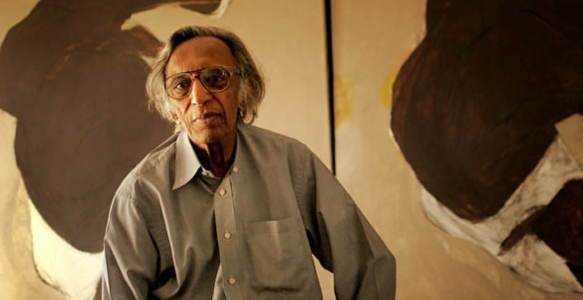
Standing in front of a Tyeb Mehta canvas, time seems to slow down. The figure contorted mid-fall or locked within a sharp diagonal, holds the room in a strange, suspended breath. The colours look calm, but you sense a flicker of unease, as if the painting has absorbed more violence than it can contain. For many viewers, Tyeb Mehta the artist is encountered first through these iconic images in catalogues and museum walls.
The artist moved between Bombay, London, New York and Santiniketan, absorbing influences from European modernism, Abstract Expressionism and Indian classical visual traditions. His paintings, sculptures and a short experimental film trace a cohesive arc: from early, textured expressionist surfaces to later, pared-down forms sliced by the famous diagonal. Today, his works rank among the famous Indian contemporary works, setting records at international auctions and shaping how modern Indian art is narrated globally.
Who is Tyeb Mehta?
In many ways, the answer to “who is Tyeb Mehta” is inseparable from the city of Bombay, its working-class neighbourhoods and its history of violence and resilience. Born into a Gujarati family that moved to the city, he grew up among the Dawoodi Bohra community near Crawford Market, absorbing street scenes, religious processions and cinema posters.
1. Early Formative Years & Artistic Education
Before stepping into the world of galleries, Mehta’s first apprenticeship was in the film studios, working as a movie editor and art department assistant. The cutting and arranging of frames, structuring of time and tension, left a subtle impression on his canvases.
In 1947, encouraged by art director A. A. Majid, he joined Sir J. J. School of Art in Bombay, entering formal art education at a moment when India itself was being reshaped. The Partition riots he witnessed that year engraved a recurring image of the falling, broken body into his memory. They materialised in the psychological intensity of many Tyeb Mehta paintings.
A Rockefeller grant and time spent in London and New York in the 1950s and 1960s exposed him to the work of Francis Bacon, Barnett Newman and post-war European and American modernism. While he absorbed elements of their expressionist distortion and chromatic austerity, he brought them back into a specifically Indian context. He placed the anonymous urban worker, the rickshaw puller or the mythic demon squarely at the centre of his picture plane.
2. Association with the Progressive Artists’ Group
While still a student, Mehta became associated with the Progressive Artists’ Group (PAG) founded in Bombay in 1947 by F. N. Souza, S. H. Raza, M. F. Husain and others who sought to break away from academic realism and the sentimentalism of the Bengal School. Their shared vision was for a modernism rooted in Indian experiences engaging with global movements like cubism and expressionism.
Through this circle, Mehta encountered a rigorous, argumentative studio culture – artists debating Cézanne and Picasso at the same table where they spoke of Ajanta murals and Pahari miniatures. The progressive artists group became a crucible for many of the ideas that would shape Tyeb Mehta’s art.
Unlike the flamboyant public personas of some of his peers, Mehta remained relatively private, working slowly and reworking motifs across decades. Yet his late-career auction records – made him a central figure in the story of India’s art market boom.
Thinking of Mehta alongside Souza, Raza and Gaitonde, what stands out is his refusal of decorative excess. Even in a landscape crowded with Indian paintings, his canvases feel pared back, just enough form, just enough colour, and an emotional charge that lingers.
Tyeb Mehta's Painting Style and Themes
Across decades, Tyeb Mehta's painting style evolved from dense, textured surfaces to large, flat planes of saturated colour, but the emotional temperature of the work never really cooled. He distilled gesture, anatomy and narrative into a handful of recurring motifs – each carrying layers of personal memory and collective history.
1. Minimalism and Diagonal Motif
By the late 1960s, Mehta began using a single diagonal line to slice his canvases into two tense, interlocking fields of colour. This apparently simple device reorganised space completely: figures appear trapped, compressed or held in precarious equilibrium along the edge of that diagonal, while the surrounding planes pulse with flat reds, ochres, greys or acid greens.
The influence of Western minimalism and geometrical abstraction is visible. The diagonal behaves like a scar or a fault line, recalling Barnett Newman’s zips even as it responds to very local memories of rupture and partition. In this, Mehta stands slightly apart from both cubism art and lyrical abstraction – closer perhaps to Francis Bacon’s interiors than to Picasso’s playful fragmentation.
2. Violence and Trauma
Violence, for Mehta, is not spectacle but aftermath. The figures in his Falling Figure series plunge through space with limbs twisted, heads thrown back, bodies sometimes intertwined with birds or abstract forms – yet their faces are oddly mask-like, withholding individual identity. The memory of that 1947 lynching reappears, transformed into a universal image of helplessness and suspended impact.
Critics have often linked these works to expressionism art, yet Mehta’s approach is almost the opposite of expressionist excess. Instead of frantic brushwork and visible emotion, he gives us controlled edges, restrained palettes and carefully balanced compositions in which suffering is embedded in the structure of the picture itself.
3. Trussed Bulls
The bull entered Mehta’s imagery in the 1950s, inspired in part by his observations at an abattoir in Bombay’s Bandra area. In *Trussed Bull* and related works, a powerful animal is bound tightly by ropes, its body twisted, legs pulled in, eyes sometimes obscured; strength is present but immobilised.
Art historians have read this motif as a metaphor for energies thwarted in post-Independence India – life “nipped in the bud” and prevented from flowering fully. The heavy impasto of these early paintings, their deep browns and reds, and the thick black contour lines differ from his later flat planes but already point to his lifelong preoccupation with constrained force.
4. Mythological Figures
In later decades, Mehta turned increasingly to Hindu mythological subjects such as Kali and Mahishasura, as archetypes of violence, resistance and transformation. The mythological paintings of Tyeb Mehta compress goddess and demon into single, hybrid forms – tongues extended, limbs overlapping, weapons and bodies merging along that characteristic diagonal.
These works sit in conversation with a long history of Indian mythology painting, yet their clarity and chromatic severity are modern. Where traditional depictions revel in ornament and narrative detail, Mehta pares everything down to one or two figures and a few fields of colour, asking what remains of myth when all decoration is stripped away.
Looked at together, those seeking a Tyeb Mehta biography will find how his work moves between the anonymous urban subject and the timeless mythic figure without changing its underlying questions. Whether bull, rickshaw puller or goddess, each body is caught in a charged geometry that refuses easy catharsis.
Famous Paintings Series of Tyeb Mehta
Certain Tyeb Mehta artworks have, over time, become touchstones for collectors, curators and students of modern Indian art. These works chart both his formal evolution and the shifting anxieties of the society around him.
1. Celebration Painting by Tyeb Mehta
Commissioned by Times Bank in Bombay in 1995, Celebration is a large triptych in which three panels of figures occupy a shallow, ambiguous space, their bodies simplified into angular forms and flat zones of colour. In 2002, this work became the first Indian contemporary painting to cross the 1 Crore mark at a Christie’s auction, turning the celebration painting by Tyeb Mehta into a landmark in the country’s art history.
2. Diagonal Series
The Diagonal Series features works structured around a single, emphatic diagonal, often with one or two figures arranged along its length. It acts as both barrier and bridge – separating bodies from one another while also connecting their fractured parts across the picture plane.
3. Mahisasura Series
Among the most famous paintings of Tyeb Mehta, the Mahisasura works depict the demon and the goddess locked together in a tense, almost sculptural embrace. One version from the mid-1990s set a record when it sold for over a million dollars at Christie’s, cementing the series’ place in contemporary Indian art.
4. Trussed Bull Series
The Trussed Bull paintings of the 1950s show Mehta still working with more textured surfaces but already distilling the animal into a compact, bound form. The motif would recur in later canvases and prints, placing these works at the core of any discussion of bull paintings in Indian modernism.
5. Falling Figures
Returning to the Falling Figure motif in the 1960s and in the 1980s, Mehta painted solitary bodies tumbling through empty, dark fields, sometimes accompanied by birds. Viewers have linked these works to wartime memories, Partition trauma and anxieties about social collapse, but their power lies in how little they explain and how much they leave to the imagination.
6. Kali Series
The Kali paintings depict a restricted palette of blacks, reds and whites, the goddess often shown with her tongue thrust out, poised between dance and attack. Here, Mehta’s diagonal cuts across the body, uniting limbs and weapons in an almost abstract rhythm that echoing both ritual movement and psychic rupture.
7. Gesture
In *Gesture*, a late work that fetched a record price at auction in 2005, human forms are reduced into intersecting planes, their hands and limbs forming the primary expressive elements. The title hints that meaning now resides more in a single, charged movement – a raised arm, a turned wrist, a reaching hand.
8. The Rickshaw Puller
The Rickshaw Puller belongs to Mehta’s earlier phase, depicting an exhausted worker in a moment of pause rather than action. The subdued palette and sparse background focus attention on the gaunt body and the weight of the vehicle, offering a quiet but pointed commentary on labour and dignity in the postcolonial city.
9. Drummer
In *Drummer*, the central figure beats a drum with an energy that seems to reverberate across the fractured planes of the canvas. The bold colours and angular lines translate sound into visual rhythm, suggesting that even celebration in Mehta’s universe carries an undertone of strain and urgency.
Seen as a constellation, these works show how Tyeb Mehta’s famous paintings are less about variety of subjects and more about a deep, persistent return to a handful of forms. Each revisit to the bull, the demon, the falling body tightens the image, like a raga explored over a lifetime.
FAQs About Tyeb Mehta Artist
Why is Tyeb Mehta famous?
Tyeb Mehta is widely regarded as one of the key architects of post-Independence Indian modernism, alongside Souza, Raza, Husain and Gaitonde. His fame rests on a formal innovation – especially the diagonal motif and distilled figures – and the way his work channels the psychic aftermath of events like Partition into art that feel both specific and universal.
What is unique about Tyeb Mehta's color palette?
Mehta’s palette is distinctive for its use of flat, unmodulated vermilion reds, teal greens, mustard yellows, dense blacks and greys – balanced with great precision. Rather than layering or blending, he lets these colours meet along sharp edges, so that tension arises from the clash or harmony of adjacent planes.
What is Tyeb Mehta's signature style?
The diagonal slash, the simplified yet powerful figure and the economy of detail together define Mehta’s signature style. Over time, he moved away from crowded compositions to focus on one or two bodies held within a precise geometry, often drawing equally from lived urban experience and mythological archetypes.
