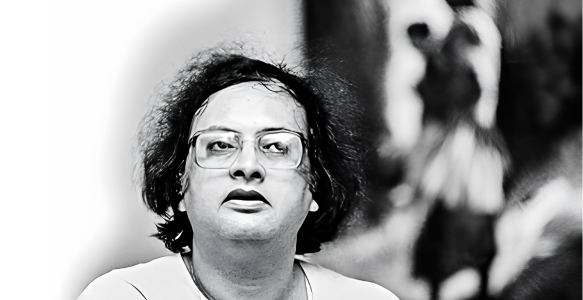
The first time you stand in front of a Bikash Bhattacharjee canvas, it isn’t the virtuoso realism that stays with you - it’s the unease. A lane in north Kolkata looks perfectly ordinary, and yet the shadows feel slightly too long; a young woman sits by a window, eyes averted, and the room seems to know a secret it will not share. Born in a middle‑class Bengali family in 1940, Bikash grew up in a city charged with political unrest, small domestic dramas, and the daily theatre of the street - all of which seeped into his work.
Artist Bikash Bhattacharjee’s realism was a way of entering the subconscious of his memories of post‑Independence Bengal. His paintings trace the map of a city living through refugee influx, Naxalite violence, and shifting class aspirations, while echoing the chiaroscuro of European Old Masters like Rembrandt and Vermeer. In the wider history of modern Indian paintings, he stands at a fascinating crossroads: technically rigorous, politically alert, psychologically disquieting.
He is less a “modern master” and more a lens, a way of looking at women, the urban middle class, and the line where realism slips into nightmare. This guide traces Bikash Bhattacharjee’s biography, his artistic journey, major themes, iconic series, and the questions viewers still bring to his work today.
Who Was Artist Bikash Bhattacharjee?
Bikash Bhattacharjee (21 June 1940 – 18 December 2006) was a Kolkata‑based painter whose work fused painstaking realism with an undercurrent of surreal unsettling imagery. Raised by his widowed mother after losing his father at six, he grew up in north Calcutta’s crumbling houses and crowded rooftops, absorbing the atmospherics of a city steeped in political debate and street‑corner theatre.
He studied at the Indian College of Art and Draftsmanship, graduating in 1963, and later taught there before joining the Government College of Art & Craft, Kolkata, where generations of students encountered the legend simply as “Bikash‑da.” Although sympathetic to leftist ideas, he avoided propaganda imagery; instead, he painted sharply observed individuals - housewives, sex workers, clerks, party workers - each laden with psychological ambiguity.
By the time searches for “who is artist Bikash Bhattacharjee” began to appear in the digital age, his oeuvre already spanned the Doll, Durga, She and King series, portraits of figures like Indira Gandhi and Mother Teresa, and deeply introspective works such as In Aquarium. His canvases entered major collections from the National Gallery of Modern Art and Lalit Kala Akademi to private museums in Europe and the Middle East, consolidating his position as a key figure in Indian contemporary art.
Bikash often becomes a bridge between viewers drawn to realistic paintings and those curious about psychologically charged, almost cinematic narratives. His work shows how “realism” can be a Trojan horse for intimacy, fear, and desire.
Quick Facts About Bikash Bhattacharjee
- Date of Birth: 21 June 1940
- Place of Birth: Calcutta (Kolkata), West Bengal, India
- Education: Diploma in Fine Arts, Indian College of Art and Draftsmanship, 1963
- Known For: Photorealist technique laced with surreal and psychological tension; depictions of women, Kolkata’s middle class, and politically charged atmospheres; Doll, Durga, She, King, Wounds series
- Parents: Middle‑class Bengali family; father died when he was six, raised primarily by his widowed mother (names not widely documented)
- Spouse: Parbati Bhattacharjee (married in the early 1970s)
- Date of Death: 18 December 2006, following a paralytic stroke that had already ended his ability to paint in 2000
Artistic Journey of Bikash Bhattacharjee
1. Early Influences and Childhood
Bikash’s formative years unfolded in a politically inflamed Calcutta of food movements, refugee scars, and rising leftist student politics. His father’s early death not only brought economic anxiety but also sharpened his attention to the precariousness of middle‑class life - the peeling plaster, dim stairwells, and anxious conversations that would later frame so many of his interiors.
He was drawn to drawing almost compulsively, encouraged by his mother even when resources were scarce. That combination of insecurity and permission produced an eye that was both empathetic and unsparing; like his near‑contemporary Ganesh Pyne, he turned Kolkata’s streets into a psychological landscape rather than a picturesque backdrop.
2. Formal Training and Artistic Development
In 1958, he attended the Indian College of Art and Draftsmanship, studying for a diploma in fine arts and graduating in 1963. Teachers like Arun Bose helped him engage both with local surroundings and with images of European painting, from Rembrandt to Vermeer to Goya.
Soon after, he became a member of the Society of Contemporary Artists (1964) and began exhibiting in Calcutta and industrial towns like Jamshedpur, followed by participation in the International Triennale in New Delhi and the IV Paris Triennale. These platforms placed him alongside Indian modernists such as S.H. Raza and F.N. Souza, even as his own path veered more towards figurative, narrative intensity than pure abstraction.
His teaching stints - first at his alma mater from 1968, then at the Government College of Art & Craft from 1973 to 1982 - rooted him in the studio rhythms of Kolkata’s art institutions, where he influenced younger painters drawn to rigorously rendered, socially alert figuration.
3. Evolution of Bikash Bhattacharjee's Artistic Style
The late 1960s to mid‑1970s saw him experiment with a darker surrealism: hybrid creatures, demonic undertones, and theatrically staged scenarios hinting at the “subhuman” lurking beneath everyday life. The famous Doll series, conceived in 1971 against the backdrop of Naxalite violence in the city, pushed this further by turning human beings into eyeless dolls, at once vulnerable and menacing.
From the mid‑1970s onwards, he pivoted to an increasingly photorealist surface, sharpened by his expert handling of oil paint, even as the atmosphere remained disquieting. Portraits, interiors and street scenes seem almost photographic at first glance, but small distortions of scale, cropping and expression inject a surreal unease that aligns him as much with surrealist paintings as with strict realism.
By the 1980s and 1990s, he was distilling this language into focused series - She, Durga, King, Wounds - each investigating a particular axis: feminine power, domestic divinity, the performance of authority, and the wounds of history.
For curators, the arc of Bikash Bhattacharjee’s history is a reminder that “style” in Indian modernism is rarely linear. His journey runs parallel to abstractionists like Tyeb Mehta, yet his own experiments stayed tethered to the face, the body, the charged room.
Major Themes in Bikash Bhattacharjee Paintings
1. Women as Subjects
Women - middle‑class housewives, sex workers, upper‑class ladies, goddesses - are among his most enduring subjects. He paints them as figures caught between roles: adorned and exhausted, seductive and guarded, sometimes looking back at the viewer with unnerving directness.
Series like She and Durga complicate easy readings of feminine power, presenting goddesses as ordinary women and ordinary women as charged, almost mythic presences. Against the backdrop of Indian narrative figuration - from Amrita Sher‑Gil’s women to Arpita Singh’s crowded domestic worlds - his female figures feel distinctly urban, often suffused with silent apprehension rather than overt drama.
2. Middle-Class Bengali Life
Bhattacharjee’s Kolkata is a world of stairwells, rooftops, cramped parlours, and old north‑Calcutta facades; the city is less a skyline and more an interior psychology. He depicts clerks, students, neighbours, and street‑corner loafers with a keen sense of their aspirations and hypocrisies, frequently highlighting small gestures - a cigarette, a sideways glance - that say more than any slogan.
In doing so, he aligns with other chroniclers of urban middle‑class life such as Bhupen Khakhar or Sudhir Patwardhan, yet his tone is more haunted..
3. Photorealism and Surrealism
Technically, Bhattacharjee is often grouped with realists because of his photographic details in precise flesh tones, reflected light, meticulously painted fabrics and furniture. But the realism is frequently undercut by surreal elements like erased eyes, dolls behaving like humans, improbable juxtapositions - that hint at something uncanny beneath the surface.
His Doll series, for instance, weds toy‑shop gloss to political terror, similar to how European artists like René Magritte used everyday objects to destabilise reality, yet remaining rooted in Kolkata’s specific anxieties. For viewers used to straightforward portrait paintings, this hybrid can be deeply disorienting.
4. Psychological Themes
Across series and decades, the psychological interior is his true subject. Characters are often alone even in company, absorbed in thought or frozen mid‑gesture, as if we have caught them in a moment they did not mean to reveal. In portraits of figures like Indira Gandhi, Mother Teresa or Rabindranath Tagore, he avoids heroism and instead emphasises introspection, fatigue, or quiet authority.
Later explorations like the Wounds and Homage series resonate with the trauma‑inflected works of artists such as Somnath Hore, yet Bhattacharjee’s approach remains resolutely pictorial and narrative, building unease through composition rather than overt expressionism.
When we place his canvases alongside surrealist paintings or psychological realist works, viewers often realise how little distance there is between the “ordinary” Bengali home and a dream sequence.
Famous Bikash Bhattacharjee Paintings and Series
1. Doll Series
The Doll series, first shown at Birla Academy of Art and Culture in 1971, remains his most iconic body of work. Eyeless dolls perch on chests of drawers, lounge on beds, or occupy cramped rooms with a menace entirely out of scale with their size. Conceived as an emotional response to the fear and clandestine violence of Naxal‑era Calcutta, these paintings transform toys into stand‑ins for citizens stripped of individuality.
2. Durga Series
In the Durga series, Bhattacharjee reimagines the goddess as contemporary women - sometimes weary, sometimes defiant, occasionally caught mid‑gesture before a mirror. Works like Darpamoyee (1989) show a woman adjusting her hair or drape, her poise echoing the stance of Durga while firmly rooted in the everyday, a reading that later resonated when a Kolkata puja pandal used a migrant‑worker‑inspired idol reminiscent of the painting. For anyone interested in durga devi paintings as cultural barometers, this series offers a counter‑narrative to the triumphant, armour‑clad goddess.
3. King Series
The King series, exhibited in 1994, presents a suite of imaginary kings - men in elaborate crowns or regal costumes, often with a faintly ridiculous or worn‑out air. Critic Manasij Majumder notes how these canvases turn authority itself into performance, suggesting that power in late‑20th‑century India is as fragile and theatrical as these painted crowns. Auctioned works like Death of a King and King with Flute underscore this uneasy blend of grandeur and decay.
4. In Aquarium
In Aquarium is a self‑reflexive Bikash Bhattacharjee painting in which the artist places himself, or a stand‑in, behind glass - as if on display, or under observation. The aquarium becomes a metaphor for isolation and self‑consciousness, highlighting how the artist watches society while also being watched by it, trapped in his own constructed environment.
5. She
The She series returns repeatedly to a solitary female figure, often in ambiguous interiors, her face and body language carrying the weight of unspoken expectations. Instead of defining womanhood, the works multiply its contradictions: sensual and tired, dignified and constrained, echoing global feminist figuration while remaining firmly located in Bengali domestic spaces.
6. Santu The Penciler
In Santu The Penciler, a young man bends into his work, the intensity of his concentration illuminated by Bhattacharjee’s trademark dramatic light. The painting reads as an affectionate yet unsentimental portrait of the artist as worker - anonymous, diligent, surrounded by modest tools rather than grand myths.
7. Darpamoyee
Darpamoyee, from the Durga series, features a woman before a mirror, part deity, part ordinary figure, captured in a fleeting, intimate gesture. When a 2020 Durga Puja pandal created an idol of a migrant worker resembling this pose, it renewed interest in the painting as a touchstone for rethinking sacred imagery in times of crisis.
Together, these works are often cited when people speak of “Bikash Bhattacharjee famous paintings,” yet they form only a slice of a prolific practice that includes the Wounds and Homage series, portraits, and lesser-known illustrations on Ramkinkar Baij.
For curators building narratives around realistic paintings, these series are invaluable case studies: each begins with recognisable figuration and then shifts the emotional temperature by a few critical degrees.
FAQs About Bikash Bhattacharjee Painter
1. Who was Bikash Ranjan Bhattacharya painter?
Bikash Bhattacharjee (1940–2006) was a renowned Indian painter from Kolkata known for his psychologically charged realist works.
2. What was Bikash Bhattacharjee known for?
He was known for combining realism with surreal and symbolic elements in paintings that explored urban life, identity, and human emotion.
3. What was Bikash Bhattacharjee's art style?
His style blended photorealism, symbolism, and surreal imagery, often featuring dramatic lighting and emotionally complex subjects.
4. What awards did Bikash Bhattacharjee receive?
Bikash Bhattacharjee received the Padma Shri, the Bangla Ratna, and honours from the Lalit Kala Akademi.
