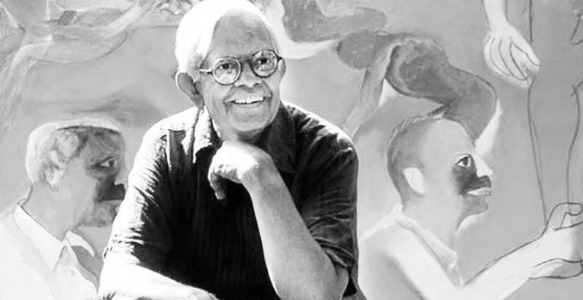
On some evenings in Baroda, people remember, you could spot a slight man in thick glasses lingering outside a modest watch shop, studying the rhythm of traffic and the tilt of signboards as if they were part of a private theatre. In that unremarkable corner of an Indian town, Bhupen Khakhar found an entire cosmos of small dramas – clerks dozing at counters, lovers on scooters, neon boards flickering half-heartedly. Out of such scenes he built an oeuvre that would quietly, and then loudly, change the way Indian modern art looked at the everyday.
Unlike many of his contemporaries who chased heroic abstraction or mythic grandeur, he stayed with the barber, the tailor, the watch repairer – people whose names rarely make it to gallery labels. In doing so, he turned the middle-class street into a painted epic, even as he wrestled – often vulnerably and explicitly – with questions of sexuality, loneliness, and faith.
For a long time, he did this after office hours as a practicing chartered accountant, painting late into the night in Baroda’s faculty studios while others had already claimed the title of “full-time artist.” That late start, the double life, the sense of arriving “sideways” into art history, remains part of what makes artist Bhupen Khakhar feel so contemporary: he paints as someone who has lived inside the systems he critiques.
Who Was Artist Bhupen Khakhar?
To answer, in the simplest terms, who is Bhupen Khakhar for the art historical record: he was an Indian painter, writer and printmaker born in Bombay on 10 March 1934, and today widely regarded as a pioneer of narrative figuration and one of India’s first “Pop” artists. A self-taught painter who first qualified as a chartered accountant, he moved to Baroda in the early 1960s to study art criticism, becoming an important voice in the Baroda Group and the larger Narrative Figurative movement.
His work is instantly recognisable: flat, luminous colour; deliberately awkward perspectives; crowded compositions in which office workers, shopkeepers, lovers and pilgrims occupy the same painted field. Critics often liken his dense, naive-yet-knowing surfaces to Henri Rousseau, while his direct treatment of queer desire and domestic interiors invites comparison with David Hockney. Yet the tonal mix – part devotional calendar, part gossip, part political theatre – is unmistakably his own.
From the late 1970s onward, Khakhar also became one of the first major Indian artists to speak publicly, and paint openly, about his homosexuality. Works such as You Can’t Please All and Two Men in Benares make erotic and emotional intimacy between men central, but without severing it from the bustle of temples, ghats, and small-town rooms. It is this weaving together of personal vulnerability and social observation that gives Bhupen Khakhar art its lasting charge.
Seen from today’s ecosystem of figurative paintings, Khakhar sits at a strange crossroads: part neighbourhood storyteller, part quiet radical inserting queer and working-class lives into the canon of Indian modernism that also includes S.H. Raza, F.N. Souza, Tyeb Mehta and others.
Quick Facts About Bhupen Khakhar
- Date of Birth: 10 March 1934.
- Place of Birth: Bombay (Mumbai), in the Khetwadi neighbourhood, in a traditional Gujarati family originally from Diu.
- Education: B.A. in Economics and Political Science; B.Com from Sydenham College, University of Bombay; qualified as a chartered accountant; later joined the Faculty of Fine Arts, M.S. University, Baroda for art criticism.
- Known For: Narrative figurative painting centred on everyday life, sexuality, and religion; often described through the lens of Bhupen Khakhar biography as India’s first pop artist and a key Baroda School figure.
- Parents: Father Parmanand Khakhar, an engineer and examiner at VJTI, died when Bhupen was four; mother Mahalaxmi Khakhar, homemaker.
- Date of Death: 8 August 2003, in Baroda, due to cancer.
Early Life and Artistic Background of Bhupen Khakhar
Khakhar grew up in Bombay’s dense Khetwadi lanes, the youngest of four siblings, in a multilingual home where Gujarati, Marathi and Hindi intertwined but English remained at a distance. His father’s early death and his mother’s ambitions pushed him toward a “stable” profession; studying commerce and qualifying as an accountant was less a calling than a compromise.
For years he worked full-time as an accountant, painting in his spare hours and reading voraciously – Hindu mythology, literature, and whatever art criticism he could find. A turning point came when he met the young poet-painter Ghulam Mohammed Sheikh in 1958, who encouraged him to come to the newly founded Faculty of Fine Arts in Baroda. There, even as a student of art criticism rather than painting, he immersed himself in studio conversations, exhibitions, and the debates that would shape what we now call the Baroda School.
His early works were experimental assemblages: deities cut from popular prints, glued onto mirrors, overlaid with graffiti-like marks. Soon, he began painting modest-sized oils of barbers, clerks and shop interiors, meticulously noting calendar images, wall colours, and the geometry of display counters. This attention to visual clutter – more “bazaar” than Bauhaus – set him apart from many modernists of his generation, including members of the progressive artists group, whose urbanity often moved in more expressionist or abstract directions.
For a platform engaged deeply with Indian paintings, Khakhar’s path is a reminder that modern Indian art did not flow in a single line from Bombay to Paris; it bent, unexpectedly, through Baroda’s classrooms, accountants’ ledgers, and small-town shopfronts.
Themes Commonly Seen in Bhupen Khakhar Paintings
1. Everyday Life
Again and again, Khakhar returns to the small-scale rituals of work and leisure: a man ironing clothes, shopkeepers under tube lights, neighbours gossiping across balconies. He paints them without sentimentality, but also without condescension; the composition gives them the dignity usually reserved for kings or gods in older oil paintings.
2. Identity
Questions of identity – caste, class, sexuality, profession – are threaded through his canvases, whether in the white shirt of a clerk or the discreet intimacy of two men standing too close at a window. The evolving Bhupen Khakhar art style uses repetition of motifs (office files, beds, shrines) to suggest how identity is both self-made and socially assigned.
3. Human Relationships
Friendship, caregiving, erotic entanglement, and intergenerational bonds appear in compositions that are dense yet emotionally legible. In some works, figures touch; in others, they look away at crucial moments, creating a choreography of connection and avoidance that feels very close to lived experience.
4. Urban Culture
From temple towns to industrial suburbs, his canvases map an India of cinema hoardings, scooters, crowded ghats and half-built structures. The city is not a glamorous skyline but a patchwork of terraces, electric wires and signage, often tilting toward the slightly unreal, echoing the sly dislocations we associate with surrealist paintings.
5. Personal Narratives
Many works are thinly veiled self-portraits – the accountant, the man on the balcony, the patient in a hospital bed – through which Bhupen Khakhar artist examines ageing, illness, and desire. Late watercolours, especially, read like diary pages, compressing scenes of pilgrimage, convalescence and erotic memory into strangely tender images.
Famous Bhupen Khakhar Paintings and Artworks
1. You Can't Please All
Perhaps the most cited of Bhupen Khakhar famous paintings, this 1981 canvas shows a life-size nude man (often read as the artist) on a balcony, watching a fable-like procession of father, son and donkey looping through a townscape below. Often read as his public coming-out, the work folds a moral tale about social opinion into an image of queer self-exposure, without offering easy resolutions.
2. Man with Bouquet of Plastic Flowers
Painted in the mid-1970s, this portrait shows a man holding an almost comically artificial bouquet against a backdrop crowded with small street dramas. The plastic roses become an emblem of aspirational romance in a working-class setting, and one of the most reproduced paintings of Bhupen Khakhar today.
3. Two Men in Benares
In this 1982 work, two nearly life-size nude male figures stand in an embrace against a nocturnal cityscape of temples and ghats. The dramatic lighting and halo-like colour around their bodies make erotic love both vulnerable and monumental – a quiet but unmistakable assertion of queer visibility in Indian art.
4. Portrait of Shri Shankarbhai
Here, a local figure – neither celebrity nor mythic hero – is painted with the gravity of an official portrait, surrounded by details that hint at his social world. It’s emblematic of Bhupen Khakhar painting as a practice of elevating the supposedly ordinary subject.
5. Janata Watch Repairing
This 1972 canvas focuses on a small watch repair shop, with its tools, posters and signage rendered in affectionate detail. Time itself becomes a character, fractured across clocks and wristwatches, while the shop’s name, “Janata,” anchors it in the language of the people.
6. De-Luxe Tailors
One of several works based on tailor’s shops, this painting captures men hunched over sewing machines, bolts of fabric stacked like chromatic columns. The cramped interior speaks to labour, aspiration and the choreography of male bodies in shared workspaces.
7. Man in Bed
In this intimate scene, a man lies in bed, sometimes read as a figure of illness or post-coital vulnerability. The domestic room – fan, sheet, side table – becomes a stage on which fear, pleasure and fatigue mingle.
8. Portrait of Pandoo
A portrait that, like many of his works, carries the name of its sitter in the title, insisting on individuality within the sea of anonymous “types.” Pandoo’s posture and surroundings do as much storytelling as his face.
9. Two Men in a Toilet
This provocatively titled work makes a cramped, private space the site of queer encounter, desire and risk. Its bluntness challenged curatorial comfort and censorship in ways that still feel raw.
10. Man Getting Out of His Car
Here the gesture of stepping out – briefcase, car door, street – encapsulates the armour of middle-class masculinity and the small theatre of arrival. It is both banal and strangely charged, a snapshot extended into painterly time.
11. Study of the Tailor's Shop
A more focused look at the interiors that preoccupied him, this study parses the geometry of tables, stools and hanging shirts in preparation for larger compositions. It shows how seriously he took observation before narrative.
12. Man Drinking at Table
A solitary figure with a glass at a table becomes a study in solitude, habit and perhaps quiet despair. As in much Bhupen Khakhar art, the emotional register is ambiguous: we are not told whether this is celebration or retreat.
13. Friends
Groups of men in casual postures, sometimes with coded intimacies, occupy this and related works. The title, deceptively simple, leaves open a spectrum from camaraderie to unspoken love.
Taken together, these works map an alternative canon of Indian figurative paintings that centres shopfronts, rented rooms and ghats rather than gods and maharajas – yet they carry a comparable intensity of presence.
Bhupen Khakhar and His Impact on Indian Contemporary Art
Khakhar’s influence is felt on several fronts: as a pioneer of narrative figuration; as a key voice in representing queer experience; and as a chronicler of India’s lower middle classes in the decades after Independence. By insisting that a watch repairer or a modest accountant’s room deserved as much painterly attention as a mythic scene, he widened the field of what could count as serious subject matter in Bhupen Khakhar art.
Internationally, his exhibitions in London, Berlin, Amsterdam and Tokyo from the 1980s onward brought visibility to Indian narrative painting at a time when abstraction still dominated many global conversations. The Tate Modern retrospective You Can’t Please All in 2016, and the presence of his works in collections like MoMA and the British Museum, confirm his position as a major modernist voice, not a regional footnote.
Within India, his openness about sexuality and the homoerotic imagery in some canvases created friction with conservative institutions, but also opened pathways for later queer artists and writers. Younger painters working with narrative figuration, kitsch aesthetics, or small-town iconography – from the Baroda circle to artists beyond – often acknowledge a debt to his visual courage and his refusal to separate politics from intimacy.
FAQs About Bhupen Khakhar
Who is Bhupen Khakhar?
Bhupen Khakhar was an Indian painter, writer and printmaker (1934–2003), associated with the Baroda School and known for narrative figurative works about everyday life, sexuality and faith.
What is Bhupen Khakhar known for?
He is known for pioneering narrative figuration in India, for being widely regarded as the country’s first Pop artist, and for his frank, often tender depictions of queer desire and middle-class existence.
What are Bhupen Khakhar's major works?
Key works include You Can’t Please All, Two Men in Benares, Man with Bouquet of Plastic Flowers, Janata Watch Repairing, and a series of portraits and shop interiors that have become landmarks of Bhupen Khakhar art.
What awards did Bhupen Khakhar receive?
Over his career, Khakhar received the Padma Shri from the Government of India, the Asian Council’s Starr Foundation Fellowship, and the Prince Claus Award, among other honours.
