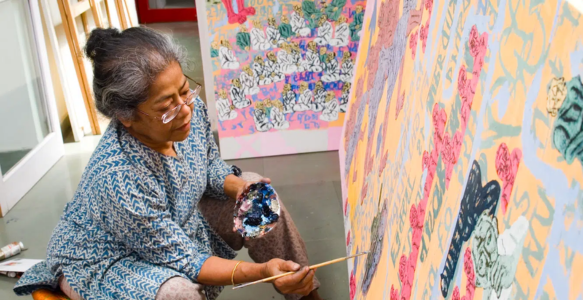
Arpita Singh is one of India’s most influential contemporary figurative painters. She is known for her vibrant, women-centred canvases that braid domestic life with myth, memory and political unease. Her work has become a touchstone for collectors and younger artists trying to understand how everyday objects, textile patterns and emotional weather can become a language of their own.
For viewers encountering Arpita Singh’s art for the first time, the surprise is often its emotional core: the colours are candy-bright, but the stories beneath can be devastating. War, loss, ageing, loneliness held gently inside a domestic frame. It’s this contrast that has made her a giant of Indian modernism and a pivotal figure for anyone asking who is Arpita Singh in the story of contemporary Indian painting.
Who is Arpita Singh?
Arpita Singh was born on 22 June 1937 in Baranagar, Bengal Presidency (now West Bengal), and moved with her mother and brother to Delhi in 1946, just before Independence. She studied at the School of Art, Delhi Polytechnic, from 1954 to 1959, graduating with a Diploma in Fine Arts. This period grounded her in both modernist experimentation and traditional Indian aesthetics.
After college she worked with the Government of India’s Cottage Industries Restoration Programme and later as a textile designer at the Weaver’s Service Centre, where she encountered weavers, embroidery traditions and regional craft idioms at close quarters. Those years left a permanent mark as the dense patterning, stitched rhythms and kantha-like surfaces we see in many an Arpita Singh painting echo this immersion.
In 1962, she married fellow painter Paramjit Singh; their home in Delhi has long been a modest but important node in the city’s art ecology, extending later to their daughter, the late artist Anjum Singh. Over six decades, she has worked largely away from spectacle, building an oeuvre that moves from early watercolours to richly worked oils, yet always circling back to the inner lives of women, the fragility of bodies and the absurdities of history.
If you want to understand about Arpita Singh, begin with the small objects she paints again and again, a flowerpot, a bedspread, a saucepan. They are the vocabulary through which she writes an unwritten autobiography of middle-class Indian womanhood.
Arpita Singh as an Artist in Indian Contemporary Art
1. Artistic Journey and Career Highlights
Emerging in the 1960s, Singh belonged to a generation that included artists like Bhupen Khakhar, Nalini Malani and Gulammohammed Sheikh. They were painters who shifted Indian modernism towards narrative, personal and often political terrains. Her first solo exhibition, held in 1972, announced a voice that was intimate yet adventurous, and over the decades her work has appeared in key museums and biennales, from the Royal Academy in London to the Centre Pompidou in Paris.
Alongside peers such as S.H. Raza, F.N. Souza and Tyeb Mehta, who pushed abstraction and expressionism, Singh carved a distinct path within figurative, story-based painting, aligning more closely with artists like Bhupen Khakhar or, globally, Frida Kahlo and Paula Rego. Her retrospective at the Kiran Nadar Museum of Art, spanning six decades of practice, underscored how steadily she has evolved her visual language while staying rooted in painting as a medium.
2. Contribution to Modern Indian Art
Arpita’s most significant contribution is arguably her insistence that the “small” world of domestic interiors, ageing bodies and household clutter is worthy of monumental treatment. Long before feminist art discourse became mainstream in India, Arpita Singh’s art placed middle-aged and elderly women, often invisible in public culture, at the centre of large, ambitious canvases.
Her narrative figuration has influenced a younger generation of painters and photographers who use the home as a stage for wider social anxieties, much as Artist Amrita Sher-Gil did earlier with works like Three Girls. In the ecosystem of contemporary art paintings, Singh’s canvases act as quiet counterpoints to spectacle-driven work, showing how politics can reside in a saucepan or an aircraft sketched over sleeping bodies.
3. What Makes Arpita Singh’s Art Unique?
Formally, her paintings are dense, almost cartographic: figures, furniture, vehicles, flowers and stray numbers float in shallow space, often arranged in grids or patchwork fields that recall textiles and miniature painting. Her palette of pinks, chalky blues, acid greens, and sudden reds is at once playful and unsettling, making it hard to separate celebration from anxiety.
Equally distinctive is her line: deceptively naive, sometimes wavering, it gives the impression of doodles in a diary rather than “high art”, even when the subject is war, displacement or death. This combination of seriousness and informality is what makes an arpita artist canvas instantly recognisable and deeply human.
Characteristics of Arpita Singh Paintings
1. Vibrant & Bold Colour
Colour is often the first thing that hits you in artist Arpita Singh paintings. The sugary pinks, powder blues, lemon yellows, all layered into a surface that feels both playful and slightly off-kilter. In monumental works like Wish Dream (1993), a 16-panel mural, this palette carries a field of floating flowers, bedspreads, aircraft and nun-like figures, turning the wall into a feverish sky.
In more contemplative works such as The Eternal Repose (2000), soft blues and pinks surround a reclining woman, creating a meditative atmosphere that complicates the painting’s themes of mortality and rest. Even when the subject is bleak (as in war-inflected canvases from the 1990s) her colours refuse pure darkness, insisting on beauty as a form of resistance.
2. Women-Centric Themes
From My Mother to the many “Munna Apa” canvases, women, often middle-aged, sometimes elderly anchor her narratives. They water gardens, sit in kitchens, lie in beds, or stand poised on thresholds, carrying the weight of family, memory and conflict in their bodies.
In a painting like Devi Pistol Wali (1990), a five-armed woman in a white sari stands atop a man in a fetal position, one hand adjusting her pallu, another holding a gun. It’s a startling inversion of power drawn from goddess iconography but set in a concrete-grey, contemporary space, part satire, part wish-fulfilment. Her work sits comfortably in any conversation about figurative painting that reimagine the female subject as agent rather than ornament.
3. Use of Symbolic Motifs
Boats, planes, cars, flowers, numbers, guns, clay birds, Arpita’s world is populated by recurring motifs that shift meaning from canvas to canvas. In 31 Days of December, small vignettes arranged like a calendar record the emotional weather of an entire month, suggesting time as both repetitive and full of rupture.
Elsewhere, as in Wish Dream or Man on White Tiger with Clay Birds (1991), vehicles and animals become carriers of desire, danger or escape, while ornamental borders recall quilts, kantha embroidery or miniature painting frames. It’s a symbolism closer to folk art than to Western abstract art paintings, yet her layering of these motifs pushes them towards a kind of narrative abstraction.
Famous Paintings of Artist Arpita Singh
Before diving in, it helps to remember that many of Arpita Singh’s popular paintings exist in series - household, kitchen, garden, calendar, each revisiting the same figure or space with small shifts. Seeing them in reproduction is one thing; encountering the physical, layered surfaces of these authentic paintings is quite another.
1. Munna Apa's Household
Painted in 1987, Munna Apa’s Household shows the interior world of a recurring character, Munna Apa, rendered in warm, patterned washes that suggest both intimacy and slight claustrophobia. Everyday objects crowd the space, turning the “household” into a kind of psychological map rather than simple documentation.
2. Wish Dreams
The monumental mural usually titled Wish Dream (1993) unfolds across sixteen canvases, populated by women, vehicles, bedspreads and floating texts inspired partly by a Tibetan play. When auctioned online by Saffronart, it set a world record for an artwork sold at any online auction and the highest price achieved by an Indian woman artist at the time.
3. My Mother
In My Mother (1993), an elderly woman sits amidst domestic objects - flowers, utensils, textiles bathed in a tender, almost melancholic light. The painting has become emblematic of Singh’s ability to turn the most ordinary room into an arena of memory, care and impending loss.
4. Devi Pistol Wali
Devi Pistol Wali (1990) depicts a many-armed woman in a white sari, one hand holding a mango, another a pistol aimed at a shrinking male figure with sword and shield. Surrounded by cars, plants, children and a strip of sky with planes and flowers, she stands like a modern Durga, part housewife, part avenger.
5. Munna Apa’s Garden
In Munna Apa’s Garden, women, windows and flowering plants share a saturated, almost theatrical outdoor space. The garden feels less like nature and more like an extension of the home. A zone where private thoughts have briefly stepped outside into the light.
6. Munna Apa's Kitchen
Munna Apa’s Kitchen (1994) is a large oil on canvas where stoves, vessels, tables and potted plants jostle around the central figure, flattening depth into a patterned field. Christie’s has described it as a “magical world where inanimate objects come to life”, echoing kantha embroidery in the way forms are stitched together.
7. The Ritual
In The Ritual (1993), a group of women gather in an ambiguous ceremony - perhaps a wedding, perhaps a puja, where red and gold tones heighten both celebration and unease. Singh leaves the exact nature of the ritual unclear, allowing viewers to project their own memories of collective, often gendered, gatherings.
8. 31 Days of December
31 Days of December (1990) arranges small scenes in a grid, each square a fragment of daily life over a month. Some vignettes are mundane, others ominous, turning the calendar format into a reflection on time, repetition and the unpredictability of events.
9. The Eternal Repose
In The Eternal Repose (2000), a reclining female figure is surrounded by floating flowers and delicate patterns, suggesting sleep, death or a moment of deep inwardness. The soft, cooling palette lends serenity to a subject that could easily tip into melodrama.
10. Man on White Tiger with Clay Birds
Man on White Tiger with Clay Birds (1991), now in the Museum of Art & Photography, Bengaluru, shows a figure astride a white tiger, accompanied by fragile clay birds. The improbable combination of power and fragility: tiger and clay creates a fable-like tension typical of Singh’s storytelling.
11. My Lollipop City
My Lollipop City: Gemini Rising (2005) is a large oil on canvas later reproduced as a limited-edition print, a chaotic urban-scape where bright candy colours collide with images of women navigating contemporary India. Commentators have read it as a response to escalating violence against women. sugary on the surface, edged with threat.
Taken together, these works show how Arpita Singh's famous paintings oscillate between the intimate (a kitchen, a mother’s room) and the epic (goddess-figures, tigers, calendars of an entire month). For many viewers, the entry point is personal: a memory of a grandmother’s house, a news headline about war or assault before the formal sophistication of the painting slowly reveals itself.
For us, Arpita Singh artist is less a “genre” and more a way of paying attention to the choreographies of daily life, to how global events bruise the quietest corners of a home. Her career suggests that staying with one’s obsessions, rather than chasing trends, can be a radical act.
If you’re mapping Indian modernism, it’s easy to plot the big, dramatic gestures - Progressive Artists’ Group, abstraction, monumental public art. Arpita Singh sits in the quieter margins of that map, yet her influence runs deep: through students, through younger women artists, and through anyone who has ever tried to paint a kitchen and ended up painting the world.
FAQs About Arpita Artist
1. What is Arpita Singh most known for?
Arpita Singh is best known for her narrative, women-centered paintings that blend memory, folklore, and social commentary. Her recurring symbols, such as boats, flowers, numbers, and vehicles, make her work instantly recognizable.
2. What style of painting does Arpita Singh use?
Arpita Singh is known for a figurative modernist style shaped by Indian miniature painting, folk art, and textile patterns. Her works are narrative, layered, and often feel close to abstraction through repetition and detail.
3. What awards has Arpita Singh received?
Arpita Singh has received major honours including the Padma Bhushan, the Kalidas Samman, the Parishad Samman, and a Lalit Kala Akademi Fellowship. She has also been widely recognised for her contribution to Indian art.
