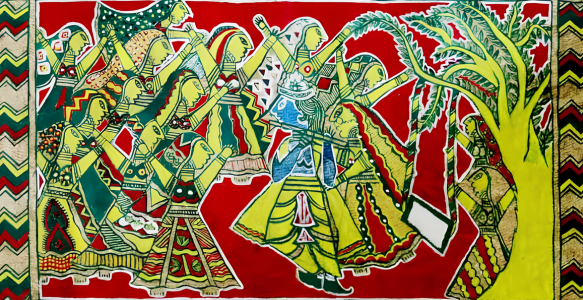
On an August morning in Bhagalpur, the angavastram-clad priest bends over a long strip of paper, its borders already alive with tiny triangles, leaf patterns, and undulating serpents. Women hum old Angika songs as they place painted boxes- manjusha- near the altar for Bishahari Puja, each side narrating a different episode from the Bihula legend. The scene feels halfway between a ritual and a storyboard rehearsal: every panel a pause in the narrative, every serpent a sentence.
This is where Manjusha art first reveals itself- not as “decorative folk painting”, but as a living script, passed from storyteller to painter to devotee. In the wider conversation about Indian folk traditions, it often sits in the shadow of Mithila or Madhubani. Yet the manjusha painting of Bhagalpur carries something remarkably cinematic: a commitment to sequencing, to the slow unfolding of a myth in frames, almost like an Anga-region cousin to Japanese emakimono scrolls or to the visual storytelling of a Jangarh Singh Shyam or a S.H. Raza, albeit in a very different idiom.
For a curator, encountering Manjusha for the first time feels slightly disorienting. You read it more than you “look” at it. The serpents coil not just as motifs but as narrative devices, guiding your eye across the surface with a rhythm that recalls graphic novels, yet grounded firmly in Bhagalpur’s ritual life and women’s storytelling circles.
What is Manjusha Painting?
Manjusha painting is a narrative folk art from the Anga region- today centred on Bhagalpur in Bihar- that visualises the Bihula–Bishahari serpent-goddess legend through boxed compositions, scrolls, and murals. The very word manjusha comes from Sanskrit and means “box” or “casket”, referring to the temple-shaped ritual boxes made of bamboo, jute, and paper that were once painted with these stories.
If you’ve ever wondered what is manjusha art beyond the quick description of “snake painting”, it is essentially a ritual storytelling system: line-drawn figures shown in X-shaped postures, rimmed by dense borders, and coloured almost exclusively in pink, yellow, green and black. The manjusha art of Bihar is deeply tied to Bishahari Puja; the paintings are not generic mythological scenes but specific episodes, characters, and symbols anchored to that local folklore.
Unlike Madhubani, which often spreads rhythmically across the surface, Manjusha art form relies on panels and seriality, closer to a strip of cinema frames than to an all-over pattern. Human figures, snakes, boats, and celestial bodies all operate like recurring cast members in a theatre piece, each with a fixed visual code that viewers in Bhagalpur intuitively recognise.
In curatorial conversations, Manjusha frequently surfaces when we think about “reading order” in folk painting. It sits interestingly beside narrative Pattachitra scrolls and even contemporary graphic storytelling, making it a fertile reference when we commission younger artists experimenting with sequential visual essays rooted in regional myth.
We often find Manjusha more “legible” to local devotees than to urban viewers trained on modernism. That gap- between ritual literacy and art-world literacy- feels important; as curators, we’re still learning how to present the work without flattening it into mere “folk aesthetics”.
History and Origin of Manjusha Paintings
1. Why Manjusha is Called India’s Only Sequential Folk Art
Manjusha art history is inseparable from the claim that it is India’s only folk painting tradition built entirely as a sequential narrative- each panel following another to tell a continuous story. Scholars and local archives trace manjusha art origin to at least the 7th century in the Anga region, though its visible flourishing occurred between roughly 1931 and 1948 when documented sets of paintings and boxes began to be systematically collected.
Textual and field research consistently describe Manjusha as a scroll and box art that must be “read” in order, much like a storyboard, which sets it apart from other Bihar traditions that may include narrative but not with this strict panel-by-panel structure. Even state tourism and GI-tag documentation highlight this sequentiality as the defining feature of manjusha art of Bihar.
2. How the Bihula–Bishahari Legend Influenced the Art Form
At the core lies the Bihula–Bishahari story: Bihula, whose husband Lakhindar dies from a snakebite, undertakes a perilous river journey and ultimately negotiates with the snake goddess Bishahari (also known as Manasa) to restore his life. In manjusha painting, each key moment- wedding night, snakebite, boat journey, confrontation with the goddess- is turned into a distinct visual episode, often framed by serpent-borders that echo danger and protection simultaneously.
Every major character carries a symbol: Bishahari’s sisters are marked by combinations of lotus, myna bird, rising sun, or kalash alongside snakes, so that even a non-literate viewer in Bhagalpur can identify which goddess appears where. In that sense, Manjusha functions as a visual theology of the Anga region, mapping grief, devotion, and negotiation with the divine onto a riverine landscape of boats, waves, and celestial witnesses.
3. Three Formats: Painted Boxes, Narrative Scrolls & Wall Murals
Historically, the earliest form appears to be the temple-shaped manjusha boxes, with eight pillars and painted surfaces, used to store ritual items during Bishahari Puja. Over time, the same visual language moved onto long paper or cloth scrolls, unfurled during storytelling sessions or festivals like a pictorial epic. Wall murals inside homes or near temporary shrines extended the vocabulary further, allowing larger-scale depictions of boats, serpents, and processional scenes.
Today, you might see a single contemporary Manjusha work compress several sequential registers on one canvas, but older pieces often retain the clear segmentation of box-side, scroll-panel, and wall-section. This is where manjusha painting of Bihar quietly converses with global traditions- from Mexican retablos to Japanese emakimono- while staying deeply local in content and function.
When we hang a Manjusha scroll next to a Madhubani panel from the same region, the contrast in narrative strategy is striking: where Madhubani densifies space, Manjusha elongates time. For exhibition design, this means thinking about eye-travel across the wall almost like editing a film sequence.
The “only sequential folk art” label is powerful, but I treat it cautiously. Oral epics in other regions also work sequentially; what feels unique here is how uncompromisingly the painting itself demands to be read in order.
Why Traditional Manjusha Uses Only 4 Colors
Traditional manjusha art painting is immediately recognisable by its limited palette- fluorescent pink-red, yellow, green, and black- usually on a white ground. Many practitioners emphasise that only three sacred colours (pink, yellow, green) were historically used, with black reserved for outlines or background, yet in practice all four function as a tightly controlled chromatic grammar.
1. Pink-Red
Pink, often tipped towards a warm red, is associated with love, care, feminine energy, and victorious devotion- qualities embodied by Bihula herself. Artists use it extensively for garments, flesh tones of key female figures, and emotionally charged scenes, where the colour reads almost like an inner glow rather than mere decoration.
2. Green
Green stands for nature, fertility, happiness, and new beginnings, and is frequently deployed in borders, foliage, and the serpents’ bodies. In many older pieces, the first sketch is done in green rather than black, giving the entire composition a vegetal, riverine feel before any other colour is added.
3. Yellow
Yellow symbolises prosperity, divine radiance, and auspiciousness; it often fills backgrounds, halos, and the bodies or auras of goddesses. In some textual accounts, yellow bands frame the painting after the border motifs are done, sealing the image like a ritual enclosure.
4. Black
Black in Manjusha is less about gloom and more about grounding: it defines outlines, anchors forms against the white base, and occasionally becomes the background against which the three bright colours vibrate. Because certain traditions consider pure black and blue less auspicious, their use is measured and mostly structural rather than symbolic.
Seen up close, the flat fills and hard-edged lines echo the graphic directness of early printmaking or comic art. For younger viewers familiar with zines and indie comics, this restricted palette actually makes manjusha art bihar feel surprisingly contemporary.
Limitation here is generative. Much like how Ram Kumar or F.N. Souza could mine entire emotional worlds from a narrow set of hues, Manjusha painters show how three brights and a black can hold grief, faith, humour, and everyday life without ever feeling chromatically starved.
Essential Motifs of Manjusha Art Paintings
1. Nahut/Serpent
The serpent- often looping and ladder-like- is both central character and protective frame, earning Manjusha its popular name as “snake painting”. Snakes in this context embody Bishahari’s power, the constant threat of death by bite, and the possibility of divine intervention.
2. Champa Flower
Champa blossoms appear as stylised, repetitive motifs, associated with fragrance, devotion, and sometimes specific Bishahari sisters. They soften compositions filled with weapons and serpents, suggesting an undercurrent of tenderness in a story otherwise marked by loss.
3. Kamal/Lotus
Lotus motifs, often linked to Padmavati among the Bishahari goddesses, stand for purity rising from troubled waters. In visual terms, they punctuate the river journey with pauses of stillness and grace.
4. Maina Bird
The maina bird is emblematic of Mynah Bishahari and symbolises communication, voice, and sometimes gossip or community memory. Its presence can feel like a small, watchful witness to the unfolding drama.
5. Sun & Moon
Sun and moon appear as twin celestial witnesses, often held by certain goddesses or placed above the narrative strip. They signal cosmic time and moral visibility: nothing Bihula endures is unseen.
6. Elephant, Turtle & Fish
Elephants, turtles, and fish anchor the story firmly in the riverine ecology of the Ganga near Bhagalpur. They also recall broader Indian cosmologies where these creatures bear worlds, guide journeys, or signify fertility and abundance.
7. Kalash Pot
The kalash carries amrita, blessing, or ritual water and appears frequently in Bishahari’s hands. It doubles as a promise of restored life and as a reminder of the precariousness of such grace.
8. Arrow-Bow
Bows and arrows connect to martial resolve and to goddesses like Jaya Bishahari, who is shown with weaponry alongside a snake. They sharpen the visual tension inside compositions that might otherwise read only as devotional.
9. ShivLing
The Shivling roots the narrative within broader Shaivite cosmology- after all, some legends begin with Shiva’s hair falling into a lake, creating the first serpents of the cult. Manjusha thereby holds both local folklore and pan-Indic mythology in a single frame.
10. Boats
Boats are the most literal motif: they carry Bihula and her husband’s corpse along the river towards divine negotiation. In repeated depictions, the same boat becomes a metaphor for perseverance, bargaining, and an almost stubborn tenderness.
When we build a wall around motifs, it becomes clear that manjusha art painting techniques aren’t only about line and colour, but about indexing a whole cosmology in a finite set of images. It’s a visual archive of Anga’s anxieties and aspirations coded into serpents, birds, and boats.
We’re struck by how little “blank” space these works tolerate; every inch tends to be charged with meaning. In a time when minimalism is often equated with sophistication, Manjusha feels unapologetically maximal, yet conceptually tight.
Manjusha Paintings FAQs
1. What is Manjusha painting and why is it unique?
Manjusha painting is a folk art tradition from Bhagalpur, Bihar, known for its sequential storytelling, snake motifs, and distinctive four-colour palette.
2. What is the Bihula–Bishahari story in Manjusha?
It tells the story of Bihula's journey to restore her husband Lakhindar's life with the help of the serpent goddess Bishahari.
3. Why does Manjusha use only 4 colors?
Traditional Manjusha paintings use pink, yellow, green, and black to create a distinctive and symbolic visual language.
4. What does the snake symbol represent in Manjusha art?
The snake represents the serpent goddess Bishahari, as well as protection, danger, and spiritual power.
5. Is Manjusha the same as Madhubani painting?
No, Manjusha painting focuses on the Bihula–Bishahari legend, while Madhubani painting covers a wider range of themes and styles.
6. Who are the famous living Manjusha artists today?
Notable contemporary Manjusha artists include Chakravarti Devi, Nirmala Devi, Manoj Pandit, and Sujit Kumar.
7. How long does it take to create one Manjusha painting?
A Manjusha painting can take anywhere from a few days to several weeks, depending on its size and complexity.
For curators, manjusha art information today also includes its post-2021 GI-tag life: it has become a source of livelihood and self-reliance for women’s collectives in Bhagalpur, as well as a case study in how traditional forms negotiate design collaborations without losing their narrative spine.
As manjusha art of Bihar moves into textbooks, textiles, and museums, the challenge is to ensure that the Bihula–Bishahari story and local ritual context remain legible. Otherwise, we risk holding only a beautiful skin of serpents and borders, with the living myth quietly drained away.
