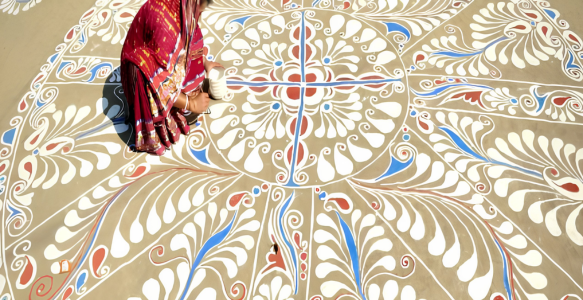
On the evening of Lakshmi Puja in a small Bengali town, the electricity goes out for a moment and the courtyard slips into darkness. When the lights flicker back, you notice what was quietly taking shape all along: a cool, white lotus opening on the damp clay floor, two tiny footprints leading towards the doorway, an owl with wide, alert eyes, all drawn in liquid rice paste by an elder of the house. It will be washed away by morning, but for one night, this fragile “drawing underfoot” becomes the most important artwork in the home - offering, threshold, and welcome all at once.
For anyone wondering what is alpana art, this is where to begin: with that intimate, almost whispered interaction between hand, earth, and ritual. Unlike indian art paintings displayed in galleries, Alpana lives close to the ground and close to daily life - part of the same ecosystem that also produced rangoli in Maharashtra and kolam in Tamil Nadu, part of the same ecosystem that also produced kolam in Tamil Nadu and broader traditions of South Indian art. As curators, we often encounter contemporary artists borrowing these circular diagrams, fish and lotus motifs, or even the idea of an “impermanent drawing” as a conceptual device, echoing what global artists like Yayoi Kusama or Sol LeWitt did with pattern and wall-drawing in very different contexts.
What Is Alpana Art?
Alpana (or Alpona/Alpona) is a Bengali folk art of floor and wall painting, made primarily with a white paste of ground rice mixed with water and sometimes accented with natural colors. It is practiced across West Bengal and Bangladesh, especially during religious festivals, household rituals, and rites of passage such as marriages or sacred vows (vrat). The designs are drawn freehand - traditionally by women - using fingertips, a cotton-wrapped twig, or a simple cloth, directly on mud, clay, or red-ochre-coated floors.
Though fragile, these traditional alpana designs are dense with meaning: they can be read as visual prayers, protective diagrams, and seasonal markers related to harvest, fertility, and household prosperity. Scholars describe alpana floor painting as an agrarian ritual art: motifs like rice stems, fish, and ploughs are not “decorative extras” but condensed images of livelihood and survival. Its imagery of harvests, courtyards, and daily rituals shares affinities with village life painting traditions. Unlike permanent murals, Alpana is meant to be ephemeral; it accepts erasure as part of the work, a quality contemporary installation artists often find deeply resonant.
From a cultural lens, Alpana is best understood not as a single object but as a practice: a way of cleaning, preparing, and sacralising a space before something significant happens. In the alpana art of West Bengal, this might mean the threshold before Lakshmi Puja, the courtyard for Durga Puja, or the corner of a room where a child’s initiation ceremony will be held. Many of these motifs continue to appear in contemporary spiritual and mythological paintings.
In studio visits, we often see younger artists from Kolkata and Dhaka translating bengali alpana art onto canvas, textiles, or digital prints - flattening the ritual into an image, but also expanding its reach into global contemporary discourse.
The risk with alpana art information online is that it often reduces Alpana to “pretty patterns.” For a gallery context, the challenge is to retain its ritual charge even when the work leaves the courtyard and enters a white cube.
Origins & History Of Alpana Paintings
1. Meaning and Etymology of the Word "Alpana"
Most researchers trace the word Alpana to the Sanskrit alimpana or alimpan, meaning “to plaster, to coat, to anoint,” pointing directly to the act of coating a floor or wall before drawing. Some folklorists suggest a parallel root in ailpona - the making of ails (embankments), suggesting that drawing boundaries of protection in pigment and raising physical embankments against flood were once part of the same mental world. That double meaning - both coating and enclosing - is a subtle but powerful key to alpana art history.
2. Pre-Aryan And Vedic Roots
Floor-painting traditions across India are often linked to pre-Aryan agrarian rites and later Vedic ritual descriptions of thresholds delineated with paste and powders. Literary and archaeological hints suggest that some form of ritual floor decoration existed more than two thousand years ago, even if the specific term Alpana appears later. In Bengal, the visual vocabulary absorbed local animist and fertility symbols - fish, serpents, rice plants - long before rigid temple iconography crystallised, making alpana bengali folk art an archive of layered belief systems.
3. Santiniketan Movement and the Revival of Alpana Art
By the late nineteenth and early twentieth centuries, urban Bengal’s elite had begun to look down on village ritual arts as “backward.” It took figures like Abanindranath Tagore and the broader Santiniketan circle around Rabindranath Tagore to look again, seeing in these practices a modern, graphic language rooted in the soil. At Visva-Bharati, teachers such as Nandalal Bose encouraged students to study Alpana and other folk forms, not as craft curiosities but as living sources for a renewed Indian modernism - just as European modernists were absorbing African and Oceanic forms. Shantiniketan-style Alpana became looser, more expressive, taking motifs like birds, sun, and fish into experimental campus murals and floor pieces that blurred the boundary between folk ritual and avant-garde art.
When we encounter Ram Kumar, S.H. Raza, or F.N. Souza, we rarely say “Alpana” out loud, yet many of their circular diagrams, seed-like units, or field-structured canvases echo the kind of spatial thinking found in alpana painting and related floor arts.
The “folk–modern” bridge built at Santiniketan is still under-theorised; we often credit European abstraction but forget how deeply artists were looking at a village Alpana before they looked at Kandinsky.
Materials Used In Alpana Art
1. Rice Powder
At the heart of Alpana is rice - soaked, ground, and thinned into a milky paste whose faint sheen catches lamplight. Using rice connects the drawing directly to food, harvest, and the invisible beings (ants, insects) to whom part of the offering is dedicated.
2. Diluted Rice Paste
The rice paste is adjusted to a medium consistency so that it flows smoothly when pinched between fingers, allowing both hairline curves and thicker strokes. In some regions, a cooked-rice paste (biswar) is used for certain regional variants like Aipan.
3. Charcoal
Burnt wood or charcoal may be used sparingly for outlines, corrections, or dark accents, especially in wall-based Alpana experiments influenced by art schools.
4. Burnt Earth
Red ochre or burnt earth (geru, lal mitti) is often used as the ground on which white Alpana is drawn - either as a full coating on the floor or as a patch under the design. The chromatic contrast of warm red and cool white is one of the signatures of many regional forms related to Alpana.
5. Vermillion
Vermilion (sindoor) mixed with water or lime adds crimson accents - dots at intersections, halos around footprints, or framing bands - especially in Lakshmi and marriage-related designs.
6. Flower Petals
Once the drawing is complete, it may be scattered with marigold petals, bel leaves, or other local flora, adding colour, fragrance, and a sense of fullness before the ritual begins.
7. Grains
Whole rice grains, lentils, or wheat may be placed at key nodes in the pattern, reinforcing the link between drawing, nourishment, and the household’s stored abundance.
Watching an elder prepare paste, strain it, test it between finger and thumb, you realise how much of alpana art origin is tactile knowledge - barely verbalised, passed down like a kitchen recipe rather than an academic syllabus.
When a contemporary artist replicates Alpana in acrylic on canvas, something crucial is lost: the edible, fragile, insect-inviting nature of the original medium. That loss can be productive - but it must be acknowledged.
Common Alpana Art Motifs And Their Meaning
1. Goddess Lakshmi's Feet, Lotus And The Owl
Lakshmi’s small feet - two opposed footprints walking into the house - are among the most recognisable traditional alpana designs, symbolising the goddess’ arrival and the wish that she stay. The lotus beneath or around them stands for purity arising from muddy waters, while the owl is Lakshmi’s somewhat unsettling vehicle, alert to both opportunity and danger.
2. Sun, Moon, Fish And The Conch (Shankha)
The sun and moon anchor Alpana to cosmic time, turning a small courtyard into a microcosm of sky and earth. Fish evoke fertility, water, and Bengal’s riverine life-world themes that continue to inspire contemporary animal paintings; the conch (shankha) signals auspicious sound, often associated with Vishnu and protective vibrations at thresholds.
3. Nature Motifs: Rice Stem, Betel, Plough And Creepers
Rice stems, betel leaves, ploughs, and winding creepers visualise the cycle of sowing, growth, and harvest. They also make visible the labour - often women’s, often unpaid - behind the prosperity invoked at festivals.
Many contemporary prints labeled about alpana paintings pick only the lotus or the footprints; in studio conversations we often encourage artists to look again at the less “pretty” motifs - the plough, the ladder, the snake - as carriers of more complex stories. These motifs continue to inspire contemporary paintings of nature.
Motifs travel faster than meanings; an owl or fish repeated on Instagram can lose its charge. Our work is partly to reattach these floating images to their original narrative circuits.
Three Core Types Of Alpana Paintings
1. Circular Alpana
Circular or mandala-like Alpana radiating from a central lotus or dot are common on courtyards and in front of home shrines. They organise space concentrically, guiding movement and gaze towards the centre where a lamp, idol, or offering may sit.
2. Panel Alpana
Panel Alpana runs horizontally - along verandahs, house fronts, or as bands on walls - often combining narrative and symbolic motifs. Santiniketan-inspired artists in particular have used panel formats to incorporate birds, human figures, and even lines of Rabindrasangeet text into extended friezes.
3. Geometric Wall And Floor Strips (Dwar Patta)
Geometric strips at thresholds (dwar patta) frame entrances with ladders, triangles, chevrons, and dotted bands, acting as both welcome and protective barrier. These resemble architectural mouldings drawn in lime rather than carved in stone.
When we translate Alpana into exhibition design, alpana floor painting sometimes becomes a wayfinding device - the circular Alpana as gathering node, the dwar patta as visual cue for transition between rooms.
I often think of these three as “cosmos, story, and boundary.” An artist who borrows Alpana vocabulary without understanding which of these they’re invoking runs the risk of flattening it into mere ornament.
Different Variations of Alpana Paintings
1. Aripan (Bihar)
In Bihar, a closely related ritual floor art is known as Aripan, made with rice paste on cow-dung or clay floors, often for vrata rituals and life-cycle ceremonies. Motifs overlap - lotus, footprints, geometric diagrams - but the compositional logic and local myths give it a distinct personality.
2. Aipan (Uttarakhand & Odisha)
Aipan in the Kumaon region of Uttarakhand (and related practices in parts of Odisha) uses a red-ochre ground with white rice-paste designs, strongly associated with entrances, puja rooms, and ritual plinths. Scholars note that Aipan, Aripan, and Alpana are often mentioned together as regional variants of the same broad family of ritual floor arts.
3. Alpoona (Bengal)
“Alpoona” or “Alpona” are alternate spellings used in Bengali sources for Alpana itself, especially in rural West Bengal and Bangladesh. In everyday speech, these variations rarely signal strict distinctions; they simply reflect linguistic drift around a living practice.
In conversations on alpana art of west bengal, we often widen the map to include Aripan and Aipan, so audiences can see how one core idea - threshold drawing with rice - fans out in different ritual and visual directions across the subcontinent.
For me, it’s less useful to police terms than to trace continuities: the same fingertip line, the same rice offering, appearing under different names in different dialects of devotion.
FAQs About Alpana Art
1. What is Alpana art and where did it originate?
Alpana is a traditional folk art of decorative floor and wall paintings that originated in Bengal, particularly in West Bengal and Bangladesh.
2. What is the meaning of the word "Alpana"?
The word "Alpana" is derived from the Sanskrit term alimpana, meaning to decorate, coat, or adorn a surface.
3. What materials are traditionally used to make Alpana?
Traditional Alpana designs are created using rice paste, natural pigments, vermilion, turmeric, and other organic materials.
4. What is the difference between Alpana and Rangoli?
Alpana uses rice paste and is rooted in Bengali traditions, while Rangoli typically uses coloured powders and is practiced across many parts of India.
5. Which festivals and occasions are Alpana designs used for?
Alpana designs are commonly created during Durga Puja, Lakshmi Puja, Diwali, weddings, and other religious ceremonies.
