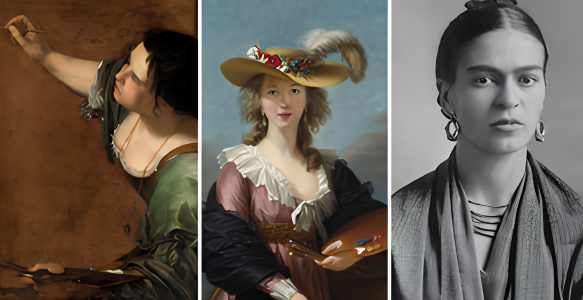
On some evenings, museum halls feel like they’re humming with conversations between artists who never met. Frida Kahlo looking across centuries at Sofonisba Anguissola; Amrita Sher-Gil exchanging a quiet nod with Hilma af Klint. The walls are crowded with genius, and yet, for a long time, most of these names were footnotes rather than headlines in art history.
This list brings together famous female painters from Mexico City to Kolkata, New York to Tokyo - women who insisted on painting their worlds even when institutions, academies and galleries hesitated to admit them.
For an Indian viewer, there is a particular jolt of recognition in seeing Amrita Sher-Gil’s earthy figuration in the same mental frame as Georgia O’Keeffe’s desert bones or Yayoi Kusama’s hypnotic dots. These are not just “women’s stories”; they are the stories through which modern and contemporary art itself was built.
As we move through these famous women painters in history, keep an eye on how each one bends colour, gesture and symbol to claim space - for herself, for her community, and often for those who rarely find themselves on the walls of museums.
Why Female Painters Are Important in Art History?
Art history has often behaved like a badly edited catalogue: whole chapters on “masters”, a rushed appendix on women. Yet from Sofonisba Anguissola in the Renaissance to Berthe Morisot among the Impressionists and Amrita Sher-Gil in modern India, female painters & artists have been central to how we see portraiture, domesticity, spirituality and politics.
Many so‑called famous female painters in history carved careers within systems that barely recognised them as professionals - Sofonisba as a court painter in Spain, Artemisia Gentileschi in the Baroque courts of Italy and England, Morisot exhibiting with the Impressionists despite resistance from family and critics. Their presence complicated who could be an artist and what subjects counted as “serious” art, bringing intimate interiors, mothers and children, or women’s labour into the centre of the canvas.
In an Indian context, pioneers like Sher-Gil, B. Prabha and Arpita Singh widened the visual vocabulary of Indian art, turning fisherwomen, small‑town brides, aging female bodies and dense cityscapes into primary subjects rather than background detail. When we think of famous lady painters today, we’re really thinking about artists who re-wrote the rules.
Their impact is not only aesthetic but infrastructural: from Faith Ringgold’s story quilts that fuse activism and imagery, to Nalini Malani’s video installations that reimagine what painting can be in the age of moving image, these iconic female painters have reshaped mediums themselves. The story of famous female painters in history is, quietly, the story of modern art becoming more porous, more political, and more human.
In studio visits across Delhi, Baroda and Mumbai, we often hear women artists talk about “permission” - the moment they first saw themselves in an artwork by another woman. Those encounters are not just inspirational; they are infrastructural, seeding new generations of popular female painters who understand they are part of a long, demanding lineage.
20 Most Famous Female Painters of All Time
This is not a definitive canon but a living map of most famous female painters, spanning centuries, geographies and styles. Think of it as a conversation between famous women painters, each insisting on her own relationship to the body, the divine, the city, the countryside, the dream.
1. Frida Kahlo
Frida Kahlo’s self-portraits - often frontal, unflinching, framed by leaves, animals and thorn necklaces - turn her body into a site of myth and medicine. A bus accident, chronic pain, multiple surgeries and miscarriages became part of her visual vocabulary, rendered in searing colour rather than sentimentality.
Often linked to Surrealism but fiercely independent of any label, Kahlo fused Mexican folk symbolism with dreamlike imagery to explore identity, colonial history, gender and desire. Her work now anchors most lists of most famous female painters of all time because her gaze feels contemporary - angry, tender, self-aware.
2. Artemisia Gentileschi
Artemisia Gentileschi’s canvases stage women not as passive muses but as protagonists with agency and muscle. In works like Judith Slaying Holofernes, blood, sinew and determination are rendered with Caravaggesque drama, but the perspective is unmistakably hers.
Working for patrons from the Medici to Charles I of England, Artemisia became one of the most sought‑after Baroque painters of her time, a rarity for a woman in seventeenth‑century Europe. Today she stands as one of the greatest female painters of all time in terms of both painterly skill and psychological depth.
3. Sofonisba Anguissola
Born into a minor noble family in Cremona, Sofonisba Anguissola trained with local painters and eventually became court painter to Philip II of Spain - an extraordinary path for a woman in the sixteenth century. Her self‑portraits and family scenes are intimate, witty and psychologically alert, quietly expanding what female representation could look like.
Contemporaries praised her as “the most illustrious woman painter in Europe”, and she lived into her nineties, advising younger artists even when her eyesight dimmed. Her life is an early template for famous women painters in history navigating courts, commissions and expectation.
4. Amrita Sher-Gil
Amrita Sher-Gil - Hungarian-Indian, Paris‑trained, profoundly rooted in India - compressed entire histories of colonialism, caste and gender into her saturated, melancholic figuration. Works like Three Girls and the South Indian trilogy depict ordinary women with an empathy that never slips into sentimentality, their bodies heavy with work, waiting, unspoken thought.
Often called “the Indian Frida Kahlo” in Western writing, she was, as she herself said, intent on expressing “the life of Indian people” through a modernist lens uniquely her own.
5. Georgia O’Keeffe
Georgia O’Keeffe, often called the “Mother of American Modernism”, stretched petals, bones and skyscrapers into monumental, near‑abstract forms. Her close‑cropped flowers and New Mexico landscapes turn the desert into a site of sensuality and austerity at once.
O’Keeffe’s independence from European movements, her long career and her control over her own image make her central to any account of famous female painters in history, not as an adjunct to male modernists but as a primary innovator.
6. Anjolie Ela Menon
Anjolie Ela Menon’s luminous figures - elongated, introspective, often frontal - occupy a world somewhere between Byzantine icon, village memory and urban Indian melancholy. Working largely in oil on masonite, she builds translucent layers that glow from within, giving her sitters an inward, almost liturgical presence.
Over six decades, she has moved across portraits, murals, glass and digital experiments, all the while re‑imagining what figurative Indian painting can be.
7. Yayoi Kusama
Yayoi Kusama, now one of the world’s most famous female painter-sculptors, turned childhood hallucinations of dots and nets into a global language of infinity rooms, mirrored pumpkins and polka-dotted environments. Her yellow and black pumpkin sculptures, in particular, have become shorthand for contemporary art itself.
Behind the Instagram spectacle lies a lifetime engagement with obsession, repetition and self‑obliteration, and a practice that bridges painting, performance, installation and literature.
8. Nalini Malani
Nalini Malani began as a painter and filmmaker and became one of India’s earliest video artists, building immersive installations that layer mythology, Partition memories and feminist politics. Reverse‑painted cylinders, shadows and erasure drawings turn her exhibitions into theatre, with viewers moving through shifting projections.
Her work addresses violence, nationalism and the silencing of women, insisting that painting today can be porous - sliding into animation and performance while staying rooted in drawing.
9. Berthe Morisot
Berthe Morisot painted the flicker of private life: a woman at her toilette, a child reading, sisters in a quiet room. Working alongside Monet, Renoir and Degas, she exhibited with the Impressionists from their first show onward, even as critics derided the group.
Her insistence on design and structure, combined with loose, luminous brushwork, makes her interiors feel both intimate and architecturally sharp. She anchors any list of famous women painters in history not just as “the female Impressionist” but as one of its key innovators.
10. Arpita Singh
Arpita Singh’s canvases are dense with imagery: women, weapons, textiles, handwritten text and fragments of news, all coexisting in an uneasy, carnivalesque space. Drawing on folk idioms, miniatures and modernist drawing, she has spent decades mapping the emotional landscape of urban Indian womanhood - aging, desiring, worrying, remembering.
Her palette can be deceptively sweet - pinks, blues, floral motifs - while the themes are anything but, touching on war, widowhood, domestic tension and political violence.
11. Tamara de Lempicka
Tamara de Lempicka’s Art Deco portraits - sleek, angular, dramatically lit - are the visual equivalent of jazz‑age glamour. Aristocrats, socialites and lovers appear as chrome‑hard bodies with sculpted cheekbones, often set against geometric cityscapes.
A Polish‑born painter who built her career in Paris and later the United States, she helped define the Art Deco style in painting, turning modern women - drivers, bohemians, divorcées - into icons of modernity.
12. Louise Bourgeois
Louise Bourgeois is better known for sculpture - her towering spider Maman, her cages and cells - but painting and drawing were constant companions over a seventy‑five‑year career. Across media, she returned to childhood memories, sexuality, architecture and the family as sites of both refuge and trauma.
Her work complicates categories: abstraction and figuration, tenderness and menace. For many younger artists, she models how a woman’s inner life can be the engine of a formally radical practice.
13. B. Prabha
B. Prabha painted the women who worked India’s coasts and fields - tall, attenuated figures with grave, elongated faces, often fisherwomen in saris caught between sea and shore. Working primarily in oil, she limited herself to a single dominant colour per canvas, achieving a haunting, graphic simplicity that made her style instantly recognisable.
Her focus on drought, poverty and women’s labour placed her firmly within a socially engaged modernism, long before “representation” became a curatorial buzzword.
14. Mary Cassatt
Mary Cassatt, an American living in France, brought mothers, children and domestic life into the centre of Impressionist experimentation. Her pastels and prints - women bathing a child, reading, or simply adjusting a hat - are formally rigorous, influenced by Degas and Japanese woodcuts, yet emotionally understated.
One of the few women to exhibit with the Impressionists, she also advised American collectors, shaping major museum collections and giving women’s perspectives a foothold in institutional art history.
15. Hilma af Klint
Decades before abstraction was “officially” born, Hilma af Klint was painting vast, diagrammatic canvases guided by spiritualist séances and esoteric study. Circles, spirals, biomorphic forms and radiant colour fields map invisible energies and cosmologies, rather than visible reality.
Her instructions that much of her work not be shown until twenty years after her death meant that her role as an abstract pioneer was recognised only recently, rewiring how we talk about the origins of modern abstraction.
16. Helen Frankenthaler
Helen Frankenthaler poured thinned paint onto unprimed canvas laid on the floor, letting colour soak into the weave in broad, translucent stains. This “soak‑stain” method, first seen in Mountains and Sea (1952), became foundational for Color Field painting and influenced artists like Morris Louis and Kenneth Noland.
Straddling Abstract Expressionism and Color Field, she insisted on spontaneity, lyrical colour and open forms, carving out a distinct space in a field dominated by male painters.
17. Agnes Martin
Agnes Martin’s quiet grids - pencilled lines and barely there bands of grey, blue or sand - feel less like compositions and more like breath made visible. Drawing on Abstract Expressionism yet edging toward Minimalism, she used near‑monochrome surfaces to evoke calm, attention and a kind of secular transcendence.
Raised in rural Canada and long resident in New Mexico, she made solitude and discipline central to her practice, proving that radical painting could be whisper-soft rather than gesture-heavy.
18. Faith Ringgold
Faith Ringgold stitched together painting, quilting and storytelling into her now‑famous story quilts, often centred on African American life in Harlem. Works like Tar Beach and Street Story Quilt combine acrylic images with borders of patterned fabric and hand‑lettered text, layering personal narrative with civil rights history.
As an artist, teacher and children’s book author, she insisted that Black women and girls see themselves not just as subjects but as makers within art history.
19. Leonora Carrington
Leonora Carrington’s Surrealist paintings are populated by hybrids, alchemists, animals and masked figures in dreamlike spaces, often drawn from Celtic myth, alchemy and her own visions. English‑born but long based in Mexico City, she combined European Surrealism with Mexican folklore and politics, later co‑founding parts of the women’s movement in Mexico.
Her work feels fiercely private, as if we’re glimpsing pages from a spellbook rather than illustrations of ready-made symbols.
20. Elaine Sturtevant (Sturtevant)
Elaine Sturtevant - who worked simply as “Sturtevant” - built her career by painstakingly re‑making works by contemporaries like Warhol, Johns and Oldenburg. These were not forgeries but conceptual “repetitions” that probed authorship, originality and the machinery of fame in post‑war art. Long misunderstood and frequently dismissed, she is now hailed as a progenitor of appropriation art, even as she herself resisted that label. Her practice asks us whether the image or the idea behind it is the true artwork.
Seen together, these twenty artists refuse to sit in a single stylistic box; they feel more like a constellation of positions from which future painters (of all genders) are still drawing lines.
There are absences - South Asian abstractionists, Indigenous painters, more East Asian voices - but the through‑line is clear: the best women painters of all time are art history, and the more we rehang collections through their work, the more accurate our picture of modern art becomes.
Perhaps the most honest way to use lists like this is not as rankings of famous female painters, but as starting points: names to pin to your mental wall, to follow into exhibitions, books and late‑night rabbit holes of images.
FAQs About Famous Lady Painters
1. Who is the most famous female artist?
Among the most famous female artists are Frida Kahlo, Yayoi Kusama, Georgia O'Keeffe, and Amrita Sher-Gil.
2. Who was the first known female artist?
Sofonisba Anguissola and Artemisia Gentileschi are among the earliest widely recognised professional female artists in Western art history.
3. What makes Frida Kahlo so influential?
Frida Kahlo is known for her deeply personal self-portraits exploring identity, pain, culture, and resilience.
4. Which female artist is known for abstract art?
Notable female abstract artists include Hilma af Klint, Helen Frankenthaler, Agnes Martin, and Yayoi Kusama.
