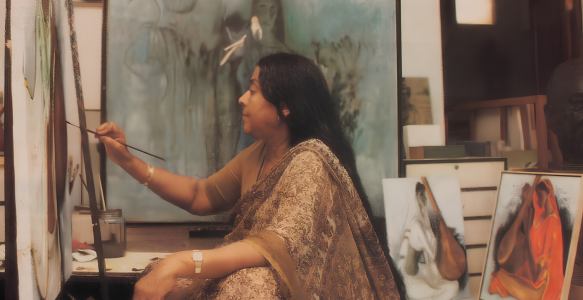
In a modest studio in mid-20th-century Bombay, B. Prabha would often return to the woman - elongated, almost weightless, standing still yet carrying the invisible burdens of an entire world. These were not portraits in the conventional sense but distilled emotions of hunger, resilience, quiet endurance. At a time when Indian modernism was negotiating abstraction, identity, and nationhood, Prabha chose something radically simple - she painted the rural women, anonymous and overlooked.
A B Prabha painting can be haunting. The figures seem suspended between presence and absence, their elongated forms stretching beyond realism. Unlike the distortions of F.N. Souza or the geometric abstraction of S.H. Raza, Prabha’s work is grounded both visually and morally in lived experience. To understand who is B Prabha, learn more about her introspective stream of post-Independence Indian art - one that speaks of persistence.
Who is Artist B. Prabha?
Born in 1933 in Nagpur, B. Prabha grew up in a culturally rich yet economically modest environment. Her father, was also an artist and teacher, recognized her early inclination toward drawing and encouraged her to pursue formal training. This early validation set her on a path that for many women of her generation remained inaccessible.
Her artistic education at the Sir J. J. School of Art in Bombay exposed her to the evolving language of Indian modernism. But unlike her contemporaries who were drawn toward abstraction or urban narratives, she remained deeply connected to rural India. This connection wasn’t romantic - it was observational, almost empathetic.
These women are neither idealized nor dramatized; they exist in a quiet state of endurance. It is this consistent, deeply human portrayal that defines the b prabha painting style.
An often-cited anecdote recounts her travels through Maharashtra’s villages, where she observed women walking long distances for water. That repetitive, physically taxing act became a recurring visual motif - transformed into some of her most enduring works.
Prabha’s refusal to diversify her subject matter was conviction. In a market that often rewards novelty, her repetition reads like resistance. While often grouped under figurative modernists, Prabha’s work feels closer to visual poetry than painting. Her restraint is her radicalism.
Quick Facts About B. Prabha
- Date of Birth: 1933
- Place of Birth: Nagpur, Maharashtra, India
- Education: Sir J. J. School of Art, Bombay
- Known For: Elongated female figures, rural women narratives
- Parents: Father was an artist and teacher
- Spouse: B. Vithal (artist and sculptor)
- Date of Death: 2001
Artistic Journey of B. Prabha
1. Formal Art Education at Sir J. J. School of Art
Bombay in the 1950s was a crucible of artistic experimentation. At J. J., Prabha encountered both academic realism and emerging modernist styles. Yet, even within this dynamic environment, her work retained a certain stillness and it’s own character.
Unlike peers such as Tyeb Mehta, who moved toward fragmentation and tension, Prabha absorbed technique without losing narrative clarity. Her academic training gave her discipline but not rigidity.
2. Development of her Signature Style
The elongated figure - now synonymous with a B Prabha artwork - did not emerge overnight. It evolved gradually, influenced perhaps by both Indian mural traditions and the stylization seen in Modigliani’s portraits.
These figures are not anatomically correct intentionally. Their stretched forms are a subtext to the emotional extension, the fatigue, longing, resilience.
3. How She Became a Leading Woman Artist in India?
In a male-dominated art world, Prabha carved her space through consistency rather than confrontation. Her participation in exhibitions, including those with the Progressive Artists’ Group circle, brought visibility.
Her marriage to sculptor B. Vithal also created a shared artistic ecosystem - though her voice remained distinctly her own.
Prabha didn’t “break into” the art world; she quietly occupied it until it had no choice but to acknowledge her. Her success challenges a common narrative - that visibility requires loudness. Prabha proves otherwise.
Styles & Themes Used in B. Prabha Paintings
1. Elongated Figures
The most defining feature of paintings by B Prabha is the vertical stretch of her subjects. These figures often appear fragile, yet grounded.
2. Plight of Rural Women
Her women are workers - carrying pots, selling flowers, waiting. There’s no spectacle here, only survival.
3. Common Folk and Everyday Life
Much like Nandalal Bose or Jamini Roy, Prabha found inspiration in the everyday. But where Roy stylized, Prabha internalized.
4. Dominant Monochromatic Palettes
Muted browns, greys, and blues dominate her canvases. These aren’t decorative choices - they reinforce mood. Silence, distance, endurance.
An anecdote from a 1970s exhibition in Delhi describes viewers standing unusually long before her works. “Nothing happens,” one critic wrote. And yet - that stillness becomes the experience.
Prabha’s palette feels like weather - subtle, enveloping, impossible to ignore once you’re inside it.
Her restraint with colour is not aesthetic minimalism - it’s emotional precision.
Famous Paintings & Series of B. Prabha
1. Women at the Well (1979)
Few images capture the essence of B. Prabha’s practice as Women at the Well. A group of women gather around a source of life, yet the painting is not really about water. It is about responsibility. The well becomes a silent witness to labour repeated across generations. The women are together, but each seems absorbed in a private world of endurance. Their elongated forms carry a rhythm and turn an everyday rural chore into something almost monumental. The work also reveals one of Prabha's greatest strengths: her ability to elevate the ordinary without romanticizing it.
The painting asks a pertinent question - how many acts of survival go unnoticed simply because they happen every day?
2. The Flower Seller
The Flower Seller appears gentler than many of Prabha's works. Flowers introduce colour, fragrance, and associations of celebration. Beneath that beauty lies the economics of survival, the artist's recurring concerns.
The seller offers objects associated with devotion, weddings, and joy, while her own expression is restrained and introspective. Beauty here is livelihood and collectors are often drawn to this duality. Prabha reminds us that behind every ritual, every offering, and every moment of beauty stands invisible labour.
3. Potsellers (1982)
In Potsellers, Prabha turns her attention to another disappearing world of traditional craft and rural commerce. The clay pots dominate the composition as symbols of preservation, sustenance, and continuity. They hold water, grain, and memory. Beside them stand the women who sustain both household and community, rendered with quiet dignity.
What makes the work compelling is its meditation on permanence and fragility. Clay vessels endure for centuries or shatter in an instant. The same tension exists in the lives of Prabha's subjects. Their resilience feels strong, yet always vulnerable to forces beyond their control.
4. Woman Carrying Water Pot
If there is one image that encapsulates Prabha's artistic philosophy, it may be the solitary woman balancing a water pot.
The composition is deceptively simple. There is no dramatic event, no narrative climax. Yet the figure becomes an emblem of endurance itself. The pot represents both necessity and burden; the act of carrying it, a metaphor for the invisible weight many women shoulder throughout their lives. Though rooted in rural India, the image transcends geography. It becomes a portrait of persistence. The quiet strength required to keep moving forward, day after day.
5. Mother and Child
Prabha's Mother and Child paintings move away from labour and toward intimacy, yet they remain deeply connected to her larger concerns.
The relationship is portrayed without sentimentality. There are no theatrical gestures or overt displays of affection. Instead, the emotional bond emerges through stillness and proximity.
What makes these works memorable is their understanding of motherhood as both tenderness and responsibility. The child represents possibility; the mother embodies sacrifice. Together, they create the passing of care, memory, and hope from one generation to the next.
6. Two Sisters (1965)
Two Sisters is among Prabha's most intriguing works because it focuses on companionship rather than solitude.
Standing side by side, the women seem connected by an unspoken understanding. Their closeness creates a sense of shared experience, shaped by the same expectations, traditions, and aspirations.
The painting is also a rare glimpse into Prabha's exploration of female relationships beyond motherhood and labour. It speaks to the emotional nuances of sisterhood: how support, memory, and identity are often built through the presence of another person who understands the world exactly as you do.
7. Black Moon (1963)
Among Prabha's most unexpected works, Black Moon reveals a different side of her artistic imagination.
Created as a mural proposal for the Tata Institute of Fundamental Research, the work is a play on cosmic symbolism and abstraction. The title itself invites interpretation. Is the black moon a symbol of mystery, transformation, uncertainty, or renewal? It is one of the rare moments in her career where the viewer encounters Prabha not as a storyteller of human lives, but as an artist contemplating larger existential questions.
8. Fisherwomen Series
The Fisherwomen Series remains one of the defining achievements of Prabha's career.
The women stand against vast skies and open waters, their bright saris contrasting with the elemental forces surrounding them. They belong to Mumbai's coastal communities, yet they’re transformed into timeless archetypes of resilience.
In these works there is a balance between documentary observation and poetic interpretation. The women are rooted in real labour, but their elongated forms and calm presence elevate them beyond reportage.
9. Kashmir Series
Created as part of her travels through Kashmir, this series demonstrates Prabha's remarkable ability to remain faithful to her vision while exploring new landscapes and cultures.
The paintings capture local traditions, attire, saffron harvests, and life around the lakes and valleys. Yet the emotional atmosphere remains familiar. The women possess the same introspective stillness found throughout her oeuvre.
This consistency reveals something profound about Prabha's worldview. Whether in Maharashtra or Kashmir, she saw a shared emotional reality in women's lives. Beauty, geography, and culture may change, but the themes of endurance, dignity, and perseverance remain universal.
10. Shradhanjali Series (1993)
Perhaps Prabha's most personal body of work, the Shradhanjali Series emerged after the death of her husband, artist and sculptor B. Vithal. The title translates as "tribute," and the paintings carry a palpable sense of reflection and remembrance. Rather than expressing grief through dramatic symbolism, Prabha approaches loss with the same restraint that defines her entire career.
They invite viewers to consider how memory survives after absence, how love continues to exist even when the person is gone. In many ways, Shradhanjali feels like the culmination of Prabha's artistic journey. The themes of endurance, resilience, and quiet dignity that shaped her portrayals of countless women are turned inward, becoming a meditation on personal loss itself.
B. Prabha's Contribution to Indian Art
1. Depiction of Women in Modern Indian Art
Before feminist discourse formally entered Indian art criticism, Prabha was already documenting women’s lived realities. Not as symbols, but as subjects.
2. Role in Post-Independence Art Movement
While others defined modernism through abstraction, Prabha grounded it in human experience. She offered an alternative modernity - quiet, figurative, and socially rooted.
3. National and Global Recognition
Her works have been exhibited internationally and continue to feature in major auctions. Yet, her recognition remains somewhat understated - perhaps mirroring her art itself.
Compared to contemporaries like M.F. Husain or Souza, her market presence is quieter - but her cultural relevance is undeniable.
Prabha expanded the definition of modern Indian art - not by rejecting tradition, but by re-seeing it.
Her legacy lies not in scale or spectacle, but in sincerity - a quality increasingly rare in contemporary practice. In the end, B. Prabha’s work resists easy categorization. It is modern, yet timeless; simple, yet deeply layered. Her women do not ask for attention - but they stay with you, long after you’ve looked away.
FAQs About B. Prabha
1. What was B. Prabha famous for?
She is best known for her poignant depictions of rural women, characterized by elongated forms and subdued palettes that reflect resilience and quiet suffering.
2. What makes B. Prabha's painting style unique?
B Prabha’s style combines stylized elongation with emotional realism. Her minimal compositions and muted colours create a meditative, almost timeless quality.
3. How did rural life influence B. Prabha's artwork?
Rural India was central to her visual language. Observations of daily labour - fetching water, selling goods - became recurring motifs, grounding her work in lived experience.
4. What is the significance of her elongated figures?
The elongated forms of B Prabha are not about anatomy and more about emotion. They suggest endurance, stretching the human form to reflect psychological and physical strain.
