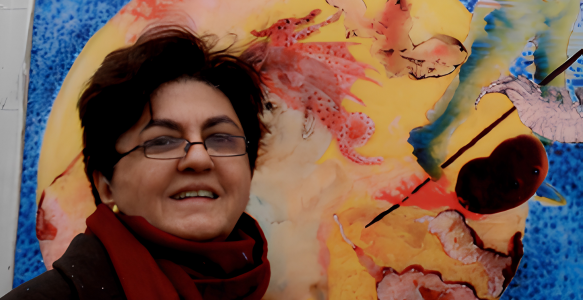
You step into a darkened gallery and, before your eyes adjust, you are suddenly surrounded by moving shadows. Cylinders painted with mythic figures rotate slowly, fragments of poetry and news images slide across the walls in restless colour. Memory itself has been set in motion. It is hard to know where to stand and disorienting. That is deliberate: Nalini Malani wants you to feel what it means to live inside histories of exile, violence, and erasure.
For anyone asking who is Nalini Malani, the story begins not in a white-walled museum but in Karachi in 1946, and in the trauma of Partition that turned her into a child refugee. This isn’t a neat Nalini Malani biography but a journey through fractures and hauntings that turn history into images and, later, into multi-channel video and shadow play.
Within Indian contemporary art, Nalini Malani the artist and storyteller stands out for the way she connects the intimate gesture of drawing with large, public questions of justice, dissent, and gender. Her practice forms a bridge between the generation of Bhupen Khakhar and Vivan Sundaram and a younger global cohort that includes Shirin Neshat and William Kentridge - artists who insist that form and politics cannot be separated.
Who is Artist Nalini Malani?
Nalini Malani was born in Karachi in 1946, in undivided British India; after Partition, her Sindhi family moved first to Kolkata and then, by 1958, to Bombay. That early experience of displacement, of losing a home and remaking another in a crowded city - echoes in the recurring motifs of uprooted bodies, shattered architectures, and unstable borders in Nalini Malani’s artwork. Growing up in post-Independence Bombay, she found herself where theatre, cinema, and modernist painting were in constant conversation.
Between 1964 and 1969 she studied at the Sir J.J. School of Art in Bombay, while working at a studio in the Bhulabhai Memorial Institute. It was a legendary cultural hub where painters, filmmakers, dancers, and musicians overlapped. Almost immediately after graduating, she began experimenting with film; Dream Houses (1969), made as part of Akbar Padamsee’s Vision Exchange Workshop, is often cited as her first video work and marks the start of her move beyond the traditional canvas. A French government scholarship took her to Paris from 1970 to 1972, exposing her to European avant-garde film and feminist discourse at a formative moment.
Returning to India, Malani oscillated between painting, photography, and experimental film; by 1981 she was already part of the landmark exhibition Place for People, which tried to realign Indian figurative painting with everyday life and politics. In 1985 she curated one of the first exhibitions in India dedicated solely to women artists in Delhi, signalling how deeply feminist questions were embedded in her curatorial as well as studio practice. Over the next decades, her work appeared in major institutions including the Stedelijk Museum Amsterdam, the Museum of Modern Art in New York, and the National Gallery in London, as well as in biennales and travelling surveys that firmly situated Nalini Malani art within a global conversation on video and installation.
Malani has received sustained recognition: an honorary doctorate from the San Francisco Art Institute (2010), the Fukuoka Prize for Arts and Culture (2013), the Joan Miró Prize (2019), and a contemporary fellowship at the National Gallery, London (2020), among others. Yet for all the accolades, she has consistently described herself less as a celebrity and more as a witness, using images to register what happens to the “silenced and dispossessed,” particularly women, in the wake of historical violence.
If we think about Nalini Malani only in terms of “pioneering video art,” we risk flattening the complexity of a practice that began with drawing and painting and still returns to those intimate acts. The surprise, when you encounter her in person, is how analog her methods remain, even inside the most technologically elaborate installation.
Themes in Nalini Malani's Work
Malani’s works are layers of myth, news footage, family memory, and feminist theory that refuse to resolve into a single, stable image. Across the media certain preoccupations recur: gendered violence, the failures of democracy, the afterlife of Partition, and the ghosts of ancient stories pressing against contemporary crises.
1. Feminism and Gender Identity
From the 1970s series His Life, which probed patriarchal family structures, to later works that centre violated female bodies, Malani has treated feminism as a method of looking. Untitled (Women Series) (1974) already shows distorted, contorted female figures rendered in expressive, almost raw brushwork; these bodies are not idealised goddesses but women caught mid-gesture, often in states of psychic or physical strain. Her visual vocabulary resonates with, yet remains distinct from, the feminist figuration of artists like Arpita Singh in India or Kiki Smith in the West, both of whom also mine the female body as archive.
Over time, Malani’s women shift from being singular figures to becoming almost archetypal presences - Cassandra, Sita, Draupadi - who appear and disappear across installations, half-shadow, half-projection. By painting and animating these characters into “reverse” narratives, she refuses the passive roles assigned to them in classical literature, turning them into witnesses and accusers instead. In a single Nalini Malani artwork, mythic heroines may stand beside anonymous victims of riots, complicating any clean separation between epic past and televised present.
2. Social Justice
Malani has repeatedly described herself as a “social activist” in the sense that her work gives space to marginalized voices. She engages with communal riots, caste inequities, and the erosion of democratic ideals - not through didactic slogans but through atmospheres of unease, where viewers find themselves implicated. Works like Unity in Diversity (2003), made in response to the 2002 Gujarat violence, foreground the gap between India’s secular slogans and the brutal realities of majoritarian politics.
3. Global Issues and Violence
While rooted in South Asian histories, her installations thread together planetary concerns: war, forced migration, ecological precarity. In Search of Vanished Blood, for instance, draws on an Urdu poem by Faiz Ahmed Faiz and on Christa Wolf’s Cassandra to suggest a continuum of violence from colonialism to contemporary wars. The swirling projections and overlapping soundtracks stage what one critic has called a “kaleidoscopic wound” - a global condition in which no one is entirely outside the blast radius.
4. Mythology and Reinterpretation of Epics
Myth, for Malani, is not an escape from politics; it is the very language through which power is naturalised. In the Stories Retold series, she uses reverse painting to revisit episodes from the Mahabharata and other epics, focusing on characters like Sita or Draupadi whose suffering has historically been glorified as devotion. Figures from these tales bleed into contemporary scenes of displacement, creating images that sit uneasily beside more conventional mythological paintings on temple walls or calendar prints.
Famous Paintings & Series of Nalini Malani
Over five decades, she has created a constellation of works that are now canonical touchstones in discussions of Nalini Malani’s famous paintings and installations.
1. In Search of Vanished Blood
In Search of Vanished Blood (2012/2017) is one of her most ambitious “video shadow plays”: an immersive environment of six-channel video, sound, and five rotating Mylar cylinders painted in reverse. As the cylinders turn, light casts their images - women, beasts, fragments of text - across the walls, colliding with projected footage and a dense soundscape. The title refers to an Urdu poem by Faiz and to broader histories of bloodshed that never fully surface in official memory. Standing inside, you feel as though you are walking through the inside of someone’s traumatised mind.
2. Untitled (Women Series)
Untitled (Women Series) (1974) is a painting from her early figurative phase, associated with feminist art and neo-expressionism. A cluster of female figures, rendered in urgent strokes, occupies the picture plane; their bodies seem compressed by the very frame supposed to contain them. There is no decorative detail, only heightened emotion - an early sign of how Nalini Malani’s paintings would refuse both prettiness and passivity.
3. Can You Hear Me?
Can You Hear Me? (2017–20), first shown as a major commission at Whitechapel Gallery, London, consists of eighty-eight hand-drawn animations projected across the walls of the former reading room. Drawn with her finger on an iPad, then animated, these images overlap quotations from Hannah Arendt, James Baldwin, Faiz, and others, creating a restless essay on silencing and dissent. The work demonstrates how art migrates fluidly from drawing to digital, without losing the pressure of the hand.
4. Remembering Toba Tek Singh
Remembering Toba Tek Singh (1998) marks a key moment when Malani turned decisively to large-scale installation. Inspired by Saadat Hasan Manto’s short story about Partition, the work uses iron canteens or trunks fitted with video screens, surrounded by larger projections of archival footage showing refugees on the move. Viewers have to weave between these metal forms, as if walking through a provisional refugee camp, reminded that the madness of borders is not just literary metaphor but lived history.
5. Stories Retold Series
In the Stories Retold series, Malani employs reverse painting on glass or acrylic, a technique with roots in Byzantine icon-making that later travelled through China, Japan, and India. By choosing this historically “decorative” form and filling it with disturbing, politically charged scenes, she subverts expectations: the glossy surface hides layers of painterly decisions that cannot be corrected once made. In these works, epic protagonists confront contemporary crowds, staging a collision between sacred narrative and daily news.
6. Dream Houses
Dream Houses (1969), created at the Vision Exchange Workshop, is often cited as one of the earliest experiments with video in India. Although less widely seen today than her later installations, it set a precedent: fragmentary, urban, attuned to how modern housing blocks reshape psychic space. Many threads that later unfurl in Nalini Malani art - the unstable home, the cinematic cut, the sense of watching from a threshold - are already there in embryo.
7. Unity in Diversity
Unity in Diversity (2003) is a single-channel video installation made in response to the Gujarat riots of 2002, in which thousands of Muslims, many of them women, were killed. The title ironically echoes India’s national motto, highlighting the distance between constitutional ideals and the reality of religious violence. Photographs, footage, and domestic furniture combine to suggest how terror intrudes into ordinary spaces, eroding any easy faith in stable “unity.”
Various Styles Used in Nalini Malani Works
Across five decades, Malani has continually reconfigured her toolkit, refusing to be tied to a single medium. A single exhibition might combine multiple art forms, blurring any neat division between painting, cinema and theatre.
1. Multimedia & Experimental Techniques
Malani is widely acknowledged as one of India’s first generation of video artists, with a practice that includes film, photography, theatre, animation, and large-scale video installations. Her multimedia environments often layer analogue and digital: hand-painted surfaces, projected animations, found footage, and soundtracks collaged from music and spoken word. This restless approach means that what might begin in the studio could end up as part of a surround-sound installation in a museum.
2. Mythology & History in Storytelling
History and myth are woven together in Malani’s narrative structures, which rarely unfold linearly. Reverse painting, learned in part from Bhupen Khakhar, becomes a way to trap figures “behind” glass or acrylic, suggesting how women and subaltern subjects are often held behind the screen of official history. Her images stage encounters between epic heroines and contemporary protesters, between classical iconography and newsreel fragments, building a kind of visual palimpsest that resonates with audiences used to layered storytelling.
3. Video Art & Shadow Play
Since the early 2000s, Malani has developed what she calls “video/shadow plays,” where painted transparent cylinders or screens interact with moving projections and light. As the cylinders rotate, their images are cast as shadows across walls and floors, multiplied and distorted by the video, turning painting into something closer to theatre or ritual. By refusing the static frame, she pushes art into a time-based, performative realm where the viewer’s own movement completes the work.
Watching Malani test a projection is like witnessing stage rehearsal rather than canvas critique. Lamps shift, images overlap, sound levels rise and fall. For anyone used to thinking of authentic indian paintings as bounded rectangles, her practice opens a possibility that an image might be something you walk through, something that stains you temporarily as you exit the room.
In a moment when “multimedia” can mean slick technology for its own sake, Malani’s experiments feel refreshingly handmade. The projectors hum, the paint drips, the timing is never perfectly looped - and that slight imperfection is where the work breathes.
FAQs About Nalini Malani
1. What is Nalini Malani's art style?
Nalini Malani's art combines figurative expressionism, video art, installation, and feminist themes.
2. What medium does Nalini Malani use?
Nalini Malani works with painting, drawing, film, video, animation, installation, and reverse painting on transparent surfaces.
3. What awards has Nalini Malani won?
Nalini Malani has received major honours including the Fukuoka Prize, Joan Miró Prize, and the National Gallery Contemporary Fellowship.
4. Why is Nalini Malani important in contemporary art?
Nalini Malani is regarded as a pioneer of video and installation art in India, known for addressing memory, gender, and social justice through her work.
