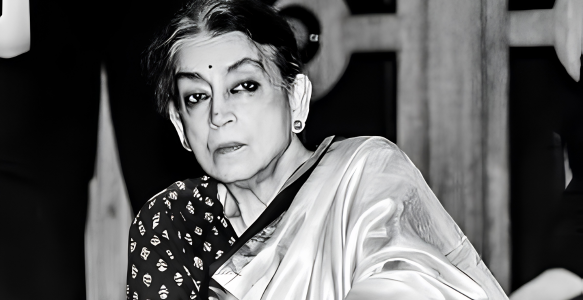
On certain evenings in 1970s Bombay, when the city had finally gone quiet, a small garage in a housing colony would still be lit. Inside, a woman sat at a modest table, copper plates and sketchbooks spread around her, the smell of turpentine and damp newsprint in the air. She had taught schoolchildren all day, put her own children to bed, and only then turned to the world that truly absorbed her: etchings of lovers at war, masked performers, women staring down an unseen gaze. That woman was Lalitha Lajmi.
To view Lalitha Lajmi’s art is to enter an intimate theatre: human relationships staged under a single spotlight, gestures exaggerated just enough to reveal what usually stays hidden. Her work moves between tenderness and unease - between the small dramas of family life and an undercurrent of psychoanalytic inquiry, death, dream and desire.
This blog is less a linear Lalita Lajmi biography than a guided walk through her studio: we pause at specific prints, recall stories from exhibitions, and listen for the echo of theatre, cinema and poetry in her images. For anyone asking “who is Lalita Lajmi”, she emerges not just as an artist, but as a patient observer of the Indian woman’s inner life after Independence.
Who is Lalitha Lajmi?
Lalitha Lajmi (1932–2023) was a Kolkata-born painter and printmaker, self-taught yet deeply embedded in a family of performers and image-makers. Sister to legendary filmmaker Guru Dutt and mother to director Kalpana Lajmi, she grew up in an atmosphere where story, gesture and rhythm were everyday language. Her uncle, commercial artist B.B. Benegal famously gave her a box of paints when she was a young girl already obsessed with classical dance - a small gift that quietly altered the course of her art as we know it.
Over six decades, she worked across etching, aquatint, watercolour, oils, and pen-and-ink, evolving a highly individual Lalita Lajmi painting style rooted in figuration but charged with the atmosphere of dream and theatre. At its core, learning about Lalitha Lajmi means talking about human vulnerability: women negotiating power, men revealed in their fragility, children caught in the cross-currents of adult drama.
From a curatorial standpoint, Lajmi sits slightly askew to the canonical narrative that foregrounds the progressive artists group and modernists like artist Tyeb Mehta. While they pushed Indian modernism outward - towards global abstraction, monumental gestures - she turned inward, mapping the psychic interior of the middle-class home. She expands how we understand post-Independence indian art paintings: as much about the rehearsal room and bedroom as about the street or the nation.
Artistic Journey of Painter Lalitha Lajmi
1. Early Life and Influences
Lajmi was born into a Bengali family in Kolkata where literature, performance and painting were woven into daily life rather than set apart on a pedestal. As a child she was drawn to classical dance, internalising rhythm and posture long before she had access to formal art education. One family anecdote recalls her practicing mudras in a corner while older relatives discussed cinema.
In some ways, the painter Lalita Lajmi grows out of these half-accidental interventions: a girl steeped in performance who finds that paper, ink and line can also hold gestures.
2. Beginning of Her Artistic Career
Lajmi began painting seriously in the early 1960s, even as she worked as a school art teacher to support her family. She participated in group exhibitions at Mumbai’s Jehangir Art Gallery before her first solo show there in 1961 - modest beginnings that nonetheless launched a long exhibiting career across India, Germany and the United States.
Those early Lalita Lajmi paintings are often described as melancholic: tight interiors, subdued palettes, figures locked in emotional stalemates.
3. Development of Her Unique Painting Style
By the late 1970s and 1980s, Lajmi had moved decisively into etching and aquatint, alongside oils and watercolours. She spoke of watercolour as the medium closest to the subconscious, and you sense that in the way washes blur at the edges of masked faces or dreamscapes. Under the influence of psychoanalysis, self-portraiture and dream imagery took centre stage; from the mask she moved to the body, from the observable scene to the interior script.
Her figures remained recognisably human - placing her within the orbit of figurative art paintings - but the emotional temperature shifted. Women grow more assertive, men more vulnerable; domestic objects become props in an unfolding play about power, desire and care.
4. First Exhibitions and Recognition
Between 1961 and 2000, Lajmi held multiple solo exhibitions in Bombay, Germany and the USA, even as she continued teaching. Over time, major institutions such as the National Gallery of Modern Art (Mumbai), the CSMVS Museum and the British Museum acquired her works, affirming her place in the canon of post-Independence Indian art.
Yet she rarely received the same art-market spotlight as male contemporaries like S.H. Raza, F.N. Souza or K. H. Ara, whose trajectories aligned more closely with the heroic narrative of Indian modernism. .
The most moving aspect of her journey is its stubborn ordinariness. No dramatic exile, no spectacular scandal - just a woman who kept returning to her plates and papers after school hours. It is precisely this “ordinary” persistence that gives Lalitha Lajmi’s paintings their slow-burning authority.
Major Themes in Lalita Lajmi's Paintings
1. Human Relationships
Again and again, Lajmi returns to the knot between men and women - lovers, spouses, parents and children - capturing latent tensions rather than overt drama. Many works stage a quiet standoff: a woman upright, a man slumped or turned away, bodies minimally touching yet bound by invisible threads. She was more interested in the human predicament than ideology.
2. Performance and the Mask
Lajmi’s close engagement with cinema and theatre makes performance a central motif: clowns, acrobats, actors and masked figures populate her prints. She traced her fascination with masks to attending daughter Kalpana’s college drama rehearsals, where stage make-up and role-play blurred everyday identity.
In her hands, the mask becomes a psychological device - something that both hides and reveals, signalling the gap between the role one plays and the emotion one carries.
3. Female Bonding
Alongside man–woman tensions, Lajmi paints mothers and daughters, women friends, sisters and surrogate kin - forms of female bonding that offer tenderness within patriarchal structures. These scenes are acknowledge rivalry and fatigue but insist on the sustaining power of women’s relationships.
4. Dreams
Dreams - both nocturnal and waking - form another key strand. Works like “Weird Dream” explore the subconscious through distorted bodies, floating objects and unstable perspectives. During periods of psychoanalysis, she actively mined dream material for images, using etching’s granular marks to evoke that half-remembered texture.
Crucially, her dreamscapes are not escapist; they fold daily anxieties about illness, loss and desire into uncanny scenes where reality feels just slightly off-centre.
What stays with you in Lalitha Lajmi’s art is her refusal to tidy relationships up. Couples do not neatly reconcile, dreams do not fully resolve.
Notable Paintings & Series of Lalitha Lajmi
1. Dream
Often associated with etchings like “Weird Dream” (1976), this body of work channels her preoccupation with the subconscious into tightly worked black-and-white images. Figures drift in and out of frame, perspective warps; you sense an artist using the bite of acid on metal to record fleeting mental states.
2. Homage to Frida Kahlo
“Homage to Frida Kahlo” (2004) is an oil on canvas that explicitly acknowledges a global feminist ancestor. Much like Kahlo, Lajmi fuses self-portraiture, symbolic objects and a heightened sense of theatre, but the emotional register remains distinctly her own - quieter, edged with Indian domesticity rather than Mexican surreal excess.
3. Death Reading a Book of Poems
In “Death Reading a Book of Poems” (1977), a skeletal figure calmly peruses a book, the scene rendered in zinc aquatint with somber tonalities. Lajmi created the work while undergoing psychoanalysis, drawing on her love of poetry and her analytic sessions to stage death not as horror, but as an oddly contemplative reader.
4. Through my Window
“Through my Glass Window” (often referred to as “Through my Window”) records the view from a friend’s London apartment - railings, trees, a city momentarily stilled. In this print, outward landscape and inner memory collapse into each other; it is as much about distance and longing as about architecture.
5. Man, Woman and Mask
Works grouped under titles like “Man, Woman and Mask” condense her interest in triangular dynamics: the couple and the mask that mediates them. The mask here feels like an extra character in the relationship - a stand-in for social expectation, repression or fantasy.
6. Death Playing Chess With a Boy I
“Death Playing Chess with a Boy” appears in her later watercolour works, created during a period when her daughter Kalpana was seriously ill. The image of a child calmly facing Death across a board is devastatingly direct; yet it also echoes medieval allegories and Bergman-like cinematic scenes, compressing private fear and art-historical memory into a single frame.mumbaimirror.
7. Performer Series
From etchings in the 1990s to large watercolours in the 2010s, the “Performer” or “Performer series” explores acrobats, jugglers and actors caught between role and self. Limbs are elongated, costumes exaggerated; you feel the strain of holding a pose, the exhaustion after applause.
8. Family Series
Although less clearly branded as a single series, Lajmi’s recurring family groupings - parents, children, grandparents - operate like a quiet “Family Series”. Here, she scrutinises the small violences and loyalties of domestic life: who leans on whom, who looks away, who shoulders the emotional weight.
9. Portrait of Gangu Bai
“Portrait of Gangu Bai” (1982), an etching on paper, depicts a woman whose name suggests a working-class or domestic-worker identity. The decision to monumentalise someone like Gangu Bai in print form hints at Lajmi’s attention to lives often peripheral in art history’s usual protagonist list.
10. Whispering Leaves
“Whispering Leaves” (1976), offered in a 2022 prints auction, is a delicately etched work where foliage feels almost sentient. Here, nature becomes another vessel for mood and memory - leaves that seem to murmur about time passing.
For viewers encountering Lalitha Lajmi’s famous paintings for the first time, these works offer a primer in how she thinks. As curators, we find it useful to place a work like “Homage to Frida Kahlo” alongside global influences, reminding audiences that Lalita Lajmi’s artwork is in conversation with both local and international feminist lineages.
Key Contributions Of Artist Lalitha Lajmi in Indian Art
1. Pioneering Printmaking
Lajmi was among the significant women printmakers in post-Independence India, building an extensive body of etchings and aquatints at a time when the medium was still relatively marginal. Her prints pirouette around themes of death, performance, surreal fantasy and complex relationships, showing how printmaking could be as conceptually and emotionally ambitious as painting.
By bringing deeply personal content - psychoanalysis, family tensions - into graphic work, she helped legitimize printmaking as a site for serious introspection within Indian modern art.
2. Feminist Narratives & Gender Dynamics
Even as she rejected simple labels, her work consistently foregrounds strong, often aggressive female figures and ambivalent male counterparts. She has spoken of not being “a feminist” per se, but of being concerned with the disturbances and relationships human beings are caught up in. That said, images of women paired with subdued men, or with goddesses Kali and Durga in commanding poses, clearly intervene in gendered visual traditions.
3. Influence of Cinema and Theatre in Her Art
Cinema’s framing and theatre’s staging permeate her compositions - unsurprisingly, given her ties to Guru Dutt’s film world and Kalpana Lajmi’s direction and theatre practice. Works often feel like stills from an unmade film: a single moment, lit dramatically, pregnant with backstory. Her recurring performers and masks bear direct trace of college drama rehearsals she attended, where she watched roles being put on and shed.timesofindia.
4. Engagement with Psychoanalysis
Perhaps her most singular contribution is the way she folded psychoanalytic experience into an Indian visual vocabulary. She underwent psychoanalysis for a period and drew directly on dream material and analytic conversations in works like “Death Reading a Book of Poems”. Recent scholarship emphasises how her relationship with her analyst fuelled a sustained practice of self-portraiture, evolving into a kind of autoethnography of the Indian woman artist in late twentieth-century Mumbai.
Looking at her work alongside artists like Frida Kahlo to Paula Rego, it reveals convergences in how women artists used the body, dream and domestic space as sites of resistance.
FAQs About Artist Lalitha Lajmi
1. What was Lalitha Lajmi famous for?
Lalitha Lajmi was known for figurative paintings and prints that explored relationships, identity, and human emotions.
2. What materials did Lalitha Lajmi use?
She worked with etching, aquatint, watercolour, oil paint, and pen-and-ink drawings.
3. What style of art did Lalita Lajmi create?
Lalitha Lajmi created figurative art marked by symbolism, theatrical imagery, and psychological themes.
4. How was Lalita Lajmi influenced by theatre?
Theatre inspired her use of masks, performers, staged settings, and dramatic visual storytelling.
5. How did Lalita Lajmi impact Indian art?
She expanded figurative art in India through her sensitive exploration of gender, relationships, and inner life.
6. What is Lalitha Lajmi's most expensive painting?
According to market data, the auction record for Lajmi is a work titled “Untitled”, which realised around $ 9,569 USD at Prinseps in 2025.
