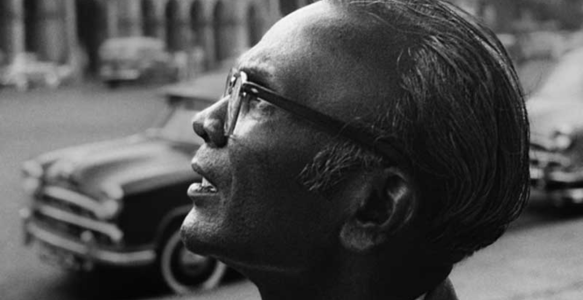
On some mornings in mid-century Bombay, you could apparently find K.H. Ara standing over a modest table – a jug, a fish, a torn newspaper, a white cloth – rearranging objects with the patience of a theatre director before a premiere. The compositions were simple, even austere, but he would keep adjusting the angle of a plate or the tilt of a bottle until the entire scene began to vibrate with quiet tension. That same table, transposed onto paper with thick, dragged colour, would become a still life that felt strangely more alive than the bustling city outside.
Ara’s journey from a difficult childhood in Secunderabad to becoming one of the founding members of the progressive artists group in Bombay is one of the most unlikely stories in modern Indian art. Even within that pantheon, alongside F.N. Souza, S.H. Raza and M.F. Husain, Ara remained something of an outlier: less rhetorical, more intimate, drawn to tabletops, dancers, and women caught in unguarded, almost private gestures.
As we look back at K. H Ara today, his still lifes and nudes feel like a quiet counterpoint to the more monumental ambitions of his peers – a reminder that modernism in India was also being negotiated on breakfast tables, in small rented rooms, and in the glow of window light on everyday bodies and objects.
Who was K.H Ara?
Krishnaji Howlaji Ara was born in 1914 in Bolarum near Secunderabad and lost his mother when he was very young; his difficult home life eventually pushed him to run away to Bombay as a child. There he worked as domestic help for a European lady, and later as a car cleaner for a Japanese firm, painting in whatever spare pockets of time he could claim for himself. In 1930, he joined Gandhi’s Salt Satyagraha and was jailed for several months, an early brush with political idealism and hardship that would shape his sensitivity to ordinary lives.
This K. H Ara biography is also the story of Bombay’s evolving art world: critics like Rudy von Leyden and art director Walter Langhammer noticed his raw talent and encouraged him, giving him access to studios, materials and, crucially, dialogue. His first solo exhibition was held in 1942 at Chetana Restaurant, an informal but important venue in the city’s cultural life, and it was a surprising commercial and critical success. From there, Ara moved quickly into the heart of India’s modernist experiment.
In 1947–48 he became a founding member of the Progressive Artists’ Group (PAG) in Bombay, alongside F.N. Souza, S.H. Raza, M.F. Husain, H.A. Gade and S.K. Bakre, determined to move beyond colonial academic realism and the romanticism of the Bengal School. Within this circle, Ara’s voice remained distinct: where Souza’s distortions were fierce and confrontational, and Raza’s language tilted toward abstraction, Ara’s focus stayed on still life and the human figure, especially the female nude, grounded in a stubborn naturalism.
Over the decades he received major recognitions – the Governor’s Prize in 1944 and a Bombay Art Society Gold Medal in 1952, along with international exposure and participation in key exhibitions. Yet even as his reputation grew, he retained the air of the self-taught outsider in the studio: working with improvised materials, pushing watercolour towards the density of oil, and revisiting familiar motifs – jugs, vases, fruits, dancers – with quiet persistence.
Contributions of Artist K.H. Ara in Modern Indian Art
1. Founding Member of the Progressive Artists’ Group (PAG)
As a K. H Ara artist, his place in the Progressive Artists’ Group is both foundational and subtly different from his peers. The PAG’s early meetings in 1947 were charged with frustration at conservative exhibition juries and a desire to create space for bold, modern work – Ara was right there, arguing for clearer principles and more inclusive platforms for young artists.
Unlike some of his colleagues who moved abroad or gravitated toward large-scale, ideologically charged canvases, Ara stayed close to Bombay, its art societies and its emergent galleries, often acting as an anchor rather than a star. As PAG exhibitions travelled to cities like Ahmedabad, Baroda and Calcutta, his still lifes and nudes carried this new language of modernism into other regional contexts, helping to normalise the idea that “modern Indian art” could look very different from nationalist or revivalist expectations.
2. Formation of Artists' Aid Centre
Ara’s contribution was institutional as much as it was pictorial. He was founder and secretary of the Artists’ Aid Centre in Bombay, envisioned as a support system for artists in need – a place where exhibitions, grants and informal mentoring could be coordinated in a city that often demanded precarity as the price of creativity. Closely linked to this was his involvement with the Artist(s)’ Centre in Mumbai, where he spent much of his later life, making it a hub for conversations, critiques and friendships.
He also served on the selection and judging committees of the Bombay Art Society and the Lalit Kala Akademi, trying to push for more transparent standards in competitions and exhibitions. It’s easy to overlook this kind of work because it doesn’t produce a single, signature canvas, but it profoundly shaped how younger artists entered the field – an invisible architecture underpinning what we now see as a thriving ecosystem of real art paintings across India.
3. What Makes K.H. Ara's paintings unique?
Critic Nissim Ezekiel once remarked that Ara was the first contemporary Indian painter to use the female nude with meticulous focus while staying within the limits of naturalism. That phrase “within the limits of naturalism” is key: where F.N. Souza twisted and fractured the body into expressionist icons, Ara’s nudes are dark-skinned, unposed, often busy with domestic tasks or simply resting.
Similarly, his still lifes never aspire to polished illusionism; the brushwork is rough, the contours firm, the surfaces built up with paint squeezed directly from the tube and dragged into dry impasto. His experiments with white – used to mould form and overflow objects – give his tables and vases an almost sculptural presence, turning apparently simple K. H Ara paintings into subtle meditations on light and tactility.
Artist Ara’s influence lingers in how contemporary painters handle domestic interiors and bodies that feel un-staged. If Souza and Raza gave modern Indian art its manifesto moments, Ara gave it a lived-in texture – the sense that modernism could unfold on a chipped plate, a fish laid out for dinner, or a woman pausing mid-task. That humility is precisely his radicality.
Artistic Style in K.H Ara Paintings
K.H. Ara’s work is often described less through theory and more through touch: the drag of pigment, the stubborn contour, the way white slices across a tabletop. Together, these decisions form what we might call the K. H Ara art style – a language at once expressionistic and grounded in close looking.
1. Expressionistic Brushwork
Ara learned much from watching Walter Langhammer paint: bold impastos, broad strokes, an almost Kokoschka-like impatience with over-refinement. Though largely self-taught, he absorbed European modernist cues – from the structural brushwork of Cézanne to the colour fields of Matisse – and filtered them through his own temperament.
In practice, this meant applying colour straight from the tube and spreading it in a dry impasto technique, even when working in watercolour, so that the surface resembled oil. The result is a vibrating skin of paint where jugs, plates, flowers and bodies seem to pulse against their backgrounds, never quite settling into quiet realism.
2. Unique Use of White
The hallmark of many Ara still lifes is his astonishing handling of white: he uses it not merely as highlight but as a structuring force that wraps around objects, spills onto table edges and folds itself into drapery. White becomes a way to carve volume out of the flatness of paper, making vases and fish feel almost three-dimensional despite their simplified forms.
In works like Still Life with Fish, white glows around scaled bodies and dishes, giving the scene a luminous, almost stage-lit quality. This approach distances him from both tight academic shading and purely tonal modernism; his whites are abrupt, sometimes “wrong” by academic standards, but visually persuasive.
3. Humanism and the Ordinary
Ara’s figures – especially his women – are rarely heroic; they’re often shown lying down, bathing, combing their hair, or simply lost in thought. They are dark-skinned, un-idealised, and presented without coyness, which makes his nudes feel less like fantasies and more like glimpses into private, domestic time.
Similarly, his still lifes take ordinary objects – jugs, fish, flowers, jars – and arrange them with a modernist sensitivity to rhythm and balance, turning humble arrangements into psychological spaces. In this sense, his work shares a kinship with global modernists who transformed everyday subjects into sites of feeling, from Morandi’s bottles to certain late Matisse interiors.
Famous Paintings Of K.H Ara Artist
Ara’s oeuvre is dispersed across museums, scientific institutions, private collections and auction catalogues, but certain works have become touchstones for understanding K. H Ara famous paintings today.
1. Two Jugs
Two Jugs earned Ara the Bombay Art Society Gold Medal in 1952, cementing his reputation as a serious modernist within India’s institutional circuits. The composition, deceptively simple – just jugs on a table – showcases his control over balance, colour blocks and, crucially, the play of white around curved forms.
2. Still Life with Fish
Frequently cited in auction literature, Still Life with Fish (circa 1950) reveals Ara at his most experimental: fish laid out among everyday objects, painted with watercolour applied thickly in a dry impasto that imitates oil. Whites overflow the edges of plates and bodies, giving the scene an almost tactile sensuality that stretches the boundaries of still life as a “minor” genre in Indian art.
3. Blue Vase
In works like Blue Vase, Ara’s interest in colour relationships comes to the fore – the cool weight of the vase set against warmer table tones and luminous highlights. The painting recalls, in spirit if not in direct quotation, the way Cézanne or early-modern European painters used a single vessel as a testing ground for spatial and chromatic questions.
4. Breakfast Table
Breakfast Table (1954), now in the Tata Institute of Fundamental Research collection, is often discussed in relation to Cézanne’s famous “tilts”: the way a table seems to tip toward the viewer, condensing time and space into a single, slightly unstable viewpoint. Everyday crockery and food items become actors in a quiet drama, anchored by Ara’s characteristic whites and sturdy drawing.artsandculture.
5. Black Nude Series
The Black Nude Series, shown at Pundole Art Gallery in 1963, represents Ara’s sustained engagement with the female body as a site of modernist inquiry. These works, often large watercolours, present dark-toned figures with minimal background detail, emphasising posture, contour and the emotional charge of gaze or its absence. For viewers of nude paintings today, the series remains a critical reference point in how Indian artists negotiated the female nude without slipping into either prudery or voyeurism.
6. Mirror
While individual works titled Mirror surface primarily through auction and gallery records, they typically play with reflection as a device – a woman before a mirror, or objects doubled in glass, allowing Ara to juxtapose solid forms with more fragmented, shimmering surfaces. This adds an introspective note to his figuration, inviting questions about self-image and interiority.
7. White Nude
White Nude is one of Ara’s best-known single-figure compositions, often reproduced in discussions of his handling of both skin tone and surrounding whites. The painting underscores his preference for unposed, absorbed figures; the model appears at ease, her body rendered with a mix of solidity and tenderness that sidesteps idealisation.
8. Window Light
Window Light, part of the TIFR collection, is one of 23 works by Ara held there and is frequently cited as a key repository for understanding his career. The piece uses light falling from a window to model form and space, bringing together his interest in still life, interior architecture and the subtle drama of illumination.
9. Deccan Dancers
Painted in 1942, Deccan Dancers captures performers in motion, probably based on Ara’s observations of regional folk or classical performances. The work predates his full immersion in still life and nudes, hinting at an early fascination with the body in movement and the choreography of colour across the picture plane.artsandculture.
Encountering these works together, one realises how consistently Ara returns to a small set of motifs – jugs, dancers, nudes, tabletops – and how much variation he extracts from them. For anyone interested in the evolution of still life in India, his canvases sit at a crucial junction between colonial-era realism and the more experimental still life paintings of later generations.
If we had to introduce someone to Ara with just one work, we would probably choose Still Life with Fish: it folds together his love of objects, his risky whites, his humanism (even toward something as unglamorous as a fish on a plate), and his refusal to separate the sensual from the everyday.
Seen from today’s vantage point, Ara feels less like a “lesser Progressive” and more like an artist who insisted that modernity could be tender, domestic and imperfect. His legacy lives not only in museum collections but also in the way younger painters treat the everyday as worthy of sustained, serious attention, whether in still lifes, interiors, or nuanced nude paintings.
In the larger map of modern Indian art, Ara occupies a quiet but indispensable role. When we revisit his works – in archives, at auctions, or in digital reproductions of K. H Ara’s paintings – we’re reminded that small rooms and small gestures can carry the weight of an era just as powerfully as grand narratives.
FAQs About Artist Ara
Why is K.H. Ara important in modern Indian art?
K.H. Ara was important because he helped move modern Indian painting toward everyday subjects like still lifes, nudes, and domestic interiors. As a founder-member of the Progressive Artists’ Group, he also helped shape Bombay’s modern art movement.
What is the art style of K.H. Ara?
K.H. Ara’s style combines modernist influence with a local Bombay sensibility. His work is known for rough brushwork, dry impasto, and strong use of light and white, especially in still lifes and nudes.
What subjects did K.H. Ara commonly paint?
K.H. Ara commonly painted still lifes, nudes, flowers, fish, tabletops, and domestic scenes. He began with landscapes and socio-historical subjects, but later focused on intimate everyday objects and figures.
