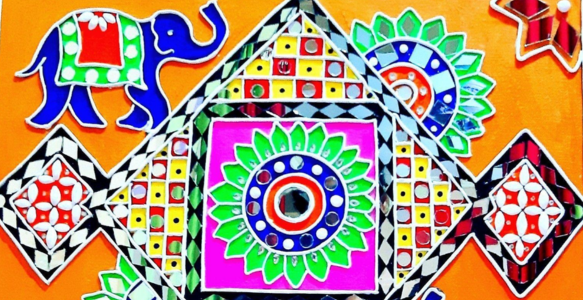
On a late afternoon in Banni, when the light thins to a soft gold, Lippan walls begin to glow before anything else in the village does. Tiny mirrors catch the last fragments of sun, flickering across the curved surface of a bhunga hut like a quiet constellation. Inside, a Rabari woman leans into the wall, fingers moving quickly through wet clay, correcting the curve of a sun motif that her daughter has drawn a little too confidently. A goat nudges open the door, dust drifts in, and for a moment the room is just mud, mirrors, and murmured corrections – a domestic choreography that has been repeated for generations.
It is in these lived, everyday gestures that we really begin to answer the question of what is Lippan Art, beyond the phrase and the Pinterest-ready panel? As curators, we see it first not as “wall décor” but as a way desert communities have thought about shelter, light, heat, pride, and beauty – all through the most modest materials available to them.
The Lippan art of Kutch asks us to pay attention to surfaces we might otherwise walk past, to see how mud can keep a home cool, how mirrors can become talismans, and how an abstract motif can carry a family’s memory the way a song might in another culture.
What is Lippan Art?
At its simplest, Lippan art is a low-relief mural tradition where patterns are sculpted in clay or mud, often mixed with dung and fibres, and then studded with tiny mirrors on the interior and exterior walls of homes in Kutch, Gujarat. The phrase “Lippan” is derived from a local word meaning “to apply” or plaster, signalling that this is first a building act, and only then an artwork.
Practiced historically by communities such as the Rabari, Mutwa, Meghwal, Maheshwari and Ahir, the work was largely done by women who translated their embroidery, stories, and observations of the desert into tactile designs on the walls of their bhungas. Mud mirror “Lippan kaam” is as functional as it is aesthetic: the mud–dung mix insulates, keeping interiors cool in summer and warmer on winter nights, while mirrors reflect scarce light into the room and are also believed to ward off the evil eye.
When we speak about Lippan today, we often slide between wall-bound reliefs in Kutch and portable panels in MDF and plaster – a reminder that what is Lippan is not fixed in time but moving between rural huts, urban apartments, craft workshops, and gallery walls. Any attempt to gather serious Lippan art information has to recognise this spectrum: from rough, almost anonymous village work to highly polished contemporary pieces that travel to design fairs. Learning about Lippan art should always talk about this tension – between its tactile, provisional origins and the very finished, almost object-like avatars we encounter in cities.
When similar pieces arrive in a white-cube context, they sit surprisingly well beside a Tyeb Mehta canvas or a minimalist installation; the clay ridges and mirror constellations echo, in their own idiom, the concerns of abstraction and light you see in global practices
Historical Background & Origin of Lippan Art
The lippan art origin story is, like most folk histories, scattered between memory, migration, and partial documentation. Some scholars trace mud mirror work back 700–800 years, linking it to the Kumbhar community of Sindh – potters who began extending the same relief vocabulary from vessels to the larger canvas of house walls. From there, the practice travelled and transformed across the Rann of Kutch, absorbing motifs and methods from pastoral Rabaris, Muslim Mutwas, and other desert groups who adapted it to their own social and religious contexts.
The history of Lippan art cannot be separated from the architecture of the bhunga – the circular mud hut whose thick walls, small openings, and thatched roof respond precisely to seismic risk and extreme temperatures in Kutch. Like many forms of village paintings, Lippan Art emerged from everyday life rather than formal art institutions, with motifs, techniques, and stories passed down through generations within the community.
In more recent decades, as the craft entered tourism circuits and design markets, traditional Lippan art has been lifted from hut walls onto independent panels, sometimes in pure white, sometimes in saturated colour, and increasingly using modern materials such as POP and synthetic adhesives. There is both gain and loss here: the work becomes mobile and collectible, but it is also gently severed from the environmental logic and domestic rhythms that first shaped it. The ongoing lippan art history is therefore also a story of negotiation – between preservation, livelihood, and the risk of turning a living wall practice into a static commodity. As collectors increasingly seek original handmade paintings and craft-based works with strong cultural narratives, contemporary Lippan panels have also found a place in homes, galleries, and design-focused collections.
Materials Used in Lippan Art
The grammar of the craft, however, rests on four core elements – clay or mud, mirrors, adhesive binders, and dung – used in different ratios to create a surface that is both sculptable and durable.
1. Clay / Mud
Traditionally, local earth from the desert – sometimes enriched with sand from the Rann – is sieved, moistened, and kneaded into a dough-like paste, often mixed with camel or cow dung for fibre strength. In some communities, wild ass dung or millet husk is mentioned as part of the mix, both tempering shrinkage and adding subtle texture. On bhunga walls this paste is applied as a base plaster and then built up into ridges and motifs by hand, while in urban studios the same role is now often played by white clay or POP on MDF boards.
When Lippan painting is adapted for contemporary interiors, artists may leave the clay white for a stark, architectural feel or stain it with earthy pigments – geru reds, ochres, or even muted blues – which catch and diffuse light differently around the mirrors.
2. Mirror Pieces
Mirrors, or abhla, are cut into circles, diamonds, triangles, and occasionally more elaborate shapes, then pressed into the wet relief along motif lines or at nodal points. Historically, mica and later small glass mirrors echoed the mirror-work on textiles. Their function is both visual and symbolic: they scatter sunlight in interiors with few openings, punctuate the design with tiny bursts of brightness at night, and are believed in many desert communities to deflect negative energies.
There is a quiet kinship between these village walls and the reflective installations of artists like Olafur Eliasson or Anish Kapoor, whose mirror-based works also re-stage viewers’ bodies and surroundings as part of the artwork.
3. Natural Adhesives
On earthen walls, adhesion is achieved largely through the tooth of the mud plaster itself, helped by fibres in dung or husk; the relief is essentially a continuation of the wall, not a separate layer. For portable panels, contemporary artisans often mix chalk powder, wood dust, and white glue into the clay to improve grip and reduce cracking, or use gesso on MDF before applying the relief. This is where what is Lippan art work in a traditional sense begins to blur with contemporary craft practices, as artists pragmatically adopt materials that will survive humidity, travel, and clients’ expectations of longevity.
4. Cow Dung
Cow dung is perhaps the least glamorous ingredient, yet it is central to the engineering of rural pieces. Dried and powdered dung adds fibre and elasticity to the mud, reducing shrinkage and allowing thicker reliefs to dry without large cracks. It also contributes to the thermal performance of walls, part of a longer Indian vernacular tradition of dung-plastered floors and thresholds that are both antiseptic and cooling. In some contemporary studio practices, artists mimic its effect through cellulose fibres or other binders, especially when working for audiences uneasy with the literal material, but the logic is the same.
When we talk about lippan art painting in urban contexts, we must keep sight of the environmental intelligence embedded in these choices, not just their rustic charm.
Common Motifs Used in Lippan Art
If the materials give Lippan its body, the motifs give it a shared vocabulary. Many of the best-documented designs come from Mutwa Lippan, where wall patterns closely echo the community’s dense, mirror-laden embroidery.
1. Machi Kanado
Machi Kanado literally means “fish bones and scales” and is often used as a border or rhythmic band. Inspired by the Mutwa community’s proximity to the Arabian Sea and the grasslands around the Rann, the motif translates the memory of fish into angular, geometric chevrons along the wall, rather than literal figuration.
2. Pako Booti
Pako comes from embroidery: it is a more elaborate version of delicate chain stitches used to outline and fill designs with colour and mirrors. In Lippan, Pako Booti becomes clusters of small, repeated units – like tiny leaves or paisleys – built up with mud ridges and set with mirrors at their cores. When seen across an entire wall, the cumulative effect is closer to a textile than a painting.
3. Katri Motif
Katri, drawn from the subcategory of kachcho embroidery, is associated with fragile, intricate stitching and fine geometric patterning. On walls, Katri motifs appear as slender, lattice-like structures or repeating diamonds and triangles, often running in a single line that anchors more exuberant forms around it. In curatorial hangs, these Katri-heavy works often converse beautifully with global abstract art because they arrive at a similar complexity through a very different route.
4. Bhori Motif
Bhori motifs are inspired by hardy desert flowers that thrive despite Kutch’s chronic water scarcity, and by the floral patterns worn by women in the region. In Lippan kaam, Bhori becomes stylised rosettes or clustered petals around mirrors, suspended like desert blossoms on the wall. When you stand close, you notice how each “petal” is actually a small, confident pinch of mud – not at all fragile in the making, even if it represents a delicate flower.
5. Ikka or Ace
Ikka (Ace) motifs recall the ace symbol from playing cards, adapted and elaborated for wall compositions. Artisans use it as a decorative unit, often pairing it with additional flourishes or mirror halos so it becomes less a card reference and more a rhythmic arrow or leaf form within the larger design.
6. Chopad Motif
Chopad motifs come from the traditional Indian dice game, also central to the Mahabharata narrative, where cross-shaped boards structure play. In Lippan, this becomes a geometric cross or grid, each arm or square accented with mirrors, creating a mandala-like field that still retains a faint memory of the game board.
7. Sun Motif
The sun, unsurprisingly, is one of the most common motifs, not as an object of worship but as a central element of Mutwa life and landscape. Radiating lines, concentric circles and mirror cores form a visual shorthand for heat, time, and daily rhythm, echoing the very real sun that the craft both responds to (through cooling walls) and visually tames.
8. Bindiya or Tika
Bindiya or Tika refers to circular designs inspired by the adornment worn on the forehead by Indian women. In Lippan painting terms, they are small, centred circles or dotted clusters around a mirror, used both as independent motifs and as punctuation marks within larger compositions. When a wall is full of them, it feels a little like standing inside a field of floating bindis, each catching light differently as you move.
9. Mirrors (Abhla)
While not a motif in the strict sense, mirrors themselves function as recurring symbolic and compositional units. They mark centres, endpoints, and junctions, turning even simple lines of mud into luminous, shifting patterns as daylight moves across the room. Many communities in Kutch consider mirrors protective and auspicious; in Lippan, they become a way to weave that belief directly into the architecture of the home.
FAQs About Lippan Kaam
What is Lippan Art made of?
Traditional Lippan Art is made using mud, clay, and small mirrors arranged in decorative patterns on walls.
Why is it called lippan art?
The word "Lippan" comes from the Gujarati term for plastering or coating a surface with mud.
Can Lippan Art be done on walls at home?
Yes, Lippan Art can be created on interior walls, decorative panels, and home décor surfaces using traditional or modern materials.
Which state is famous for Lippan Art?
Lippan Art is most closely associated with the Kutch region of Gujarat, India.
What tools are required for making Lippan Art at home?
Basic materials include clay or moulding paste, mirrors, glue, carving tools, and a base surface such as MDF or a wall panel.
