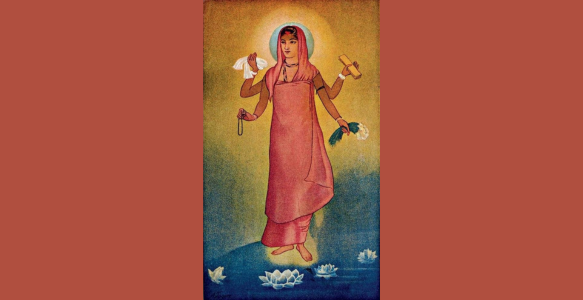
On a small sheet of paper, not much larger than a diary page, a saffron‑clad woman stands alone, her four arms quietly extended, offering food, cloth, a manuscript, and prayer beads. There is no flag, slogan or battlefield- just a still, glowing figure against a soft, washed background. Yet this is the image that helped turn the idea of India into a person, a mother you could look in the eye and silently vow allegiance to.
Bharat Mata by artist Abanindranath Tagore was painted in 1905, at the height of the Swadeshi movement in Bengal, using gouache in a delicate “wash” technique that merged colour and atmosphere rather than sharp outlines and illusionistic depth. Measuring roughly 26.6 by 15.2 cm, it is an intimate work rather than a monumental one, designed to be held close, passed around, reproduced, and remembered. For a generation of artists, writers, and political thinkers, this modest sheet became a touchstone: the bharat mata painting by abanindranath tagore was less a single artwork and more a shared mental image of the nation.
What is Bharat Mata Painting by Abanindranath Tagore?
When people ask who painted Bharat Mata, art historians almost always point to Abanindranath’s 1905 image as the first fully formed visual of “Mother India” as a political and spiritual icon. Executed in gouache and wash, the painting shows a young woman standing frontally, framed by a double halo, lotus flowers at her feet, and an aura of light that blends softly into the landscape around her.
She is not a conventional goddess descended from a specific puranic story, but an allegorical figure - part Durga, part Bodhisattva, part everyday Bengali woman- channeling the allegory of a nation that was still in the process of imagining itself. Contemporary viewers immediately read the bharat mata painting as an emblem of Swadeshi era nationalism, even though there is no overt anti‑colonial motif in the picture.
For modern audiences accustomed to loud, muscular versions of national imagery, encountering Abanindranath’s original can feel almost disorienting. Seen from a curator’s desk in Bengaluru, this painting often functions as a quiet counterpoint to later, more bombastic representations of Bharata Mata in posters and political murals. It invites us to think about nationhood as a tender, precarious emotion rather than a fixed, triumphant stanc e- something we often echo when we juxtapose contemporary works on identity with early nationalist images in our editorial features.
The Historical Context Behind the Creation of Bharat Mata
1. Rise of Nationalist Thought in Art and Literature
By the early twentieth century, Indian artists and writers were engaged in intense debates about what “Indian” art should look like under colonial rule. Academic realism, imported through British art schools, dominated official taste, with oil paintings by artists such as Raja Ravi Varma showcasing Western perspective and modelling while depicting mythological and allegorical themes.
Alongside this, literary and political circles were starting to imagine the nation itself as a mother figure - visible in Bankim Chandra Chattopadhyay’s Vande Mataram from Anandamath, which personified the land as a goddess long before Abanindranath began painting Bharat Mata. This fusion of cultural pride and political aspiration set the stage for an image like Abanindranath’s, where the nation could be both sacred and modern, rooted in tradition yet speaking to immediate political anxieties.
2. Why Abanindranath Tagore Painted Bharat Mata
Abanindranath - nephew of Rabindranath Tagore - was deeply involved in this search for an indigenous artistic language, and his practice became a laboratory for rethinking subject matter, technique, and audience. The impetus to paint this work came amid the anti‑colonial Swadeshi movement in Bengal, as activists resisted the 1905 partition of the province and called for indigenous production and cultural renewal.
He envisioned the figure initially as “Banga Mata” (Mother Bengal), drawing from the everyday presence of Bengali women around him, perhaps even modelling the face on his own daughter. In other words, the painting Bharat Mata was not only a political act but a familial and aesthetic one, grounded in the textures of daily life.
3. Bharat Mata and the Swadeshi Movement
Created in 1905, it circulated quickly in Swadeshi circles: it was copied by other artists, reproduced in vernacular magazines, and used on posters to raise funds and morale. One 1906 periodical famously captioned a reproduction “The Spirit of the Motherland,” signaling how rapidly the image had moved from personal work to public symbol.
For activists and students, the painting offered a non‑violent, devotional focus for their anger and hope. Instead of rallying around a battlefield scene, they rallied around a serene mother whose four gifts- food, clothing, knowledge, faith - mapped neatly onto Swadeshi demands for economic self‑reliance, indigenous education, and cultural renewal.
4. How Banga Mata Became Bharat Mata
Abanindranath’s original title, “Banga Mata,” indicates a more regional devotion; the shift to “Bharat Mata” happened through reception rather than a single artist’s decree. As the image circulated beyond Bengal, viewers began to read the figure as representing the entire subcontinent, not just one province.
In that sense, Bharat Mata painted by Abanindranath became a site of negotiation: between region and nation, between inclusive pan‑Indian visions and the risk of equating the nation too closely with a specifically Hindu goddess form. The painting’s afterlife- spanning posters, murals, and later reinterpretations by artists like Nandalal Bose - traces how a regionally inflected “Banga Mata” grew into a widely recognised Bharath Matha painting.
Visual Features of the Bharat Mata Painting
1. Appearance and Posture of Bharat Mata
At the centre of the composition stands a youthful woman, upright yet gentle, her weight evenly distributed, her gaze slightly lowered rather than confrontational. She is encircled by a double halo that radiates into a warm, golden field, visually linking her to both Buddhist icons and Mughal imperial portraits where halos signal divine authority.
Lotus flowers line the ground by her feet, forming a kind of floral throne that underscores her purity and spiritual elevation. The overall effect is of quiet, contained energy rather than dramatic movement - closer to the inward poise of a meditating figure than the dynamic stride of a warrior goddess.
2. The Four Arms and Their Symbolic Meaning
The figure’s four arms immediately tie her to the world of Hindu goddesses like Durga, whose multiple limbs signal their ability to hold, protect, and act in many realms at once. In Abanindranath’s version, each hand holds a distinct attribute: a palm‑leaf manuscript, a sheaf of grain, a white cloth, and a rudraksha mala.
Together, these elements outline a blueprint for a self‑sufficient nation: knowledge, food, clothing, and spiritual resilience. Abanindranath Tagore’s Bharat Mata painting thus compresses an entire programme for social and economic renewal into a calm, almost domestic gesture of offering.
3. Clothing, Colors and Spiritual Elements
Her robes are predominantly saffron - colour of renunciation and sacrifice- softened by Abanindranath’s wash technique into veils of tone rather than flat patches of pigment. The earth‑toned, muted background eschews detailed landscape in favour of atmospherics: a soft glow where earth and sky meet, suggesting a land bathed in spiritual light.
The halo, lotus, and rudraksha beads together align her with a broader pan‑Asian visual vocabulary spanning Buddhist, Jain, and Hindu traditions, rather than a single sectarian identity. Yet that very amalgam anticipates later debates about how fully a figure like Bharat Mata can include non‑Hindu citizens in her embrace.
4. How the Composition Reflects Indian Identity
Compositionally, the painting avoids Western linear perspective, opting instead for a frontal, hieratic figure set against a shallow, flattened space - an echo of Rajput and Mughal miniatures. This refusal of academic realism is not merely stylistic; it’s a statement about locating modern Indian identity within indigenous visual lineages.
In doing so, the work aligns itself with a broader move in the Bengal School to resist colonial academic norms, choosing instead a synthesis of older Indian and East Asian models. The result is an image that feels culturally specific yet porous enough to accommodate multiple readings, from devotional to political, from personal to collective.
For us, the most radical decision here is not the four arms or the halo; it’s the softness. In a period of political turbulence, Abanindranath gives us a nation that refuses spectacle and instead insists on vulnerability as a form of strength.
Symbolism of Bharat Mata
1. The Book as a Symbol of Knowledge
The manuscript in Bharat Mata’s hand gestures to education and intellectual self‑determination- an insistence that political freedom without cultural and pedagogical autonomy would be incomplete. At a time when colonial education policies were reshaping everything from curricula to aspirations, this book becomes a quiet counter‑manifesto.
2. The Sheaf of Paddy and Agricultural Prosperity
The sheaf of grain evokes rural life, agrarian labour, and the promise of food security. It acknowledges that nationalist dreams rest on the labour of peasants and farmers, long before policy documents catch up.
3. The White Cloth and Self-Reliance
The white cloth has often been read as a symbol of purity and self‑reliance, anticipating later Swadeshi emphasis on indigenous textiles. It is a modest counterpart to the more famous homespun of Gandhian khadi, a textile gesture embedded not in spinning wheels but in painted folds.
4. The Rudraksha Mala and Spiritual Strength
The rudraksha mala signals faith - though not a narrowly defined one. It points to an inner reserve of spiritual strength that would be needed to withstand a long struggle for independence.
Artistic Techniques Used in Bharat Mata
1. Influence of Mughal and Rajput Miniature Traditions
The painting’s flatness, delicate line, and frontal, iconic figure reveal Abanindranath’s sustained engagement with Mughal and Rajput miniature traditions. He drew on these earlier schools for their stylised treatment of space and their capacity to make small works feel monumental in meaning.
The halo and compositional emphasis on a central figure echo Mughal allegorical portraits like Bichitr’s Jahangir Preferring a Sufi Shaikh to Kings, where rulers are framed by cosmic symbols. Abanindranath translates that imperial aura into a democratic icon, replacing emperor with mother, court with countryside.
2. Japanese Wash Technique and Its Impact
Tagore’s signature wash technique - developed partly through his engagement with Japanese ink painting and broader Pan‑Asian currents- relies on diluted pigment, layered gently to create a luminous, atmospheric effect. In Bharat Mata painting, this method allows the figure and background to bleed into one another, erasing the hard edges typical of Western academic art.
This soft merging of forms underscores the painting’s thematic concern with unity and interdependence: land and figure, body and aura, nation and devotee.
3. Distinctive Features of the Bengal School Style
Bharat Mata is often cited as a foundational work of the Bengal School of Art, which sought to build a truly “national” style rooted in regional materials like tempera and watercolour, and in historical visual sources from across South Asia. In contrast to British academic art, which prized illusionism, the Bengal School emphasised mood, colour, and spiritual introspection.
This shift had far‑reaching implications, influencing artists such as Nandalal Bose and shaping the visual vocabulary of early independent India. In that lineage, Bharat Mata painted by Abanindranath stands at once as an experiment and a manifesto, bridging miniature traditions, Japanese aesthetics, and modern political urgency- a nexus that later artists would revisit in their own ways, including in contemporary bharath matha painting reinterpretations.
Bharat Mata's Influence on Indian Art
The impact of Bharat Mata on subsequent Indian art is hard to overstate. It quickly became a touchstone for the Bengal School, influencing students like Nandalal Bose and shaping how nationalist leaders imagined a “truly Indian” art form. Reproductions of the image circulated widely, entering popular visual culture through posters, calendars, and political ephemera.
Beyond Bengal, the painting’s template - female allegory, halo, attributes, soft palette- echoed in countless later depictions of Mother India, from studio prints to political posters. At the same time, its Pan ‑ Hindu visual language later raised questions about how inclusive this national mother could be, especially for religious minorities - questions that contemporary artists continue to engage with in their own responses to bharath matha, Bharat Mata allegory, and modern Bharat Mata imagery.
FAQs About Bharat Mata Painting
1. What is the meaning of Bharat Mata painting by Abanindranath Tagore?
The painting presents the nation as a serene, four‑armed mother figure offering food, clothing, knowledge, and faith- an allegory of a self‑reliant, spiritually grounded future India.
2. When was the Bharat Mata painting created?
It was painted in 1905, in the midst of the Swadeshi movement and opposition to the Partition of Bengal.
3. How is Bharat Mata connected to the Swadeshi Movement?
The work was conceived during the Swadeshi agitation, circulated through posters and magazines, and used to inspire anti‑colonial sentiment and support indigenous production.
4. Which art style influenced the Bharat Mata painting?
The painting draws on Mughal and Rajput miniature traditions, Buddhist and Hindu iconography, and Japanese‑influenced wash techniques, and is a foundational example of the Bengal School style.
5. Why is Bharat Mata considered an important nationalist artwork?
It is one of the earliest and most influential visualisations of Mother India as a political icon, uniting spiritual symbolism with nationalist aspirations.
6. Where is the original Bharat Mata painting located today?
The original work is housed in the Victoria Memorial Hall in Kolkata.
7. How did Bharat Mata influence the Bengal School of Art?
It helped inaugurate the Bengal School’s search for a national style rooted in indigenous materials and pre‑modern Indian art forms, steering artists away from British academic realism.
8. What makes Bharat Mata different from other depictions of Mother India?
Unlike later, more dramatic images, Abanindranath’s version is intimate, understated, and deeply spiritual, relying on softness, atmosphere, and allegory rather than spectacle.
