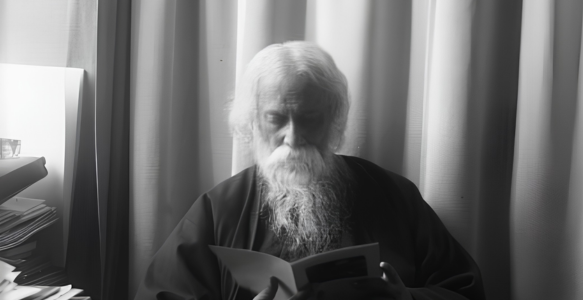
Standing before a Rabindranath painting, you don’t immediately “decode” it - you feel it first. The faces look familiar yet unplaceable, the birds are half‑real, half‑dream, and the landscapes seem to hover between twilight and memory.
For a generation raised on the poet, discovering Rabindranath Tagore the artist can feel like stepping into a parallel universe - one where the Nobel laureate speaks in ink blots, veiled profiles, and “probable animals” instead of rhyme and metre. His late‑life art practice wasn’t a polite hobby on the side; in the last decade of his life, painting became his primary language to speak to a world that might never read Bengali.
This guide looks at Tagore's paintings as a radical, self‑invented visual grammar that altered the course of modern Indian art.
Who Was Rabindranath Tagore?
To answer “who is Rabindranath Tagore” visually, we have to begin with the life that preceded the paintings. Born in 1861 into a prominent Brahmo Samaj family in Calcutta, Tagore grew up in a household saturated with music, literature, theatre, and reformist ideas. His nephew Abanindranath Tagore would later pioneer the Bengal School, so the young Rabindranath was surrounded early by experiments of nationalist aesthetics.
As a writer, Tagore reshaped Bengali literature, composing poetry, plays, essays, novels and songs; he became Asia’s first Nobel laureate in 1913 for Gitanjali, and his songs would go on to become the national anthems of India and Bangladesh. This Rabindranath Tagore biography is familiar: poet, philosopher, educator, founder of Visva‑Bharati at Santiniketan, a university that treated nature and craft as integral to learning. Less known is that he had no formal training in art; whatever we now call Rabindranath Tagore’s art emerged from a private, experimental space.
Between 1928 and his death in 1941, he produced more than 2,000 works, condensing a lifetime of intuition, doubt, and spiritual enquiry into just over a decade of feverish making.
Artistic Journey of Rabindranath Tagore
1. Beginning of His Artistic Career in His Sixties
The story begins almost accidentally. In the mid‑1920s, Tagore started “spoiling” his own manuscripts - turning scratched‑out words and ink blots into shapes so they wouldn’t distract him. These corrections slowly morphed into faces, birds, and hybrid beings; by the late 1920s, he had turned this private diversion into a serious visual practice. His first public exhibition of paintings was held not in India but in Paris in 1930, positioning him unexpectedly alongside global modernists rather than within a provincial niche.
Unlike his contemporaries paintings, which grew out of a consciously nationalist rejection of Western academic realism, Tagore’s art stepped into a more inward, psychological territory - closer in spirit to European Expressionism and Surrealist explorations of the subconscious.
2. How Manuscript Doodles Evolved into Art
Those first manuscript “doodles” are essential to understanding Rabindranath Tagore’s painting style. Tagore often let accidents lead the way: a spill suggested a beak, a crossing‑out became the curve of a nose, and a lingering ink trail hinted at a figure’s profile. Over time, these marginalia detached from the text and moved onto separate sheets, becoming autonomous drawings and paintings made by Rabindranath Tagore.
He embraced this intuitive method - what today we might call automatic drawing - as a way to bypass the intellect and let the subconscious speak. That’s why art by Rabindranath Tagore rarely illustrates specific literary scenes; instead it feels like visuals after‑images of emotions, half‑remembered dreams, or characters who never made it into the stories.
3. Complex Landscapes & Symbolic Beings
From these beginnings grew two main streams: complex, moody landscapes and a cast of symbolic beings - faces, masks, birds, and “probable animals.” His landscapes often sit at twilight, the horizon low, skies heavy and streaked, with solitary trees or clustered houses that feel more psychological than geographic. The creatures, meanwhile, seem assembled from memory: a bird with exaggerated claws, a beast whose anatomy is deliberately uncertain, human heads that are part mask, part confession.
Tagore's paintings origin in “mistakes” matters: it gives viewers permission to see hesitations, erasures and oddities not as flaws but as the very engine of the work.
That vulnerability of lines searching for form - is still palpable in the drawings; it’s one reason Rabindranath Tagore’s artwork feels oddly contemporary to younger artists used to multidisciplinary practice.
Styles and Influences in Rabindranath Tagore's Paintings
1. European Expressionism Influence
Many critics have pointed to the kinship between Tagore’s late portraits and European Expressionism: thickened outlines, distorted features, compressed space, and an emphasis on psychological intensity over anatomical accuracy. Yet his figures are quieter, more inward‑turned, less concerned with urban angst than with spiritual solitude - closer perhaps to the interiority we see in S.H. Raza, Ram Kumar or Tyeb Mehta’s early heads, though reached by a completely different route.
2. Ink and Wash Technique
Technically, much Rabindranath Tagore art style rests on ink and wash on paper: sepia, brown and grey inks dragged into soft halos, sometimes over touches of colour. Tagore had encountered Japanese artists Yokoyama Taikan and Hishida Shunsho, whose calligraphic brushwork and wash techniques strongly influenced the Bengal School; their approach to line and fluid tonal transitions seeped into his own work as well. In some landscapes - such as the blue‑toned mountain scenes - he uses wash to dissolve form almost to the edge of abstraction.
3. Use of Rhythmic Lines and Geometric Planes
Alongside wash, his line is intensely rhythmic: looping around a chin, tightening at the nose, released suddenly in the sweep of hair or drapery. In works like Head Study (Geometric), this line breaks into sharp planes and facets, suggesting he was watching the same global shifts toward Cubism and geometric simplification even if he never fully embraced them. His lines have an almost carved, insistent weight.
In the Indian context, Rabindranath Tagore’s paintings and scale align him more with miniature painting and calligraphy than salon oil painting - another quiet refusal to play by European academic rules even while conversing with European modernists.
Famous Paintings by Rabindranath Tagore
What follows is a selection of works frequently cited when we speak of Rabindranath Tagore’s famous paintings, gathered from museum collections and later scholarship.
1. Bird Fantastic
Bird Fantastic is one of the best known images of Tagore’s fantastical avian world: a dark, elongated bird, claws tense, perched as if midway between folklore and pre‑historic cave walls. He often painted “weird and fantastic birds and beasts,” letting pattern and plumage become almost calligraphic. It is perhaps the quintessential famous painting of Rabindranath Tagore for audiences encountering his art for the first time.
2. Landscape (Evening Silhouette)
Sometimes described as Landscape or Evening Silhouette, this work belongs to a group of landscapes set in liminal light - dusk or dawn, where forms appear as silhouettes against heavy skies. Here, a strip of land with trees or houses is pressed low in the composition, the sky taking up more space, as if the real subject is atmosphere rather than terrain.
3. Dancing Woman
In Dancing Woman, a lone female figure, caught mid‑gesture, is built up from sweeping curves and dense blocks of colour or ink. Rather than anatomical precision, Tagore emphasises rhythm and inner abandon - the body almost becoming a calligraphic sign for movement itself.
4. Woman's Face
Woman’s Face (often identified with NGMA’s Face of a Veiled Woman) is a sepia‑ink portrait with a soft veil and an oval head - one of his most iconic head studies. The features are simplified, eyes downcast, but the tension between concealment and presence is intense.
5. Head Study (Geometric)
Head Study (Geometric) pushes his portraiture into sharper abstraction: planes slice across cheeks and forehead, and the head becomes almost architectural. It’s a crucial work in understanding how far he was willing to distort form while still retaining a recognisable human presence.
6. Masked Faces
Across several works grouped as “Masked Faces,” Tagore overlays human heads with mask‑like features - flat eyes, rigid outlines, decorative patterning. These images tap into the uncanny: are we looking at theatre, ritual, or the social masks of modern life?
7. The Blue Landscape
Sometimes associated with works like The Blue Mountain, these landscapes use blue wash to turn hills into almost breathing entities. Forms dissolve at the edges, as if you’re watching a memory rather than a scene.
8. Probable Animal
Tagore himself referred to some of his creatures as “probable animals” - beings that might exist only in the mind. In such images, anatomy is deliberately unresolved; you see hints of horns, wings, or tails without certainty, echoing his fascination with fantasy and the absurd.
9. Portrait of a Man
A number of untitled male heads are often catalogued as Portrait of a Man, showing furrowed brows, intense gazes, or stoic calm. Some are strongly expressionist; others are quieter, almost icon‑like, expanding the range of Rabindranath Tagore portrait studies.
10. The Forest (Mystical Woods)
In works loosely grouped as The Forest or “mystical woods,” trees crowd the picture plane, their trunks and branches forming a dense, almost script‑like pattern. Light flickers through gaps, turning the forest into a state of mind rather than a botanical record.
11. Self-Portrait
Tagore painted himself several times: long hair, intense eyes, features simplified into broad planes. These self‑portraits feel less like likenesses and more like states of being - ageing, contemplative, burdened yet luminous.
12. Piyali
Piyali (1940), a pen‑and‑ink portrait on paper, is among the more tender late works: a woman’s head, simply drawn yet emotionally charged. Auction records and institutional notes suggest an intimate, possibly personal subject, adding to its aura.
13. Face (Met Museum)
The Metropolitan Museum’s Face (ca. 1930) is a pen‑and‑ink and wash head, typical of his late style. The museum notes his interest in the subconscious and Surrealist currents of the time, reading the work as an expression of internal negotiations rather than a specific sitter.
14. Untitled (Couple)
In a number of works loosely described as Untitled (Couple), two figures lean into or away from each other in compressed spaces. Relationships are implied but not narrated; proximity and posture do the emotional work that text might have done in his stories.
15. Where the Mind is Without Fear
While Where the Mind is Without Fear is primarily a poem, later curatorial practice has associated some contemplative head and landscape compositions with its spirit, occasionally using the title for exhibitions or reproductions. This is a case where the literary text and visual mood echo across media rather than one illustrating the other.
16. The Heart Sculpture: Tagore's Only Known Sculpture
The Heart is a small quartzite object carved by Tagore in 1883 - his only known sculptural work. Shaped like a heart with a Bengali inscription, it was likely a love token, later identified and sold at auction in Kolkata in 2025 for over ₹1 crore, underscoring how even this modest object has entered art history.
Beyond these, we could add works like Veiled Woman, Blue Mountain, and his woodcut of men at prayer (Namaz) as important paintings made by Rabindranath Tagore. Lists of “iconic works” risk freezing a restless practice. A more truthful way to encounter Rabindranath Tagore art work is to track how a single motif mutates over years - the same oval face growing heavier, more abstract, more mask‑like - as if we’re watching him think in slow motion.
Key Characteristics of Rabindranath Tagore's Artwork
1. Fusion of European Modernism & Indian Spirituality
In many pieces, we see a fusion of European modernist devices - distorted anatomy, expressive line, abstracted space - with an Indian spiritual and philosophical undertone rooted in the Upanishads and the Bhakti tradition. This fusion underlies how historians place his style within “Contextual Modernism”: a modernism responding to local histories rather than merely importing Parisian fashions.
2. Feminine Focus in Portraiture
Women appear frequently in his heads and half‑length figures - veiled, introspective, often unnamed. Unlike the iconic feminine allegories in nationalist art (think Bharat Mata in Abanindranath’s work), Tagore’s women feel more individual and psychologically dense, their stories withheld rather than proclaimed.
3. Spiritual Undertones
Even without overt religious symbols, many works carry spiritual undertones: solitary figures in vast landscapes, faces lost in thought, beasts that feel like totems rather than zoological studies. As with his songs, the spiritual here is less doctrinal and more experiential - a sense of being suspended between the finite and infinite.
Symbolic Motifs in Rabindranath Tagore's Art
1. Self-Portraits
His self‑portraits compress ageing, ego, and vulnerability into a single visage. They’re not flattering: cheeks sag, eyes burn, the beard becomes a mass of strokes. Seen next to his public photographs, they feel brutally honest, almost as if he reserved his most unguarded self for the page.
2. Bird Paintings
Birds recur in many works, from the famous Bird Fantastic to smaller ink studies titled simply Bird. They oscillate between symbol and species: sometimes predatory, sometimes comic, often perched on the edge of metamorphosis.
3. Human Heads & Faces
Faces are, as one exhibition put it, “quintessential” in his art. They carry the narrative function that characters do in his novels - only here without words, just the tilt of a head, the curve of a lip, the weight of a brow.
4. Mask Imagery
Masks and mask‑like faces suggest performance, concealment, and the fragmentation of identity in modern life. They may draw on folk, tribal or theatrical forms, but in his hands they also echo a psychological mask - the roles we inhabit in society.
5. Mystical Landscapes
His landscapes, especially the liminal blue landscapes and evening silhouettes, operate almost like emotional weather. They’re less about geography than about states of mind - melancholy, solitude, quiet elation.
For someone arriving via Rabindranath Tagore information searches, motif‑based curation can offer an accessible entry point into a body of work that otherwise feels elusive.
Rabindranath Tagore's Impact on Indian Art
As a visual artist, Tagore modernised Bengali art by rejecting rigid classical forms and linguistic strictures, contributing to a broader shift we now call modern Indian art. His paintings, created outside academic institutions, legitimised the idea that a major cultural figure could reinvent himself visually late in life and be taken seriously on international stages.
His work expanded the possibilities of modern Indian art, influencing later generations - from Husain’s mythic horses to Ram Kumar’s haunted cityscapes - to explore personal, psychological, and symbolic subjects. Rabindranath Tagore’s art style positioned between the Bengal School and post-Independence modernism, made him a key figure whose multidisciplinary practice continues to resonate with contemporary artists.
FAQs About Rabindranath Tagore
1. When did Rabindranath Tagore start painting?
Rabindranath Tagore began painting seriously in the late 1920s, when he was in his sixties.
2. How many paintings did Rabindranath Tagore create?
Tagore created more than 2,000 paintings and drawings during the last decade of his life.
3. What art style is Rabindranath Tagore's work categorized under?
His art is associated with modernism, expressionism, and imaginative, experimental forms.
4. What medium did Rabindranath Tagore primarily use for painting?
Tagore primarily worked with ink, brush, and wash techniques on paper.
5. What are Rabindranath Tagore's most famous paintings?
Some of his best-known works include Bird Fantastic, Dancing Woman, Woman's Face, and The Blue Landscape.
6. Was Rabindranath Tagore formally trained in art?
No, Rabindranath Tagore was largely self-taught and developed his artistic style through experimentation.
