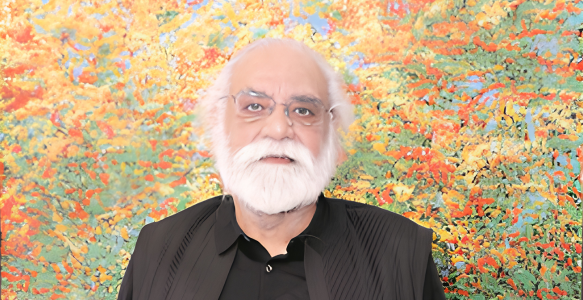
On some evenings in Delhi, if you look closely enough at the horizon, the city seems to dissolve into a low band of green-grey, neither fully real nor entirely imagined. It is exactly in this in‑between space that Paramjit Singh has painted for more than six decades – forests that never quite belong to a map, grass that shimmers between memory and dream, skies that feel like held breath. For a generation of younger painters, Paramjit Singh, the artist is shorthand for a very particular kind of interior landscape: quiet, dense, and yet always on the verge of movement.
What makes his work compelling is not just its lyrical beauty but the way it redefines landscape within Indian modernism – closer in spirit to S. H. Raza’s meditative abstractions or Ram Kumar’s existential cities than to straightforward topography. While global viewers sometimes reach for analogies with European abstractionists, Singh’s forests, fields and shadows remain stubbornly rooted in North Indian light, Punjabi memory and the long arc of post-Independence Indian art.
Who Was Artist Paramjit Singh?
Paramjit Singh was born in Amritsar on 23 February 1935, and the pastoral surroundings of Punjab stayed with him long after he moved to Delhi. He studied at the School of Art, Delhi Polytechnic (now the College of Art), completing his fine art diploma in 1958, a period when Indian modernism was finding a new, self‑conscious language after Independence.
In 1960, he became a founding member of “The Unknown,” a Delhi-based group of young artists and sculptors who wanted to test the boundaries of form and subject beyond the academic canon. Over three decades of teaching at Jamia Millia Islamia in New Delhi – eventually heading the Fine Arts department and later being honoured as Professor Emeritus – he helped shape how generations of students thought about landscape, surface and silence.
His reputation today rests on an extraordinary body of landscape paintings and charcoal drawings that hover between realism and abstraction: dense clusters of trees, flowing water, rugged boulders and tall grass rendered with dynamic brushwork and subtle, shimmering light. Rather than documenting a specific place, Paramjit Singh art feels like walking through the remembered outskirts of a city, where the line between inner and outer worlds is constantly blurred.
When we ask who is Paramjit Singh in the context of contemporary Indian landscape, the answer is deceptively simple: he is the painter who made “silence” a subject without ever painting a figure. His importance lies not in grand gestures but in the way his work teaches us to look – slowly, patiently – into undergrowth, twilight and shadow.
Quick Facts About Paramjit Singh
- Date of Birth: 23 February 1935
- Place of Birth: Amritsar, Punjab, India
- Education: Diploma/Bachelor’s in Fine Arts, School of Art, Delhi Polytechnic (1953–1958)
- Known For: Imagined yet lifelike landscapes, charcoal forests, lyrical landscape paintings, and the idea of capturing the “sounds of silence” in nature.
- Parents: Not widely documented in public art-historical sources; biographical profiles tend to foreground education and professional life instead.
- Spouse: Married to fellow painter Arpita singh, one of the leading figures of Indian contemporary art.
- Base: Lives and works in New Delhi, India
It’s telling that Paramjit Singh’s biography entries privilege forests and classrooms over family detail – his public identity is almost entirely woven through teaching, painting and quiet experimentation. That reticence mirrors the paintings themselves: intensely personal, yet guarded, always offering atmosphere rather than confession.
Artistic Journey & Early Background of Paramjit Singh
Paramjit Singh’s journey begins in the libraries and courtyards of Khalsa College, where he first encountered European and Indian art books while still surrounded by Punjab’s fields and orchards. This early combination of printed image and lived landscape would later shape the tension in his work between observed nature and imagined terrain.
By the mid‑1950s, as he studied at Delhi Polytechnic, the debates around modernism were in full swing: the Progressives in Bombay, experiments with abstraction, and a new urgency to define “Indian” form without slipping into cliché. Singh began with more conventional landscapes, along with portraiture and figuration, before slowly pushing his canvases towards looser brushwork and denser atmospheres.
His first solo show at Triveni Kala Sangam in 1967 marked the emergence of a distinct voice – landscapes already moving away from topographical description toward mood. A stint in Norway, working on printmaking at Atelier Nord, sharpened his sensitivity to monochrome, leading later to the charcoal drawings that would become central to The Seventh Walk film. Across these decades, Paramjit Singh history is inseparable from his role as an educator: travelling, exhibiting, and returning to the classroom, where teaching appears to have deepened rather than diluted his studio practice.
Seen from today’s vantage point, his career runs parallel to the institutionalisation of contemporary art in India – from artist-led groups like The Unknown, through state academies and university departments, towards the international circuits of biennales and film festivals. Artist Paramjit Singh becomes, almost accidentally, a bridge between generations.
When I think of Paramjit Singh biography in a single image, it’s the figure suggested in The Seventh Walk: an artist wandering through a forest, following a footprint and a faint thread of music, not entirely sure where it will lead. That openness to being led – by memory, by mark‑making – is at the heart of his journey.
Styles & Themes Used in Paramjit Singh Paintings
Over time, Paramjit Singh painting styles have moved through at least three recognisable phases: early, more descriptive landscapes; a period of still lifes and landscapes; and a mature language of imagined terrains with strong orchestration of light and colour. Across these shifts, certain anchors remain: the absence of human figures, a fascination with edges (the line where field meets forest, water meets rock), and an insistence on nature as something felt rather than merely seen.
1. Abstract Landscapes
Singh’s landscapes sit between figuration and abstraction, grounding themselves in trees, stones and grass but dissolving into rhythm and texture as you look closer. Critics have described them as “fictitious landscapes” – boundless and often without conventional perspective, where low horizons and dense foliage pull the eye sideways rather than into deep space.
The absence of narrative detail or figures places his work in a quiet dialogue with global abstractionists who approached landscape as energy field rather than vista, even as his palette and motifs remain resolutely North Indian.
2. Sounds of Silence
In one oft‑quoted remark, Singh said he wanted to “capture the sounds of silence in nature,” signalling how central stillness – and its hidden turbulence – is to his practice. Branches bend towards one another as if in conversation; dry earth seems to crackle; the forest canopy traps not just light but an almost audible hush.
The film The Seventh Walk, built around his charcoal drawings and his presence in the Kangra landscape, makes this sensorial silence explicit: footsteps, rustling leaves, and long, meditative pauses echo the atmosphere of his drawings.
3. Color Palette and Emotional Tone
His canvases lean heavily into greens, blues, lilacs and earth tones, often modulated so finely that a single patch of foliage contains multiple temperatures of green. Highlights in yellow or white flicker like caught sunlight, while darker passages push his work towards something almost nocturnal, even when the scene is ostensibly daytime.
Rather than chasing picturesque beauty, the colour in Paramjit Singh paintings tends to suggest mood: anticipation before a storm, the heaviness of summer heat, or the cool, slightly melancholic calm of twilight.
4. Dynamic Brushstrokes
At close range, his surfaces are built from short, dynamic strokes that sometimes read like grass, sometimes like pure gesture. In works from the 2000s, especially, this flickering brushwork lends the foliage a tremor – you sense wind, insects, and the constant, low‑level movement of a living ecosystem.
By contrast, the charcoal drawings strip away colour to focus on tonality and mark: soft smudges and sharp, dark accents that build a forest out of light and shadow alone.
Placed alongside other Indian modernists who reimagined landscape – from Ram Kumar’s abstracted cities to Raza’s meditative bindus – Paramjit Singh art occupies a quieter, more rural register. It asks us to consider landscape not only as geography, but as a space where memory, time and solitude accumulate.
If I had to summarise Paramjit Singh painting styles in one phrase, it would be “restless stillness.” The surface always hums – with strokes, lines, tonal shifts – yet the overall experience is one of absolute quiet. That contradiction is where his work lives.
Famous Paintings of Artist Paramjit Singh
While many of Singh’s works are titled simply “Untitled,” a handful of named pieces and bodies of work have become touchstones in discussions of Paramjit Singh history. These works map how his language of forests and fields has evolved over time, from denser, more linear compositions in the 1970s to the expansive, luminous canvases of the 2000s.
1. The Seventh Walk Series
The phrase “The Seventh Walk” refers both to a body of drawings and to the 2013 experimental film by Amit Dutta, built around Singh’s charcoal forests and his presence in the Kangra landscape. The film – screened at festivals in Toronto, San Francisco, Rotterdam, Rome and even at MoMA, New York – follows a painter wandering through a forest, led by a footprint and a fragment of music, mirroring the way Singh “walks” through his own imaginary terrains on paper.
2. Near the Woods
Painted in 1970, Near the Woods is an oil on canvas work that shows Singh already deeply engaged with dense foliage and ambiguous space. In 2026, the painting made headlines when it sold at Sotheby’s New York for around 243,200 USD, more than twenty times its low estimate – a late but emphatic recognition of his place in the market narrative around South Asian modernism.
3. Leaf Shower
Leaf Shower (2004), an expansive oil on canvas measuring roughly 48 by 96 inches, presents a forested scene where foliage seems to fall or cascade across the surface. The title hints at both meteorological and emotional weather: a moment where the forest briefly reveals its own fragility.
4. Red Bloom
Another work from 2004, Red Bloom, uses a dominant red field against darker greens and blacks, creating a landscape that feels almost volcanic from a distance. The “bloom” here is not a single flower but an overall flare of colour, as if the land itself were flushing.
5. The Path in the Grass
The Path in the Grass (1986) is a quieter, more intimate canvas: an 18.5 by 24 inch oil where a narrow passage cuts through tall grass, the kind of path that appears only because bodies have walked it repeatedly. It is a simple motif, but it condenses many of Singh’s concerns – transition, threshold, and the traces humans leave on landscapes even when they’re not pictured.
These works, taken together, show how artist Paramjit Singh keeps returning to similar motifs – trees, grass, paths, clearings – without ever repeating himself. Each painting feels like a different chapter in the same long, wordless walk.
Awards and Recognition Received by Paramjit Singh
Singh received the National Award from the Lalit Kala Akademi in 1970, a pivotal moment that acknowledged his contribution to redefining landscape within Indian modern art. This recognition arrived relatively early in his career, just a few years after his first solo show, underlining how quickly his peers and institutions registered the distinctiveness of his vision.
Beyond formal prizes, his long tenure at Jamia Millia Islamia – and his later designation as Professor Emeritus – stands as a different kind of honour, rooted in pedagogy and institutional memory rather than trophies. Internationally, the circulation of The Seventh Walk at major film festivals and at MoMA in New York positioned him in another, more experimental circuit, bringing his drawings to audiences far beyond the gallery.
FAQs About Paramjeet Singh
1. What is Paramjit Singh famous for?
Paramjit Singh is known for his atmospheric landscape paintings that blend realism, memory, and abstraction.
2. What is Paramjit Singh's painting style?
His style features imagined landscapes, rich natural colours, expressive brushwork, and a strong sense of mood and contemplation.
3. Where can I see Paramjit Singh's paintings?
His works can be found in major museums, galleries, and private collections across India and internationally.
4. Why are Paramjit Singh's paintings considered unique?
His paintings transform landscapes into meditative spaces that evoke memory, silence, and emotion.
5. Where has Paramjit Singh exhibited his artworks?
Paramjit Singh has exhibited extensively in India and abroad, including New Delhi, New York, London, Singapore, and Hong Kong.
