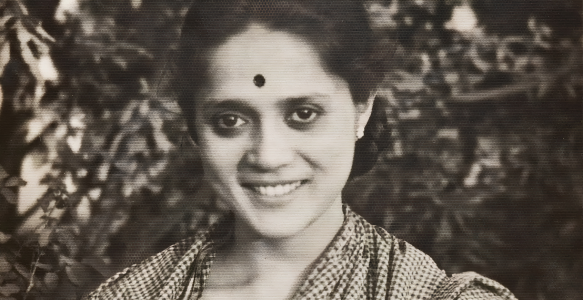
Who was Meera Mukherjee?
Artist Meera Mukherjee (1923–1998) emerged from Kolkata’s Bengal School tradition to become one of modern India’s most distinctive sculptors. Trained in painting, graphics, and sculpture, she later studied in Munich before a clay horse figurine and her time with Bastar’s Gharua artisans redirected her practice toward Dhokra casting. From that point on, the Meera Mukherjee biography became a story of translation: folk craft into modern form, village life into bronze, and everyday labour into art of lasting dignity. Meera Mukherjee’s artwork remains memorable for its texture, humanism, and deep connection to India’s rural and spiritual worlds.
Quick Facts About Meera Mukherjee
– Date of Birth: 1923
– Place of Birth: Kolkata (then Calcutta), West Bengal
– Education: Indian Society of Oriental Art (Calcutta, Tagore’s class); Government College of Art (Kolkata); Delhi Polytechnic (now Delhi Technological Univ.)
– Known For: Bronze sculpture; pioneering use of Dhokra (lost-wax) casting to portray rural and spiritual themes
– Parents: Dwijendramohan Mukherjee; Binapani Devi Mukherjee
– Spouse: Briefly married in 1941; divorced (remained single thereafter)
– Date of Death: 1998
Artistic Journey of Meera Mukherjee
1. Munich Years and a New Artistic Direction
Awarded an Indo-German fellowship, the 30-year-old enrolled at Munich’s prestigious Akademie der Bildenden Künste. Initially grounded in India’s Bengal School aesthetic, she absorbed Europe’s avant-garde. “She met English sculptor Henry Moore,” notes one source, whose organic forms would later echo in her own figures. Yet it was Toni Stadler who steered her inner compass: he urged Mukherjee to seek inspiration in India’s folk heritage rather than European trends. By 1956, Mukherjee returned home with a resolve to sculpture art – letting form emerge from the clay and bronze traditions of her land.
2. Engagement with The Gharua Community
After Munich, Mukherjee’s canvas expanded to the forests and villages of India. Commissioned by the Anthropological Survey of India (ASI), she became a full-time researcher (1961–64) of India’s metalcraft traditions. With a sketchbook and camera, she lived among the Gharua artisans of Bastar (Chhattisgarh) for two years. They were master Dhokra casters using the cire-perdue (lost-wax) process; Mukherjee learned to pour molten bronze into their motifs. She meticulously documented every technique and daily ritual – these notes would fill books like Gharuas: A Metal Artisan Group and Their Art (1974) and Metal Craftsmen of India (1978). In one diary she compares their sacred smithing to religion, and strove to give that devotion equal dignity in her art.
3. Recognition and Exhibitions
By the late 1960s Mukherjee was nationally acclaimed. In 1968 she won the President’s Award for Master Craftsmen, and soon received West Bengal’s Abanindra Prize (1981) and India’s Padma Shri (1992). Major retrospectives followed: in 1983 Jehangir Art Gallery in Mumbai traced her work from 1963–1983, and her bronzes have since entered institutions like Bangalore’s Museum of Art & Photography (MAP) and Delhi’s Kiran Nadar Museum. Even decades after her death, Meera Mukherjee’s legacy is revived in shows – as recently as 2021–23 at Galerie 88 (Kolkata) and Mumbai’s 47/A space.
Techniques Used in Meera Mukherjee’s Works
1. Dhokra Art (Lost-Wax Casting)
At Bastar, she absorbed the Dhokra tradition – an ancient Indian bronze-casting method using wax models. In the cire-perdue process, she sculpted a detailed figure in wax, encased it in clay, then melted out the wax and poured molten bronze (copper alloy) into the cavity. The result is one of a kind. Mukherjee didn’t just follow the old steps; she modernized Dhokra. For instance, she wove wax “threads” and placed bronze pellets on her figures to echo tribal styles but in contemporary contexts.
2. 3-Phase Casting Method
To cast big figures safely, Mukherjee devised a three-step mold system. First she built a rough clay core of the sculpture’s shape. On this, she layered wax coils, refining the form and adding surface details. Finally she covered the wax with an outer clay shell. When fired, the wax dripped out, leaving space between inner core and outer crust for the bronze. This method prevented the mold from bulging under bronze’s heat.
3. Terracotta & Ceramic Works
Mukherjee was not confined to metal. In the 1970s–80s she produced many terracotta and ceramic figures and panels, often smaller-scale. Terracotta allowed her more spontaneity; for example, she made clay figures of dancers and women with muted earthy tones. In fact, many of her early Kantha embroidered works (1950s–’80s) began as drawings she herself painted, then gave to village women to stitch – fusing her painting background with folk craft.
4. Textural Memory
A signature of Mukherjee’s style is the texture of her surfaces. Unlike polished bronze statues, her pieces proudly show the seams of molds and the fingerprints of casting. She consciously retained “uneven surfaces” and the bronze “threads” used to join sections, as a tactile reminder of the process. In many works (e.g. Rudra Veena Player, Cosmic Dancer) these pellet lines coil around limbs or instruments, creating visual motion as if the figure were dancing in place.
Major Themes in Meera Mukherjee’s Sculptures
1. Dignity of Labour
The daily toil of ordinary people is a sacred subject for Mukherjee. Her bronzes often show labourers at work – boatmen, bricklayers, construction crews – heroes of survival. In Earth Carriers and Cablemen, anonymous builders bear the weight of progress with quiet strength. Even tasks like weaving or baking become lyrical under her hands.
2. Humanism & The Quotidian
Beyond labor, Mukherjee celebrated everyday life with warmth. Her characters sleep, play music, carry infants or protest in the streets. A series of “Minibus” and “Cablemen” set pieces capture crowds on the move, yet each figure retains individuality. In her diaries she wrote that watching villagers jump a bus bench gave her more inspiration than any textbook. Works like Spirit of Daily Work (a woman with a winnow) illustrate this: simple chores become meditative acts.
3. Spirituality and Music
Despite her focus on the mundane, the spiritual undercurrent runs through Mukherjee’s oeuvre. Deeply trained in Hindustani classical music, she often sculpted musicians and dancers as if capturing a silent song. The Rudra Veena Player and Cosmic Dancer (1982) are inscribed with the rhythmic beads and coils that mimic musical notes frozen in bronze. Works like The Buddha and Pilgrims to Haridwar also sit within a wider conversation around spiritual paintings.
4. Historical Figures
Mukherjee occasionally tackled grand history. Her Ashoka at Kalinga (1972) is the most famous: Ashoka’s moment of war-renunciation, captured in serene bronze. Unveiled amidst India’s post-Independence strife, it was a plea for peace. It shows Ashoka teaching his son, a gesture of passing non-violence across generations. Similarly, He Who Saw (1968) – sometimes interpreted as a rudimentary deity or prophet – blends folk primitive imagery with an implied narrative about vision and awakening.
5. Nature and Rural Life
Mukherjee was rooted in earth and village. Her portfolio overflows with trees, goats, rivers, and villages observed on countless walks. In her Mother Earth series, female faces merged with foliage, embodying fertility and nurture. The countryside she grew up in (a Bengal shaped by rivers and monsoons) frequently surfaces in works like Rain and Pankhawala.
Meera Mukherjee’s “stitched paintings” (collaborations with rural embroiderers) depict huts and landscapes with childlike vibrancy. This ties into the village art painting and realistic nature art.
Notable Sculptures by Meera Mukherjee
1. Ashoka at Kalinga (1972)
Meera Mukherjee’s famous sculpture, this bronze monument (about 3.5–4m tall) depicts Emperor Ashoka shortly after he witnessed the carnage of Kalinga and chose nonviolence. Ashoka’s hand on his son’s shoulder, gazing downward, conveys compassion. Created during a time of political strife (late 1960s India), it was intended as a message: even rulers must be human. Today it stands outdoors at Delhi’s ITC Sheraton Hotel, looming over gardens.
2. He Who Saw (1966–68)
Conceived in 1965 and cast by 1968, this was Mukherjee’s first true “monumental” bronze. The 2-meter figure, modeled after a local Bastar god’s idol, has the stance of a deity – broad chest, upright posture – but the featureless face of meditation. Composed of eight welded parts, it epitomizes her Dhokra casting; the seams and bead patterns are visible on its tall form. Perhaps “He who saw” implies a being who has witnessed both the divine and the mundane.
3. Pilgrims to Haridwar (c. 1983)
A rare polychrome bronze, this round relief (ca. 30 cm diameter) depicts a group of devotees carrying jugs and bundles, walking in silhouette. Despite small scale, Mukherjee packs spiritual drama: the figures are arranged rhythmically, as if circling a shrine, their forms elongated by the flow of cloth and bundles. An exhibition label explains that Mukherjee “approached the ordinary with spiritualism,” and Pilgrims to Haridwar is textbook example – the piety of simple village pilgrims is rendered with the grandeur of myth.
4. Sanjha Chulha (Evening Hearth)
One of Mukherjee’s most humanist compositions, Sanjha Chulha (often dated around the 1970s) shows family life around a cooking fire. It’s a small grouping of figures – probably a woman stoking coals and children watching – cast in warm bronze. The title means “twilight hearth,” and indeed the sculpted clay stove glows with implied warmth.
5. Fisherman’s Family (c. 1970s)
This bronze grouping shows a fisherman, his child and wife, fishing gear at rest. The family cluster expresses togetherness after labor. Mukherjee was drawn to such scenes – one finds record of this title in exhibition archives. In the style of Dhokra, the figures have smooth contours with spotty textures. The boat and nets (cast separately) are attached, demonstrating her sectional casting method.
6. Dancing Baul / The Dancers (1982)
In 1982 she sculpted Cosmic Dancer, a dynamic female form with arms overhead, and Melody as well as a Rudra Veena Player – a seated male musician. Collectively known as her “Dancers and Bauls,” they celebrate Bengal’s folk musician-saints. These bronzes feature her signature dotted patterns: musical notes are literally worked into the figures’ bodies. The Baul figure wears a wrap and carries a kulli (string instrument).
7. Earth Carriers (1970s)
A striking tribute to laborers building India’s infrastructure, Earth Carriers shows two or three figures straining under baskets of soil on their backs. Mukherjee cast these in heroic scale with heavy pelvises and bent spines. In one version, a man and woman make a solemn procession; in another, just two men. The rough-textured baskets and stout legs communicate weight without motion.
8. Lady Waiting for the Bus (c. 1972)
A smaller, urban scene: this bronze stands about 40 cm high and shows a woman holding her handbag, leaning back as if anticipating a bus. It captures mid-1970s Kolkata life – maybe painted yellow at some shows to mimic a bus. The figure is modestly dressed and casts a patient, calm silhouette. It’s a reminder that Mukherjee’s concern was not only rural; she found nobility in city life too, even in a quiet wait.
9. The Lamp (c. 1970s)
This life-size bronze shows a young woman mid-step, carrying a burning clay oil lamp. The lamp’s flame is a separate metal appliqué, the only polished element amid the matte bronze. The Lamp symbolizes knowledge and hope – perhaps a commentary on India’s emerging future. Astaguru notes it as a highlight of her “humanist themes,” alongside the baker and fishermen pieces.
10. The Buddha (Seated Buddha, 1997)
Mukherjee’s final magnum opus was a colossal Seated Buddha, begun in 1996. By her death in 1998 it was 4.3 meters tall, formed of 64 sections. She envisioned placing it facing Mount Kanchenjunga; indeed it was fired and installed posthumously in the Himalayan foothills. The Buddha sits in dhyana mudra (meditation pose) with a serene, elongated face. Its scale dwarfs all earlier works; she effectively went full circle from tiny tribal gods to this serene giant.
Contributions of Meera Mukherjee in Indian Art
1. Modernising Dhokra Art
Mukherjee single-handedly brought the ancient Dhokra craft into the canon of modern art. By learning the tribal techniques intimately, she treated them as fine art rather than folkcraft. She improved the lost-wax process for large formats, effectively rewriting tradition with innovation. Through her writings and workshops, she taught younger sculptors how to use Dhokra methods, ensuring that villages continued to cast under her influence.
2. Bridging Tribal Craft and Modern Indian Sculpture
Meera Mukherjee’s sculpture lived at the intersection of craft and art. Unlike some who saw “folk” as relics, she saw them as equals. By traveling to Bastar, Bihar and Nepal, then turning what she learned into personal expression, she merged two worlds. Her monumental bronzes carry the spirit of gramadevata while standing alongside, say, a Max Ernst or S.H. Raza in a 20th-century gallery. This has deeply influenced later Indian sculptors, from Subodh Gupta to Bharti Kher, to value local knowledge in modern art.
3. Representation of Everyday Life and Working Communities
Mukherjee’s commitment to “ordinary people” changed how art in India could look. Instead of kings or myths alone, her heroes were cooks, bus drivers, weavers and street singers. She chronicled the village economy and urban masses in the tumult of nation-building (her Andolan pieces recall student protests at her alma mater). In a country often divided by caste, class and region, Mukherjee’s art unified by celebrating common bonds – work, music, faith.
FAQs About Meera Mukherjee
1. What is Meera Mukherjee famous for?
Meera Mukherjee was an Indian sculptor known for combining the traditional Dhokra casting technique with modern sculpture.
2. What are the famous works of Meera Mukherjee?
Her best-known works include Ashoka at Kalinga, Earth Carriers, Fisherman's Family, and Seated Buddha.
3. Where did Meera Mukherjee study art?
She studied at the Government College of Art in Kolkata, Delhi Polytechnic, and the Academy of Fine Arts in Munich, Germany.
4. How did Meera Mukherjee influence Indian art?
She helped revive traditional Dhokra metal casting and brought folk craft traditions into modern Indian sculpture.
5. What features make Meera Mukherjee’s art unique?
Her sculptures are known for textured bronze surfaces, folk-inspired forms, and depictions of everyday people and workers.
