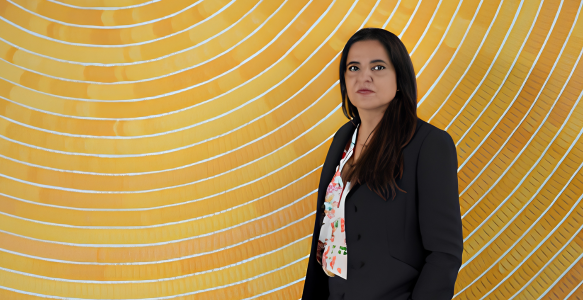
On a humid Delhi afternoon in the 1990s, a young painter from London walked into a small cosmetics shop and asked for every packet of sperm‑shaped bindis they had in stock. That impulse purchase - part curiosity, part compulsion - would slowly rewire contemporary sculpture and painting from the subcontinent. Over the next three decades, Bharti Kher turned this mass‑produced adornment of the “third eye” into a material language for thinking about love, migration, gender, mythology, and the fragility of bodies.
To trace Bharti Kher’s journey is to follow a life lived between London and New Delhi, between Western art schools and Indian streets, between the intimacy of the studio and the scale of public monuments like Ancestor in New York’s Central Park. Her practice moves restlessly across mediums - bindi paintings, resin hearts, melting glass bangles, life‑cast bodies, mythic beasts - but the questions remain disarmingly consistent: What does a body remember? Where does identity begin and end? How do we live inside contradictions?
This article is not just a Bharti Kher biography; it is a long, unresolved conversation between artist and motif, material and history. The work asks for time - the kind of slow, circling attention you’d give to Louise Bourgeois’s Cell installations or the shadow plays of Nalini Malani - and rewards it with images that refuse easy closure.
Who is Artist Bharti Kher?
If you’re asking “who is Bharti Kher” in 2026, it’s tempting to answer in terms of milestones and market. But in the gallery, what registers is something slower: a stubborn attention to how ordinary materials - a dot of vinyl, a broken shrine figure - can still carry metaphysical weight. Born in London in 1969 to Indian parents, Bharti Kher studied art and design at Middlesex Polytechnic before completing a BA (Hons) in Fine Art, Painting at Newcastle Polytechnic in 1991. In 1992–93 she travelled to India, a trip that turned into a permanent relocation to New Delhi, where she has lived and worked since, while increasingly maintaining a life between India and the UK. This bi‑continental existence sits at the core of artist Bharti Kher’s unsettled, hybrid visual language.
Her practice has been radically heterogeneous from the outset: paintings, sculptures, installations, text pieces, and site‑specific works sit side by side. Bindis, glass bangles, broken mirrors, cast bodies and found figurines recur like characters in an expanding mythological novel, reappearing in different guises from early bindi fields on board to monumental bronzes like Ancestor. It is telling that Kher herself resists narrow labels such as “bindi artist”; for her, the bindi is a raw material, a code, a skin - not an end in itself.
There is also a more intimate biography folded into the formal one. Soon after arriving in India, she met and married fellow artist Subodh Gupta, and their intertwined yet distinct practices have often been read as a kind of double portrait of post‑liberalisation India. If Gupta turned the stainless‑steel vessel into an icon of migration and aspiration, Kher pushed the bindi, the sari, the elephant, the whale’s heart into charged symbols of female experience and psychic weather.
Artistic Journey of Bharti Kher
1. Early Life and Background
Kher’s early training in British art schools gave her a rigorous grounding in painting just as post‑conceptual practices were loosening what painting could be. That formal discipline remains visible even in the most exuberant bindi surfaces; underneath the dots, there is almost always a painter’s sense of composition and edge.
The move to India in her early twenties exposed her to a different register of visual chaos: temple processions, political posters, sari shops, street shrines. In interviews she often points back to this moment of sensory overload - suddenly understanding that the “readymade” in India might be a plastic toy god, a wall of bangles, a pile of discarded idols, not just a Duchampian urinal.
2. Reinventing Traditional Symbols (Bindis)
The bindi entered her work around 1995, after that now‑famous encounter in the bindi shop. Initially, she used them almost like brushstrokes, mapping abstract constellations and weather systems onto board and mirror. Over time, she came to think of them as “texts” or “cell structures” - units of information that could swarm into galaxies, viruses or storm fronts.
In works like Algorithm for time travel (2018) or Algorithm that dreams you are human (2018–19), thousands of bindis spiral across mirrors and boards, at once decorative and diagrammatic. The traditional third‑eye marker, once tied to marital status and devotion, becomes a thinking device, closer to code than ornament.
3. Influence on Indian Contemporary Artists
Kher belongs to a generation that includes artists like Shilpa Gupta and Nalini Malani, who have also used everyday materials and feminist narratives to probe power, memory and the body. While it is difficult to quantify “influence”, younger practitioners in India and the diaspora often cite her as a model for how to hold together conceptual rigour, material experimentation and unapologetically female subjectivity.
Her hybrid forms - part animal, part goddess, part human - echo across contemporary sculpture just as Louise Bourgeois’s spiders and Cells haunted late‑twentieth‑century feminism. In that sense, every new Bharti Kher artwork enters a conversation that is already in motion, between Indian mythologies and global feminist archives.
4. How to Understand Bharti Kher's Art?
Approaching Bharti Kher paintings and sculptures, it helps to suspend the need for a single meaning. The works are riddles more than statements: a whale’s heart the size of a small car, an elephant lying between death and sleep, a mother with twenty‑three heads. Start with the material - vinyl, fibreglass, bronze, glass, hair - then notice what these substances already signify in everyday life before they arrive in the studio.
Then, pay attention to scale and skin. Surfaces in her work are rarely neutral: bindis swarm like stars or wounds; mirrors crack and shimmer; bronze remembers the fingerprints of clay. Rather than asking “What does this symbolise?”, it can be more generative to ask: “What state of being does this object describe?”
Many contemporary Indian artists engage identity; what sets Bharti Kher’s art apart is a willingness to let metaphors remain unstable. The whale’s heart is love and science and myth and fear, all at once - and she never quite resolves it for you.
Key Themes in Bharti Kher's Work
1. The Bindi Motif
Across decades, the bindi remains her key motif: sometimes forming aerial maps, sometimes coating a whale’s heart, sometimes flickering across shattered mirrors. She has described it as both membrane and skin, a way of giving objects a second epidermis that holds cultural memory.
2. Female Identity and Empowerment
Works like The Skin Speaks a Language Not Its Own and Six Women foreground female bodies that are vulnerable yet resolutely present. Cast from sex workers who are also mothers, the seated figures in Six Women refuse both idealisation and voyeuristic pity, inhabiting a matter‑of‑fact physicality very different from devotional sculpture.
3. Transformation and Hybridity
Kher’s many chimeras - women with antlers, deities made of broken figurines, elephant‑humans - speak to identities formed in migration, caste, gender and class crossings. Transformation is rarely seamless; the joins, scars and sutures are left visible.
4. Body, Life, and Memory
From the sperm whale’s heart in An Absence of Assignable Cause to the monumental maternal figure of Ancestor, the body becomes an archive where love, labour and inheritance are stored. Here Kher’s concerns brush against Louise Bourgeois’s lifelong exploration of the body as a vessel of trauma and care.
5. Cultural and Metaphysical Duality
Her practice keeps returning to doubleness: secular and ritual, scientific and magical, British and Indian, intimate and monumental. The bindi itself - once a spiritual marker, now a cheap fashion sticker - becomes the perfect emblem of this cultural and metaphysical duality.
Famous Painting Series By Bharti Kher
1. Weather Paintings (2023–2024)
In the recent Weather Paintings, including Weather painting: the hunger (2023–2024), Kher returns to large‑scale painting with a renewed urgency. These circular and rectilinear works, executed in oil and oil pastel on teak or linen, stage turbulent, abstract landscapes in which interior moods and planetary crises collide.
Critics have described them as “psychic, intimate, and abstract landscapes,” where storms, calms, and underground movements mirror the flux of body and mind.
2. The Sun Splitting Stones
Perrotin Paris’s exhibition “The Sun Splitting Stones” gathered these Weather Paintings into a field of force, their surfaces cracked with light and density. One eponymous work, Weather Painting: The sun splitting stones (2023–2024), stretches six by ten feet, its layered marks evoking an atmosphere under pressure - almost geological, almost emotional.
4. The Hunter and the Prophet
Though less widely discussed than the Weather cycle, works grouped under titles like The Hunter and the Prophet extend her interest in allegorical figures navigating uncertain terrain, often borrowing from mythological and folkloric archetypes that straddle violence and foresight.
5. Bindi Series (2000s–Present)
Her long‑running bindi panels - from early constellations to later mirror works - anchor Bharti Kher’s paintings in a language of dots, spirals and fields. Whether echoing Van Gogh in Starry Night After V.G or mapping imagined geographies, these works are as much about perception - looking, reflecting, fragmenting - as about ornament.
6. Dark Matter MM (2015)
Dark Matter (MM), shown prominently in her “Dark Matter (MM)” exhibition in Germany, pushes this vocabulary into a more cosmic register. Across paintings and installations, Kher stages collisions of creation and destruction, chaos and order, against the backdrop of a globalised world out of balance.
7. Indra's Net Series (2010)
In the Indra’s Net works, including Indra’s Net Mirror 1 (2010), bindis swarm over mirrors in dense lattices. The reference to the Buddhist/Hindu metaphor of a universe reflected in each jewel feels apt: viewers glimpse their own faces fragmented among the dots, woven into a larger, glittering grid.
8. Algorithm Series (2018–2019)
The Algorithm series, with works like Algorithm for time travel, Algorithm that dreams you are human and Algorithm for making snow in Delhi summer, treats bindis almost as coded instructions. Circular formats, meticulous placement and speculative titles suggest systems that are both rational and dream‑like - a quiet echo of how algorithms shape contemporary life.
Notable Sculptures by Artist Bharti Kher
1. The Skin Speaks a Language Not Its Own (2006)
Perhaps the most iconic Bharti Kher sculpture, this life‑size fibreglass sculpture depicts a female elephant lying on the ground, its body covered in serpentine bindis. The pose hovers between collapse and rest, inviting viewers to read it as both mourning and metamorphosis.
2. An Absence of Assignable Cause (2007)
An Absence of Assignable Cause is a resin sculpture of a blue sperm whale’s heart, made to scale and coated in turquoise and green bindis. The piece grew from years of research into scientific images, but its impact is emotional: the largest heart in the animal world becomes an allegory for the irrational, unmeasurable force of love.
3. Ancestor (2022)
Installed at the southeast entrance of Central Park, Ancestor is an 18‑foot‑tall patinated bronze of a sari‑clad mother whose body sprouts twenty‑three children’s heads. Built from broken and found figurines, it encodes multiplicity, migration and intergenerational memory in one towering, vulnerable figure.
4. Six Women
Six Women (2013–14) consists of life‑sized seated sculptures cast from sex workers who have had children, produced in her New Delhi studio. The works, first shown at the Biennale of Sydney, foreground the transaction of money, time and flesh while asking whether a single body can carry the memories of many.
5. Warrior with Cloak and Shield
Warrior with Cloak and Shield shows a female figure whose shield is a banana leaf and whose cloak is a shirt draped over enormous antlers. The antlers impede movement even as they grant a strange power; her fragile armour embodies Kher’s recurring tension between vulnerability and strength.
6. The Girl With The Hairy Lip Said No
This 2004 work disrupts a tea table with broken crockery, false teeth and a teacup lined with hair, explicitly critiquing both English tea rituals and arranged‑marriage bride‑viewing ceremonies. Its surreal humour nods to Meret Oppenheim’s fur cup while bringing the politics of consent squarely into Indian domestic space.
FAQs About Bharti Kher
What is Bharti Kher famous for?
Bharti Kher is best known for using bindis in paintings and sculptures that explore identity, gender, and culture in contemporary India.
What materials does Bharti Kher use?
Bharti Kher works with bindis, fibreglass, resin, bronze, mirrors, textiles, and found objects.
Which is Bharti Kher's most famous work?
The Skin Speaks a Language Not Its Own, a life-size elephant covered in bindis, is widely regarded as Bharti Kher's most famous artwork.
Why are bindis important in Bharti Kher's art?
Bharti Kher uses bindis as a visual symbol of identity, culture, memory, and transformation across her artworks.
How does Bharti Kher fit into global contemporary art?
Bharti Kher is considered a leading contemporary artist whose work combines South Asian visual traditions with global artistic concerns.
