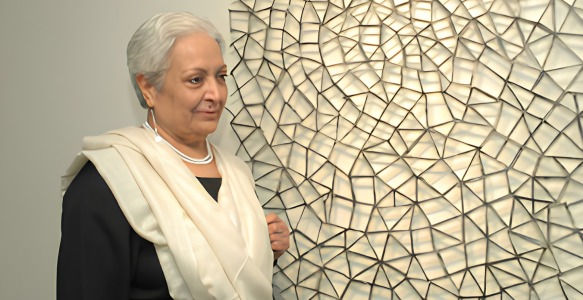
Under a vast night sky, a lone black triangle points upward. Who is Zarina Hashmi, the artist behind that quiet abstraction?
For Zarina the simplest shapes evoked profound memory. She once wrote, “Memory is the only lasting possession we have… In dreams and on sleepless nights, the fragrance of the garden, image of the sky, and the sound of language returns. In her minimalist woodcuts and paper sculptures, every line is freighted with the lost homes and journeys of her life.
Visiting Zarina Hashmi’s art feels like peering into a private album. Walking among her prints one senses a contradiction: they feel intimate like old letters, yet they hang like distant constellations. Zarina taught us that silence can speak, and an empty square can bear the weight of history.
Quick Facts About Zarina Hashmi
- Full Name: Zarina (born Zarina Rashid) – often published simply as Zarina.
- Date of Birth: 16 July 1937[9]. Place: Aligarh, United Provinces, British India.
- Education: BSc in Mathematics (Aligarh Muslim University, 1958; studied printmaking (woodblock) in Thailand and Japan; Atelier 17 intaglio in Paris.
- Known For: Spare woodcut and intaglio prints, textured paper works and collages. Key themes: home, displacement, borders and memory.
- Parents: Sheikh Abdur Rasheed (history professor, AMU) and Fahmida Begum.
- Spouse: Saad Hashmi (m.1958–his death 1977), Indian Foreign Service officer.
- Date of Death: 25 April 2020 (London).
Artistic Journey of Zarina Hashmi
1. Early Life & Education
Zarina’s journey began in the campus town of Aligarh, where she grew up with her sister Rani under the scholarly roof of historian parents. Her father Sheikh Abdur Rasheed raised his daughters to think for themselves; Zarina later said the intellectual climate at Aligarh Muslim University “motivated me… to get educated”. As a girl she sketched the old unbaked-brick house of their childhood and traced patterns in the courtyard. On summer nights, “we would sleep under the stars and plot our journeys in life,” she recalled. This stargazing foreshadowed her wanderlust. In 1958, Zarina earned a math degree at AMU, an unusual achievement for women at the time, and married Saad Hashmi, an aspiring diplomat.
2. Woodblock Printing in Bangkok and Tokyo
When the Hashmis moved to Bangkok for Saad’s first posting, the city’s golden temples left an impression on Zarina. She later noted how “the gilded spires… reflected in the sun,” inspiring her to use gold leaf on paper in later works. In Bangkok she formally learned woodblock techniques at a local studio. A few years later in Tokyo, she studied with master printer Tōshi Yoshida (1957–60), mastering the delicate art of Japanese woodblock. Returning briefly to India, she soon won a fellowship to Atelier 17 in Paris (1964–67), where she trained under Stanley William Hayter and Krishna Reddy. There Zarina’s practice expanded into intaglio and polychrome etching.
Curators who interviewed Hayter’s students mention Zarina’s perseverance. She saved money to buy the best Nagasawa paper in Tokyo; in France she scratched her plates with a dentist’s bur. In her New York studio in the 1980s, she kept those tools – a pile of chisels, a Japanese baren – as relics from her Asian journey.
3. Impact of Partition
Zarina was just ten when British India fractured in 1947, yet Partition’s shadow followed her. Though she left India in 1958, family ties split across the new border haunted her. Her family’s move from Delhi to Karachi after Independence mirrored the dislocation experienced by millions. In later years Zarina admitted, “I do not feel at home anywhere, but the idea of home follows me wherever I go”. In many works this latent trauma emerges. In letters and essays she quoted Darwish: “You can never go home again.”
Key Themes in Zarina Hashmi’s Art
1. Home and Belonging
In Zarina Hashmi’s paintings, home is as fluid as a dream. The opening print of Home Is a Foreign Place is a simple floorplan labeled ghar. By privileging the idea of belonging, Zarina hints that “house” and “home” are intertwined. Her sparse lines (a door, wall, courtyard) stand in for the family rituals once lived there. As she once put it, she chose words that would “trigger memory”. In a way, she built every print around that search for home: in Home Is a Foreign Place, each woodcut is underlain by an Urdu word – a vocabulary of longing.
In her cast-paper sculpture Ghar (Home) (1988) she pressed mica into handmade paper so it glimmers, reminding us that even a fragile home “can burn down to nothing” and still reflect light.
2. Displacement and Exile
The flip side of belonging is being without it. Though she never experienced Partition violence herself, her family’s split – an uncle in Pakistan, the rest in India – made borders personal. Zarina Hashmi’s works treat lines as fissures. Dividing Line (2001) is one such work: a jagged black slash on white that feels like rupture. Critics note she often “presents the border as an instrument of control and violence” – yet her approach is not angry.
After 1947, Zarina likened Urdu (her mother tongue) to a “homeless language,” and she kept it alive in her art. In Letters from Home, the Urdu writing becomes code: text overlaid with prints so the words are unreadable, yet the script’s curves are ever-present. Zarina’s work sits alongside other global diaspora artists who grapple with nationhood: we see echoes of how Palestinian artist Emily Jacir folded maps into blankets of memory, or how Indian artist Nalini Malani uses silhouettes to speak of migration.
3. Memory and Personal History
“Memory is the only lasting possession we have,” Zarina affirmed, and she built her art as an archive of remembrance. Every print is like a photograph negative: something lost is immortalized. Her works are often titled with maps or diary cues – I’ll Go Back, Map of Memories – signaling a return journey. In "Home Is a Foreign Place”, the images themselves are wordless poems, but Zarina called them her “visual vocabulary of memory, loss”.
In practice, Zarina mined her own life: letters, plans, souvenirs became imagery. For instance, Letters from Home integrates actual fragments of her sister Rani’s Urdu letters. In interviews she explained that folding family traces into prints was like “tying my end to my beginning”.
Famous Paintings of Zarina Hashmi
1. Home Is a Foreign Place (1999)
Artist Zarina Hashmi’s seminal portfolio Home Is a Foreign Place consists of 36 woodblock prints, each a pared-down abstraction of “home”. She began by listing words like ghar (home), diwaar (wall), darya (river), sending them to a calligrapher who wrote each in flowing Urdu script. Then she carved those shapes into blocks, turning language into image. Another panel, titled Courtyard, shows a simple black rectangle and dotted lines: an echo of the family courtyard where she once plotted life under the stars.
In one print a tiny swastika (symbolizing her Islamic childhood) appears like a hidden stitch; in another, a door is ajar, caught mid-swing. Together they form a geometric poem about exile. “All the words I have chosen are triggers for memory,” she said, “I revisit [home] with the help of language”. Home Is a Foreign Place remains her most famous suite, anthologized by the Guggenheim and studied by students of global minimalism.
2. I’ll Go Back (2003)
In I’ll Go Back (2003) Zarina turns a simple phrase into art. The title itself – a pledge to return – suggests hope amid displacement. The woodcut print presents a vertical geometric form: a long black wedge pointing skyward, an arrow of longing. Its austerity is disarming, inviting reflection on why the promise of return can feel both comforting and impossible. Critics link this work to her sister’s unsent letters: “I will go back” was Rani’s repeated phrase in their childhood correspondence. Zarina never provides context in the print; instead, she lets viewers imbue their own memories.
3. Dividing Line (2001)
Dividing Line is among Zarina’s most analyzed works. It appears at first as a fragmentary, jagged vertical line set off-center on pristine handmade paper. There are no elaborations – just that one black gouge. Viewers often see it as the Radcliffe border splitting India and Pakistan in 1947. Indeed, the artist and scholars have linked it to Partition trauma: Curators say Dividing Line has “symbolic potency” – it even came to stand for Zarina’s legacy on many catalog covers. It dares us to see geography and politics in pure form.
4. Letters from Home (2004)
This multi-part series is perhaps her most personal. Letters from Home consists of six woodcut prints integrating actual text. They are born from a real-life episode: Zarina’s sister Rani once gave her six unsent Urdu letters, pouring grief and longing onto paper. Zarina overlaid each letter with black blocks and cartographic lines, so the original writing is fragmented. The effect is poignant: we see glimpses of handwriting, but the message is buried. As she explained, “home is not a place, it is wherever the people you care about most are waiting” – for Zarina, Rani was that home.
One print shows a faint map of Delhi behind sliced Urdu script; another overlays Karachi’s neighborhood lines on a scraped white field. In Letters from Home, memory and distance unite: the art is quietly radical for refusing to let these letters disappear.
5. Flight IV (1966)
Created in Paris during her Atelier 17 years, Flight IV reveals Zarina’s early graphic experimentation. This etching (open-bite, multiple colors) is one of her few richly colored pieces. It depicts a textured black mass with undulating red, green and ochre lines – like a collage of torn city posters or a shattered urban wall. The Met writes that Flight IV’s surface “evoke[s] scarred and isolated figures as well as urban walls… covered with graffiti”. In other words, it channels the raw energy of Existentialism and post-war collage. Here the line is still organic and aggressive – not yet the serene geometry of her later woodcuts. It hints at the turbulence she left behind in Europe, before turning her focus solely to the monochrome abstractions of home.
6. Preamble (c. 1983)
Preamble is a lesser-known but evocative print. Its title suggests a beginning or prologue. The image is sparse: a horizontal bar and a vertical line intersect like an upside-down “T” on empty paper. Though minimal, it feels charged and there are no clear metaphors. One scholar notes that in works like Preamble, the absence of detail forces viewers to “become aware of ourselves and our place in the world”.
7. The House at Aligarh (1990)
Zarina’s nostalgia for her childhood home in Aligarh takes form in this large calligraphic piece. It is literally an artist’s book: scrolls of hand-painted ink text. The central poem reads like a letter to her house: “My house was built of unbaked brick… If I close my eyes I see it like I used to. Someday, I will see it again…”. These lines, visible in archival photos of the work, are beautiful in their simplicity and longing. The visual is minimal – mostly blank paper with careful black Urdu script.
8. Map of Memories (2014)
In Map of Memories, Zarina literalizes her theme of recollection as geography. This collage/print overlays outline maps with charcoal lines and tiny sketches. One sees an outline of Manhattan’s grid, a fragment of an Urdu script, a stair-step shape – all layered transparently. The resulting image is chaotic yet serene.
Here the memory is a landscape. We might recognize shapes of streets she walked in New York or lanes of Old Delhi, though nothing is labeled. Instead the viewer senses that this is a palimpsest of homes: former and imagined. In Map of Memories, Zarina seems to suggest that our memories, like maps, guide us even when we lose our way.
9. Fragments of Home (2008)
This print is another meditation on the incomplete. A wide black line is broken by a gap; a corner of a house silhouette peeks from the edge; faint hand-drawn marks are barely visible. The composition feels torn, as if we’ve caught a glimpse of a larger design just out of frame.
Viewers have described it as akin to a half-erased blueprint. One curator wrote that Zarina often “teases narrative without closure” – Fragments of Home is exactly that tactic. We see vestiges of walls and stairs but no people. It’s as though a house has been torn down and you are left with a few bricks.
10. Contours of Solitude (2015)
In this late work, Zarina turned to collage and ink on paper. Contours of Solitude depicts a single, oversized black form with ragged edges, set against a creamy sheet. The shape resembles both a floating island and a burnt photograph. It’s reminiscent of a solitary bird in flight – black ink spreading its wings above empty sky. The print resonates with her late style: bold use of negative space. It stands as a quiet finale: even completely abstract, it carries Zarina’s memory of homes as a negative space around the figure.
FAQs About Zarina Hashmi
1. What is Zarina Hashmi famous for?
Zarina Hashmi is known for her minimalist prints exploring themes of home, memory, migration, and exile.
2. What inspired Zarina Hashmi’s artwork?
Her work was inspired by memories of home, the experience of migration, and the lasting impact of the Partition of India.
3. What techniques did Zarina Hashmi use in her art?
Zarina worked primarily in woodcut, linocut, etching, and other printmaking techniques, often using handmade paper.
4. Why is Zarina Hashmi important in contemporary art?
Zarina Hashmi is celebrated for combining minimalist aesthetics with personal and historical narratives of displacement and belonging.
5. How did the Partition of India influence Zarina Hashmi’s work?
The Partition shaped many of Zarina's artworks, inspiring her exploration of borders, memory, migration, and identity.
