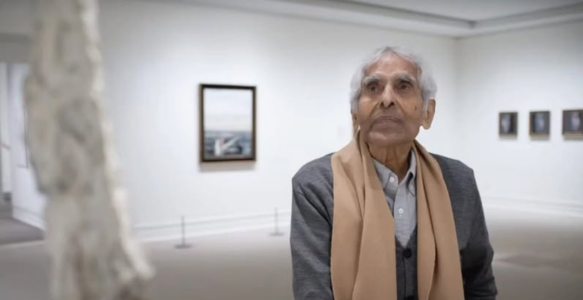
Who is Artist Krishna Reddy?
The first time you encounter a Krishna Reddy print, the experience can feel almost tactile. The surface seems to pulse with intention. You notice layers of color arranged with such deliberation that you find yourself wondering: How is this even possible from a single plate? That instinct, that sense of something groundbreaking at work, is precisely why Krishna Reddy (1925–2018) matters. He was a master intaglio printmaker and sculptor whose revolutionary approach to color viscosity printing fundamentally changed what printmakers could express. Yet despite his international renown, his work remains less known in the very cultural landscape that shaped him than it deserves to be.
Reddy's significance extends beyond technical mastery. He was an artist who refused compartmentalization: sculptor, printmaker, teacher, philosopher, traveler. Born in Andhra Pradesh, he grew up studying under some of India's most influential modernists, then spent decades immersed in post-war European artistic ferment before returning to America as a force in contemporary printmaking. His entire life embodied a belief that art should bridge cultures, that technique should serve curiosity, and that teaching was as vital as making.
Artistic Journey and Biography of Krishna Reddy
1. Early Years & Indian Roots
Krishna Reddy grew up in Andhra Pradesh in a family where art was part of everyday life. His father was a sculptor and a painter of temple murals, so he learned early that art was made through hands, materials, and repetition. Growing up around temple murals and traditional making gave Reddy an early relationship with material and process, something often central to handmade Indian paintings.
At Rishi Valley School, he also encountered the teachings of Jiddu Krishnamurti. Ideas about awareness, attention, and observation stayed with him and later shaped the way he worked.
In 1942, at seventeen, he joined Kala Bhavana at Visva-Bharati University. There he studied under Nandalal Bose, Ramkinkar Baij, and Benode Behari Mukherjee.
Santiniketan left a deep mark on him. The school was trying to build a modern Indian language of art rooted in looking closely, not copying. Bose’s lesson was plain but demanding: look hard enough at nature and abstraction will come through.
Reddy carried that idea into the rest of his career.
From 1947 to 1950, he headed the art section at Kalakshetra in Madras. By then he was already teaching, but he still wanted more. Europe, and especially sculpture, was the next step.
2. European Modernism & Paris
At the Slade School of Fine Art, Reddy studied sculpture under Henry Moore. Moore’s influence was less about appearance and more about thinking through form, space, and balance.
In Paris, he worked with Ossip Zadkine, who pushed him further toward abstraction. Through Zadkine, he entered Atelier 17, the printmaking workshop led by Stanley William Hayter.
At Atelier 17, Reddy began treating the plate like sculpture. He cut, gouged, and built into the metal instead of using it as a flat surface. Working with Hayter and Kaiko Moti, he developed viscosity printing.
The method was simple in concept and radical in effect: several colours could be printed from a single plate in one pass.
That changed modern intaglio.
During this period, he also encountered Constantin Brancusi, Alberto Giacometti, and Joan Miró. These were not formal lessons so much as exchanges around form, reduction, and abstraction.
3. Life in New York and Artistic Legacy
In 1976, Krishna Reddy moved to New York after more than two decades in and around Paris.
He founded the Color Print Atelier and became director of graphics and printmaking at New York University, where he taught for over twenty years.
New York gave his practice a wider audience.
He worked closely with Robert Blackburn’s Printmaking Workshop, introducing viscosity printing to a new generation of artists. But he never treated printmaking as a technical exercise alone.
For Reddy, the process mattered as much as the result. The plate, the ink, the roller, and the press all played a part in the discovery.
By the 1980s, his influence had spread far beyond New York. He helped establish workshops across Africa and India, including the Asilah Print Workshop in Morocco. Wherever he worked, he carried the same belief: art should move across borders, and knowledge should not be kept private.
In 1972, he received the Padma Shri, one of India’s highest civilian honours.
Krishna Reddy Art Style and Techniques
1. Viscosity Printing Technique
The phrase krishna reddy painting style is often used loosely, but the real story sits in his printmaking.
Viscosity printing is the technique most closely associated with Krishna Reddy. Traditional intaglio printing usually required separate plates for separate colours. Registration was difficult, and colour often meant complication.
Reddy saw another possibility.
Different inks behaved differently. Some were thick and resistant. Others were loose and fluid. Instead of treating that as a problem, he treated it as an opportunity.
By adjusting the thickness of inks with linseed oil, he could apply different colours to different depths of the same engraved plate. Hard rollers touched only the surface. Softer rollers reached deeper grooves. The colours stayed separate without needing multiple plates.
One plate. One press run. Multiple colours.
It simplified the process and expanded what printmakers could express. That is why the method became foundational in studios and universities around the world.
2. Mastery of Intaglio
Before viscosity printing, Reddy had already mastered intaglio itself.
He worked across etching, engraving, drypoint, aquatint, and later carborundum etching. His early prints from the 1950s show an artist obsessed with surface - grids, flowing lines, stippling, scratched marks, dense textures.
He treated the plate like something alive.
Each mark created an image, but it also changed how ink would behave later. A single plate could take weeks. Sometimes longer.
That patience matters when you look at the finished prints. They feel tactile. You sense the pressure of tools, the slow accumulation of decisions, and the artist’s refusal to rush.
3. Influence of Sculpture on Prints
The key to understanding Reddy’s printmaking is simple: he never stopped being a sculptor. That is also what makes Krishna Reddy sculpture so important to the larger body of work.
He approached every metal plate like bas-relief. He carved ridges, valleys, and surfaces that could hold colour at different depths.
His training under Henry Moore and Ossip Zadkine shaped that instinct.
That is why his prints rarely feel flat. Even on paper, they carry the weight of sculpture—the sense of mass, contour, and form pressing outward from the surface.
Printmaking came second. Sculpture came first.
Famous Paintings of Artist Krishna Reddy
For readers looking up Krishna Reddy’s paintings or Krishna Reddy's famous paintings, these are the works that usually matter most.
1. Untitled Abstract Etchings
Many of Reddy’s early works from Paris were untitled abstract etchings.
That was deliberate.
Without a title directing interpretation, the viewer meets pure form first - one of the defining experiences of engaging with abstract art. The spirals, grids, sudden gestures, textured fields, sometimes feel like landscapes. Others feel almost musical.
The point is not recognition. It is attention.
These works show Reddy learning how far abstraction could go without losing emotional force.
2. Whirlpool
Created in 1963, Whirlpool may be the print most people remember first.
Concentric circular forms create the sensation of rotation, like a vortex suspended in stillness. Gridded textures and flowing curves push the eye inward and outward at the same time.
It feels like water, but it is not really about water.
It is about rhythm, turbulence, and controlled movement. Held in the Metropolitan Museum of Art, Whirlpool remains one of the defining examples of his colour viscosity printing.
3. “Great Clown” Series
Reddy began the Great Clown series after taking his daughter to the circus in New York.
But the prints are not really about clowns.
They are about energy, performance, spectacle, movement, and the strange loneliness that can exist inside public joy. Bursts of colour and radiating forms replace literal figures. The clown dissolves into abstraction.
He printed multiple colour variations from the same plate, and each one changed the emotional tone completely.
That flexibility was the real power of viscosity printing.
4. La Vague (The Wave)
In 1963, Reddy created Wave, often discussed alongside S.W. Hayter’s La Vague.
Both works respond to water in motion, but Reddy pushes further into abstraction. Instead of describing a wave, he lets colour and texture behave like one.
The print feels fluid - transparent in places, dense in others, constantly shifting.
It is less a picture of a wave and more a work built from wave-like movement itself.
5. Germination
Germination (1961), now in the Metropolitan Museum of Art, shows Reddy’s deep attention to small living things.
The work includes an insect and forms that suggest seeds or plant structures. You move between recognition and abstraction without settling fully in either.
You can still feel Santiniketan here—the patience, the close observation, and the refusal to treat nature as decoration. This sensitivity to the natural world also connects closely with many collectors drawn to nature paintings.
It is a quiet work, but one of the clearest examples of how his Indian training and European abstraction met.
6. Splash
Splash continues Reddy’s fascination with water, movement, and impact.
The title suggests a moment, water striking a surface but the print avoids literal illustration. Instead, it gives you dispersal, force, and suspended motion.
The colour seems to move rather than sit still.
That tension between control and spontaneity is where the work lives.
7. Three Graces
Created in 1958, Three Graces takes its title from Greek mythology, but the print offers no visible figures.
Instead, Reddy translates grace into rhythm - layered colours, flowing lines, and a composition that feels both chaotic and balanced.
The work shows his technical confidence clearly. Multiple colours coexist without becoming muddy, and the plate holds surprising spatial depth. Though rooted in abstraction, works like Three Graces still carry the symbolic weight often associated with spiritual paintings and mythological themes.
It is part of the Tate collection and remains one of his strongest examples of abstraction, carrying classical reference without illustration.
8. Aspiration
Aspiration is one of Reddy’s major sculptural works, created in marble.
Unlike the prints, this work confronts you with physical weight. The stone holds both solidity and upward movement. The title feels accurate before you even know it.
It reminds people that Reddy never left sculpture behind.
Printmaking made him famous, but sculpture remained central to how he thought about form.
9. Water Lilies
Water Lilies is a carborundum etching that returns to one of Reddy’s recurring subjects: water.
Carborundum allowed him to create richer texture than traditional intaglio. The surface feels rougher, more organic, almost botanical.
There is an echo of Claude Monet in the title, but the approach is entirely Reddy’s. He is less interested in optical beauty and more interested in structure,the tangled life beneath the surface.
The result feels intimate rather than decorative. That is part of the broader Krishna Reddy artwork appeal: it rewards looking closely.
FAQs About Krishna Reddy
1. What is Krishna Reddy known for?
Krishna Reddy is best known for viscosity printing. He developed a way to print multiple colours from a single metal plate, which changed modern printmaking and made his work widely studied in art schools.
2. What type of art did Krishna Reddy create?
He was mainly a printmaker, especially known for intaglio works such as etching, engraving, and drypoint. He also made sculptures in bronze, stone, and terracotta, along with drawings and watercolours.
3. Where did Krishna Reddy study art?
He studied at Visva-Bharati University under Nandalal Bose, later trained at the Slade School of Fine Art under Henry Moore, and worked at Atelier 17 in Paris with Stanley William Hayter.
4. How did Krishna Reddy influence modern printmaking?
He expanded what intaglio could do, both technically and visually, through viscosity printing. As a teacher, he also helped make printmaking a serious global practice.
5. Who is Krishna Reddy?
Krishna Reddy was an Indian printmaker, sculptor, and teacher whose work changed modern intaglio and expanded the role of colour in printmaking.
6. What is this article about Krishna Reddy?
This article about Krishna Reddy covers his biography, training, artistic method, major works, and wider influence on printmaking.
ArtFlute Curatorial Insight
The through-line connecting Reddy's sculpture, his engravings, and his color viscosity prints is a fundamental conviction about form as language. He believed that if you carved or marked a surface with sufficient attention—if you understood each gesture as a conversation with material—then color, light, and texture would naturally reveal layers of meaning already present in the form itself. His innovation wasn't about adding complexity; it was about allowing complexity already embedded in the plate's topography to become visible. When you stand before one of his prints in the Great Clown series, seeing the same composition reborn in different color combinations, you're witnessing not variety for its own sake but the discovery of how form contains multitudes. The plate doesn't change; our perception of it does. That's the principle underlying all his work: look carefully enough at what's already there, and everything becomes new.
Closing
It's worth pausing here: Krishna Reddy's significance isn't confined to technical innovation or career achievements. What lingers is how his practice modeled an approach to art that we need now more than ever—one where crossing boundaries isn't a loss of identity but a deepening of vision, where teaching and making are inseparable, where observation of nature's smallest details can yield insights about human experience. His prints invite you to respond with eyes, inner awareness, and hands. They ask less for your admiration than for your participation. And that openness, that collaborative generosity, might be his most important legacy of all.
