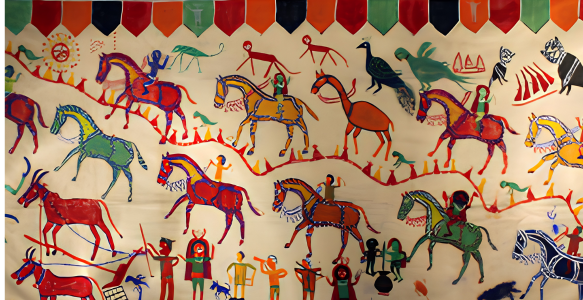
On a cool evening in Chhota Udepur, you can hear the painting – drums from the courtyard, the murmur of a Badva’s chant, the faint sour–sweet smell of mahua liquor in the air. Step into the osari, the front room of a Rathwa home, and the wall itself seems to be breathing: a white field dense with horses, elephants, suns, moons, tiny trains and teeming villages, all converging around a central rider – Baba Pithora, the tribal deity the painting is named after.
For the Rathwa, Bhil, Bhilala and Nayak communities of eastern Gujarat and western Madhya Pradesh, a pithora painting is a fulfilled vow, a contract with the divine, and a visual record of the community’s myths and memories.
We often think of Pithora as a kind of tribal “manuscript” on the wall – closer to writing than painting. It sits alongside other ancestral mark‑making across India – from Warli and Gond to the different types paintings of India – yet carries a ritual charge that is hard to domesticate or neutralise.
What is Pithora Painting?
At its simplest, if you ask a Badva “what is pithora painting,” he is likely to correct you – Pithora is for the gods, not a “painting” in the gallery sense. It is a ritual wall mural created on three interior walls of a Rathwa or Bhil home, usually at the threshold, to honour Baba Pithora and a pantheon of deities after a vow has been fulfilled.
The tradition is concentrated in the tribal belts of eastern Gujarat especially Chhota Udepur and Panchmahal and continues across the border into the Alirajpur and Jhabua region, which gives us the closely related pithora painting of Madhya Pradesh. Over time, similar ritual wall traditions in central India have been grouped under the label pithora painting of Chhattisgarh as well, though locally they may carry other names.
Within this broad frame, there are two main types: Ardho Pithoro (half Pithora), with five to nine horses and only Ganesha as a rider, usually commissioned when a vow or resources are modest; and Akho Pithoro (complete Pithora), with eighteen horses and their riders, a full-blown cosmology across the three walls. Even when transposed to paper or canvas as contemporary pithora painting of Gujarat, artists often retain these ritual structures.
In a museum or gallery, a single Pithora panel can feel strangely at ease next to contemporary Indian artworks– its dense, all-over surface has the rhythmic charge of a Raza or a Miró, yet every horse and dot is still answerable to a village priest back home.
History and Origin of Pithora Paintings
1. Tribal Roots and Cultural Background
Many Rathwa artists today will trace their origin story to a rock shelter on Koraj hill, where archaeologists dated a set of horse-and-rider motifs to around 12,000 years ago. Historically, Pithora is associated with the Rathwa (or Rathva) Adivasis of eastern Gujarat and neighbouring Bhil, Bhilala and Nayak communities, whose agrarian and forest-based lives are woven into the paintings. In some sources, the Jhabua–Alirajpur belt in Madhya Pradesh, is often cited as a key early centre.
2. Significance of Rathwa Paintings
Within the Rathwa world, rathwa paintings are not seen as “folk” or “tribal art” categories, but as a crucial part of ritual life linked to their chief deity, Baba Pithora. In a classic Pithora a wavy line divides the upper world of the gods from the lower zone of humans, animals and landscapes, with processions of horses and elephants crossing between them.
Scholars have also read older murals as a kind of cartography – fields, hills, rivers, railway lines and forest patches are placed in relative position doubling as a map of the tribe’s lived world. In that sense, Pithora sits in conversation with global map-like painting traditions – from Aboriginal songlines in Australia to Paul Klee’s meandering cityscapes.
3. When and Why Pithora Paintings are Created?
The story almost always starts with a problem: a sick child, a failing crop, a long drought, or a string of misfortunes. The family head consults the Badva, who may prescribe a vow – if Baba Pithora resolves the crisis, the family will commission a mural on their front room walls.
Once the wish is granted, the long ritual begins: wall purification (leepna), invitations to human and divine guests, the summoning of a respected Lakhara and his team, and finally a communal feast once the painting is complete. Pithoras may also be commissioned to mark weddings, the birth of a child, to commemorate ancestors, but the logic remains one of reciprocity – humans honouring a vow to the deity.
The Pithora painting history is less linear and more a spiral: each new mural restages the first drought, the first vow, the first rain, re‑binding a present-day household to an origin story that is always being retold.
Various Motifs in Pithora Art Paintings
1. Horses and Rider
If there is a single shorthand for pithora art, it is the frieze of horses, painted in bands across the wall in reds, greens, blues and ochres. These are vehicles for gods, goddesses, ancestors and legendary heroes – each colour, position and rider signalling a different presence.
Seven horses may stand for the seven hills around the tribal region, while special categories like Saval Dharmi Ghoda (horses of civic righteousness) and Purvaj na Panch Ghoda (the five ancestor horses) honour local heroes and the dead. In contemporary works, these horses resonate with viewers drawn to equine imagery and modern horse paintings, but their “beauty” is inseparable from their cosmological function.
2. Sacred Animals and Birds
Around and between the horses, the wall is crowded with camels, deer, monkeys, bulls, goats, elephants and flocks of birds, each rendered in a direct, almost childlike graphic language. The buffalo and cow are considered especially sacred for their milk, dung and ritual usefulness; goats are central to sacrificial rites linked to Baba Pithora.
These animal clusters are where Pithora overlaps most visibly with broader animal paintings and nature art, and they record the tribe’s dependence on forests, fields and cattle.
3. Sun and Moon
In many murals, the sun and moon anchor the upper corners, almost like punctuation marks of cosmic time. Placed in the “god” register above the wavy dividing line, they frame the entire narrative as something unfolding under celestial oversight – a reminder that vows, rains and harvests are part of larger cycles.
4. Scenes of Tribal Life
Below, the imagery slides easily into the everyday: farmers ploughing fields, women carrying water, musicians with drums, traders, markets, even trains and roads. In Gujarat, some researchers have shown how these scenes line up with actual fields, hills and railway lines around the village, reinforcing the idea of Pithora as a lived map.
5. Processions
At the heart of many compositions runs the wedding procession of Baba Pithora and Pithori Rani – horses and elephants laden with divine guests, musicians and relatives, with Raja Bhoj’s elephant often anchoring the lower band. It becomes a specific marriage story and a more general image of abundance, hospitality and communal joy.
Pithora works are different from other narrative spiritual paintings where gods, animals, trains and trees all claim equal space instead of a single icon.
Sacred Deities Depicted in Pithora Art
1. Pithoro Dev or Baba Pithora
Baba Pithora is the central deity and namesake of the tradition, usually shown on horseback at the compositional centre, surrounded by his retinue. For the Rathwa, he is both a creator figure and the one who can remove obstacles and restore balance when things go wrong.
2. Pithori Rani
Pithori (or Pithori Rani) is Pithora’s consort and, in many tellings, the daughter of the farming couple Abho Kunbi and Mathari. She often appears just behind him on horseback, holding a fan, and is particularly invoked around fertility, crops and drought.
3. Lord Ganesha or Baba Ganeh
Baba Ganeh, the tribal counterpart of Ganesha, is always painted first – usually in the lower right corner, seated on a horse. He is the remover of obstacles and the guardian of thresholds, aligning the mural with a broader Indian visual tradition of Ganesha artworks.
4. Indra Dev or Baba Ind
Baba Ind is the rain-giver and protector of animals, a key deity in an agrarian community where a failed monsoon can mean catastrophe. In Pithora compositions he appears among the horseback gods, ensuring timely rain and the health of livestock.
5. Rani Kajal
Rani Kajal is described as the kuldevi, or clan goddess, of many Rathwa families and appears among the chief pantheon in most ritual murals. Her presence signals the intimate overlap between family lineages and divine protection.
6. Baar Matha no Dhani
Baar Matha no Dhani “the enlightened one with twelve heads” protects Adivasis from all twelve directions and is associated with vast knowledge and bravery. He is often shown holding Nagdevta (the serpent deity) and swords, and is remembered for protecting Rani Kali Koyal in labour.
7. Raja Bhoj and his Elephant
Raja Bhoj (also called Raja Bavaji) is a legendary benevolent king who looks after agriculture, livestock and rain on earth. In Pithora murals he is always shown astride an elephant in the lower band, a stabilising figure amid the dense imagery.
8. Abho Kunbi and Mathari
Abho Kunbi and Mathari are the primordial farming couple credited with inventing agriculture and teaching humans how to till, sow and harvest. As parents of Pithori Rani, they embody both the practical knowledge of farming and its sacred genealogy.
9. Nakti Bhuten
Nakti Bhuten (or Bhutan) is a fierce household protector, usually shown on a white horse to the left of the main Pithora image. Unlike many benevolent gods, he has a terrifying aspect, which is precisely what makes him effective as a guardian against malevolent forces.
10. Lakhari and Jokhari
Lakhari and Jokhari are mythic scribes of destiny. According to legend, they wrote Baba Pithora’s future on the wall which set the precedent for painting Pithora on walls; they are also said to write a child’s fate on the fifth or sixth day after birth.
11. Purvaj na Panch Ghoda
Purvaj na Panch Ghoda – the five horses of the ancestors – symbolise the community’s forebears. In life, families install carved wooden horses (Khatrij Dev) in fields or homes; in the mural, these five horses carry the memory and ongoing protection of the ancestral line.
Famous Artists of Pithora Paintings
1. Bhuri Bai
Bhuri Bai, born in Pitol village in Jhabua district, Madhya Pradesh, grew up watching mud-wall Pithora murals before becoming the first Bhil woman to bring the form onto paper and canvas. Discovered while working as a labourer in Bhopal, she went on to work with the Tribal Museum and Adivasi Lok Kala Academy, and in 2021 received the Padma Shri for her contributions.
2. Lado Bai
Another pivotal figure is Lado Bai, also from Jhabua, whose paintings translate Bhil ritual and Pithora-inspired imagery into luminous fields of dots, animals and everyday scenes. Initially a construction worker at Bharat Bhavan in Bhopal, she was encouraged by Jagdish Swaminathan to paint, and has since shown in exhibitions across India, France and the UK.
3. Paresh Rathwa
From Gujarat’s Chhota Udepur comes Paresh Rathwa, perhaps the most recognised contemporary Pithora painter of Gujarat today. A hereditary Lakhara, he has spoken publicly about Pithora as a 12,000‑year-old art linked to the Koraj caves, represented India’s tribal art at the G20 culture exhibition, and received the Padma Shri in 2023 for preserving this heritage.
4. Harsingh Hamir
Harsingh Hamir represents a younger generation of Rathwa artists who are comfortable moving between ritual wall work and books or digital media. His picture book Painting Everything in the World, which uses Pithora motifs to tell a children’s story about the transformative power of art, won a Purple Island award at the Nami Concours in 2019.
5. Ramesh Baria
Bhil painter Ramesh Baria, working from the tribal regions of Madhya Pradesh, is often associated with the Bhilala sub-tradition known for its Pithora heritage. His paintings use dense fields of dots to evoke deities, festivals and seasonal cycles, a language that has been discussed alongside other Bhil artists in museum and foundation collections.
These artists have created some of the most famous pithora paintings on portable surfaces, opening up the form to new audiences while continually negotiating how far a ritual image can travel from its wall.
FAQs About Rathwa Paintings
1. What is the origin of Pithora painting?
Pithora painting originated among the Rathwa, Bhil, Bhilala, and Nayak tribal communities of Gujarat and Madhya Pradesh.
2. Which state is Pithora painting in?
Pithora painting is most closely associated with Gujarat, particularly the Chhota Udepur and Panchmahal regions.
3. Who specially paints the Pithora artwork?
Traditional Pithora paintings are created by specialist ritual artists known as Lakharas, often under the guidance of a Badva (priest).
4. What makes Pithora painting unique?
Pithora painting is a ritual art form created to fulfil vows and depict deities, horses, animals, and scenes from tribal life.
