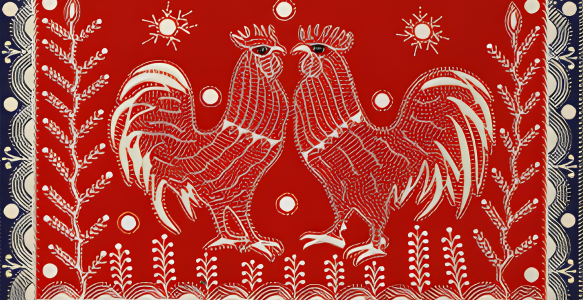
On winter mornings in eastern Rajasthan, before the sun has fully warmed the courtyard, you’ll often find an older Meena woman crouched close to the earth, fingers dipped in a white slurry, drawing steady, unhurried lines on a wall the colour of baked terracotta. No grid, no preliminary sketch- just memory and muscle guiding the curve of a peacock’s neck, the flare of a lotus, the geometry of a chowk. By the time the household fully wakes, the mud floor and walls have been transformed into a temporary shrine of lines and symbols that will slowly flake away- only to be remade when the next festival comes around.
This is Mandana art, a ritual floor and wall-painting tradition practised primarily in Rajasthan and Madhya Pradesh, especially among the Meena community. At its simplest, it is lime or chalk on a red earth ground; at its deepest, it is a visual prayer drawn at thresholds, courtyards, granaries and chulhas to invite prosperity, ward off evil, and mark life events- births, marriages, harvests, and major festivals like Diwali or Govardhan Puja. Unlike studio-based “folk art” made for markets, Mandana lives in domestic architecture, tied to the everyday cycles of cleaning, cooking, and worship.
For those of us working with Indian folk and tribal expressions today, Mandana folk art quietly challenges the way we think about authorship and permanence. The makers are almost always women, the works unsigned, the surfaces vulnerable to rain, dust, and time. And yet, the visual language- its chowks, animal forms, lotus grids- remains astonishingly coherent across regions, even as younger artists begin to translate Mandana art painting onto board, canvas, and digital formats to keep it visible in a rapidly urbanising landscape.
When we look at a contemporary geometric abstraction by, say, S.H. Raza or Agnes Martin, it’s hard not to think of these rural grids and radiating lotuses- built not for galleries, but for the gods, the neighbours, and the soil itself.
If we call a single framed work “a painting” and a courtyard filled with lines “decoration”, we risk missing how a traditional Mandana art form expands the very idea of what a painting can be.
History & Origins of Mandana Art
1. Meaning of the Word "Mandana"
The word “Mandana” is often traced to the Sanskrit mandan- to decorate, to adorn- and in some readings manda, or auspicious. In practice, villagers use the term fluidly: it can refer to the act of drawing, the finished design, or even the larger set of rituals around preparing the house before a festival.
Across sources, Mandana art origin stories are less about a single historical “moment” and more about continuity: lineages of women copying their mothers’ hands, adapting motifs but keeping the logic of symmetry and sacred geometry intact. Unlike court painting traditions that can be pinned to patrons and workshops, Mandana emerges from anonymous, domestic labour- closer to how rangoli and kolam operate in other parts of India.
2. The Role of the Meena Community in Preserving the Tradition
Mandana is strongly associated with the Meena community, one of the oldest tribal groups in eastern Rajasthan and neighbouring Madhya Pradesh. Women are its primary custodians, learning informally by watching elders, never in formal art schools or gurukuls. In Rajasthan, Meena women paint both mud walls and floors; in Madhya Pradesh, the practice is often limited to floor designs.
These designs are more than embellishment. They mark thresholds as sacred, protect granaries, honour village deities, and signal hospitality to humans and gods alike. As concrete replaces mud houses and rati clay becomes harder to source, this community-based transmission has come under strain, though certain regions- Hadoti, Sawai Madhopur, Bundi- remain vital nodes of practice.
3. How Mandana Became a Symbol of Auspiciousness
Within village life, a freshly drawn Mandana is read instantly: a grid with diyas might indicate Diwali, a complex Shiva-Parvati composition might precede a marriage, a full courtyard chowk could mean a major puja. The very act of drawing is preceded by cleaning with water and cow-dung mixtures, so auspiciousness here is as much about purification as about symbolism.
Over time, these forms have come to stand in for “Rajasthani-ness” in tourist literature and state cultural promotion, often flattened into a generic motif. Yet on the ground, the logic is precise: each rajasthani mandana painting encodes local deities, crops, animals, and social relationships, making it a living archive rather than a static symbol.
When we speak with village painters about Mandana art history, it rarely comes as dates or dynasties; instead, we hear stories- “my grandmother drew this when your uncle was born”, “this pattern is only for Teej”- a different kind of timeline entirely.
In many ways, Mandana’s “history” isn’t a linear narrative but a circular one- like the lotuses that appear again and again, season after season, hand after hand.
Materials and Techniques Used in Mandana Painting
1. Clay and Natural Materials
Traditional Mandana relies on what the environment offers: clay (often rati), cow dung, and local soils to prepare a smooth, dark base on floors and walls. This layer disinfects, seals dust, and creates the deep brown or red ground that makes the white motifs gleam.
Many practitioners still insist that without a mud wall or earthen courtyard, the work loses a certain softness- the way the lime sinks slightly into the surface, leaving a subtle relief impossible to imitate on cement. When we document these homes, the smell of damp earth and dung-plaster is inseparable from the visual memory.
2. Geru (Red Ochre) Backgrounds
Geru mitti, a red ochre or iron-rich soil, is central to the high-contrast look that people associate with mandana art Rajasthan. Mixed with clay and sometimes cow dung, it produces the warm terracotta hue we see in photographs of Meena houses in Bharatpur, Bundi, Alwar, and Sawai Madhopur.
In some villages, geru is applied in multiple thin coats to achieve a richer ground before the white lines go on. The result is remarkably contemporary- minimal colour, strong negative space- recalling how artists like Paul Klee or Nasreen Mohamedi built entire universes with limited palettes.
3. Khadiya and Chalk
The drawing medium is usually khadiya, a local white clay or chalk, ground and mixed with water into a slightly viscous solution. Sometimes rice paste or lime is added for opacity, or turmeric and other natural pigments for occasional yellows, greens or blacks. Despite this range, most traditional Mandana keeps to a disciplined red-and-white or earth-and-white scheme.
4. Intricate Patterns Without Sketches
What astonishes urban viewers most is that these intricate patterns are drawn freehand, generally without preliminary sketching. Women use their fingers, a rag wrapped around thumb and forefinger, or improvised brushes made from date palm stalks, grass, or tufts of hair. Symmetry is achieved by plotting a few points- say, the corners of a triangle or lotus- and then “thinking in grids” as the hand moves.
The process has its own rhythm: surface cleaning, base coat, marking the key axis, then filling in borders, secondary motifs, and tiny jaali-like infill patterns. In these quiet repetitions, traditional mandana art overlaps with the meditative labour we associate with mandala art of Rajasthan in the popular imagination, even though the two have different genealogies.
Watching a Meena artist work, we’re reminded of how Ganga Devi or Jangarh Singh Shyam held entire cosmologies in their line. The tool is simple; the thinking is anything but.
In a moment where “materials” in contemporary art often mean synthetics and screens, Mandana quietly insists that mud, lime, and habit can also be a kind of technology.
Different Types of Mandana Art
1. Bhopa-Bhopi Mandana
Bhopa-Bhopi Mandana is associated in some accounts with Rajasthan’s Mewar region, echoing the visual world of Bhopa-Bhopi ballad singers and their narrative scrolls. These designs often feature dynamic figures, instruments, and ritual objects, woven into a field of geometric borders and animal motifs.
2. Chaumukha Mandana
Chaumukha Mandana literally invokes the “four faces” of Lord Brahma, the creator. Typically divided into four quadrants radiating from a central point, it becomes a kind of cosmogram- each section housing different symbols of creation, guardianship, and balance.
3. Dandia Mandana
Dandia Mandana surfaces around Navratri, echoing the energy of dance. Floral bursts, crossed sticks, and rhythmic chevron borders give these designs a kinetic structure, often more densely filled than everyday household Mandana.
4. Shiva-Parvati Mandana
Shiva-Parvati Mandana, often drawn before a marriage or major family ritual, stages the divine couple at the centre of a radiating composition. Here, organic hues- red, yellow, green derived from natural pigments- sometimes accompany the white, underscoring fertility, union, and continuity.
5. Rangoli Mandana
Rangoli Mandana blurs the line between region-specific Mandana and pan-Indian floor art practices. Using coloured powders or flower petals, it translates the linear logic of Mandana into more painterly, filled-in surfaces, especially to welcome guests at thresholds.
In many villages, these are not rigid “categories” but overlapping tendencies. A single courtyard for Diwali might combine chowk geometry, Shiva-Parvati imagery, and rangoli-like floral infills, embodying the layered nature of mandana art of Madhya Pradesh and Rajasthan practice.
As curators, we often see city-based artists borrow these typologies- Bhopa-Bhopi, Shiva-Parvati, Chaumukha- and re-stage them on canvas. The question is always: what travels, and what gets left back in the courtyard?
Categories help us talk about Mandana in an art-historical way, but on the ground, a woman simply says, “We’ll draw the marriage one today,” and her hand knows what that means.
Common Designs Used in Mandana Paintings
1. Chowk Patterns
Chowks- framed square or rectangular fields often subdivided into grids- are the backbone of many designs. Like chowk-purana traditions elsewhere in North India, these squares are “filled” with lotus rosettes, diya motifs, or animal forms, anchoring the composition at the centre of courtyards or thresholds.
2. Peacock Motifs
Peacocks, symbols of beauty and monsoon fertility, are among the most beloved mandana art motifs. Their arching necks and elaborate tails lend themselves to stylisation, sometimes framing a chowk, sometimes perched at corners like guardians.
3. Floral Designs
Lotuses, creepers, and stylised blooms appear everywhere- at borders, inside grids, around deities. The four- or eight-petalled lotus is so ubiquitous in Mandana that some writers call it the most recognisable emblem of the style.
4. Animal Motifs
Tigers, elephants, cows, fish, birds- all enter the Mandana world as stand-ins for strength, prosperity, fertility, and protection. Lord Ganesh, too, appears frequently, bridging animal and deity, often placed at entrances or near chulhas.
5. Daily Rural Life
Women grinding grain, drawing water, tending cattle; tools, carts, granaries- these fragments of daily life form an unobtrusive documentary layer in many works. In such scenes, mandana painting of Madhya Pradesh and Rajasthan becomes an unselfconscious ethnography, recording gestures and implements even as it prays for their continued abundance.
Across these patterns, a rajasthani folk art Mandana vocabulary takes shape- geometric yet fluid, sacred yet grounded in the tasks of an agrarian life.
When we juxtapose Mandana with works by artists like Madhvi Parekh or Bhupen Khakhar, the kinship is obvious: the same delight in flattening space, repeating symbols, and allowing daily life to sit right next to myth.
Perhaps the most contemporary thing about Mandana is its refusal to separate “art” from life- both literally share the same floor.
FAQs About Mandana Art
What is the history of Mandana?
Mandana Art is a traditional folk art of Rajasthan and Madhya Pradesh, practiced for centuries as part of household and religious rituals.
What is the process of making Mandana art?
Mandana Art is created by drawing geometric and symbolic designs with white chalk or rice paste on mud-plastered walls and floors.
What is the difference between Mandana and mandala art?
Mandana is a traditional folk art from Rajasthan, while Mandala art refers to symbolic circular designs found across various spiritual traditions.
Which community is traditionally associated with Mandana Art?
Mandana Art is most closely associated with the Meena community of Rajasthan.
Is Mandana Art still practiced today?
Yes, Mandana Art continues to be practiced during festivals, ceremonies, and cultural events in many parts of Rajasthan and Madhya Pradesh.
How has Mandana Art evolved in modern times?
Today, Mandana motifs are also used on canvas, paper, textiles, and contemporary design products.
