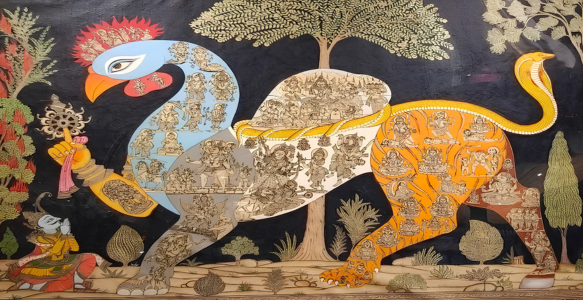
At dusk in a Bhil village, walls begin to glow - not with electricity, but with colour. Dots gather into deer, trees breathe through patterns, and stories ripple across mud-plastered surfaces. An elder once described it simply: “We don’t paint what we see. We paint what remembers us.” That quiet inversion captures the essence of Bhil paintings - an art form where memory, ritual, and ecology dissolve into one visual language.
Unlike courtly miniatures or urban modernism, bhil art emerges from lived experience - rain cycles, forest spirits, harvest songs, and ancestral myths. Yet, when viewed today in contemporary galleries alongside works by S.H. Raza or indigenous artists from Australia, its visual sophistication feels startlingly global. The dotted constellations, rhythmic compositions, and symbolic density position bhil tribal art not as “folk” in a reductive sense, but as a deeply intelligent aesthetic system.
This guide moves through its origins, techniques, and key artists - not as a catalogue, but as a layered cultural encounter.
What is Bhil Painting?
Bhil painting is a traditional art form practiced by the Bhil tribe - one of India’s largest indigenous communities - primarily in Madhya Pradesh, Rajasthan, Gujarat, and Maharashtra. Rooted in ritual practice, these paintings historically adorned walls and floors during festivals, marriages, and agricultural ceremonies.
At its core, bhil art painting is a storytelling device. Each motif - whether a peacock, a hill, or a human figure - carries symbolic meaning tied to fertility, protection, and cosmic balance. Unlike narrative painting traditions that unfold linearly, bhil compositions feel simultaneous, almost like memory maps where multiple events coexist.
A striking feature is how space is treated. There is no emptiness. Surfaces are filled with dots, lines, and organic shapes, suggesting abundance. This density reflects a worldview where nature is not separate from human life - it is continuous, breathing, and sacred.
In recent decades, artists have transitioned from walls to paper and canvas, bringing bhil art of Madhya Pradesh into contemporary discourse. Yet the grammar remains intact. The artists rarely sketch first. The painting grows intuitively - like weaving. It’s closer to improvisation in music than planned composition.
To ask “what is bhil painting” is to confront categories themselves. It resists neat labels - neither purely ritual nor purely aesthetic. It exists somewhere in between, where life and art are indistinguishable.
History & Origin of Bhil Art Paintings
1. The Bhil Tribe – India's Indigenous Community
The Bhils are among India’s oldest tribal communities, with references in ancient texts like the Mahabharata. Historically forest dwellers, their identity is inseparable from land and ecology.
Their visual culture developed not in isolation, but in dialogue with seasonal cycles. A hunter’s route, a sacred grove, a monsoon pattern - these became visual motifs over generations.
2. Origins of Bhil Paintings on Walls and Floors
The earliest bhil tribe painting practices were ephemeral. Created using clay, leaves, and natural dyes, they were meant to fade. Paintings marked events - births, marriages, harvests - and were renewed periodically.
This impermanence is crucial. Unlike museum art, these works were never intended to last. Their value lay in the act of making.
3. Cultural and Spiritual Roots of Bhil Paintings
Bhil paintings are deeply spiritual. Deities like Pithora Dev appear frequently, especially in ritual contexts. These are not decorative images but invocations - meant to invite divine presence.
There’s an interesting overlap with Gond and Warli traditions, yet Bhil art distinguishes itself through its distinctive dotted surface, which some interpret as seeds, others as rain.
In conversations with artists, the idea of “finishing” a painting feels foreign. One artist remarked, “It’s complete when it feels alive.” That sense of animation is central to bhil art history.
Modern collectors often seek permanence. Bhil art reminds us that transience can be equally profound - perhaps even more honest.
Key Characteristics & Styles of Tribal Bhil Art
1. The "Dotted" Technique
The most recognizable feature of traditional bhil painting is its intricate dot work. These dots are not decorative fillers; they structure the entire composition.
Each dot is placed rhythmically, often using twigs or brushes. From a distance, they form patterns; up close, they feel almost meditative.
2. Nature-Centric Themes
Animals, trees, rivers, and mountains dominate the visual field. A deer is not just a deer - it represents sustenance, grace, and sometimes ancestral spirits.
The compositions often resemble ecosystems rather than isolated scenes.
3. Natural Pigments
Historically, colours came from turmeric, indigo, leaves, and soil. Even today, many artists retain this palette - earthy reds, deep greens, luminous yellows.
These pigments age differently, adding a temporal dimension to the work.
4. Symbolism
Every element carries meaning. Dots may signify seeds or rainfall. Trees often represent life cycles. Human figures are stylised, almost merging with their surroundings.
Watching an artist build layers of dots is hypnotic. It recalls pointillism - think Georges Seurat - but with a completely different philosophical grounding. The dots are often described as decorative, but that misses the point. They are structural, conceptual - closer to language than ornament.
Famous Paintings by Bhil Tribe
1. My Village
A recurring theme, this composition captures daily life - fields, huts, animals, and people interconnected in a single frame. It functions almost like a visual census of memory.
2. Tree of Life
This motif appears across cultures, but in bhil folk art, it becomes intensely local. Each branch may hold birds, spirits, or seasonal markers.
3. Pithora on Horseback
Linked to ritual painting traditions, this subject depicts the deity Pithora. To understand the relationship between Bhil art and Pithora paintings, read our feature on the Pithora art form.
4. Hunting Scenes
These works reflect older ways of life - depicting animals, weapons, and collective movement. They are dynamic, often filled with motion.
5. Festival Celebrations
Paintings of Holi, harvest festivals, or marriage ceremonies bring colour and rhythm into focus - music translated into visual form.
Interestingly, no two “Tree of Life” paintings are alike. Each artist reinterprets it, much like variations in classical ragas.
These are not “famous” in the conventional art historical sense. Their importance lies in repetition and variation - like oral storytelling.
Renowned Artists Creating Bhil Paintings
1. Bhuri Bai
Among the first Bhil artists to transition to paper, Bhuri Bai redefined the medium. Her works retain traditional motifs but explore new formats.
2. Lado Bai
Known for intricate detailing, her paintings often feel dense and immersive - almost overwhelming in their visual richness.
3. Sher Singh Bhabor
His works bring a strong narrative quality, often depicting community life with subtle shifts in scale and perspective.
4. Geeta Bariya & Shanta Bhuriya
These artists represent a newer generation, balancing tradition with contemporary experimentation.
In urban exhibitions, Bhuri Bai’s works are often placed alongside Indian modernists. The dialogue is fascinating - parallel evolutions rather than hierarchies. Recognition brings visibility - but also risk. The challenge is preserving integrity without freezing the art into a static “style.”
FAQs About Bhil Tribe Paintings
1. What is the origin of Bhil painting?
Bhil art origin lies in ritual wall paintings created by the Bhil tribe for ceremonies and seasonal events, evolving organically over centuries.
2. Which state is Bhil painting in?
It is primarily associated with Madhya Pradesh but also practiced in Rajasthan, Gujarat, and Maharashtra.
3. Who specially paints the Bhil artwork?
Traditionally, both men and women participate, though certain ritual paintings are led by specific community members or shamans.
4. What makes Bhil painting unique?
Its dense dotted technique, ecological themes, and symbolic storytelling distinguish it from other Indian art paintings, creating a visually and conceptually rich form.
