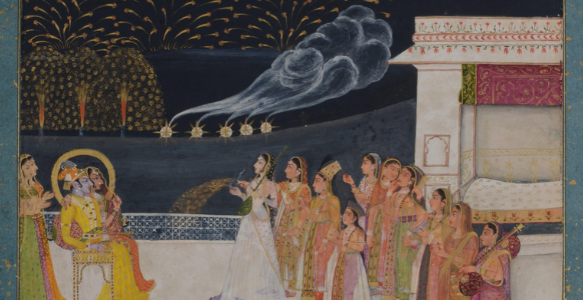
In the National Museum’s Radha and Krishna in the boat of love, the lovers share a boat with musicians. Lotus flowers occupy the water, while palaces extend across the distance. The museum names Nihal Chand as the painter and dates the work to around 1750. It gives us a particularly clear way into Kishangarh miniature painting: devotion takes place within a world of courtly leisure, music and carefully arranged landscape.
Another picture might isolate a face. An eye stretches towards the temple; the brow rises above it; a narrow nose continues the long profile. These features have become closely associated with Bani Thani and the Kishangarh court. Yet recognising a face type is only the beginning. A painting’s subject, attribution and original setting still need attention.
Kishangarh art paintings belong to Rajasthan’s history, but their connections reach into Mughal workshops, devotional literature and the lives of particular patrons. Nor did the tradition consist of one painter making one famous portrait. Rulers, poets and workshop artists contributed at different moments. Looking across several works brings out that range. This guide follows the court, the materials and the recurring subjects, while distinguishing museum records from later attributions. It also considers contemporary practitioners without assuming that a present-day workshop has the same setting as an eighteenth-century atelier.
What is Kishangarh Art?
What is Kishangarh painting? It is a court painting tradition from the former kingdom of Kishangarh in present-day Rajasthan. Its best-known eighteenth-century works combine idealised figures, poetic devotion and expansive lake landscapes. Within Indian paintings, it forms a distinctive part of Rajasthani miniature painting, with subjects extending beyond the celebrated Radha-Krishna pairs.
History and Origins of Kishangarh Painting
By the time Nihal Chand painted the works now associated with the school, Kishangarh already had court painters and Mughal connections. Kishangarh art history needs that earlier setting. Sawant Singh’s patronage brought a particular flowering, rather than painting appearing at an otherwise empty court.
1. Founding of Kishangarh State and Its Royal Court
The state’s foundation under Kishan Singh is conventionally dated to 1609. Later painters had the court for patronage and the surrounding place for subjects. Gundalao Lake is especially important: it appears as a named setting, not merely an imaginary stretch of water behind the figures.
2. Role of Raja Sawant Singh (Nagari Das) in Shaping the Style
Nagari Das was Sawant Singh’s poetic name. Verse and commissions made him an active participant in the court’s artistic world, although his documented role is that of ruler, patron and poet. LACMA places his investment as ruler in 1748 and retirement to Vrindavan in 1757. That interval helps locate the paintings within his changing political life.
3. Influence of Bhakti Movement and Vaishnavism
A pair of lovers might be a courtly subject, a devotional one, or both. Kishangarh’s Vaishnava setting makes that overlap possible. Longing for a beloved could also be understood through longing for Krishna. A scene of leisure therefore asks for more than a literal account of who is sitting in the boat.
4. Evolution Within the Rajasthani School of Miniature Painting
Bhavanidas brought experience from the Mughal court to Kishangarh around 1719. Later, Nihal Chand developed the expressive figures associated with Sawant Singh’s patronage. The Kishangarh school of painting drew on imperial technique while giving local poetry and devotion a highly recognisable form.
Key Features of Kishangarh Painting
The long eye is easy to remember. In the Kishangarh art style, however, a face belongs to a whole arrangement. Follow the line of a terrace, then look across the water: figures and landscape hold the picture together.
1. Elongated Facial Features and Idealised Form
An eye curves towards the temple beneath a high brow. A tapering nose and pointed chin continue the profile. The Met reads these forms through poetic metaphors of beauty. Their precision is deliberate, but it serves an ideal rather than the ordinary measurements of a sitter’s face.
2. Panoramic Landscapes and Marbled Architecture
In the Boat of Love, white and pink palace forms recede beyond the water. Elsewhere, hills and terraces stretch the setting around a small group. Architecture helps articulate distance. White painted walls may suggest marble, but the material of a depicted building cannot always be established from its colour.
3. Vibrant Yet Delicate Colour Palette
Greens can spread through the landscape while pale clothing, coloured borders and gold details direct attention to the figures. Museum records identify opaque watercolour and metallic media in particular works; they do not establish one fixed palette for the entire school.
Materials and Techniques Used in Kishangarh Art
Natural colour on paper is the National Museum’s description for the Boat of Love. Other collection records specify ink, opaque watercolour and metallic media. Broader miniature methods explain how a painter might prepare those materials; the record of the individual sheet tells us which claims are secure.
1. Natural Mineral and Vegetable Pigments
Ground mineral, earth and other colours belong to traditional miniature practice. The National Museum describes natural colour in its Kishangarh records. A specific ingredient should not be identified from hue alone: a blue-looking area does not by itself prove the use of lapis lazuli.
2. Use of Gold, Silver and Precious Stone Colours
The Met’s Gundalao Lake includes silver, now oxidised. That change is worth remembering when looking at its present tones. Gold also appears in collection records. “Precious stone colours” concerns mineral-derived pigments; it does not establish that a particular sheet contains gemstones or even a particular blue mineral.
3. Waslis, Brushes and Traditional Surfaces
Wasli is prepared from joined sheets of paper. Gyan Museum describes its use, burnishing and fine brushes within Rajasthani miniature technique. Many Kishangarh collection entries specify only paper, so the more precise support should be claimed only when the object or its documentation warrants it.
How Kishangarh Paintings Are Made
This sequence outlines traditional Rajasthani miniature methods relevant to Kishangarh. It is not a recovered manual from one historical court workshop.
Step 1 - Preparing the Wasli (Base Surface)
Paper sheets are joined and the surface prepared and burnished. The resulting support allows controlled drawing and thin applications of colour. Its smoothness is part of the finished effect, even where the viewer’s attention goes first to faces or jewellery.
Step 2 - Sketching the Outline
Before colour, the outline locates figures and their setting. The long profile has to sit correctly on the head, just as a pavilion needs a place across the water. Jewellery and textile detail come within an arrangement already worked out in drawing.
Step 3 - Applying Base Colours
Broad areas are laid in before later modelling and detail. Water, land, sky and clothing provide different fields for the eye to follow. Subsequent layers can adjust their depth and relation without abandoning the underlying arrangement.
Step 4 - Fine Detailing with Squirrel-Hair Brushes
Squirrel-hair brushes are documented in general Rajasthani miniature practice. Fine points serve small features, ornament and textile patterns. This explains a traditional tool, not the verified brush construction behind every surviving Kishangarh sheet.
Step 5 - Final Touches in Gold and Silver
Gold is applied and polished in documented miniature methods; silver appears in specific Kishangarh works. Their placement and present condition need close attention, especially when interpreting a reproduction.
Common Themes and Motifs in Kishangarh Paintings
Related traditional paintings in india offer useful comparisons, but a Kishangarh subject should be read through its own literary and courtly setting.
1. Radha and Krishna
The National Museum’s Boat of Love gathers Radha and Krishna with musicians on the water. The figures belong to a devotional story, but the boat, palaces and attendants also evoke court life. Both readings are present; reducing the work to an outing would miss its central subjects.
2. Love and Devotion
Love can be human, divine and allegorical in the same work. Sawant Singh’s poetry and patronage helped cultivate that overlap. The category mythical paintings provides a broader context, though these particular images need their Vaishnava setting to be understood.
3. Ras Leela and Krishna Leela
Krishna’s activities supplied a rich narrative repertoire. Devotional affiliations at the court encouraged these subjects. A specific scene still needs identification: not every gathering around Krishna represents the same episode, and not every musical image is a Ras Leela.
4. Courtly Life
Terraces, attendants, musicians, horses and royal boats preserve the presence of the court. Portraiture can also merge with divine imagery. LACMA records Sawant Singh in Krishna’s guise, showing why royal identity and devotional subject cannot always be separated cleanly.
5. Bani Thani as Radha - The Central Motif
The long-eyed Radha and the face associated with Bani Thani have become closely linked in the school’s reception. That connection is not a licence to identify every Radha as a portrait of one woman. The ideal type, the historical person and a particular attributed sheet remain separate questions.
6. Nature and Seasonal Landscapes
A stretch of water can occupy more space than the lovers it carries. Gardens and hills lead the eye away from a close encounter towards the horizon. Moonlit and sunset scenes give these settings different moods. Look at the sky as well as the faces when reading the work’s emotional register.
7. Literary and Religious Narratives
The Bhagavata Purana and devotional poetry offered subjects and ways of reading them. Nagari Das’s literary world is particularly important. Where a text or inscription survives, it can guide interpretation more securely than a general association between romance and religion.
Famous Artists of Kishangarh Painting
Painters, patrons and present-day practitioners occupy different positions in this list. Kishangarh art paintings emerged from workshops and relationships as well as individual skill. Naming a person requires attention to what the record actually establishes.
1. Nihal Chand
For a documented Kishangarh artwork by Nihal Chand, begin with the Boat of Love. The National Museum names him directly. Other familiar images have less settled attributions, so recognition of his style cannot replace a catalogue record. His importance is clear without making him the author of every celebrated sheet.
2. Raja Sawant Singh (Nagari Das)
Sawant Singh belongs here as a creative patron and poet. His verse and commissions helped shape the emotional world of the paintings. The available evidence does not establish that he was a professional painter, and his role should not be described as identical to Nihal Chand’s.
3. Amar Chand
Amar Chand appears in discussions of later Kishangarh painting, but the biographical evidence checked is limited. Individual attributed works offer a better route than an expanded life story. Training, dates and family relationships need catalogue support before they can be stated confidently.
4. Surajmal
Surajmal is associated in secondary accounts with the later Kishangarh tradition. Claims linking him to Nihal Chand’s family require stronger documentation. The name is retained here without turning that uncertain lineage into a settled biography.
5. Shehzad Ali
This may refer to the contemporary practitioner Shehzaad Ali Sherani, associated in current artist profiles with Kishangarh and Pichwai painting. The identity and award claims need official confirmation.
6. Rajnish Nimbark
A Rajasthan government craft profile identifies Rajnish Nimbark with miniature painting. That supports a contemporary practitioner entry. It does not by itself establish that every work follows a historical Kishangarh composition; individual images and workshop information would allow a closer account.
Bani Thani and Its Connection to Kishangarh Art
Bani Thani is associated with Rasik Behari, a poet and singer at the court, and with the idealised face now widely recognised in Kishangarh imagery. The related bani thani paintings of rajasthan offer a route into that visual history.
Attribution needs care. The National Museum’s Bani Thani entry lists the artist as unknown, despite the widespread association of the image with Nihal Chand. That uncertainty belongs to the individual record. It does not diminish the importance of Nihal Chand’s documented works or the broader Bani Thani-associated type.
Kishangarh Art vs Other Rajasthani Schools
A Radha-Krishna subject does not identify a school on its own. Several courts painted it, and artists moved between centres. Compare the faces, the setting and the collection attribution before deciding where a sheet belongs.
1. Kishangarh vs Bundi School
Bundi’s landscapes can be vigorous, with dramatic skies and dense natural settings. Kishangarh’s lake-palace vistas often give a more poised effect. Both make landscape expressive. A useful comparison follows how the setting carries the figures, rather than assigning nature to one school alone.
2. Kishangarh vs Jaipur School
Jaipur’s court painting developed through strong connections with Mughal practice and a broad range of royal subjects. Kishangarh also absorbed Mughal techniques, but its best-known mature imagery is particularly associated with stylised devotional lovers. Neither school can be reduced to one subject alone.
3. Kishangarh vs Pahari (Kangra) School
Kangra belongs to the Pahari schools of the Himalayan hills. It enters this comparison because Krishna and Radha recur there too. Lyrical figures and foliage may invite comparison with Kishangarh, but the sharply idealised Kishangarh profile offers a different solution. The shared devotional subject crosses regional boundaries.
FAQs About Kishangarh School of Art
What is Kishangarh art?
It is a Rajasthani miniature tradition associated with the Kishangarh court. The Kishangarh art school is especially known for idealised figures, Radha-Krishna imagery and poetic landscapes, though its subjects are broader than those familiar examples.
Where did Kishangarh painting originate?
For “kishangarh painting which state,” the answer is Rajasthan. The former Kishangarh state was founded in the early seventeenth century. A search for “kishangarh art rajasthan” therefore points to the correct present-day regional setting.
Why is Kishangarh painting famous?
Its elongated faces, Bani Thani-associated ideal and Nihal Chand’s devotional works are particularly recognisable. Sawant Singh’s patronage and poetry also help explain the distinctive emotional world of the school.
What are the main characteristics of Kishangarh art?
Long eyes, arched brows, slender profiles, poised bodies and panoramic lake settings recur. Kishangarh miniature painting also uses fine line and carefully balanced colour. Features vary with artist, date and subject.
How is Kishangarh art different from other Rajasthani painting styles?
The mature Kishangarh school of art is especially recognisable through its idealised face type and devotional court allegories. Comparison with Bundi or Jaipur is most useful at the level of individual works, rather than fixed rankings or absolute stylistic rules.
