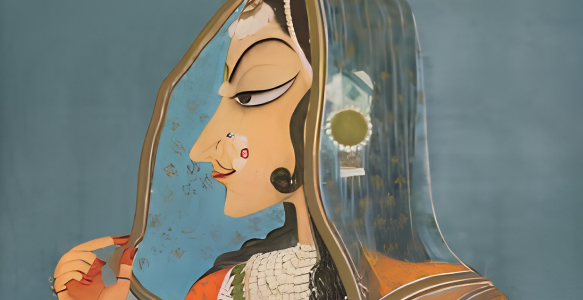
On a quiet weekday afternoon at the National Museum in New Delhi, the gallery of Rajasthani miniatures often feels like a murmured conversation between centuries. You turn a corner, and suddenly there she is: a woman with a long neck, a sharp aquiline nose, brows like drawn bows, and eyes that refuse to meet yours, yet never quite let you go. Her lips hold a half-smile that might be shyness, might be irony, might be devotion. No label can fully explain why viewers linger; the painting works less like an image and more like a presence.
For many of us working with Indian art, the first encounter with the famous Bani Thani feels startlingly modern, even though it emerges from an 18th‑century Jain–Rajput court in Kishangarh, Rajasthan. The stylisation, the almost mannerist elongation, the faintly theatrical costume and jewellery - they make her feel as constructed, as “designed”, as any carefully curated Instagram portrait today. She occupies the same imaginative space in Indian visual culture that Leonardo’s Mona Lisa does in Europe: endlessly reproduced, rarely fully understood.
In curatorial conversations, Bani Thani comes up when we discuss idealised beauty, longing, bhakti, and the thin line between portrait and archetype. She belongs to the Kishangarh school of miniature painting, yet she has slipped free of that label to become an emblem on stamps, posters, and truck panels - a face that left the palace walls and entered everyday life.
What Are Bani Thani Paintings?
When people ask what is bani thani painting, they are usually thinking of a single iconic portrait - the elegant woman against a dark background, holding a lotus, her features exaggerated into a new canon of beauty. Strictly speaking, art historians use “Bani Thani paintings” to describe a cluster of Kishangarh miniatures in which this same stylised female figure appears, sometimes as a courtly woman, sometimes as Radha in devotional Radha–Krishna imagery. In that sense, what is a bani thani painting is both simple and layered: it is a work where the beloved of Raja Sawant Singh becomes the visual template for feminine grace.
The phrase “Bani Thani” itself was a nickname; the woman’s birth name was Vishnupriya, a singer and poet in the Kishangarh court during the reign of Raja Sawant Singh (also known in poetry as Nagari Das). “Bani Thani” roughly translates to “decked-out lady” or “well‑adorned woman”, a nod to her elaborate jewellery, textiles, and careful self‑presentation once she became close to the ruler. Over time, the bani thani painting of Rajasthan came to stand for the Kishangarh ideal of beauty - elongated, poised, slightly otherworldly - in the same way that Ajanta murals carry an older Buddhist feminine ideal.
In miniature circles, conversations about bani thani painting often spiral outward into broader questions: where does portraiture end and allegory begin, and how do patron and painter collude in the making of a myth? Just as Raja Ravi Varma’s heroines absorbed faces from Kerala nobility while claiming to be Shakuntala or Damayanti, so too this painting of radha bani thani folds a real woman into a devotional ideal. That is why bani thani painting information always oscillates between biography and bhakti.
In curating Kishangarh works alongside Mughal portraits and later figurative painters like Amrita Sher‑Gil, the Bani Thani image often acts as a hinge: viewers recognise the stylisation instantly, then begin to notice how later artists - from Raja Ravi Varma to contemporary illustrators - negotiate similar tensions between idealisation and lived personality.
History And Origin of Bani Thani Painting
1. Origin of Rajasthani Bani Thani Art
The bani thani painting origin lies in a small Rajput kingdom rather than a large imperial court - Kishangarh, located near today’s Ajmer in Rajasthan. Here, in the 18th century, a refined, poetic miniature style evolved under the patronage of Raja Sawant Singh, marked by slender figures, lyrical landscapes, and an intense focus on Radha–Krishna devotion. One could say that bani thani kishangarh imagery crystallised when Sawant Singh’s spiritual and romantic lives converged visually.
Vishnupriya, the court singer later nicknamed Bani Thani, was employed by the king’s stepmother and became his companion in both music and poetry. Some sources mention that she wrote verses under the pen name Rasik Bihari, participating in the Vaishnava bhakti culture that defined Kishangarh’s aesthetic atmosphere. In this environment, bani tani painting motifs emerged naturally: love lyrics, monsoon scenes, temple courtyards standing in for Vrindavan, even though the artists worked in Rajasthan.
2. How Nihal Chand Brought Bani Thani to Life?
The court painter Nihal Chand is widely credited with giving Bani Thani her now‑famous form. Trained within the Marwar–Kishangarh miniature tradition, he absorbed Mughal refinements in portraiture - fine brushwork, controlled shading - and fused them with a new, highly stylised figure type. Under Sawant Singh’s guidance, Nihal Chand painted a series of Radha–Krishna works in which the faces of the divine lovers echo those of the king and his beloved.
A canonical example is Radha and Krishna in the Boat of Love, where the lovers drift on placid water, surrounded by attendants and lotuses. The Radha figure here carries the same elongated face, sharp nose, and large, sidelong eyes we associate with bani thani paintings. In a sense, bani thani painting history is inseparable from Nihal Chand’s capacity to transform private courtly romance into a public devotional image.
3. Cultural Significance of Bani Thani Paintings
Over time, these works acquired a life beyond Kishangarh’s palace walls. As reproductions spread, the bani thani painting of rajasthan became a shorthand for Rajasthani elegance, much as Pichwai lotuses or Nathdwara Shrinathji faces stand in for specific devotional ecologies. In 1973, the Indian postal department even issued a stamp featuring Bani Thani, signalling her elevation into the national visual canon.
Today, when educators introduce students to miniature art, Bani Thani often appears alongside works by Mughal masters, Pahari Radha–Krishna scenes, and European portraits like Mona Lisa to discuss cross‑cultural ideals of beauty. The bani thani painting history thus folds into larger conversations about representation, gendered gaze, and the politics of taste.
The more one reads bani thani painting origin stories, the more contradictions appear: was she primarily a historical consort, a poetic persona, or a Radha‑figure? We tend to keep all three possibilities alive at once; they make the image richer, not less truthful.
Key Characteristics of Bani Thani Paintings
1. Facial Structure
The most striking element of bani thani chitrakala is the face: oval yet elongated, tapering to a pointed chin, with a slim, high bridge to the nose and lips pressed into a small, knowing smile. Art historians have compared this stylisation to both earlier Indian ideals and, intriguingly, to the elongated figures of Amedeo Modigliani - different epochs, similar abstraction of anatomy into a type. In many works, the neck is unusually long and graceful, giving the figure a swan‑like, almost mannerist elegance.
2. Lotus Like Eyes
The “lotus eyes” are the true focal point: large, almond‑shaped, heavily outlined, with irises shifted sideways in a perpetual three‑quarter glance. This is where the Radha archetype fuses with Vishnupriya’s remembered features, and where viewers often feel Bani Thani’s gaze slipping past them, as though fixed on a beloved just outside the frame. In some versions, especially those where she appears as Radha, the eyelids droop slightly, suggesting modesty and desire in equal measure, the classical markers of shringara rasa.
3. Costumes and Jewelry
The costume vocabulary of a typical Rajasthani bani thani painting echoes Rajput royal fashion: translucent odhnis edged with gold, patterned ghagras, cholis with fine borders, and profuse yet delicately painted jewellery. Necklaces, nose rings, earrings, armlets, and hair ornaments are rendered with tiny dots of white, yellow, and red, mimicking pearls, kundan, and enamel. These details align Bani Thani with other aristocratic women in Rajput miniatures, even as her face follows a more extreme stylisation.
4. Use of Colors
Colour plays its own quiet role in bani thani painting information: backgrounds are often deep blue, night‑green, or warm brown, setting off the lighter complexion and bright textiles. The palette leans towards saturated reds, pinks, and golds for clothing, with lotuses or patterned textiles adding further rhythm to the surface. Mineral pigments and natural dyes give these works a particular matte luminosity that differs from the oil sheen of later portraitists like Raja Ravi Varma.
Famous Themes Seen in Bani Thani Paintings
1. Divine Romance (Radha-Krishna)
Many works we classify as bani thani paintings are, formally, Radha–Krishna miniatures where the lovers bear the faces of Sawant Singh and Bani Thani. Scenes such as Krishna applying kohl to Radha’s eyes, playing Holi, or gliding in a boat on the Yamuna are classic Kishangarh subjects. The devotional narrative allows private love to be reframed as spiritual longing, a strategy also seen in Bhakti poetry across Braj and Bengal.
2. Royal Court Scenes
Some compositions pull back from divine settings into more earthly court spaces: terraces with jharokhas, carpets patterned like miniature gardens, attendants holding morchhals or flywhisks. Here, the Bani Thani figure appears as a refined lady of the palace, sometimes listening to music, sometimes exchanging glances with a prince.
3. Romantic Narratives
Beyond explicit Radha–Krishna episodes, Kishangarh artists developed a repertoire of romantic vignettes: lovers meeting in a pavilion, separated by monsoon rain, or exchanging letters. In many, the female protagonist carries the Bani Thani face type, turning these into echoes of her legend even when no inscription names her.
4. Sringara Rasa (The Emotion of Love)
The emotional core is unmistakably shringara rasa - love in its many moods, from playful teasing to separation, longing, and fulfilment. Gesture, glance, and small props (a letter, a veena, a monsoon cloud) do much of the storytelling, much as they do in Pahari miniatures or in later cinematic close‑ups.
5. Baramasa (The Twelve Months)
In some Kishangarh cycles, the twelve months (baramasa) are personified through scenes of lovers responding to changing weather and seasons. When the Bani Thani type appears here, the series becomes a calendar of her emotional life, resonating with Baramasa traditions in poetry and Pichwai painting cycles around Shrinathji.
6. Poetry and Music
Given that Vishnupriya/Bani Thani was herself a singer and poet, it is fitting that several scenes show her holding a musical instrument, listening to musicians, or exchanging verses with a prince. These images echo the intertwined lives of painter and poet in other traditions - think of Rabindranath Tagore’s late drawings, or the musical salons that shaped European portraiture.
Why Is Bani Thani Called the Indian Mona Lisa?
The comparison to the Mona Lisa stems from several overlapping factors: a mysterious, ambiguous smile; worldwide reproduction; and a status as an emblem of a broader artistic tradition. Like Leonardo’s painting, Bani Thani sits at the intersection of portrait and ideal, biography and symbol. Both faces have become shorthand - one for the Italian Renaissance, the other for Kishangarh miniatures and, by extension, Rajasthani art.
There is also the matter of circulation. The key bani thani painting origin lies in an 18th‑century Kishangarh court, but its afterlife runs through postage stamps, calendar art, and popular prints. The best‑known image, often referred to as the original bani thani painting, is housed in the National Museum, New Delhi, though related works exist in other collections. For many viewers, this is the first miniature they can name, just as Mona Lisa is often the only Renaissance painting non‑specialists recognize.
In curatorial texts, describing this as the “Indian Mona Lisa” is both helpful and limiting. The phrase opens a door for global audiences, but it can flatten the specificities of bani thani painting information: its bhakti roots, its Rajput courtly context, its link to Radha imagery. The more we return to the painting itself - the line of the nose, the compressed smile, the sideways gaze - the less we need the analogy.
FAQs About Bani Thani Chitrakala
Who is Bani Thani?
Bani Thani was Vishnupriya, a singer and poet at the Kishangarh court in 18th-century Rajasthan.
What is the real name of Bani Thani?
The real name of Bani Thani is believed to be Vishnupriya.
What makes Bani Thani paintings unique?
Bani Thani paintings are known for elongated features, arched eyebrows, lotus-shaped eyes, and idealised beauty.
Who painted the famous Bani Thani artwork?
The most famous Bani Thani painting is attributed to Nihal Chand, the court painter of Kishangarh.
What is the time period of Bani Thani painting?
Bani Thani paintings emerged in the mid-18th century during the reign of Raja Sawant Singh.
Where is the painting of Bani Thani?
The most famous Bani Thani painting is housed in the National Museum, New Delhi.
