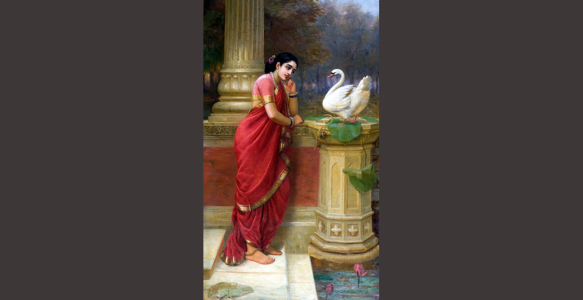
The first time you really look at Raja Ravi Varma’s Hamsa Damayanti, it doesn’t feel like a grand mythological moment at all. It feels like we’ve walked in on a young woman mid-thought, leaning into a stone pillar, the dusk light softening her profile, her jewellery catching a quiet gleam. A white swan stands at her feet, improbably poised, its beak lifted as though speaking, its presence almost stranger than the gods who usually fill such canvases.
Created in 1899, this oil on canvas now sits at the Sri Chitra Art Gallery in Thiruvananthapuram and has become one of the most reproduced & recognised works in Indian culture. Many people encounter it first not on a gallery wall but in family homes- on a calendar, a print, or a laminated postcard quietly pinned near a puja shelf. It belongs to other works like Ravi Varma’s Shakuntala and his sacred mother-and-child pictures, images that shaped how generations imagined mythic women.
At ArtFlute, while navigating between contemporary styles and deep classical references, Hamsa Damayanti becomes a kind of anchor work: a reminder that Indian storytelling has always been as much about the inner weather of its characters as about its grand cosmic battles.
What Is Hamsa Damayanti?
Hamsa Damayanti (often titled Damayanti and the Hamsa) is an 1899 oil painting by Raja Ravi Varma depicting Princess Damayanti of Vidarbha listening to a swan that brings a message of love from King Nala of Nishadha. The painting measures roughly 150 x 83 cm and is considered one of the artist’s definitive mythological works.
Damayanti stands in a palace garden or terrace, leaning against a stone pillar. Her body is angled toward the viewer, but her gaze drops slightly toward the swan, creating a subtle diagonal of attention that runs from her face down to the bird. It is a surprisingly quiet scene for such a pivotal episode in the Mahabharata, which spans love-at-a-distance, gambling, exile, and eventual reunion.
The painting draws directly from the Nala–Damayanti narrative in the Vana Parva (Forest Book) of the Mahabharata, where the hamsa (swan) becomes an intermediary between two people who have never met, carrying descriptions of beauty and virtue between them. When we speak of the hamsa damayanti painting today, we are also speaking of a larger cultural moment- Ravi Varma’s attempt to fuse European academic realism with Sanskrit epic storytelling.
Over time, hamsa damayanti by raja ravi varma has become a shorthand reference point: a single work that encapsulates how myth, romance, and modern pictorial language began to converse in late nineteenth-century India. When we refer to the damayanti painting by raja ravi varma, we are implicitly talking about this iconic image of a woman and a swan.
We often think of this work as “the stillness before the novel begins.” Everything that will go wrong (and right) in Nala and Damayanti’s life is already latent here. And the painting lets us linger in that moment of first hearing one’s own name echoed back as a story on someone else’s tongue.
The Story Behind Hamsa Damayanti
1. Damayanti and Nala
In the Mahabharata, Damayanti is the daughter of Bhima, king of Vidarbha, celebrated for both her beauty and her inner strength. Nala, son of Virasena, rules the kingdom of Nishadha and is virtuous, generous, and exceptionally skilled charioteer. Their story stretches over multiple chapters, intertwining romance, misfortune, and spiritual growth.
For anyone wondering who is damayanti beyond the painting, she is more than a passive beauty. She chooses Nala over gods who desire her, remains loyal through exile and hardship, and plays an active role in their eventual reunion.
2. The Swan's Role in the Story
In the epic, a flock of swans visits Damayanti’s garden. She catches one, and the bird, in exchange for its freedom, promises to carry messages between her and Nala. The swans praise Nala’s qualities to Damayanti and later describe her beauty to Nala, becoming a kind of ancient “messenger service” for feelings that have not yet found words.
Ravi Varma compresses this entire sequence into a single encounter between one swan and one princess. The bird’s raised beak and attentive posture suggest speech, while Damayanti’s lowered gaze suggests listening and inward processing.
3. Why This Story Became Famous
The Nala–Damayanti narrative resonated across centuries because it combined courtly romance with deeply human vulnerabilities: gambling addiction, loss of status, separation, and slowly earned redemption. It was retold in regional languages, performed in theatre and dance, and re-imagined in paintings, prints and photographs.
When we speak with younger audiences today, this painting becomes an unexpected entry point into the Mahabharata. Instead of beginning with war or dharma, we begin with a conversation between a woman and a bird- an intimate scale that makes the epic suddenly feel close to everyday emotion.
What moves me is that the first “medium” in this love story is a living creature. In an era of text messages and notifications, the idea of a sentient messenger who can choose to speak or remain silent gives the relationship a different ethical weight- and Ravi Varma hints at that by making the hamsa almost eerily present.
Key Elements of the Hamsa Damayanti Painting
1. Damayanti's Appearance
Damayanti stands draped in a richly patterned sari, with her upper body partially covered by a transparent veil that catches the light. Her jewellery- necklace, earrings, bangles, waist ornament- is rendered with a miniaturist’s precision, with classical Indian aesthetics and Victorian portraiture. Her posture is relaxed yet contained: one hand touches the pillar, the other lightly gathers her drape, suggesting both support and self-consciousness.
Ravi Varma idealises her features- oval face, large eyes, smooth skin- in line with his broader canon of feminine beauty, a vision that would later influence calendar art and popular religious imagery. When we speak of a damayanti painting in Indian art circles, this is often the mental image that surfaces first.
2. The Swan as a Symbol
The swan stands near Damayanti’s feet, its body turned toward her, neck curved in an almost conversational arc. Its feathers are painted with careful gradations of white and grey, so that it feels solid and luminous. The bird’s presence grounds the narrative: without it, we might read the painting as a generic portrait; with it, the image locks into a specific mythological coordinate.
3. Natural Setting and Background
The background suggests a palace terrace or balcony opening onto a lush garden, with distant greenery and perhaps a hint of water or sky beyond. Architectural elements- stone pillars, balustrades- frame Damayanti, turning her into both participant in the scene and almost a sculptural presence within it. The subdued, warm light suggests late afternoon or early evening, a time often linked to introspection in Indian visual and poetic traditions.
4. Expressions and Emotions
Damayanti’s expression is the centre of the painting: her mouth slightly closed, her eyes lowered yet alert, her brows gently curved, as though absorbing something that unsettles and pleases her at once. The emotional tone is introspective; she is not swooning in love but thinking through it. That tension between inwardness and outer poise is what keeps the painting from slipping into mere sentimentality.
High-resolution imaging changes how we read this work. On screen, we can zoom into the minute modulation of Damayanti’s lips or the near-imperceptible line of shadow under her eye, reading them as emotional annotations that earlier photographic reproductions simply blurred out.
We often feel the painting is less about beauty and more about listening. Damayanti’s body language is that of someone hearing themselves described by another- and that is a complex, even risky, emotional experience.
Symbolism in Hamsa Damayanti
1. Meaning of the Swan
Within the narrative, the hamsa is a literal messenger of love, but symbolically it also stands for the possibility of communication across distance- between kingdoms, between genders, between inner desire and social duty. In many Indian traditions, the hamsa is associated with purity and discernment, the ability to separate essence from surface, and Ravi Varma taps into that reservoir of meaning without resorting to overt religious iconography.
2. Themes of Love and Destiny
The painting condenses the epic’s large arc- romantic attraction, divine rivalry, separation, and reunion- into a single moment of intimate destiny. Damayanti has not yet met Nala, but the words carried by the swan are already shaping her path, raising questions about choice, fate, and the thin line between them. The hamsa damayanti scene thus becomes a visual emblem of love that feels both chosen and preordained.
3. Representation of Beauty and Grace
Ravi Varma’s Damayanti is graceful in a way that bridges classical sculpture, miniature painting, and European salon portraiture. Her elegance is not just in physical features but in the measured containment of emotion, a quality that makes the image feel surprisingly contemporary when placed alongside works by artists like Amrita Sher-Gil or even John Singer Sargent, who also painted women caught in reflective pauses.
In curatorial conversations, this painting often surfaces when we discuss how Indian art has visualised “romantic love” as distinct from bhakti or maternal affection. Hamsa damayanti painting sits at an interesting intersection: it is devotional only in the loosest sense, but deeply invested in the ethics and texture of love.
What I find radical is the painting’s refusal of spectacle. In a culture that could have showcased gods and miracles, Ravi Varma chooses a private conversation with a bird. Symbolism here is quiet, almost whispered, and that modesty makes it enduring.
Artistic Style & Technique in Hamsa Damayanti
1. Realistic Depiction of Characters
Ravi Varma’s training in European academic techniques is evident in the modelling of Damayanti’s face and hands, where careful shading gives volume and anatomical credibility. This realism was unusual in Indian mythological art of the time, which often favoured flatter, more stylised figures in line with miniature or temple traditions. In hamsa damayanti by raja ravi varma, the myth becomes almost novelistic- populated by people who could step out of the frame.
2. Use of Colors and Light
The painting leans toward warm earth tones and muted golds, with the white of the swan and the highlights on the jewellery the focal points of brightness. Light falls from the left, carving Damayanti’s profile out of the surrounding space and creating a soft halo around her figure, a technique of European paintings Ravi Varma admired. The restraint of the palette intensifies the emotional atmosphere rather than competing with it.
3. Attention to Detail
The textures in the stone pillar to the folds of the sari and the individual feathers on the swan, the painting displays an almost obsessive attention to surface detail. This attention to detail aligns him with contemporaneous global realists and classicists, while still being rooted in the specificity of Indian textiles, jewellery, and architecture.
Legacy & Influence of Hamsa Damayanti
Over the twentieth century, Hamsa Damayanti travelled far beyond the gallery as prints, oleographs, and later digital reproductions circulated. These variants show how oral culture, regional pronunciation, and print capitalism entangle around a single image.
It is frequently cited as one of Ravi Varma’s famous paintings, both technically and emotionally. It helped cement his reputation as an artist who could humanise mythological subjects without stripping them of their aura, influencing later calendar art, theatre sets, and even film visualisations of epic stories.
In contemporary practice, echoes of this work appear in everything from fashion editorials staged as “mythic romance” to digital art projects revisiting epic heroines. Artists as diverse as Jamini Roy, who rejected Ravi Varma’s realism, and S.H. Raza, who moved toward abstraction, nonetheless worked in a landscape shaped by the visual expectations his canvases created.
When we curate collections that dialogue between nineteenth-century academic realism and current figurative painting, hamsa damayanti painting often becomes a reference point- even if it is not physically present. Younger artists might quote the tilt of Damayanti’s head, the placement of a bird, or the mood of suspended decision as a way of nodding to, and quietly re-writing, this legacy.
Hamsa Damayanti by Raja Ravi Varma FAQs
1. What is the relationship between Hamsa and Damayanti?
In the story, the swan (Hamsa) acts as a messenger between Damayanti and King Nala, helping bring them together.
2.What is the painting Hamsa Damayanti about?
The painting depicts the moment when a swan tells Damayanti about Nala, inspiring her love for him.
3. Who are Nala and Damayanti in Indian mythology?
Nala and Damayanti are legendary lovers from the Mahabharata, celebrated for their devotion, separation, and eventual reunion.
4. What does the swan symbolize in Hamsa Damayanti?
The swan symbolizes love, communication, purity, and the connection between Nala and Damayanti.
5. Why is Hamsa Damayanti considered one of Raja Ravi Varma's best paintings?
The painting is admired for its realism, emotional depth, and elegant interpretation of a classic Indian legend.
6. How does Hamsa Damayanti reflect Indian culture and traditions?
The painting draws from the Mahabharata and reflects themes of love, destiny, devotion, and classical Indian storytelling.
