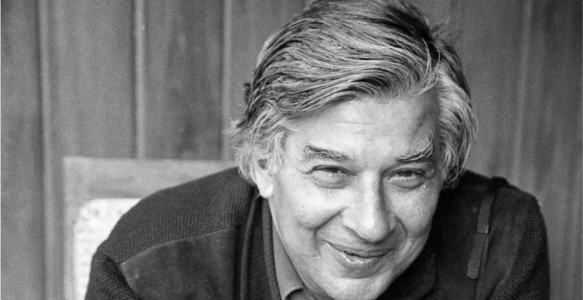
On certain evenings in Delhi, people passing by Krishen Khanna’s studio describe a radio playing old ghazals, turpentine in the air, and canvases where a brass band suddenly erupts in crimson and gold across the surface. It is an atmosphere suspended between memory and performance, where Partition trains, truck cabins, and street musicians all seem to pass through the same doorway of paint.
Among India’s modernists, few have held on to the human figure with as much tenacity as Krishen Khanna. For emerging collectors and curious viewers encountering Krishen Khanna paintings today, this mix of realism, memory, and empathy feels strangely current, even when the scenes are decades old.
What follows is a walk through the life, work, and enduring questions at the heart of Krishen Khanna’s art - how do ordinary people carry history on their shoulders, and what does it mean to keep painting their stories long after the headlines fade.
Who is Artist Krishen Khanna?
Born in 1925 in Lyallpur, in pre‑Partition Punjab (today’s Faisalabad in Pakistan), Krishen Khanna grew up in Lahore in a milieu where literature, music, and debate shaped everyday life. As a teenager he was sent to the Imperial Service College in England on a Rudyard Kipling scholarship.
Returning to Lahore, he studied English literature at Government College and attended evening classes at the Mayo School of Art, quietly stitching together the foundations of what would later be recognised as a major modernist practice. When Partition forced his family to migrate to India, the shock of displacement with crowded trains, hurried departures, the sense of lives packed into bundles, became the emotional undercurrent of much of Krishen Khanna's history on canvas.
In 1946 he joined Grindlays Bank in Bombay, entering the city’s post‑war cosmopolitan ferment just as the Progressive Artists’ Group (PAG) was taking shape. It was in this world that the banker‑by‑day, painter‑by‑night version of Krishen Khanna the artist emerged, sharing conversations and exhibitions with F.N. Souza, S.H. Raza, M.F. Husain, and later Tyeb Mehta. His first group show with them came as early as 1949, followed by a solo at the USIS in Chennai in 1955, even as he remained in banking until 1961.
From the 1960s onward, recognitions followed steadily: a Rockefeller fellowship that took him to the US as artist‑in‑residence, the Lalit Kala Akademi National Award in 1965, and later major honours including the Padma Shri (1990), Lalit Kala Ratna (2004) and Padma Bhushan (2011). His exhibitions since have spanned India, Europe, and the US, yet his studio life has remained curiously grounded.
For anyone searching “who is krishen khanna” it is useful to remember that his story is not one of a prodigy who abandoned everything for art overnight, but of a man who moved slowly from the security of a bank job toward a vocation that demanded watching, waiting, and painting the long arc of everyday life.
Artistic Style in Krishen Khanna Paintings
Khanna’s works are often the first stop for viewers who gravitate to indian paintings where the human figure still anchors the drama. With time, Krishen Khanna’s painting style has become shorthand for Indian figurative expressionism that stays close to lived experience.
1. Figurative Expressionism
At a time when his contemporaries embraced abstraction, Krishen held firmly to the figure, even as he himself experimented with abstraction early on. He has spoken of feeling that “the person is being neglected,” choosing instead to emphasise individuals caught in specific conditions. These could be workers, musicians, migrants, much like the social realists of Mexico or the empathy‑laden figures of Käthe Kollwitz.
His work often sits comfortably within figurative paintings, but the bodies are elongated, bent, or clustered in ways that emphasise psychological tension. In this sense, he sits alongside Indian peers like Husain or Tyeb Mehta, and globally with painters such as Bacon or early Lucian Freud, all of whom stretched the figure to register inner states.
2. Use of Colors and Textures
Krishen’s changes across his series: the Truckwallahs tend to be austere, dusty, almost monochrome, evoking long highways and diesel‑stained afternoons, while the Bandwallahs erupt in crimson, scarlet, and yellow, punctuated with flashes of green and gold. His brushwork is thick and energetic in some works, scraping and scumbling paint to build a tactile surface, while in other works the paint thins out into translucent washes, especially in works that recall memory or dream.
Texture becomes a way of registering fatigue in a shoulder, the weight of a drum, or the metallic glare of a truck. Viewers often notice that entire zones of a canvas are worked and reworked, evidence of an artist who is not afraid to worry about a passage of colour until it resonates with the mood he remembers.
3. Narrative Storytelling in Paintings
Krishen is, above all, a narrativist; his works “weave images out of the fragments of time,” as several writers have noted. Rather than illustrating grand myths, he returns to small, recurring motifs of the musicians, journeys, gatherings, and waiting crowds. Each canvas holds a scene that feels like it might continue just outside the frame. Series like the Bandwallahs, Truckwallahs, or his various Last Supper reinterpretations show how the same narrative structure can be relocated from Renaissance antecedents to the streets of contemporary India.
This narrative impulse places him in dialogue with Indian modernists like Raza, who turned memory into abstraction, and with European painters such as Chagall, whose floating figures similarly carried entire villages in their gestures. For many viewers, Krishen Khanna the artist is inseparable from his stories; the paintings feel like episodes in a long, unfolding visual novel.
Khanna’s style is a reminder that figuration in India did not simply yield to abstraction in the 1950s and 60s. His insistence on story and situation complicates any easy timeline of modernism here, and nudges us to think of style as something porous - absorbing cinema, photojournalism, and street theatre as much as European avant‑gardes.
Famous Paintings & Series by Krishen Khanna
Over the years, certain works have crystallised into Krishen Khanna’s famous paintings that recur in catalogues, exhibitions, and collectors' memories.
1. Bandwallahs Series
His most iconic body of work, the Bandwallahs series portrays Indian wedding bands with musicians in ornate uniforms, their faces often lined with exhaustion, caught in moments between performance and waiting. The canvases pulse with deep reds, yellows, and golds, transforming these everyday figures into almost mythic presences. In recent decades, Krishen Khanna’s sculpture from this series has further extended the motif, with bronze musicians captured mid‑step or mid‑note.
2. The Last Supper Series
Khanna’s various Last Supper interpretations merge the biblical scene into Indian settings, sometimes recasting Christ and the apostles as contemporary figures or band players gathered around a table. These works speak to his interest in how global religious narratives intersect with local, lived realities, echoing how contemporary practitioners have used the theme to explore betrayal, loyalty, and mortality.
3. Truckwallahs Series
The Truckwallahs series shifts attention to drivers and helpers who spend much of their lives on highways, confined to the small theatre of a truck cabin. Painted largely in greys and dusty tones, these works foreground the machinery and cramped interiors, with human figures almost merging with the cargo they carry. The near‑monochrome palette underlines the anonymity and fatigue of these workers, a counterpart to the flamboyance of the Bandwallahs.
4. Game
Works titled Game often depict groups of men in dense clusters, sometimes engaged in cards or other games, sometimes in ambiguous gatherings where the “rules” are unclear. These scenes echo older traditions of depicting gamblers or chess players, but Khanna’s versions carry a subtle political charge - suggesting strategies, alliances, and risks playing out in post‑Independence India.
5. The Journey
Journey motifs run throughout his oeuvre, but paintings explicitly titled The Journey often compress multiple figures into a shared space like train compartments, buses, or imagined thresholds. For viewers aware of his Partition history, these works resonate as meditations on migration, exile, and the fragile comfort of fellow travellers.
6. The Anatomy Lesson
In The Anatomy Lesson, Krishen nods to Rembrandt’s The Anatomy Lesson of Dr. Nicolaes Tulp to modern medical and institutional scenes. His version carries a more complex tone, as Indian figures gather around a body or demonstration, their faces reflecting curiosity, unease, or quiet horror.
7. News of Gandhiji's Death
Painted in 1948, News of Gandhiji’s Death shows a crowd gathered around the announcement of Gandhi’s assassination, the shock of the moment registered in the stillness and clustering of bodies. Auction records and institutional essays often cite this early work as a key example of how a Krishen Khanna artwork can turn collective grief into a carefully staged yet deeply felt tableau.
Across these works, his art offers a sustained reflection on how public events like weddings, processions, assassinations, journeys are experienced at the level of the ordinary person.
Krishen Khanna's Contribution to Indian Modern Art
Within Indian modernism, Khanna occupies a contrasting position: deeply embedded in the cosmopolitan networks of Bombay and Delhi, yet consistently committed to a grounded, observational figuration. Krishen is among the last surviving voices of a generation that includes Souza, Raza, Husain, Ram Kumar, and Akbar Padamsee, yet his trajectory has never been a simple mirror of theirs.
1. Influence on Contemporary Artists
Many contemporary painters, photographers, and even filmmakers credit Khanna with legitimising an empathetic, socially engaged figuration that neither idealises the poor nor reduces them to statistics. Younger artists often point to his Bandwallahs or Truckwallahs as early encounters with images that acknowledged labour and exhaustion without losing visual pleasure.
2. Role in Shaping Figurative Modernism in India
In art‑historical terms, Krishen helped shape a version of Indian modernism where the figure remained central, even as form, colour, and composition evolved. While Souza pushed toward angular distortion and Raza toward luminous abstraction, he maintained a narrative realism inflected by expressionism, contributing to the broader story of modern figurative paintings. For scholars writing Krishen Khanna's biography, this refusal to abandon the human figure has become a key interpretive thread.
3. Association with the Bombay Progressive Artists' Group
Krishen’s association with the Bombay progressive artists' group was both formative and slightly tangential; he is often described as part of the “extended” PAG rather than the core founding circle. Invited by Husain, he exhibited with them from 1949 onwards, absorbing their push toward a modern Indian vocabulary. His journey suggests that movements are rarely as neatly bound, artists drift in and out, bringing with them other stories, in this case of banking, Partition, and the long years in Delhi.
Today, when museums, biennales, and auction houses revisit mid‑century Indian modernism, krishen khanna art is read as a crucial bridge between historic trauma and contemporary questions of migration, labour, and faith.
FAQs About Krishen Khanna
1. What is Krishen Khanna famous for?
Krishen Khanna is best known for his figurative paintings, especially the Bandwallahs and Truckwallahs series.
2. What themes are commonly depicted in Krishen Khanna's paintings?
Krishen Khanna’s themes include migration, labour, music, processions, and collective experience through weddings, journeys, political gatherings.
3. Which artistic style is Krishen Khanna known for?
Krishen Khanna is known for figurative expressionism with strong brushwork, colour, and narrative detail.
4. What is the most famous series by Krishen Khanna?
The Bandwallahs series is his most famous, though the Truckwallahs series is also widely recognised.
5. What mediums did Krishen Khanna primarily use?
He worked mainly in oil, drawing, and mixed media, and also made bronze sculptures.
6. What makes Krishen Khanna an important figure in modern Indian art?
He is important for bringing strong human emotion and social observation into modern Indian art.
