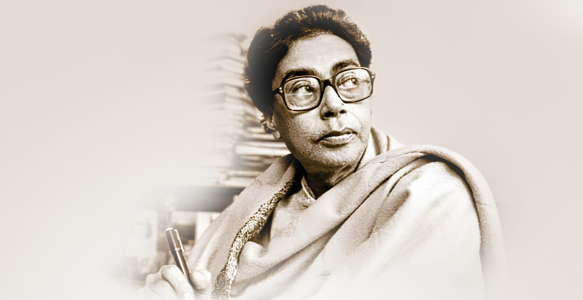
On some evenings in north Kolkata, neighbours recall seeing a faint light burning in an old mansion on Kabiraj Row, well after the rest of the lane had gone quiet. Inside Ganesh Pyne was bent over a small tempera board, building a world of phosphorescent blues and bone - whites, where apes guard flowers, boats are made of skeletons, and windows open into palpable darkness. The city outside was loud, chaotic, sharply real, while his art felt almost whispered - like half-remembered stories from a grandmother, or scenes from a black‑and‑white film that won’t quite leave the mind.
To speak about Ganesh Pyne the artist, is to speak about a sensibility rather than a career graph - a sensibility shaped by childhood trauma, folk tales, and a lifelong dialogue with death. He has been called “the painter of eloquent silence”, a modernist who kept largely to Kolkata, working slowly, producing perhaps nine or ten works a year.
In tracing his life, themes, and some key works, we’re not only gathering Ganesh Pyne’s information; we’re also entering an intimate, shadowed theatre where reality, myth and memory keep changing places.
Who was Artist Ganesh Pyne?
Ganesh Pyne was born in 1937 in Calcutta (now Kolkata), into a culturally rich but financially fragile family, in a 19th‑century mansion whose decaying corridors later haunted his imagination. He lost his father at the age of nine, and in the same period witnessed the Direct Action Day riots of 1946, seeing cartloads of bodies being brought into a hospital mortuary - a searing encounter with violence he would recall for the rest of his life. Those formative years, marked by grief and public unrest, are the subterranean layer under almost every Ganesh Pyne painting you encounter.
In contrast to this harsh outer world, his inner world was lit byhis grandmother’s folktales on the balcony, Bengali children’s books, episodes from epics and local legends that blurred the line between ghost story and moral fable. This is the “oral archive” from which he would later draw his skeletal horses, masked figures, puppets and spectral animals - images that feel as if they’ve stepped out of a dream. Any Ganesh Pyne biography that ignores this domestic storytelling misses the quiet, matrilineal thread in his work.
Pyne studied at the Government College of Art & Craft, Kolkata, an institution deeply linked with the Bengal School and artists like Abanindranath Tagore and Nandalal Bose. He admired Abanindranath’s lyricism and ink‑wash subtlety, while also absorbing the structural clarity of Western painters such as Rembrandt, Frans Hals and Paul Klee. Over time, however, he peeled away from both strict Bengal revivalism and overt Westernisation to shape a language that critics now file under “poetic surrealism”, but which he himself treated as an intensely private vocabulary.
If you put aside market labels and simply ask “who is artist Ganesh Pyne to his own city?”, the answer often begins with that house: its peeling walls, its echoing corridors, its stories. His art feels less like a long, haunted conversation between that building, his childhood self, and the darkening decades of post‑Independence Bengal.
Artistic Journey of Ganesh Pyne
1. Early Work in Animation
After college, Pyne’s first steady income came from his work as an illustrator and then as a draughtsman at Mandar Studios, one of India’s early animation outfits run by filmmaker Mandar Mullick. Here he sketched characters frame by frame, learning how a subtle change in posture could shift an entire mood; how a figure turning its head could move a story forward without a single spoken word.
The studio later invited Claire Weeks, an animator from Walt Disney, to train the team, introducing Pyne to a different discipline of exaggeration and timing. He also immersed himself in European cinema, particularly Bergman, Wajda and Fellini - films where mist, shadow and off‑screen sound do as much storytelling as the actors. At one point, as a blog on his life notes, the film he was working on never got made, and Mullick and his wife died in poverty - a harsh reminder of creative labour’s precarity that stayed with him. You can almost feel that fragility in the way many paintings by Ganesh Pyne balance on a knife‑edge between image and erasure.
2. Development of His Distinctive Tempera Style
Pyne began as a watercolourist in a Bengal School vein, painting wayside temples and quiet mornings before gradually moving to gouache and, finally, to tempera - his lifelong medium. Tempera allowed him to build his surfaces slowly: multiple translucent layers burnished to a soft sheen, creating that unmistakable inner glow where light seems to emerge from beneath the skin of the image rather than fall upon it. The palette - ochres, smoked blues, velvety blacks - is restrained, almost monastic, yet within it a single red flower or sliver of bone can feel electrically alive. When people speak of a Ganesh Pyne art style, they’re often talking about this paradox: darkness as a carrier of luminosity.
3. International Recognition and Exhibitions
Pyne joined the Society of Contemporary Artists in 1963, exhibiting alongside peers such as Bikash Bhattacharjee, Ganesh Haloi and Shyamal Dutta Ray, who were all rethinking the possibilities of figuration in a newly independent India. Through the 1970s, his reputation grew quietly but steadily; M. F. Husain famously called him the best painter in India, and international curators began to seek out his work as a key voice of dark surrealism from the subcontinent.
Even though he rarely travelled, he was present in important shows of modern Indian art abroad, and his works began appearing at auction in London, New York and Mumbai. Paintings like Raktakarabi (1957) and The Door, The Windows (1980) have since fetched significant prices, with the latter setting a record for the most expensive Pyne sold at auction. Yet he continued to live in Kolkata in relative austerity, uneasy with the “art bazaar” and the jealousies it brought, preferring to let the images travel without him.
Themes in Ganesh Pyne 's Paintings
1. Solitude and Psychological Depth
Stand before any small tempera by Pyne and you’ll notice how often the central figure is utterly alone - a child, a soldier, an animal, a masked presence framed by emptiness. That emptiness is never just background; it’s a psychological field, loaded with the memory of riots, personal loss and a lifelong contemplation of mortality. As Bhupen Khakhar once observed, his personal encounters with violence formed the dark backdrop of the work, while the “language” came from animation.
These figures rarely perform; they exist in suspended states - waiting, listening, bracing. The result is an intimacy that can be unsettling for viewers accustomed to more declarative modernism from peers like F. N. Souza or Tyeb Mehta; Pyne’s drama is interior, almost whispered.
2. Fantasy and Dark Surrealism
Pyne’s universe is full of impossible combinations: skeletal boats gliding across inky waters, apes cradling flowers, masks alongside disembodied limbs, windows opening into dense blue voids. This is why critics often situate Ganesh Pyne artwork within “dark surrealism”, but unlike European Surrealists who leaned on Freud, Pyne’s dream‑logic is steeped in local folklore and personal memory. His self‑described “poetic surrealism” lies in that balance between terror and tenderness, horror and lullaby.
For contemporary audiences exploring surrealist paintings, his work reads almost like a bridge between Odilon Redon’s smoky visions and the narrative density of Indian miniature traditions.
3. Folklore and Mythology
The stories his grandmother told - about ghosts, village deities, trickster animals - never left him, and they surface repeatedly as motifs: puppets, crows, chariots, thresholds between village and forest. Later in life, he turned explicitly to epic material, most notably in his Mahabharata series (2007–2009), where he focused on peripheral, wounded characters like Ekalavya or Amba.
Raktakarabi, painted when he was still in his twenties, draws from Rabindranath Tagore’s play of the same name, recasting its critique of greed and industrial violence into a compact, melancholic image that would go on to become a seminal work in the market. For viewers used to grand mythological paintings, Pyne’s approach feels more like an after‑image of mythology - what lingers after the story has been told.
4. Animation Influence
Even in his most static compositions, you can sense an animator’s mind at work. In Encounter in the Twilight Zone (1974), for instance, an Amazonian woman stands on a boat seemingly fashioned from bones under a pale moon; the fog, the angle, the grain all recall the cinematography of European art films he admired. The same applies to his framing - doors, windows, arches - acting like storyboards, suggesting scenes before and after the one we see.
Famous Paintings of Ganesh Pyne
1. Crossing the Fountain
Crossing the Fountain (1974) has become one of the most cited works among Ganesh Pyne famous paintings - a spectral figure moving past a fountain that itself seems half‑ruin, half‑memory. Auction essays link the motif to a scene from Fellini’s La Dolce Vita, filtered through Pyne’s own darkness: the fountain as threshold, the act of crossing as a quiet existential gamble.
2. Encounter in the Twilight Zone
Painted in 1974, Encounter in the Twilight Zone shows a lone woman on a bone‑like boat under a washed‑out moon, suspended between arrival and departure. Christie’s describes the work’s atmosphere in cinematic terms - fog, grain, exaggerated shadows - making it a key example of how a single Ganesh Pyne artwork can hold both narrative and dream.
3. The Blue Herb
In The Blue Herb (1974), a fragile plant burns with an otherworldly blue against a dark ground, the entire tempera surface shimmering with layered light. The modest scale belies its intensity; the painting reads like a study of resilience, a botanical still life pushed into metaphysical territory.
4. Raktakarabi
Raktakarabi (1957), executed in watercolour, is often cited as an early but crucial work, translating Tagore’s anti‑industrial play into a visual language already tinged with melancholy. Decades later, it would achieve a notable auction result - far exceeding estimates - marking how deeply this image had lodged itself in the imagination of collectors.
5. The Assassin
Works like The Assassin push his fascination with violence and guilt to the surface: a figure caught in the aftermath rather than the act, surrounded by the residue of what has happened. Essays on the painting note how Indian viewers often read vastu, karma and fate into such images, overlaying their own belief systems onto his already dense symbolism.
6. Ape and the Flower
In Ape and the Flower (1990), a simian figure tenderly regards a delicate blossom, the contrast between brute body and fragile colour setting up a tense, almost allegorical encounter. The motif of the ape recurs across his oeuvre; one critic has called it “a subject of great importance to the artist”, a stand‑in perhaps for the raw, instinctual self confronting beauty.
7. The Masks
The Masks (1994) brings together toys, masks, skulls and disintegrating objects, condensing several of his obsessions into a single, unsettling tableau. Nandalal Bose’s writings on masks and folk theatre, which Pyne read early in his career, likely fed this fascination with faces that can be put on and taken off.
8. The Door, The Windows
Painted in 1980, The Door, The Windows has achieved iconic status not only for its record auction price but for how it turns simple architectural elements into metaphors for looking, exclusion and interiority. Three apertures glow against darkness, suggesting multiple vantage points into the same troubled world - one of the clearest examples of how paintings by Ganesh Pyne turn everyday objects into psychological devices.
When we map these works across decades, what emerges is less a linear progression and more a constellation of recurring images: fountains, doors, boats, masks, flowers. For curators, the challenge (and joy) lies in hanging them so that these motifs echo across the room, inviting viewers to trace their own pathways through the darkness.
FAQs About Ganesh Pyne
1. What is Ganesh Pyne known for?
Ganesh Pyne is known for his atmospheric tempera paintings that explore memory, folklore, solitude, and mortality.
2. What style of painting did Ganesh Pyne use?
Ganesh Pyne worked primarily in tempera, creating layered, dreamlike paintings often associated with dark surrealism.
3. Why are Ganesh Pyne's paintings important in Indian art?
Ganesh Pyne's paintings are important for their distinctive visual language and lasting influence on modern Indian art.
4. What influenced Ganesh Pyne's artistic style?
His work was influenced by Bengali folklore, the Calcutta riots, the Bengal School, animation, and artists such as Rembrandt and Paul Klee.
