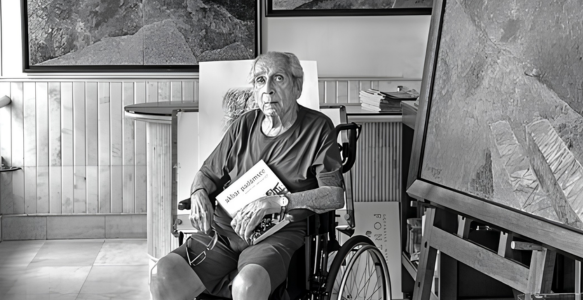
On a damp Bombay evening in the late 1950s, viewers walked into Jehangir Art Gallery and found themselves face to face with vast, almost soundless canvases in grey. Heads, nudes, rooftops, a distant Greek hillside – all dissolved into a spectrum of ash, slate and pearl, as if someone had turned down the volume of the visible world. For many, these works felt disorienting; for Akbar Padamsee , they were necessary experiments in “seeing without distraction.”
Padamsee belonged to that restless first generation of post-Independence modernists. His art moved between media – oil to photography to computer graphics – with the same intensity with which he moved between heads, landscapes, couples and mythic figures.
His rigorous formal inquiry and meditative stillness is what continues to draw curators, scholars and collectors back to Akbar Padamsee’s artworks.
Who Was Artist Akbar Padamsee ?
Akbar Padamsee (1928–2020) was a pioneering Indian modernist whose practice stretched from painting and sculpture to photography, film and computer-generated images. Born into a traditional Khoja Muslim family in Bombay, he emerged as the youngest associate of the Bombay progressive artists group, aligning himself early with artists determined to reimagine Indian art after Independence.
After graduating from the Sir J. J. School of Art, he left for Paris in 1951 on a French government scholarship, entering a world where Cézanne, Picasso and Matisse were living visual arguments on museum walls. Those years in Europe sharpened his modernist foundations while reinforcing his instinct to avoid easy stylistic labels. He was also, importantly, a “thinker’s artist”: his Metascapes and Mirror Images are more about the structure of consciousness, reflection and duality. His works carry a sense of inner weather: psychological space rendered through flattened planes, calibrated tones and a disciplined palette.
When engaging with indian art paintings today, Padamsee rarely appears as an easy “influence” – and that feels right.
Quick Facts About Akbar Padamsee
- Date of Birth: 12 April 1928.
- Place of Birth: Bombay (now Mumbai), Maharashtra, India.
- Education: Diploma in Painting, Sir J. J. School of Art, Mumbai (graduated 1948–51 period).
- Known For: Indian modernist painter; Grey Series, Metascapes, Mirror Images; heads, nudes, landscapes, couples; experiments across film, photography and computer graphics.
- Parents: Hassan Padamsee (businessman) and Jenabhai Padamsee (homemaker).
- Spouse: First married Solange Gounelle in Paris in 1954; later lived in Mumbai with his wife Bhanumati Padamsee.
- Date of Death: 6 January 2020, Coimbatore, Tamil Nadu, aged 91.
The biographical outline looks straightforward, but the real “Akbar Padamsee biography” lives in the gaps: the studio decisions, the court case over an “obscene” nude, the philosophical reading that slipped between painting sessions – fragments that surface only in anecdotes, letters and the work itself.
Early Life & Artistic Background of Akbar Padamsee
1. Formal Training at Sir J. J. School of Art
At Sir J. J. School of Art, Bombay’s colonial-era bastion of academic realism, Padamsee learned drawing, anatomy and oil technique – but he also learned he did not want mere imitation of European salon painting. His student years coincided with a hunger among young Indian artists to loosen that grip and seek a language that acknowledged both Ajanta and the avant-garde.
Teachers and peers recall him as a quiet, meticulous student, more likely to be found redrawing a single head. Early copies made from magazines like The Illustrated Weekly of India in his father’s account books hint at how drawing and daily life were intertwined from the start.
An important intervention came from community leader Aga Khan, who supported his desire to pursue art and even suggested Paris for further study – a rare endorsement at a time when the family expected him to join the flourishing business.
2. Association with the Progressive Artists' Group
Still a student when the Progressive Artists’ Group announced itself in 1947, Padamsee gravitated towards its members – F.N. Souza, S.H. Raza, M.F. Husain – and became its youngest associate. The PAG’s rejection of both colonial academism and sentimental nationalism offered exactly the kind of modern, secular, experimental space he was searching for. He was never the group’s loudest voice; instead, he absorbed conversations about artists, cubism and Indian sculpture, letting them percolate into his own more introspective line of inquiry.
3. Paris Years and European Influence
In 1951, Akbar Padamsee the artist boarded a ship for France on a government scholarship and stepped into a city still buzzing with post-war debates around abstraction, existentialism and psychoanalysis. He worked at Stanley Hayter’s famed Atelier 17, an experimental printmaking studio, and spent time with fellow Indian modernists Raza and Souza, whose own careers were unfolding in Paris and London. Museum visits exposed him to Cézanne’s constructed planes, Matisse’s economy of line and Picasso’s shifting perspectives. His early Paris exhibitions, including a 1952 solo at Galerie Saint-Placide, marked him as a serious emerging modernist, with works like Woman with Bird winning critical attention and the Prix de la Critique.
4. Evolution of Paintings Styles and Techniques
Across decades, Padamsee moved between charcoal heads, sensuous nudes, densely worked cityscapes and austere Metascapes, but the underlying concern remained consistent: the relationship between structure, light and inner states. The Grey Series crystallised this – by limiting himself to tonal variations in grey plastic emulsion, he pushed texture, brushwork and spatial rhythm to the forefront. His later explorations into Mirror Images and computer-generated works at IIT Bombay’s Visual Computer Centre in the late 1960s and 1970s reveal the same analytical impulse, now applied to questions of reflection, symmetry and perception.
Major Themes in Akbar Padamsee 's Paintings
1. Modernist Foundations and Influences
Padamsee’s modernism is not about stylistic bravado; it is about method. You see it in the way he builds a head from intersecting planes, or a cityscape from vertical stacks of tone, echoing constructive brushstroke and cubist spatial thinking without becoming derivative. European influences coexist with an awareness of Indian miniatures, sculpture and temple architecture.
2. Blend of Abstraction and Figuration
Many of Akbar Padamsee’s artworks hover in that charged zone where a motif is recognisable but on the verge of dissolving: a rooftop cluster edging toward pure geometry, a couple defined as much by the space between them as by their outlines. This tension between abstraction and figuration aligns him with peers like V.S. Gaitonde and Ram Kumar.
3. Monochromatic Exploration (Grey Series)
The Grey Series is perhaps his most radical and influential body of work. Using plastic emulsion and common house-painters’ brushes, he produced large-scale greyscapes – heads, landscapes, city views – in which subtle tonal shifts carry enormous emotional weight. For all the talk of monochrome minimalism, Padamsee’s work is surprisingly tactile; the paint feels breathed, not imposed.
Famous Paintings & Series of Akbar Padamsee
1. Reclining Nude
Reclining Nude from 1960 is central to understanding both his treatment of the body and his position within modern Indian art. A sensuous yet unsentimental figure, constructed through earthy tones and firm contours, the work later set a record at Sotheby’s, signalling how Akbar Padamsee’s famous paintings have come to anchor the secondary market.
2. Rooftops
Padamsee’s Rooftops (1959) marks the start of his famed “grey period.” This monumental canvas (nearly 8×2.4 meters) unfolds as a continuous panorama with no clear beginning or end. It densely packs block-like buildings along a sloping cityscape, from domed towers to tiled houses, all rendered in tonal grays. Padamsee painted it outdoors at night, then invented a unique scroll-like composition: he rolled out huge canvas sections in sequence, “opening it part by part” as he worked. The result is an almost infinite vista freed of any real geography, suggesting a timeless urban maze.
3. Greek Landscape
Greek Landscape (1960) is a sweeping imagined panorama in Padamsee’s Grey Series. It spans a vast terrain of rolling hills and crumbling classical ruins beneath soft cloudy skies. Painted in Paris, the work channels the spirit of Mediterranean antiquity through abstraction: its forms suggest temples and villages, but all detail is distilled into masses of gray. Padamsee himself quipped that he had “never even been to Greece” – the title was given later to evoke a Mediterranean feel. At 4.3×12 feet, Greek Landscape is one of Padamsee’s largest works. It set a world auction record (Rs 19.19 crore in 2016), reflecting its importance.
4. Woman with Bird
Padamsee’s Woman with Bird (1951) is an intimate, symbolic portrait and one of his earliest famous works. It shows a solitary female figure with a small bird, executed in a simplified, dreamlike style. In 1952 this painting won a prize from André Breton (the Surrealist poet) in Paris. Padamsee later explained that even here he painted the eyes as mere circles to give the face a haunting, expressionistic look. The result fuses gentle emotionality with Surrealist suggestion: the figure’s calm demeanor is balanced by the enigmatic bird motif, hinting at themes of freedom and introspection.
5. Cityscape
Padamsee’s Cityscapes present urban scenes with rhythmic geometry. In his late-1950s Gray Period, works titled Cityscape (e.g. 1959) turned skyward, showing rows of abstracted buildings and a distant horizon. Unlike his close-up city paintings of the early 1950s, the Grey Cityscapes are panoramic: clusters of rectangles - windows, roofs, balconies spread under a faint moon and glowing sky. The grayscale palette gives them a calm, “restful” atmosphere, even as the repeated shapes create a subtle rhythm. Padamsee himself made dozens of custom grays (like “cadmium-red gray” or “yellow gray”) to enrich these scenes.
6. Grey Series
Padamsee’s Grey Series (1959–60) encompasses a handful of large, monochrome works that redefined his art. After returning to India from Paris, he chose to “paint only in shades of grey”. In just a few months he created four massive horizontal paintings (including Rooftops and Greek Landscape) plus an equally large reclining nude. The Grey Series was revolutionary in India: its exhibition in March 1960 (at Gallery 59, Mumbai) was a sensation. Exploring gray helped Padamsee in eliminating color freed composition – he famously said gray is “without prejudice… It does not discriminate between object and space”.
7. Head Series
Throughout his career Padamsee returned again and again to portraits and Heads. His Head Series (in oils, watercolors, prints, sculpture) reflects a fascination with the human face as a vessel of emotion. However, he rarely aimed for likeness; instead, he “constructed form rather than…the specifics of portraiture”. Across all, the eyes (even when just painted as circles) are focal – as he noted, a face gains “a look” from the eyes. The head series underscores Padamsee’s belief that a figure can exist in paint without narrative – the head alone carries a thought or presence.
8. Couples Series
Padamsee’s Couples works pair two human figures in close intimacy. Early on, Padamsee caused a scandal when his 1954 Jehangir show included two paintings of nude couples (these were censored and ordered removed by police). Throughout his career he returned to the subject of pairs – lovers, parents with child, or symbolic duos. In the typical Couples painting, two bodies are arranged in a shallow space and often overlap or touch. There is rarely a narrative caption: the tension arises only from posture and proximity. This allows the viewer to feel the emotional pull (is it love, protection, alienation?) without any explicit story.
9. Nude Series
Padamsee’s Nude paintings extend his figure work into the realm of pure form. Starting with the sensual nudes of his Paris years, he continually revisited the human body – often female – as subject. But his nudes are not erotic in a narrative sense. By the 1960s and later, these nudes became increasingly angular and abstract. Legs, breasts or arms may appear like overlapping curved surfaces lit from above, so that the figure itself reads as a study in light and shadow. Padamsee saw abstraction as integral to even a nude, “Even when you do a nude if the quality of abstraction is not there, it’s not art”.
10. Metascapes
Padamsee coined Metascapes to describe his “beyond landscape” paintings. These are neither realistic vistas nor pure abstraction but “mental terrains” that merge nature and imagination. Beginning in the 1970s, Padamsee infused them with spiritual symbolism drawn from Indian philosophy. A recurring motif is the sun and moon coexisting in the sky – a direct nod to Kalidasa’s Sanskrit play Abhijñānashākuntalam. By weaving mythic imagery into luminous plains, Padamsee’s Metascapes seek to convey universal moods rather than depict any real place.
11. Mirror Images
The Mirror Images series (from the 1990s onward) explores symmetry and reflection. Each Mirror Image is typically a large diptych: two side-by-side panels that together form one picture. But rather than literally mirrored, the halves contain echoed shapes and colors. In any Mirror Image painting, every element in one panel has a counterpart in the other – a double or counterpoint. This visual doubling symbolizes Padamsee’s interest in opposites: conscious vs. unconscious, form vs. void. As Christie's notes, these works “epitomize Padamsee’s life-long obsession with using color and reflection, and experimentation with notions of duality”.
FAQs About Akbar Padamsee
1. What is Akbar Padamsee known for?
Akbar Padamsee is known for his Grey Series, Metascapes, and his pioneering role in modern Indian art.
2. What type of art did Akbar Padamsee create?
He created modernist paintings, sculptures, photographs, films, and digital artworks, working across both figurative and abstract styles.
3. What awards has Akbar Padamsee won?
Akbar Padamsee received several honours, including the Padma Bhushan, Kalidas Samman, and Lalit Kala Akademi Fellowship.
4. Why is Akbar Padamsee important in contemporary art?
Akbar Padamsee is regarded as a key figure in modern Indian art, known for his experimental approach to form, colour, and space.
