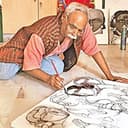

Born in 1942 in Boorugupali, Andhra Pradesh, Thota Vaikuntam studied at the college of Fine Arts and Architecture, Hyderabad. And in 1971, he made his way to study at the M.S. University, Baroda thanks to his securing the Lalit Kala Akademi Fellowship. Each stroke in Vaikuntam's paintings and artworks carries a sense of power. His controlled lines and expertly applied finer strokes give off a maj...
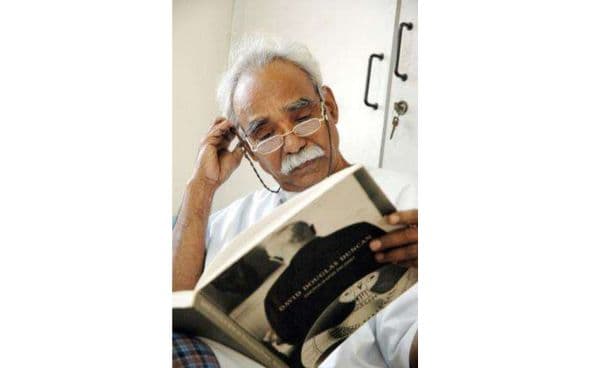
Born in 1942 in Boorugupali, Andhra Pradesh, Thota Vaikuntam studied at the college of Fine Arts and Architecture, Hyderabad. And in 1971, he made his way to study at the M.S. University, Baroda thanks to his securing the Lalit Kala Akademi Fellowship.
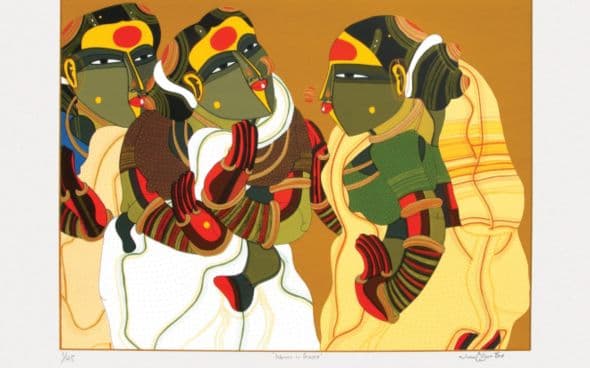
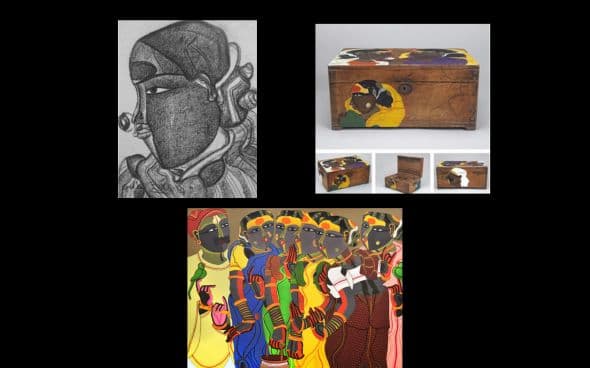
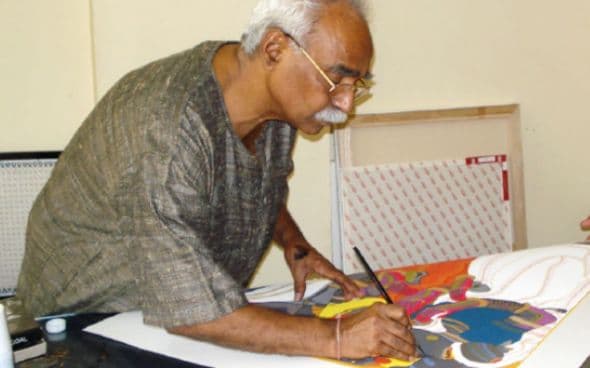
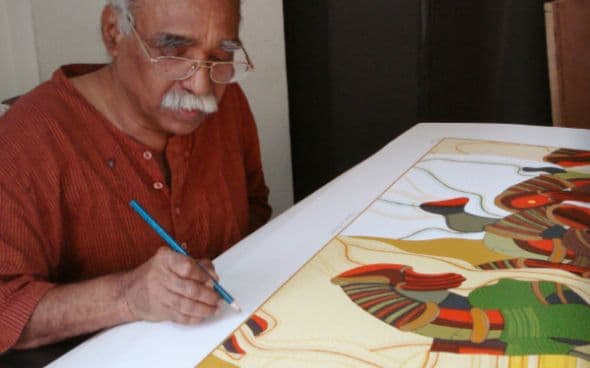
Each stroke in Vaikuntam's paintings and artworks carries a sense of power. His controlled lines and expertly applied finer strokes give off a majestic aura that emanates from him. Thota Vaikuntam typically sticks to using basic colours. Since he thinks that composite colours are artificial and don't exist in nature. He likes to use strong primary colours such as red, saffron, and even orange, as these are primarily Indian hues. These colours give his works a sense of character and depth.
Contemporary Indian Artist Thota Vaikuntam has held numerous solo exhibitions in Delhi, Mumbai, and other Indian cities despite the fact that he resides and works in Hyderabad. Additionally, the paintings of Thota Vaikuntam have been shown in New York, London, Dubai, Birmingham, and Kassel. His work was displayed at the VII Triennale in Delhi, and in 2001, he also participated in exhibitions with Saffronart in Los Angeles and Hong Kong. In 1988, he received the Bharat Biennale Award in Bhopal, and in 1993, the Indian government presented him with the National Award for Painting. You can browse through our gallery of Serigraphs to see more of his artworks and paintings along with other famous serigraph artists.
Each stroke in Vaikuntam's paintings and artworks carries a sense of power. His controlled lines and expertly applied finer strokes give off a majestic aura that emanates from him. Thota Vaikuntam typically sticks to using basic colours. Since he thinks that composite colours are artificial and don't exist in nature. He likes to use strong primary colours such as red, saffron, and even orange, as these are primarily Indian hues. These colours give his works a sense of character and depth.
Contemporary Indian Artist Thota Vaikuntam has held numerous solo exhibitions in Delhi, Mumbai, and other Indian cities despite the fact that he resides and works in Hyderabad. Additionally, the paintings of Thota Vaikuntam have been shown in New York, London, Dubai, Birmingham, and Kassel. His work was displayed at the VII Triennale in Delhi, and in 2001, he also participated in exhibitions with Saffronart in Los Angeles and Hong Kong. In 1988, he received the Bharat Biennale Award in Bhopal, and in 1993, the Indian government presented him with the National Award for Painting. You can browse through our gallery of Serigraphs to see more of his artworks and paintings along with other famous serigraph artists.


byThotaVaikuntam.jpg)








Mask1_24inchX24inch_AcryliconCanvas.jpg&w=750&q=75)





.jpeg&w=750&q=75)