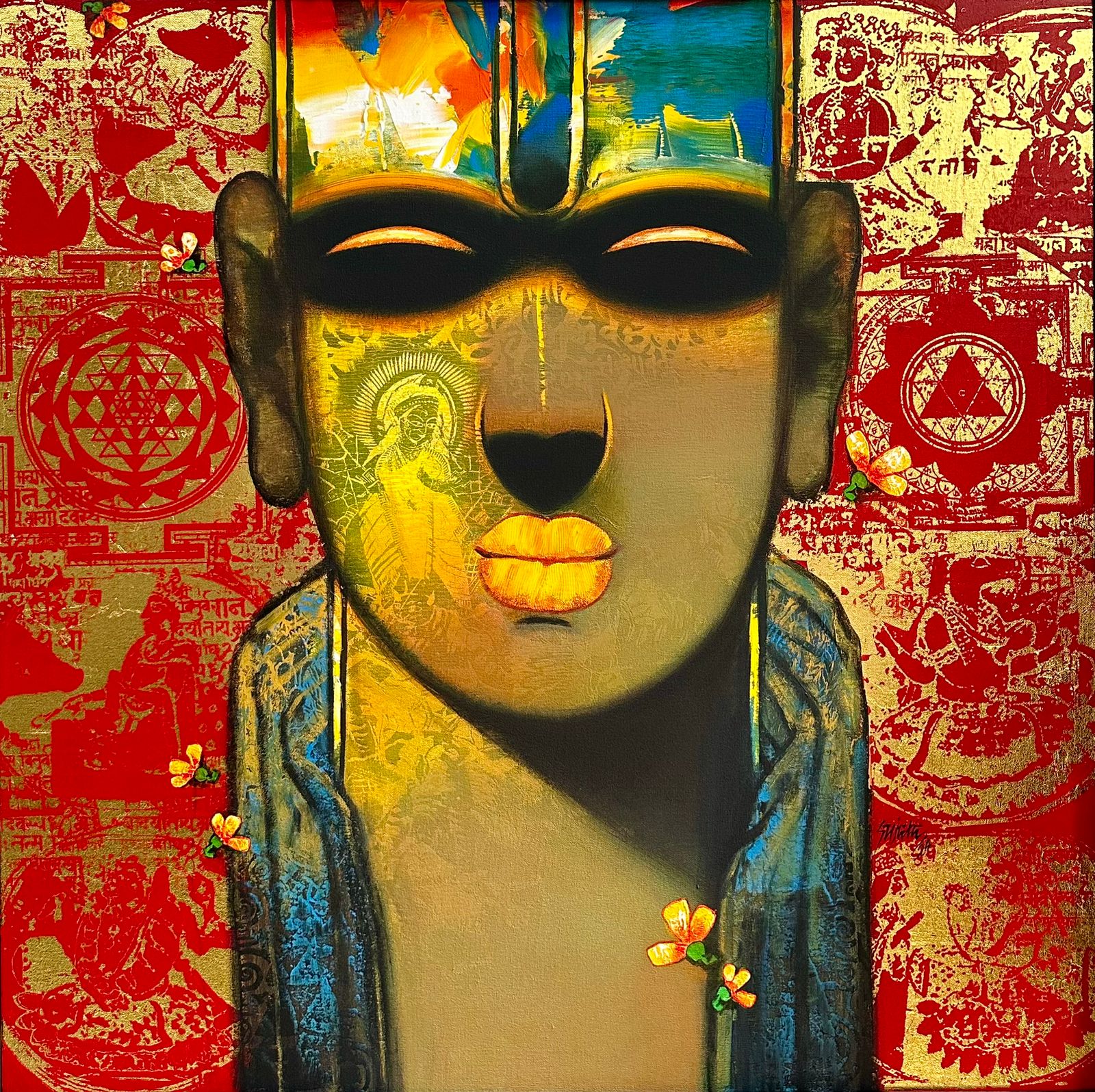
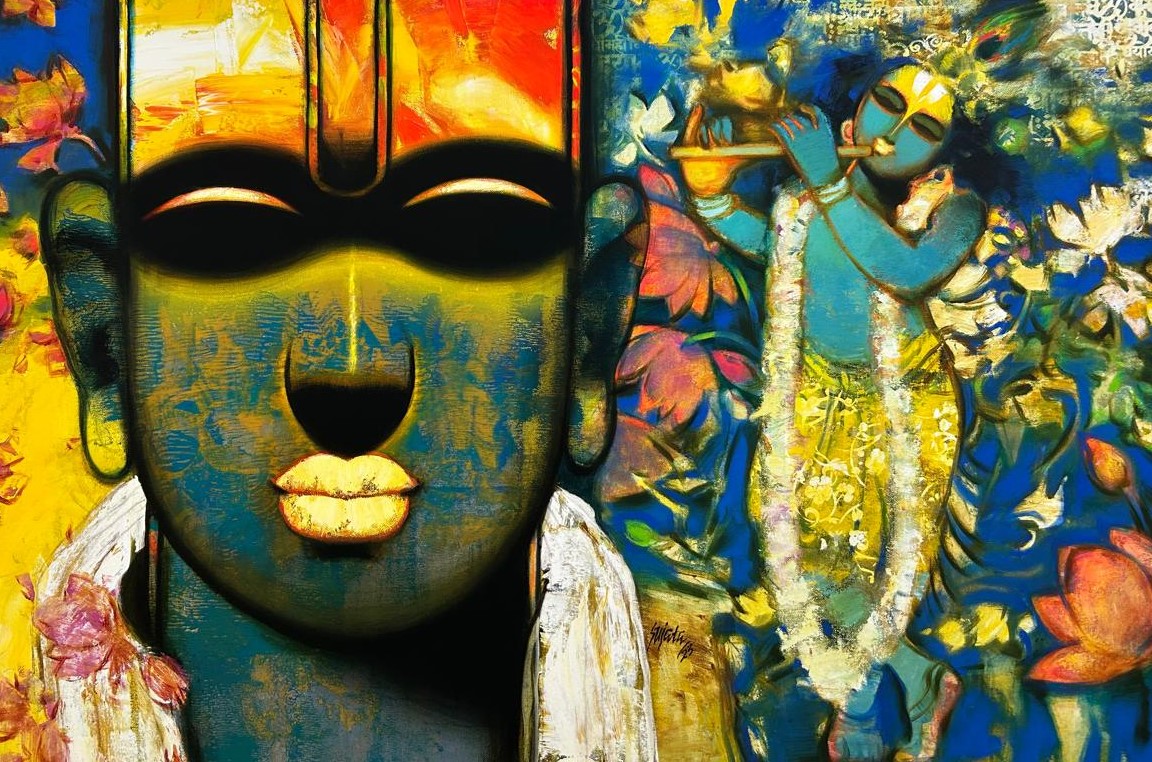
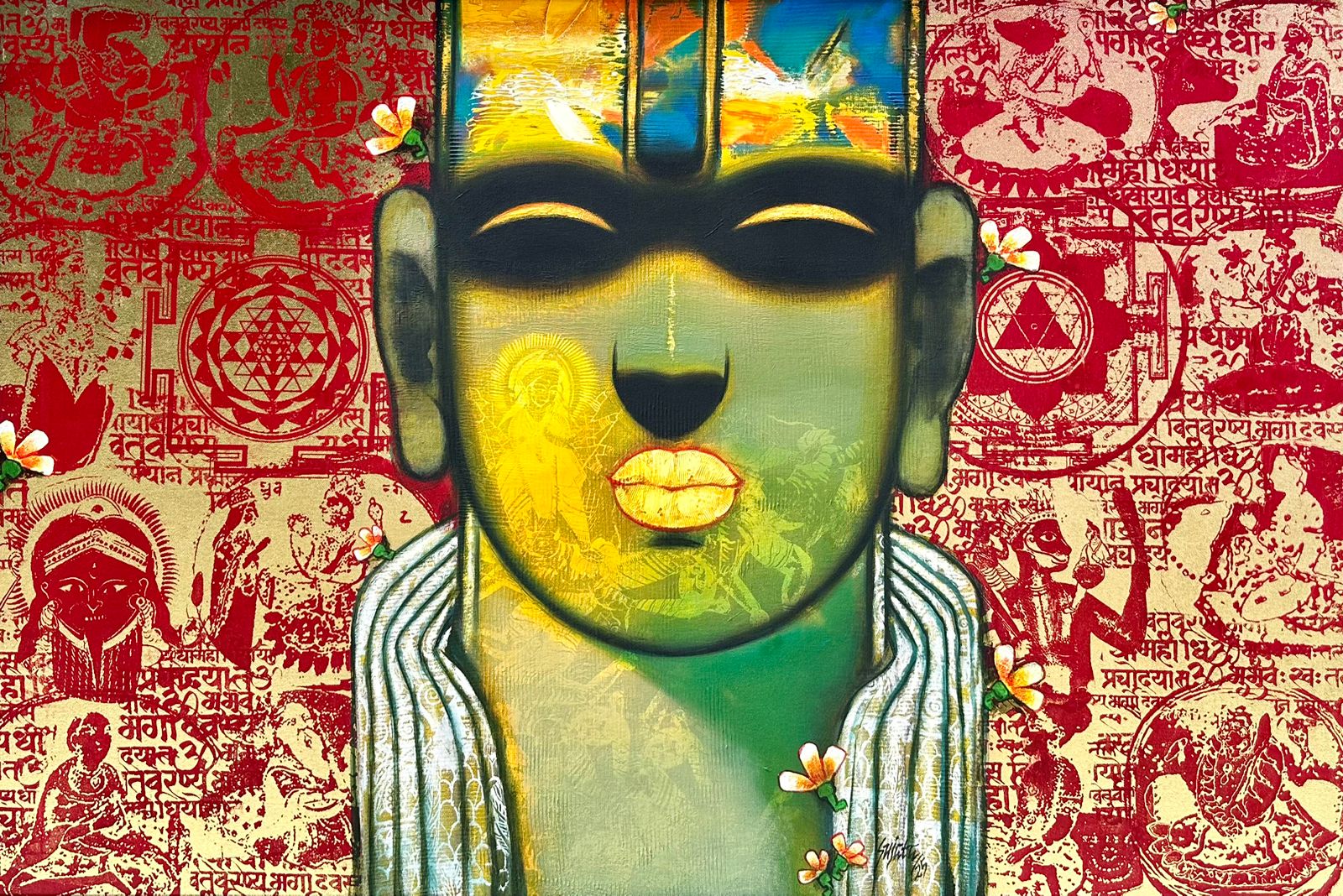
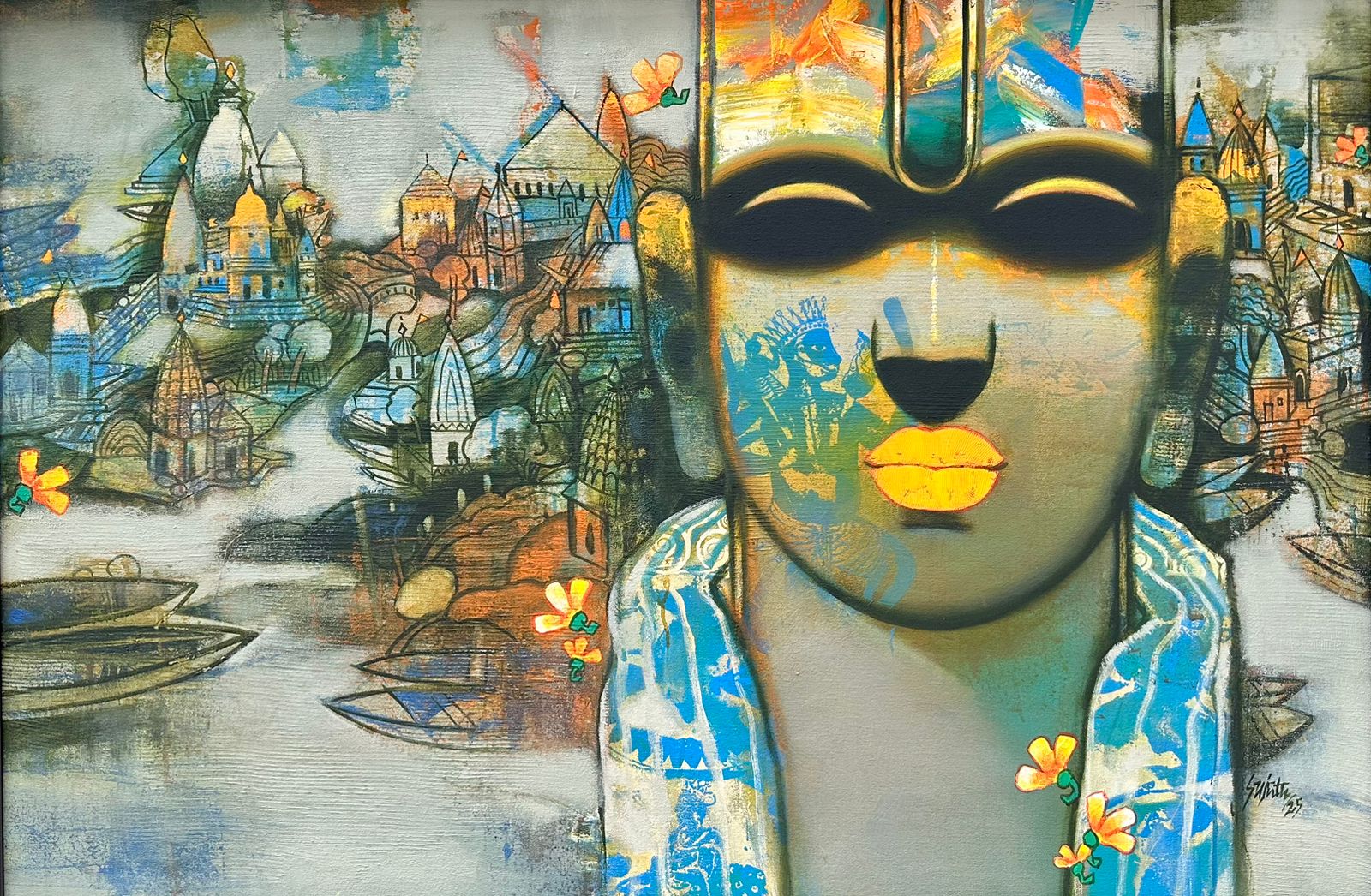
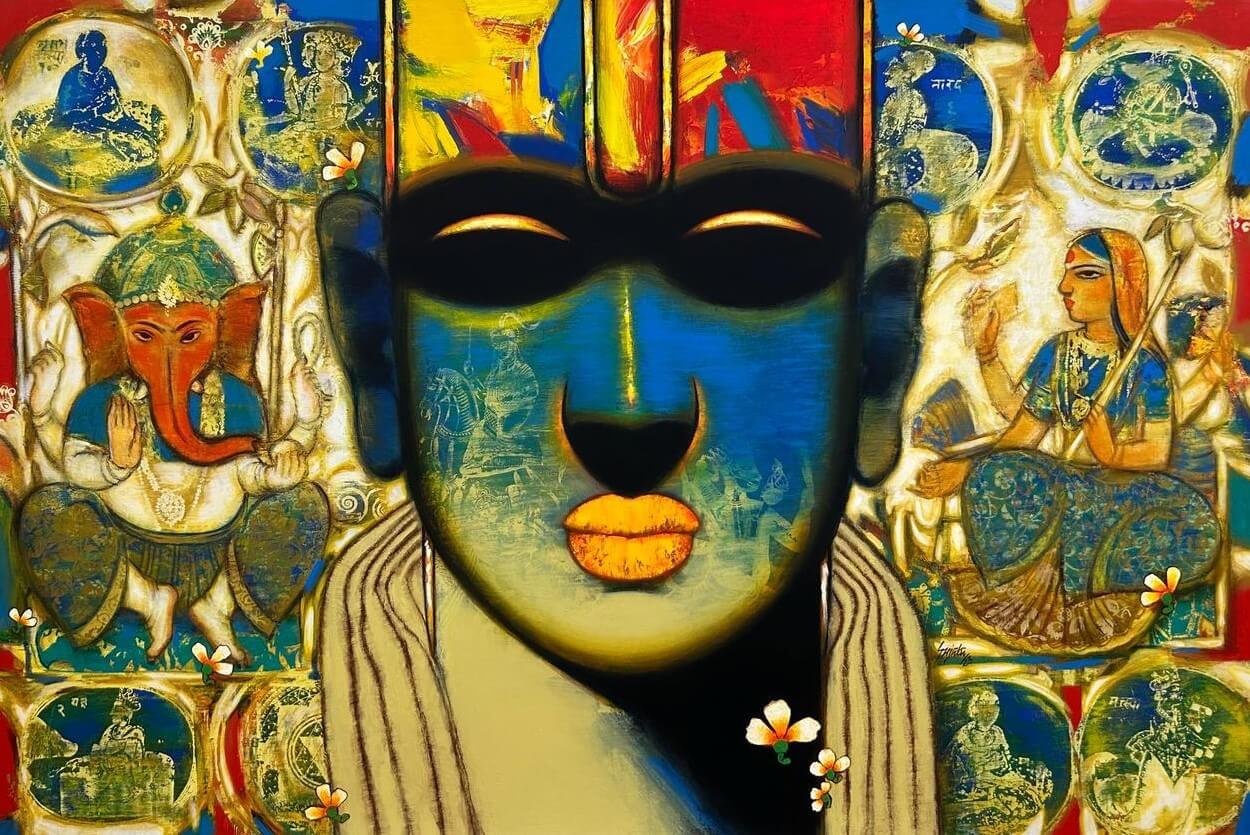
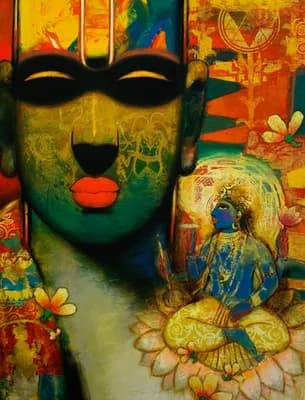
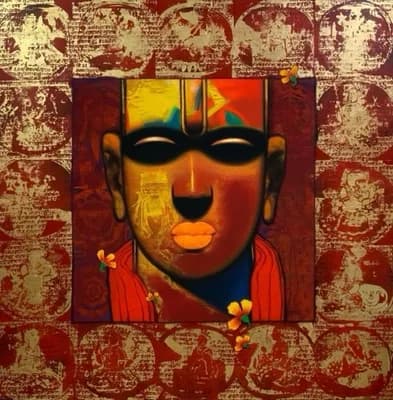
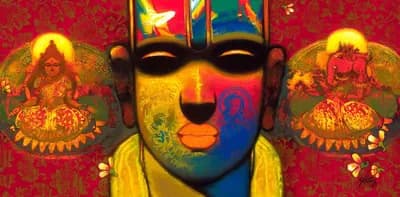
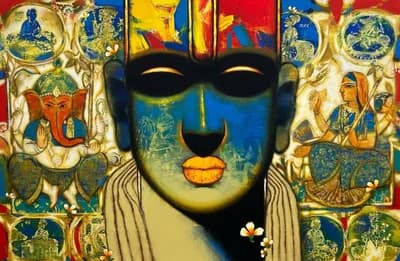
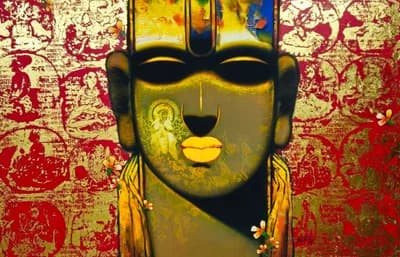
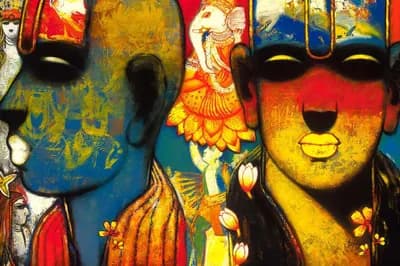
Crucially, religion is not Achrekar’s subject. Her work resists institutional doctrine. What she pursues instead is spirituality — unstructured, fluid, deeply personal. Her figures are mid-thought, mid-prayer, mid-wondering. They do not know. They are simply present. While Achrekar’s visual language is rooted in Indian classical motifs, her spirit is contemporary. She draws from the textures of old texts, the repetition of ritual, the intimacy of inner dialogue. The urban landscape she lives in does not dull her introspection — it intensifies it. Mumbai, with all its noise, becomes a backdrop for her contemplative stillness.
Sujata Achrekar
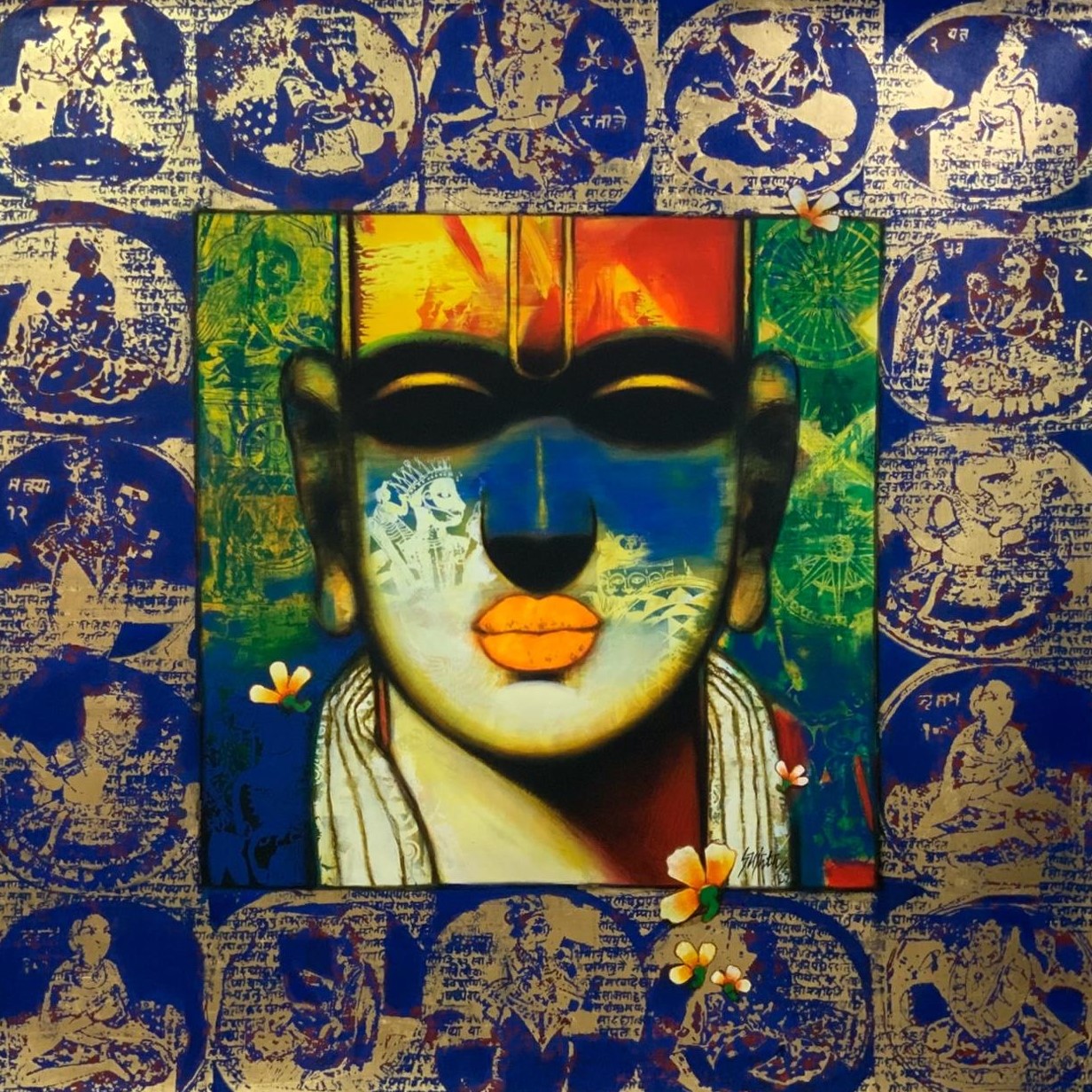
My work isn’t meant to be decoded; it’s meant to be felt. Figures sit in a hush between the seen and the sensed, carrying silence like a second skin. The Brahmachari boys, the floating Sanskrit, the pared-down forms - all are vessels of inner seeking rather than ritual. Spirituality, not doctrine, is where my gaze rests.

Sujata Achrekar
Contemporary Artist
About Artist
Crucially, religion is not Achrekar’s subject. Her work resists institutional doctrine. What she pursues instead is spirituality — unstructured, fluid, deeply personal. Her figures are mid-thought, mid-prayer, mid-wondering. They do not know. They are simply present. While Achrekar’s visual language is rooted in Indian classical motifs, her spirit is contemporary. She draws from the textures of old texts, the repetition of ritual, the intimacy of inner dialogue. The urban landscape she lives in does not dull her introspection — it intensifies it. Mumbai, with all its noise, becomes a backdrop for her contemplative stillness.
- Previous
- 1(current)
- Next
A Journey of Spiritual Expression
Sujata Achrekar’s art is a reflection of profound stillness and inner light. Her Brahmachari figures, glowing with a golden-yellow hue, embody spiritual seekers on a path of devotion and surrender. Rooted in her heritage from Maharashtra’s Konkan region, Sujata's art reflects a deep connection to tradition, shaped further by her practice of Vipassana meditation. Through vibrant textures, celestial hues, and themes drawn from the Bhagavad Gita, she weaves the concept of Brahman into her work, inviting viewers to explore their own spiritual journeys. Her paintings transcend the traditional, offering a personal, transformative experience of devotion and self-realization.
Highlights And Achievements
Artist Education
L.S. Raheja School of Art, Mumbai, in 1990
Diploma in Art Education from the Sir J.J. School of Art, Mumbai
Group Shows
Over 50 group exhibitions worldwide, including prominent shows in Hong Kong, Singapore, and various cities in India.
Solo Shows
DRS Arts Company, Ahmedabad (Sampada, (2024)
3 solo shows at Jehangir Art Gallery, Mumbai
Point of View Gallery, Mumbai (2007)
Jehangir Art Gallery, Mumbai (2004, 2001)
Sans Tache Art Gallery, Mumbai (1997)
Y.B. Chavan Art Gallery, Mumbai (1996, 1995)
Nehru Centre, Mumbai (1996)
Famous Paintings and Artwork Series of Sujata Achrekar
Across Sujata Achrekar’s paintings, three recurring streams stand out for collectors: the Brahmin Brahmachari series, meditative monk-like figures, and priest–pilgrim archetypes that reference temple cultures without becoming narrative illustrations.
For collectors, these figures don’t behave like separate series so much as variations of a similar presence. The differences are subtle - how a face is held, how much of the body is shown, how the surrounding space is treated.
1. Brahmin Brahmachari Series
The Brahmin Brahmachari series is the core of Achrekar’s practice and the body of work most closely associated with her name. These paintings depict young male disciples, often children of priests shown with shaven or closely cropped heads, white robes and downcast or closed eyes, suspended in a moment of deep meditation.
These are not portraits in a conventional sense. The faces feel reduced and controlled, with script and markings sitting lightly across the surface rather than describing a story.
For collectors, these are the most iconic works of artist Sujata Achrekar, ideal as a defining entry point into her practice. Larger works from this series typically sit at the higher end of her pricing spectrum.
2. Meditative Monks and Silent Guardians
Parallel to the brahmacharis, artist Sujata Achrekar’s paintings frequently feature monk-like or guardian figures - solitary, composed, often front-facing but emotionally turned inward. These figures may not be explicitly named as monks, yet their posture, robes and bearing evoke the watchfulness and restraint of monastic life.
Expression is kept minimal here. The figures don’t do much, and that restraint becomes the point—most of the attention stays on the face, with very little competing around it.
Collectors often place these “silent guardians” in transitional spaces like entrances, passages, or reception areas where their quiet presence feels like a blessing or watchful energy rather than a narrative story to be decoded. Each Sujata Achrekar artwork in this category functions as a quiet visual anchor.
3. Pilgrims and Priests
A third recurring current in Achrekar’s work is her exploration of priests and pilgrim-like figures rooted in India’s temple towns and ritual geographies. These works draw from temple and pilgrimage contexts but reduce them to a single contemplative presence. For collectors interested in similar themes, exploring broader mythological paintings can offer additional context on how spirituality is interpreted across artists.
These works form an important part of Sujata Achrekar collections for collectors drawn to ritual and cultural memory.
Price of Sujata Achrekar Paintings Collection
Sujata Achrekar’s paintings place her in the mid-career segment above emerging artists yet below senior auction-driven names. This makes her practice particularly relevant for collectors looking to acquire works with both conceptual depth and long-term potential.
In most cases, Sujata Achrekar’s painting cost loosely follows a range of around ₹30,000–35,000 per sq. ft., though this shifts depending on how worked the surface is. This offers a useful baseline when evaluating works across different sizes and compositions. Collectors can also browse a wider range of Indian paintings online to compare pricing, scale, and styles across artists.
To simplify how her works are typically distributed in the market:
Compact works (head-and-shoulder portraits): Usually in the ₹1 lakh – ₹2 lakh range, with controlled texture and detailing
Medium works (expanded portraits / half-figure compositions): Typically ₹2 lakh – ₹3.5 lakh, with more layered surfaces
Large works (full compositions with heavy texture): Commonly ₹3.5 lakh – ₹6 lakh+, featuring dense script and material richness
Pricing varies based on texture, subject resolution, scale, and exhibition history.
How to Choose the Right Sujata Achrekar Paintings
Most people don’t arrive at a choice analytically. A particular face or tone tends to hold attention first, only after that do size, colour, and placement start to matter.
A Sujata Achrekar painting is built through layered surfaces and script, creating subtle shifts with light.
The same subject can shift quite a bit depending on how it’s handled, just the colour and tone change the way the figure sits in a space. A Brahmachari face in a deep indigo field will hold a room very differently from a soft, cream-and-gold priestly figure intended for a bedroom or meditation corner.
This approach becomes especially useful when you are looking to buy sujata achrekar paintings for a specific emotional or spatial intent.
1. Emotional Tone and Subject
Different figures tend to carry distinct emotional weights: Brahmacharis lean toward introspection, guardians suggest protection, while priests feel more grounded in presence. Consider whether you connect more with youth, maturity, or archetypal anonymity.
2. Palette and Décor Integration
Warmer palettes tend to sit more naturally within traditional interiors, while cooler tones align better with contemporary spaces. Neutral works act as quiet anchors, while textured pieces can become focal points.
If your room already contains strong colours, a more neutral, parchment-toned work with subtle script can hold space quietly. In minimal interiors, a richly textured Brahmachari head with metallic highlights can function as a luminous focal point.
3. Ideal Size & Layout
Scale changes how the figure is experienced—whether encountered closely or read from across the room.
Small works: Suitable for bedside walls, reading corners, or meditation spaces
Medium works: Work well in transitional areas like corridors or studies
Large works: Anchor living rooms, offices, or reception areas
4. Budget and Long-Term Collecting
Start with a smaller, representative work and expand over time into larger, more complex pieces. Many collectors build across archetypes, creating a layered and cohesive collection.
Authenticity & Certification Process
Every original painting acquired through ArtFlute is accompanied by a certificate of authenticity, documenting medium, dimensions, year of creation, and verification from the artist or exhibiting gallery. This ensures clear and reliable provenance.
FAQs About Sujata Achrekar Paintings
1. What themes does Sujata Achrekar explore in her paintings?
A lot of her work circles around recurring figures—Brahmacharis, monks, and priests—used to express inward focus rather than narrative.
2. Are Sujata Achrekar’s paintings religious or spiritual?
Sujata Achrekar’s art is spiritual rather than religious, using universal symbols of meditation and inner stillness.
3. What mediums and techniques does Sujata Achrekar use?
She works primarily in acrylic on canvas, often incorporating metallic elements and layered textures through script and surface work.
4. How much do Sujata Achrekar’s paintings cost?
Sujata Achrekar paintings cost typically ranges from ₹1–6L+, with ~₹30,000–35,000 per sq. ft. as a general benchmark.
5. Where do Sujata Achrekar’s paintings work best in a home or office?
They suit meditation areas, bedrooms, and living rooms in individual spaces where quiet presence enhances the environment. Larger guardians or priestly figures work beautifully in offices, reception zones and meeting rooms, signalling depth and cultural rootedness. You can also explore curated paintings for office to see how similar works function across professional spaces.
6. Can I commission a custom painting from Sujata Achrekar?
Commissions may be possible based on subject, size, and palette, while allowing the artist freedom in execution.
7. What awards and recognitions has Sujata Achrekar received?
She has received honours including the Maharashtra State Award, Bombay Art Society Award, and AIFACS recognition, supported by a strong exhibition record.
8. Does ArtFlute ship Sujata Achrekar’s paintings internationally?
Works are shipped with protective packaging, documentation, and tracking for domestic and international orders.