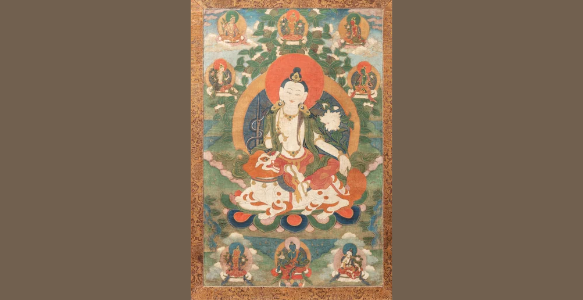
A thangka has a life beyond the moment when its painted surface is finished. Cloth is joined to cloth, a rod weights the lower edge, and the image can be rolled and opened again. Its portability is part of its purpose. In a monastery, a home or a teaching space, the scroll provides a focus for practices that a museum label can describe only in part.
What is thangka art, then? It is a Buddhist image tradition in which the identity of a figure, the proportions of its body and the objects it holds matter deeply. A painter may have considerable skill, but sacred iconography is not freely rearranged to suit a passing preference. The work carries knowledge transmitted through teachers, texts and workshops.
There is also a history of exchange within its borders. Indian Buddhist teachings, Nepalese artists, Tibetan patrons and later regional workshops all contributed to the surviving works. Today, trained painters continue that practice while some contemporary artists take its imagery into other settings. This guide follows both the material object and those distinctions. A handmade scroll, an embroidered image and a printed reproduction may show a related subject; they are different things to make, use and care for. Recognising the difference makes looking more attentive.
What is Thangka Painting?
What are thangkas? Most are Buddhist hanging scrolls with an image painted on prepared cloth and surrounded by a textile mount. The term also embraces embroidered and appliqué works. Tibetan thangkas can support meditation, teaching, ritual and remembrance; their function is not exhausted by describing their appearance.
History and Origins of Thangka Painting
Thangka painting history belongs to a wider movement of Buddhist texts, people and images across Asia. Surviving objects provide firmer dates than stories about a single first painting.
1. Meaning of the Word “Thangka”
In museum usage, thangka means a Tibetan hanging scroll. Popular accounts offer several literal translations, but these should not be treated as settled etymology. Tibetan thangka meaning is best approached through the object’s format and its role in Buddhist practice.
2. Origin of Thangka in Tibetan Buddhism
For thangka painting origin, early surviving works are important evidence. The Met dates its Portrait of the Indian Monk Atisha to the early or middle twelfth century. This is an early preserved example, not proof that it was the first thangka made.
3. Influence of Indian Buddhist Art on Thangka
Atisha’s portrait points to connections with Indian monastic learning. Buddhist painting and manuscript traditions from India helped shape Tibetan images, alongside other contributions. It would be misleading to turn those exchanges into a simple claim that one country invented the entire later tradition.
4. Evolution Across Himalayan Regions
Nepalese artists, Tibetan schools and Himalayan workshops developed different approaches over time. Bhutanese thangka painting is one regional expression. In India, Dharamshala and Sikkim offer well-documented contemporary centres; Ladakh and other Himalayan Buddhist communities also belong to this wider artistic geography.
Key Features of Thangka Painting
Information about thangka painting becomes more useful when features are connected with use. Proportion helps establish a deity’s identity. Composition makes a hierarchy legible. The textile mount allows the sacred image to be displayed and protected.
1. Intricate Symmetrical Composition
A central figure or mandala often establishes the main axis. Teachers, attendants and protectors occupy related positions around it. Narrative scenes can be less symmetrical, so symmetry is a common organising principle rather than a rule describing every scroll.
2. Sacred Geometric Proportions
Iconometry governs the proportions of sacred figures. A grid locates the body and its parts through relationships, allowing a composition to change scale. Learning those relationships is part of a painter’s training; fine brushwork alone does not supply the required knowledge.
3. Rich Mineral and Gold Colors
Mineral and organic colours, with gold in some works, give painted scrolls their distinctive surfaces. Pigments vary by period and workshop. A bright blue in a photograph cannot establish a specific mineral without technical evidence from the object.
4. Scroll-Based Fabric Mounting
The surrounding fabric belongs to the finished object. A lower rod helps the image hang and provides a support for rolling. Borders, covers and cords serve practical functions as well as framing the central panel for display.
Materials Used in Thangka Painting
A thangka art painting combines several materials with different needs. Cloth, ground, paint and textile mount age differently.
1. Cotton or Silk Canvas
Cotton is a common painted support; silk also occurs. The cloth must be prepared before detailed painting begins. A silk brocade border should not be confused with the support beneath the image: they are separate parts of a composite object.
2. Natural Mineral Pigments
Traditional workshops use prepared mineral and other pigments with a binder. Grinding, mixing and application affect the resulting surface. Contemporary practice can include additional materials, so “natural pigments” should not be assumed solely because a work follows traditional imagery.
3. Gold Dust and Gold Leaf
Gold paint and selectively polished gold details are documented in workshop accounts. Gold leaf is a different application method and needs object-specific confirmation. Metallic thread in an embroidered thangka is different again; the glint does not identify the technique.
4. Handmade Brushes and Tools
Fine brushes, drawing implements, frames and tools for surface preparation all contribute to the work. The available sources do not establish one universal brush-hair recipe. Describing a painter’s control is safer than assigning every atelier the same handmade tool.
How Thangka Painting Is Made
The following sequence describes a painted scroll. Workshops differ in their materials and working order; embroidery and appliqué require other processes. Norbulingka’s contemporary training and museum demonstrations show how preparation supports the precision of the later image.
Step 1 – Preparing and Stretching the Canvas
Cloth is secured under tension to a frame. This provides a stable working surface for the ground and painting. The temporary frame used during making is not the same as the textile mount fitted for the finished scroll.
Step 2 – Applying Base Coating
A prepared ground reduces the visibility of the weave and gives the painter a smoother surface. Glue and chalk-based preparations appear in workshop descriptions.
Step 3 – Sketching Sacred Grid Proportions
Measured lines establish the intended figure’s proportions. The painter works from the iconographic system appropriate to that subject. The grid provides relationships within the body, rather than simply dividing the cloth into equal squares for copying a picture.
Step 4 – Drawing the Main Deity or Mandala
Posture, attributes and attendant figures are laid out. A mandala also requires carefully organised architecture and directional relationships. At this stage, knowing what must be represented matters as much as the ability to draw an accurate outline.
Step 5 – Layering Colors and Details
Areas of colour, shading and fine outlines build the image. Clothing, landscape and ornament add further work at different scales.
Step 6 – Gold Embellishment and Final Finishing
Gold may highlight ornaments and other details. In documented practices, the eyes are completed late in the process, and ritual images may undergo consecration. Not every newly made scroll is consecrated, so that status should never be assumed from appearance.
Step 7 – Mounting in Silk Brocade
The finished panel is joined to its textile surround and fitted with the components needed for hanging and rolling. A thangka scroll painting is thus completed through sewing as well as painting.
Common Themes in Thangka Paintings
1. Buddha and Bodhisattvas
A Buddha thangka painting may depict Shakyamuni or another Buddha, with identifying gestures and attributes. Bodhisattvas such as Avalokiteshvara and Manjushri have their own iconographies.
2. Mandalas
A mandala thangka painting presents an ordered sacred domain, often a deity’s palace. Circles, gates and figures have specified relationships. It is more than an attractive geometric pattern; its interpretation belongs to the relevant Buddhist teaching and practice.
3. Deities and Protectors
Wrathful protectors can have flames, fangs and fierce expressions. These features do not make them embodiments of evil. Their meaning must be read within the image’s Buddhist context, including the particular protector’s identity and role.
4. Life of Buddha
Episodes from the Buddha’s life can unfold across one surface, bringing several moments into view. Birth, renunciation, enlightenment and teaching provide narrative subjects.
5. Spiritual Narratives and Cosmology
Lineage histories, previous lives and cosmological diagrams widen the range. Some scrolls communicate medical knowledge. Thangka art therefore includes teaching images whose purpose becomes clear only when the depicted sequence or system is identified.
Symbolism in Thangka Art
1. Lotus Symbolism
Lotus seats commonly evoke purity and awakening. Their presence also helps organise the figure’s place within the image. The familiar association with a flower emerging from muddy water should not replace attention to the particular deity and composition.
2. Wheel of Dharma
The wheel refers to Buddhist teaching and its transmission. It can appear among auspicious symbols or within a specific teaching context.
3. Mudras and Hand Gestures
Hands can signal teaching, meditation, generosity or the earth-touching gesture associated with enlightenment. These are codified forms, not casual poses.
4. Sacred Colors and Their Meaning
Colour contributes to a deity’s prescribed identity. A universal chart in which each colour always means one thing would be misleading. The figure, lineage and ritual context determine how a colour should be understood.
5. Flames, Clouds and Halos
Flames around a protector can suggest the force of wisdom; halos mark sacred presence. Clouds may separate or connect figures within visionary space.
Types of Thangka Paintings
These types of thangka painting mix categories of technique with categories of appearance. A painted black-background scroll differs from an embroidered one in a different way from how it differs from a gold-background painting.
1. Painted Thangka
Pigment on prepared cloth is the familiar painted format. Tibetan thangka painting can include elaborate figures, narrative scenes or mandalas. Subject and technique are separate questions: a Buddha can be painted, embroidered or assembled from fabric.
2. Embroidered Thangka
Thread builds the image through stitches. Imperial Chinese embroidered Buddhist scrolls are important surviving examples. Their relation to painting is close in subject and format, but a catalogue should identify their textile technique accurately.
3. Appliqué Thangka
Pieces of fabric are assembled to form the image, with stitched details and outlines. Some examples are monumental. Viewing such a work only as a photograph can conceal the joins and changes of material that constitute its surface.
4. Black Background (Nagthang)
Nagthang names a black-background format, often articulated with gold or coloured lines. Details emerge against the dark field.
5. Gold Background (Serthang)
Serthang uses a gold ground with drawn or painted detail. The background changes the relation between line and light. Transliteration varies, so catalogue searches may also encounter spellings such as sertang.
Renowned Artists of Thangka Painting
Many older scrolls are unsigned. Contemporary named artists should be distinguished from unidentified historical workshops, and similar names need careful checking. Several entries requested here remain insufficiently documented to support full biographies.
1. Locho and Lharik artists from Dharamshala
Locho is associated with contemporary sacred painting in Dharamshala. “Lharik” has not been established here as the name of a second individual artist. It should not be expanded into an invented biography or an unsupported joint career.
2. Ngawang Jorden and Karsang Lama
Karsang Lama’s practice is documented by Tibet House US through its Tibetan Tangkas Today exhibition. Ngawang Jorden identifies as a thangka painter in an open-studios profile. That profile needs to be distinguished from records of scholars sharing the name.
3. Master Tubten Gyatso
The requested painter’s identity remains unresolved. Similar spellings also identify the Thirteenth Dalai Lama. Without a workshop, exhibition or collection reference, these identities should not be merged or presented as a verified artist biography.
4. Tsering Sherpa
This appears to refer to Tsherin Sherpa, the contemporary artist trained in thangka by his father. The spelling requires confirmation. His contemporary reinterpretations should be distinguished from scrolls made to fulfil a traditional ritual commission.
5. Samten Dorje
A reliable record establishing this exact name as the intended thangka artist has not been located. Related names identify different practitioners. More specific documentation is needed before assigning training, birthplace or major works.
6. Krishna Tashi Palmo
Profiles document Krishna Tashi Palmo’s practice in Lahaul-Spiti, Himachal Pradesh. Her presence broadens the view of contemporary Himalayan painting beyond a single institutional centre.
7. Khandu Wangchuk Bhutia
Khandu Wangchuk Bhutia is a documented Sikkimese thangka artist and a Padma Shri recipient in 2022.
8. Tempa Chöphel
Norbulingka identifies Tempa Chophel as a late master of its thangka workshop. His role connects individual expertise with the training of other painters. Spellings vary across institutional accounts, including Chöphel and Chophel.
9. Tenzing Lama (or Tenzin Lama)
These spellings are not enough to identify one person securely. Reports discuss Tenzing Wangdak Lama of Sikkim, while other profiles use similar names elsewhere. The intended entry needs a location or workshop reference before fuller identification.
10. Dawa Dolma
The available records do not securely establish the intended Dawa Dolma as a renowned thangka painter. A source supplied by the artist or an exhibiting institution would help resolve the entry.
FAQs About Thangka Prints
Why is Thangka painting important in Buddhism?
It supports teaching, devotion, visualisation and lineage memory. For readers asking what is thangka art, those functions belong alongside its technique. Thangka prints can reproduce imagery, but a reproduction does not automatically share a handmade ritual image’s status.
Which regions in India are known for Thangka painting?
The query “thangka painting which state” has several answers. Sikkim and Himachal Pradesh have documented practitioners and training centres; Ladakh also forms part of the wider Himalayan Buddhist setting.
How long does it take to make a Thangka painting?
It depends on size, complexity and technique. Norbulingka gives roughly six weeks for a standard example in its collection. Large commissions can take much longer; that workshop estimate is not a universal production time.
Why is gold used in Thangka paintings?
Gold gives selected details luminosity and marks precious or sacred features. It may appear in ornaments, outlines or a broad background. The exact form—paint, leaf or thread—depends on the object and its technique.
Are there modern thangka artists?
Yes. Traditional workshops and individual painters continue the practice, while artists such as Tsherin Sherpa reinterpret its visual language. A contemporary artist’s training does not mean every work they make is itself a traditional ritual thangka.
What is the most expensive Thangka painting?
Christie’s sold a Yongle-period imperial embroidered silk thangka for HK$348.4 million in 2014. That is a documented public auction result, not proof of every private price. It was an embroidered textile, so calling it simply a painted scroll would be inaccurate.
