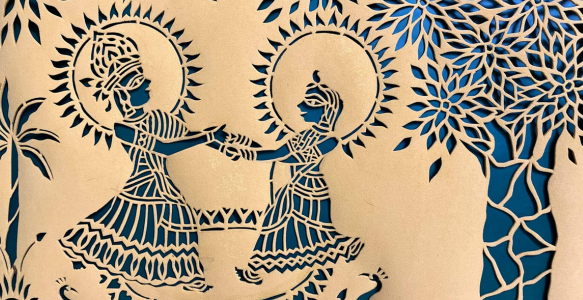
On an autumn evening in Vrindavan, as the temple bells begin their low, insistent rhythm, a courtyard slowly fills with colour. A mud platform - its surface still damp and cool - is smoothed by hand. Over it, a thin paper stencil is laid down. Fine powdered colour is pressed through the cutwork, the way one might whisper a mantra. When the stencil is finally lifted, Radha and Krishna appear - encircled by creepers, peacocks, and the curve of the Yamuna - only to dissolve back into water or dust a few hours later.
This ritual choreography is at the heart of Sanjhi: an art form that lives in the pause between making and unmaking. It belongs to the Braj region - Mathura, Vrindavan, and their surrounding villages - where stories of Krishna are rehearsed daily in gesture, image, and song.
Read on to discover what is sanjhi art and how it is a rich art form for today’s curators and viewers.
What Is Sanjhi Art?
Sanjhi is a traditional paper-cutting and stencil-based ritual art from the Braj region, centred on Mathura and Vrindavan, in which intricate designs - often of Radha and Krishna - are cut into paper and used to create ephemeral images on floors, walls, or water. The word “sanjhi” is linked both to sajja (decoration) and sanjh (dusk), evoking both ornament and the twilight hour when these images are traditionally revealed.
In its most refined form, Sanjhi paper cutting art involves cutting elaborate, lace-like designs with small scissors or blades, often freehand, without a prior drawing. These cut papers - known as khakha - serve as stencils for coloured powders, flowers, or even stone dust.
Symbolically, Sanjhi is thick with metaphors: the painstaking cutting followed by inevitable dissolution echoes the impermanence of life; the act of “revealing” images at dusk mirrors the unveiling of the deity in temple ritual; the empty spaces cut out of paper are as significant as the remaining form.
In curatorial conversations, we find Sanjhi sits comfortably alongside other devotional image traditions - Pichwai, Mithila painting, even certain mythical paintings that orbit Hindu cosmology - while retaining a stubborn, tactile specificity: the sound of scissors through dense handmade paper; the way powdered colour settles into micro-cuts; the faint halo left behind when the stencil is lifted.
As a platform rooted in authentic Indian art, Sanjhi invites us to think about devotion as process rather than finished object. It complicates the neat categories of “painting” and “craft,” asking us instead to look at gesture, ritual timing, and the choreography of making as integral to meaning.
History & Origin of Sanjhi Art
1. Where Did Sanjhi Art Originate?
Most scholars agree that Sanjhi art origin stories converge on the Braj region, particularly Mathura and Vrindavan, where Krishna’s childhood legends are geographically anchored. Early references suggest that Sanjhi emerged around the 16th–17th centuries, in tandem with temple culture and the rise of Krishna bhakti in North India.
Over time, this domestic, playful practice - young girls making images in cow dung, mirrors, and stones on village walls - was absorbed into more formal temple ritual, especially in Vaishnava shrines.
2. Religious and Cultural Significance of Sanjhi Art
In temple contexts, Sanjhi operates as a visual offering - a form of seva - where images are created, unveiled, and then allowed to disappear. Traditionally, paper stencils are laid on a vedi (a raised platform of mud and cow dung) and filled with natural pigments; the unveiling at dusk is accompanied by chanting, lamps, and a carefully choreographed sequence of rituals.
In the domestic sphere, saanjhi art also carried votive meanings: unmarried girls in Uttar Pradesh, Rajasthan, Punjab, and Madhya Pradesh would create wall images of Sanjhi Devi on a cow-dung base and worship them in the hope of finding a good husband. This double life - as temple ritual and village folk custom - makes Sanjhi a rich lens through which to think about gender, devotion, and the everyday poetics of rural north India.
3. Evolution of Sanjhi Art Across Different Regions
While Sanjhi is rooted in Braj, the practice has travelled. In Rajasthan, Jal (water) Sanjhi developed as a specialised tradition, especially in Udaipur, where artists like Rajesh Vaishnav choreograph coloured powders on water into floating tableaux. Mughal-era aesthetic influences also seep in: jali-like lattice patterns, Persianised flora and fauna, and more secular themes began to appear alongside strictly devotional narratives.
In contemporary studios from Alwar to Bengaluru, Sanjhi now intersects with graphic design, installation, and even light-based work, morphed under modernist and global influences. Yet core ritual centres in Mathura and Vrindavan still maintain the older rhythms, particularly during Holi, Janmashtami, and the fortnight of Pitra Paksha when temple Sanjhi is traditionally prepared.
Different Types and Styles of Sanjhi Art
1. Paper-Cut Sanjhi
This is the most widely recognised form: intricate paper stencils cut with tiny scissors or blades, used either as artworks in themselves or as tools for floor designs. Artists like Ram Soni and Vijay Soni have pushed this format into large-scale, stand-alone compositions - sometimes mounted against contrasting backgrounds, sometimes lit from behind to turn negative space into luminous line.
2. Rangoli (Floor) Sanjhi
Here, the stencil is a means, not an end. Designs are cut on paper, laid onto a vedi, and filled with dry colours, flowers, or powdered stone to create elaborate floor images, especially in temple courtyards. These rangoli-like works are unveiled at dusk and often erased by morning, echoing the ephemerality of kolam or alpana in other regions.
3. Jal (Water) Sanjhi
Jal Sanjhi is arguably the most fragile form: stencils are placed over a thin layer of white powder floating on water, then filled with coloured pigments; when lifted, the colours spread slightly, creating a soft-edged, almost dreamlike image that eventually dissolves. Rajesh Vaishnav’s practice in Udaipur has become emblematic of this tradition, turning ritual action into a kind of performance art.
4. Clay & Leaf Sanjhi
In some folk variants, Sanjhi designs are made on walls and floors using cow dung as a base, embellished with stones, mirrors, leaves, and flowers. These versions, often created by young girls, sit closer to votive wall painting than to refined paper-cut stencilling, but they share the same twilight timing and devotional intent.
5. Temple Tradition (Pushtimarg)
Within Pushtimarg and related Vaishnava traditions, Sanjhi paintings of Mathura and Vrindavan are part of a daily and seasonal cycle of seva - from Janmashtami to Sharad Purnima - where images are created as offerings to Krishna. The traditional art of stenciling from Mathura in these contexts is precise, codified, and deeply embedded in liturgy.
6. Contemporary Sanjhi Art Forms
Today, traditional sanjhi art coexists with experiments on glass, acrylic, mirror, and even layered installations where multiple stencils create architectural depth. Artists like Jaishree Pankaj have brought Sanjhi into gallery circuits in Mumbai and beyond, while younger practitioners collaborate with designers, animators, and photographers.
Materials Used in Sanjhi Art
1. Traditional Paper Used in Sanjhi Art
Historically, artisans used sturdy handmade paper (locally sourced) that could endure dense cutting without tearing and withstand the pressure of rubbing colours through the stencil. In many Mathura studios, slightly thicker, off-white sheets remain the norm, chosen for their resistance and the way they hold a crisp edge.
2. Cutting Tools and Blades
While scissors are iconic - especially the fine custom-made pairs used in Braj - many contemporary artists now combine them with surgical blades or craft knives for micro-detail. The grip is almost jeweller-like; not surprising, given that several Sanjhi lineages come from traditional goldsmith families.
3. Stencils and Pattern Templates
The paper itself becomes the stencil or khakha: some artists sketch lightly first, others cut directly from an imagined composition. In floor and water Sanjhi, multiple stencils may be layered to build complex scenes with repeated borders, architectural frames, and narrative vignettes.
4. Sketching Tools
Where drawing precedes cutting, artists typically use simple pencils or pens; in some workshops, basic exercise sheets are used to practice circles, lines, and leaf shapes before moving to final paper. The “real” drawing, many will tell you, happens with the scissors.
5. Adhesives
For framed sanjhi paper art, thin adhesives or mounting tapes are used to fix cut papers onto contrasting backgrounds - sometimes layered to create a sense of depth. In rangoli contexts, the stencil is usually held in place by hand and the weight of colour rather than glue.
6. Colours and Natural Dyes
Traditional Sanjhi relied on natural colours derived from flowers, minerals, and herbs - powders that could be easily brushed through stencils and would sit lightly on mud or water surfaces. Today, many artists balance these with modern pigments, fluorescent hues, and even metallic powders, depending on the context.
Common Themes and Motifs in Sanjhi Art
1. Radha and Krishna Narratives
Sanjhi painting, in its ritual sense, is almost inseparable from Krishna - his childhood pranks, flute-playing, Ras Leela, and nocturnal encounters with Radha. Central figures are often framed by octagonal or circular borders, echoing mandala forms and reinforcing the idea of a sacred, enclosed space. For viewers familiar with radha krishna paintings, Sanjhi offers a more skeletal, distilled version of the same stories - stripped down to contour, rhythm, and negative space.
2. Floral and Nature-Inspired Designs
Peacocks, cows, monkeys, kadamba trees, and the sinuous line of the Yamuna recur across traditional Sanjhi compositions, mapping the ecology of Braj as much as its mythology. Creepers and lotus borders stitch scenes together, turning each image into a small cosmology of land, water, and sky.
3. Religious Symbols and Mythological Elements
Conch shells, kalash, temple arches, and stylised gopis appear frequently, especially in temple commissions. In some works, Sanjhi overlaps with the visual language of mythical paintings more broadly - celestial chariots, weaponry, or planetary motifs - though these remain secondary to the Braj stories.
4. Geometric Patterns and Decorative Borders
The geometry of Sanjhi is not mere decoration; octagons, squares, and pentagons are often drawn first in dry colour to define the field before narrative motifs are added. Jali-inspired lattices, influenced by Mughal architecture, frequently appear as backgrounds, echoing the relationship between light and perforated stone.
5. Folk Stories and Cultural Scenes
Beyond strict devotion, many artists incorporate bullock carts, village women at wells, or festival processions, bridging the gap between mythic time and everyday life. In workshops with younger practitioners, I’ve seen Sanjhi used to depict musicians, city skylines, even cinema stills - visual proof that about Sanjhi art is also about the evolving imaginations it holds.
Well-Known Artists of Sanjhi Art
1. Love Kumar Soni
Mathura-born Love Kumar Soni comes from a family where Sanjhi has been practised for generations; he is known for versatile, finely detailed paper works and has been recognised in national craft award circuits.
2. Mohan Kumar Verma
A hereditary Sanjhi paper-stencil artisan from Mathura–Vrindavan, Mohan Kumar Verma is celebrated for delicate designs featuring peacocks, carts, and Krishna narratives.
3. Ram Soni
Often described as a Sanjhi maestro, Ram Soni - originally from Mathura and now based in Alwar - belongs to a family that has practised the craft for over 350 years and is a National Award and UNESCO Award recipient.
4. Ashutosh Verma
A sixth-generation artist from Mathura, Ashutosh Verma is adamant that Sanjhi is not merely “stencilling” but a highly skilled paper-cut craft, and is known for intricate Radha–Krishna compositions.
5. Sumit Goswami
Acharya Sumit Goswami, associated with the historic Radha Raman temple in Vrindavan, is a key figure in maintaining the ritual Sanjhi tradition within temple practice.
6. Jaishree
Hyderabad- and Mumbai-linked artist Jaishree Pankaj learned Sanjhi from her grandfather in the 1950s and has held museum-quality exhibitions of paper cuttings, helping to reintroduce the form to urban audiences.
7. Gopal Lal Sharma
Mathura-based Gopal Lal Sharma has practised Sanjhi for nearly four decades and is frequently cited in contemporary overviews of the craft.
8. Sunita Devi
Sunita Devi appears in recent documentation of folk Sanjhi practices from Mathura - particularly social media-led visibility around wall and floor works dedicated to Radha–Krishna.
9. Vijay Soni
Working closely with his brother Ram, Vijay Soni is known for highly detailed paper cuts and bespoke framed pieces that have entered both craft and auction circuits.
10. Rajesh Vaishnav
Based in Udaipur, Rajesh Vaishnav is one of the primary contemporary exponents of Jal Sanjhi, teaching and performing the water-based tradition through workshops and public programmes.
11. Gunjan & Parag Pancholi
Gunjan and Parag Pancholi are among the younger practitioners experimenting with Jal and floor Sanjhi in Rajasthan, contributing to its visibility through experiential art platforms.
For audiences already familiar with sanjhi painting of mathura, the next step might be to look sideways - to Jal Sanjhi, to wall-based village practices, to how this “minor” art speaks to broader questions of memory, ritual, and obsolescence in Indian visual culture.
In the end, sanjhi paper art asks a disarmingly simple question: can an image be fully itself even when it’s meant to vanish?
FAQs About Sanjhi Paper Art
What is Sanjhi?
Sanjhi is a traditional paper-cutting art form from Mathura and Vrindavan, known for its intricate devotional designs inspired by Krishna.
In which state is Sanjhi art practiced?
Sanjhi art is primarily practiced in Uttar Pradesh, especially in the Mathura and Vrindavan regions.
What is the process of Sanjhi art?
Artists create detailed paper stencils and use them to form designs with coloured powders, flowers, or other decorative materials.
Is Sanjhi art still practiced today?
Yes, Sanjhi art is still practiced by traditional artisans, temple communities, and contemporary artists across India.
