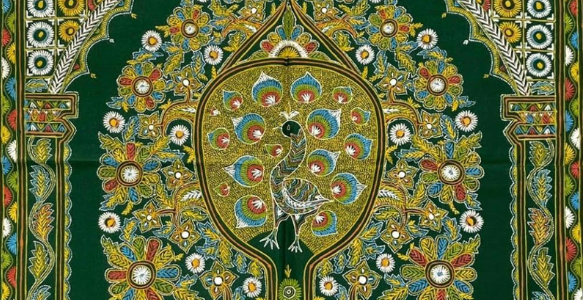
In 2014, a Rogan “Tree of Life” from Kutch entered a highly public diplomatic setting when it was presented by India’s prime minister to Barack Obama, according to Gujarat Tourism’s account of the craft. The gesture mattered because Rogan is not a palace-school miniature or a widely distributed folk idiom; it is a rare textile-painting practice, closely associated with Nirona village near Bhuj, whose line is made from a dense oil paste rather than from ordinary paint. A branch, a bird, a border, even a tiny flower is not brushed on. It is drawn out as a sticky filament and guided onto cloth with a metal stylus.
Craft records include ghagras, odhanis and bridal cloths; contemporary accounts also list wall hangings, cushions and saris. The change of use matters. A textile may now be encountered frontally as a panel, rather than as part of clothing. To ask what is Rogan art is therefore to ask about use as well as technique. The discussion below follows the paste, tools and patterns through those changing settings. Rogan art information comes from institutional documentation and practitioner records, placing the craft within traditional paintings in India while keeping its particular textile history in view.
What is Rogan Art?
Rogan art is an oil-based textile painting tradition from Kutch, Gujarat. Artists make a thick, elastic colour paste from heated oil, most often described today as castor oil, mixed with pigments or dyes. The paste is not spread like watercolour. It is stretched into a thread and laid onto cloth with a metal stylus, creating a raised, lustrous line.
So, what is Rogan art in practical terms? It is painting, textile embellishment and craft knowledge at once. Officially, the protected geographical indication is “Kutch Rogan Craft,” while readers may encounter phrases such as Rogan painting, Rogan art painting, or the Rogan art of Kutch. Unlike many Indian paintings, its identity rests as much on the behaviour of Rogan paint as on the motif itself.
History and Origins of Rogan Art
Rogan art history survives through a mixture of craft memory, regional documentation, artisan lineages and more recent institutional recognition.
1. Meaning and Origin of the Word "Rogan"
Gujarat Tourism explains the Persian-derived name as oil-based. Other craft accounts use oil or varnish in their explanation. The name points towards the prepared medium: for a Rogan art painting, colour is carried in a thick oil paste that can be lifted and stretched.
2. Persian Roots and Journey to India
The Rogan art origin is usually connected with Persian or Iranian transmission. Dates are less settled. Gujarat Tourism gives roughly300 years, while textile documentation records oral accounts of over400 years at Nirona. These are approximate craft histories, rather than evidence for an exact year or an identifiable individual inventor.
3. Where is Rogan Art Practiced?
Nirona, near Bhuj, is the best-known centre for the Rogan art of Kutch. Older accounts often focus on its Khatri family. The official GI 718 record also lists Madhapar under authorised-user details. A source describing practice at one historical moment should therefore not become a claim that no other practitioner exists today.
4. Why Rogan Art Is Called the "Drying Oil" Technique
Craft sources sometimes describe Rogan as a drying-oil technique because the heated oil-and-colour paste must settle and harden on cloth. Castor oil is boiled until it becomes viscous, then worked with colour. In strict chemistry, “drying oil” has narrower meanings, so the phrase is best understood here as a craft descriptor.
Key Characteristics of Rogan Art
In traditional Rogan art, the relation between paste and cloth determines what the line can do. A repeated design still depends on the handling of a wet material.
1. Mirror-Image / Folded Symmetry Technique
Painted on one half of the cloth, a wet design can be pressed onto the other half by folding. When the textile opens, the line appears in reverse. The maker has to anticipate that reversal and leave room for the transfer. The paste’s condition at the moment of folding affects the result.
2. Freehand Application
Rogan is usually drawn freehand. The stylus does not behave like a pen scratching a surface; it coaxes a filament of paste from the artist’s palm to the cloth. No tracing paper is required in the best-documented practice. Spacing and the thickness of the strand have to be judged during application.
3. Glossy, Raised Embroidery-Like Finish
Old Rogan art is often compared to embroidery because the dried line sits slightly above the fabric. This raised surface gives even small Rogan art designs a tactile presence.
Materials Used in Rogan Art
The Rogan art materials begin with an oil base and colour. The metal tool helps turn the prepared paste into a line, while cloth receives and retains it.
1. Castor Oil Base
Contemporary sources most often identify castor oil as the base. The oil is heated for many hours until it thickens, then cooled or cast into water to form the sticky residue known as Rogan. Historical accounts of related roghan textiles also mention oils such as linseed or safflower.
2. Natural Pigments and Colours Used
Sources describe Rogan colours variously as mineral colours, stone pigments, chalk pigment, dyes or natural colours. Yellow, red, blue, green, white, brown, black and orange appear in documented descriptions. These varied descriptions do not establish that every colour is a vegetable dye or that every workshop uses an identical palette.
3. The Tulika / Kalam (Metal Stylus)
An iron or metal stylus is central to the process. Suya and kalam appear in documentation; tulika also occurs in contemporary explanations. It lifts and guides the prepared paste. The fine line is made through the relation between that tool, the artist’s hand and the cloth, rather than a conventional brush stroke.
4. Brass Molds (Biba)
Metal blocks occur in accounts of Rogan-related printing. Some contemporary descriptions call the brass moulds biba. They produce repeated motifs by a different method from the freehand Rogan art process described above. Keeping the variants distinct avoids assigning a printing tool to every Nirona painter’s practice.
How Rogan Art Is Made
For readers asking what is Rogan painting, the making sequence gives a practical answer. The preparation of the paste comes before drawing, transfer and drying; exact methods vary between workshops.
Step 1 - Preparing the Rogan Paste
Oil is heated until it becomes a thick residue, then cooled or cast into water in documented accounts. The making of the base precedes the fine drawing. A Rogan art painting depends on that material preparation: an ordinary liquid oil-and-colour mixture would not behave in the same way.
Step 2 - Mixing Natural Colours
Colour is worked into the prepared base. Craft descriptions refer variously to mineral, stone or chalk pigments and dyes. They also record paste kept in water between uses. That storage detail helps explain the material problem: it has to remain workable until it is placed on the cloth.
Step 3 - Body heat activation
IGNCA’s 2017 field notes describe paste worked on the palm with a metal needle. Stirring and rubbing soften it sufficiently to draw out a fine line. This documented preparation explains the body-heat heading without turning it into a claim of a separate chemical activation process.
Step 4 - Drawing the Motif with the Stylus
The lifted strand is guided onto the textile. The stylus controls where it is placed, rather than being dragged across the cloth like a brush loaded with liquid paint. The line of Rogan paint therefore has a physical thickness, with intervals of exposed fabric remaining between its marks.
Step 5 - Folding and Transferring the Mirror Image
The painted half meets the unpainted half when the cloth is folded. On opening, the transferred marks reverse the design. The Rogan art of Kutch is closely associated with this method, although a maker can also draw a complete composition directly. Folding is a technique available for particular arrangements, rather than an obligation for every image.
Step 6 - Sun Drying and Finishing
Once the design is complete, the textile is left to dry and set, often in sun or ambient warmth. UNESCO notes that weather affects the paste’s density and drying behaviour: monsoon dampness, winter chill and summer heat all influence transfer, sharpness and finish.
Common Motifs in Rogan Art
Rogan art motifs include floral, geometric and figurative forms recorded in craft documentation.
1. Tree of Life
The Tree of Life is especially visible in contemporary Rogan. A central trunk and paired branches can work with the fold-transfer method. The theme also offers a comparison with tree paintings and nature art, while the oil-paste line and cloth support identify this particular treatment.
2. Peacocks and Birds
IGNCA’s field documentation lists the peacock among Rogan motifs. Birds also belong to the wider textile vocabulary. A specific species or symbolic meaning should be identified from the work itself, rather than assigned to every small bird-like form.
3. Floral and Paisley Patterns
Floral and curving patterns are well documented. “Paisley-like” is a useful description where the shape supports it, but the institutional sources checked establish floral and curvilinear motifs more securely than a universal paisley repertoire. Their arrangement can extend from a central design into borders.
4. Mandalas and Geometric Designs
Circular medallions, lattice-like patterns and geometric borders appear in craft documentation. “Mandala-like” describes their organisation; it need not establish a specific ritual meaning for every circular design. Repeated dots and lines structure the surface around centres, edges and intervals.
5. Cultural and Figurative Scenes
Field documentation records motifs such as women churning butter, elephants and other cultural scenes. These connect Rogan to figurative art and, at times, to storytelling traditions linked with mythical paintings, though Rogan’s strongest language remains ornamental and textile-based.
Famous Artists Practicing Rogan Art
1. Abdul Gafur Khatri & Family
Abdul Gafur Khatri received the Padma Shri in 2019, recorded by the government under Art-Painting, Gujarat. His Nirona family is central to documented accounts of continuation and training. For readers using the search phrase “Rogan art Kutch,” the awards and 2014 Tree of Life gift provide concrete references for why this practice became widely visible.
2. Khatri Shahenajbanu Sumar
The GI record includes Shahenajbanu Sumar Khatri in Nirona. The family’s own website discusses her practice in the context of women entering a craft previously described as male-dominated. That family account should be distinguished from an independently established claim that she was the first woman anywhere to practise Rogan.
3. Khatri Arab Hasam
Khatri Arab Hasam of Nirona is documented in government award records as a National Award recipient for Traditional Rogan Art in 2016. Khamir’s artisan profile records his account of learning from his father and continuing a practice that many families had abandoned.
4. Ashish Shantilal Kansara Family
Ashish Shantilal Kansara of Madhapar appears in the official record’s authorised-user details. That entry complicates simplified accounts of Rogan as only one family’s current practice. The GI record lists him under Kutch Rogan Craft, showing that contemporary continuity also includes documented practice beyond Nirona’s famous Khatri household.
Uses and Modern Applications of Rogan Art
1. Wall Art and Framed Paintings
A framed panel remains a painted textile. Its flat presentation invites close inspection of the raised line, while clothing presents a different relation between design and body. Wall hangings are documented among current uses, extending the craft beyond the earlier community garments.
2. Sarees, Lehengas and Apparel
Ghagras, odhanis and bridal cloths appear in historical documentation. Contemporary accounts include saris and garment borders. A lehenga or another adapted garment needs its own object record; the earlier textile vocabulary should not be replaced entirely by today’s apparel names.
3. Home Décor and Gifting
Cushions, table covers and other household textiles appear in contemporary documentation. Official cultural gifts provide another setting, as the 2014 Tree of Life presentation shows. Each use changes who encounters the work and how it is displayed, even where a familiar motif and the oil-paste technique remain.
FAQs About Rogan Art
What is Rogan art used for?
Rogan art has decorated bridal textiles, ghagras, odhanis and household cloths. Today it is also used for wall panels, framed works, sarees, cushions, table linen and cultural gifts.
What does the word "Rogan" mean?
“Rogan” is commonly traced to Persian terms for oil, oil-based substance or varnish.
Who invented Rogan art?
No single inventor is documented. The practice is better understood as an inherited textile-painting tradition shaped by Persian-influenced craft routes and sustained by artisan lineages in Kutch.
Which family is famous for Rogan art?
The Khatri family of Nirona, especially Abdul Gafur Khatri and his relatives, is the most famous. Current GI records also document Ashish Shantilal Kansara of Madhapar.
How long does it take to make a Rogan art piece?
Timing depends on size, colour density, motif complexity and weather. Small works may be quicker; detailed cloth paintings, especially large Trees of Life, can take weeks or months.
Is Rogan art still practiced today?
Yes. Rogan remains rare, but GI registration, authorised users and recent government awards confirm that the craft continues in Kutch through documented contemporary practitioners.
What is the difference between Rogan art and Madhubani painting?
Rogan is an oil-paste textile technique from Kutch, often using folded symmetry. Madhubani, or Mithila painting, is a distinct Bihar-Nepal tradition known for line, pattern and narrative imagery.
