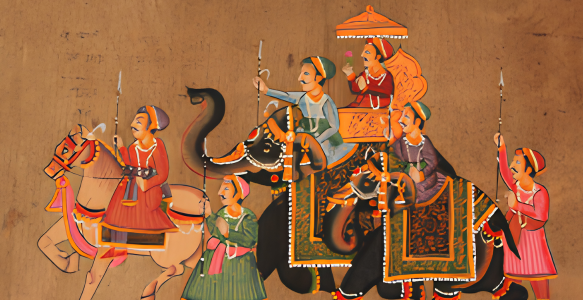
On an afternoon in Udaipur, a miniature painter grinds a fragment of lapis lazuli till it turns into the softest blue dust. He mixes it with gum arabic, tests a stroke on the edge of his thumb, then he moves over a palm-sized sheet of handmade paper. This intense, devotional concentration captures something essential about Rajput paintings: they were a way of imagining love, landscape and divinity in intimate scale and purely courtly decoration.
These works feel closer to music or poetry - compressed, symbolic, intentionally stylised. Like a camel hurtling through an abstracted desert in Maru Ragini, or a storm rendered as zigzag lines and emerald clouds while Krishna calmly lifts Govardhan. Rajput courts were small, but their painters built vast inner worlds: devotional Vrindavan gardens, dangerous hunting grounds, terraces where queens and attendants share conspiratorial glances.
Each region from Mewar to Kishangarh developed its own colours and drawing style, also absorbing Mughal techniques in portraiture and architecture. Many living artists working in handmade Indian art still reference these compositions, palettes and narrative strategies, sometimes consciously, but often by inheritance.
What Is Rajput Painting?
Primarily Rajput painting refers to the miniature traditions that flourished in the Hindu Rajput courts of Rajasthan and neighboring regions from the late sixteenth to the nineteenth century, roughly parallel to the Mughal era. When people think of these paintings today, they often picture jewel-bright scenes of Krishna, royal processions, or lovers meeting in monsoon gardens, executed on paper, cloth or palace walls.
These are primarily a form of Rajput miniature painting, using opaque watercolour (gouache) with gold and sometimes silver on a burnished surface, which allows colour to sit flat and saturated. The line is usually decisive and calligraphic, figures are elongated or stylised, because emotional rasa or bhav matters more than realism. So what is Rajput painting in simple terms? It is a Rajput painting style that translates poetry, music and mythology into visual dramas, meant to be held in the hand and read almost like a manuscript. Religious narratives from the Bhagavata Purana and Ramayana coexist with Ragamala series, Barahmasa (the twelve months), and scenes of everyday courtly life.
History and Origin of Rajput Paintings
1. Rise of Rajput Art in Early India
Rajput paintings origin is usually traced to the interplay of older Jain and manuscript traditions with emerging court cultures in regions like Mewar and Marwar around the sixteenth century. Early works preserve a deliberately “conservative” style - flat planes of colour, bold contour lines, stylised trees - linked to narrative styles like the Caurapañcāśikā group. This early phase is crucial to understanding rajput paintings history, as it shows how strongly local visual memory persisted even as empires shifted.
2. Influence of Mughals on Rajputana Art
By the 17th century, proximity to the Mughal court brought new materials, techniques and subjects into Rajput ateliers like the finer portraiture, more naturalistic shading, depictions of actual historical events alongside mythological scenes. Many Rajput rulers served in Mughal campaigns and artists travelled with them or were invited from imperial workshops, leading to a hybrid zone where rajput art absorbed but did not imitate Mughal naturalism. This is where we begin to see what we now label “rajputana painting” - deeply rooted in local devotional and folk traditions, with technical influence of Persianate and European styles via the Mughals.
3. Growth of Different Regional Schools
As political power fragmented, each kingdom - Mewar, Bundi, Kota, Kishangarh, Jaipur, Jodhpur evolved its own atelier, styles and patronage networks. Geographic terrain, court taste, religious affiliation, and even a ruler’s temperament could tilt the visual language one way or another, so a Rajput painting of Rajasthan from desert Marwar feels very different from a lush Bundi forest hunt. Over time, historians grouped these as sub-schools within a broader Rajputana miniature painting tradition stretching across Rajasthan and parts of present-day Madhya Pradesh.
The usual narrative of Mughal court as “high art”, Rajput as provincial is slowly being undone. Looking at the best Rajput series, you realise the “provincial” label says more about where museums were historically located than about the sophistication of the work itself.
Different Regional Styles in Rajput Painting
1. Mewar School of Rajput Paintings
Centred in Udaipur and its dependencies like Nathdwara and Devgarh, the Mewar school is considered as the earliest and one of the most “conservative” strands. Bright vermilion, leaf-green and yellow dominate and figures are robust, with expressive eyes and strong outlines. Artists like Sahibdin illustrated texts such as the Rasikapriya, Ramayana and Bhagavata Purana, mixing courtly scenes with intense devotional imagery.
2. Marwar School of Rajput Paintings
Based in Jodhpur and Bikaner, the Marwar school reflects its desert setting in ochres, deep reds, and patterned textiles that almost compete with the figures. Early works show heavier Mughal influence in costume and architecture, gradually shifting to a more assertive local line and flatter space in the eighteenth century. Themes include Ragamala, Barahmasa and dynamic court scenes.
3. Bundi School of Rajput Paintings
The Bundi school, from the Hadoti region of present-day Rajasthan, is memorable for its romantic, rain-soaked landscapes - palaces perched above swirling monsoon clouds, dense forests rendered with layered greens. Its refined drawing and controlled palette show clear Mughal links, yet its lyrical treatment of water, foliage and night skies feels distinctly local.
4. Kota School of Rajput Paintings
Emerging from Bundi, the Kota school specialises in hunting scenes: kings poised on galloping horses, tigers mid-leap, thick forests teeming with animal life. Painters here paid obsessive attention to the musculature of animals and the choreography of chase, often using diagonals and overlapping forms to heighten drama.
5. Kishangarh School of Rajput Paintings
Kishangarh, a small state, produced some of the most iconic images in all rajput style painting, especially under Raja Sawant Singh and his muse Bani Thani. Figures are elongated, with lotus-petal eyes and aquiline noses; landscapes are ethereal, filled with misty hills and delicate lotuses. This idiom becomes a visual metaphor for spiritualised love, particularly in Radha–Krishna narratives.
6. Jaipur School of Rajput Paintings
Originating at Amber and later Jaipur, this school sat closest to the Mughal capitals of Agra and Delhi, and its painters assimilated more courtly refinement and architectural detail. Wall paintings at Amer Palace show an early phase; later works balance folk energy with Mughal-influenced costumes and cityscapes.
7. Dhundar School of Rajput Paintings
Dhundar covers regions like Amber, Jaipur, Shekhawati and surrounding areas, sometimes grouped within the Jaipur school. Here, bold narrative frescoes in havelis coexist with miniatures that blend courtly portraits, processions and religious themes, creating a bridge between palace and mercantile patronage.
8. Jodhpur School of Rajput Painting
Jodhpur (Marwar) developed a distinct flavour under rulers like Maharaja Jaswant Singh, with early Ragamala series by artists such as Virji in the seventeenth century. Later, under Man Singh, ateliers produced illustrated Ramayana, Dhola-Maru, Panchatantra and Shiva Purana series, often with a strong narrative drive and saturated palette. These courts are central to any survey of Rajput painting of Rajasthan as a whole.
As curators, we’re interested in how contemporary painters reinterpret these “backgrounds” as protagonists, especially in nature art paintings that fold mythology, climate anxiety and memory into a single frame.
Most Famous Rajput Style Paintings
Within this vast corpus, certain images recur in popular culture, exhibitions and conversations as each famous Rajput painting becomes a kind of shorthand for its school. Together they form a loose canon.
1. Bani Thani
Often called the “Mona Lisa of India”, Bani Thani from Kishangarh depicts a beautifully adorned woman with arched eyebrows, long eyes and a faint, private smile. Painted by Nihal Chand in the mid-eighteenth century, it is believed to represent Vishnupriya (Bani Thani), the poet-singer beloved of Raja Sawant Singh, modelled on Radha in his devotional poetry.
2. Maru Ragini
Maru Ragini, attributed to Sahibdin of Mewar around 1660, shows a royal couple riding a camel through a stylised desert, part of a Ragamala series linking musical modes to moods and narratives. The painting uses diagonals and minimal but intense colour to convey both romance and danger at once.
3. Chaugan Players
In Chaugan Players, often associated with the Jodhpur tradition, polo (chaugan) becomes an excuse to explore movement, rivalry and spectacle. Horses, mallets and garments create a dense choreography, with the flat ground functioning almost like a stage set.
4. Krishna Supporting Mount Govardhan
This recurring subject across Rajput schools shows Krishna lifting Govardhan mountain to shelter villagers from Indra’s storm. Rajput versions often exaggerate the curve of the mountain, the diagonals of rain, and the clustering of cows and people to heighten the sense of protection and cosmic play.
5. Raja Ummed Singh Shooting Tigers
From Kota, Raja Ummed Singh Shooting Tigers epitomises the hunting genre: the king poised on horseback, tigers mid-spring, dense foliage engulfing the scene. The work is at once a record of royal bravado and an almost psychedelic study of animal energy.
Younger collectors often respond first to their graphic strength - the cropping, the colour blocking - before they parse the narrative. That design intelligence makes them fertile ground for dialogue with illustration, graphic novels and even game design, especially around mythical paintings.
Key Themes & Motifs in Rajput Paintings
1. Radha and Krishna
Radha–Krishna imagery, especially from Vaishnava courts like Kishangarh and Nathdwara, runs like a spine through Rajput visual culture. Episodes from the Bhagavata Purana - the Raslila, secret meetings in groves, moments of separation - are reimagined as allegories of the soul’s longing for the divine. Contemporary radha and krishna paintings still lean on these archetypes, whether in strict miniature idioms or looser, modernist interpretations.
2. Ragamala Paintings
Ragamala series translate musical modes (ragas) into seasons, times of day and emotional states, populated by lovers, ascetics, kings and nature. Each raga becomes a scene - often titled, sometimes with verses - which viewers were expected to “hear” visually, much as they would a poem by Bihari or a raga by Tansen.
3. Royal Life and Portraits
Courtly portraits, processions, durbars and hunts allowed patrons to see themselves woven into a mythic order. Even the most “realistic” likeness tends to be slightly idealised, suspended between human individuality and archetypal heroism - a kind of royal Rajput painting that doubles as political theatre.
4. Nature and Romance
From monsoon-black skies in Bundi to stark dunes in Marwar, nature is rarely neutral backdrop; it amplifies mood. Lovers meet in stormy pavilions, seasons turn across Barahmasa cycles, animals serve as companions, omens or stand-ins for human feeling.
In a lot of contemporary artists’ works, we meet these themes as a vocabulary: lotus ponds recast as urban lakes, Radha–Krishna reframed as everyday couples, Ragamala reimagined as playlists. In that sense, Rajput motifs behave a bit like folk songs - constantly re-sung, never quite owned by any one hand, resonating alongside the broader folk paintings of india.
Difference Between Rajput vs Other Painting Styles
1. Rajput vs Mughal Painting Style
Mughal painting, shaped by Persian ateliers and imperial taste, leans toward realism, controlled perspective and secular court chronicles - battles, durbars, diplomatic encounters. Rajput painting, by contrast, is more inward-looking: mystic, devotional, often drawing on folk idioms and saturated colour to convey spiritual and emotional intensity. While Mughal works tend to celebrate imperial order and spectacle, Rajput images frequently foreground familiar mythic narratives and local landscape, giving them a more “popular” or participatory feel.
2. Rajput vs Pahari Painting Style
Pahari painting (from the hill states like Kangra, Basohli and Guler) overlaps chronologically and thematically with Rajput work, especially in its Radha–Krishna focus, but the visual accents differ. Early Pahari idioms like Basohli share Rajput “conservative” traits - flat colour, abstract forms - while later Kangra works become more lyrical and soft, with cooler palettes and greater Mughal-style refinement. Rajput series, especially in Mewar or Marwar, often retain bolder colour blocks and tougher line, making emotion feel more forceful than dreamy.
FAQs About Rajputana Paintings
1. What is Rajputs style of painting?
Rajput painting is a style of Indian miniature art known for bold colours, stylised figures, and themes drawn from religion, literature, and royal life.
2. What are the two styles of Rajput paintings?
Rajput paintings are often grouped into traditional regional styles and later Mughal-influenced styles that show greater naturalism and detail.
3. What are the major features of Rajput paintings?
Rajput paintings feature vibrant colours, strong outlines, stylised figures, decorative landscapes, and themes from mythology, music, and court life.
4. What materials are used in Rajput paintings?
Artists traditionally used handmade paper, natural pigments, gold leaf, and fine brushes made from animal hair.
5. Are Rajput paintings still made today?
Yes, Rajput paintings are still created by traditional artists and contemporary practitioners, especially in Rajasthan.
