Five elephants gallop across a small painted card in the Los Angeles County Museum of Art. Its catalogue title identifies it as number six of the Gajpati, or Lord of Elephants, suit. Five animals; a card numbered six. That detail alone is a reason to look carefully before guessing how a historical deck worked. Made in nineteenth-century Mewar, the card measures just 9.21 by 6.35 centimetres. Opaque watercolour and gold cover cardboard, with a red border framing the animals. It belongs to a game, although it now asks to be studied as a painting.
This movement between handling and looking runs through ganjifa art. A deck has to work as a set: suits must be recognised, ranks remembered and cards distinguished during play. At the same time, painters found room for court figures, Vishnu’s avatars, planetary deities, animals and elaborate borders. A game could carry a great deal of pictorial knowledge without becoming an illustrated book.
What is ganjifa art, then? A useful answer has to travel between regions. Mysore in Karnataka, Sawantwadi in Maharashtra and Odisha’s Ganjapa workshops made different kinds of cards. This guide brings together ganjifa art information from museum records and institutional catalogues, keeping those differences in view rather than searching for one standard deck.
What is Ganjifa Art?
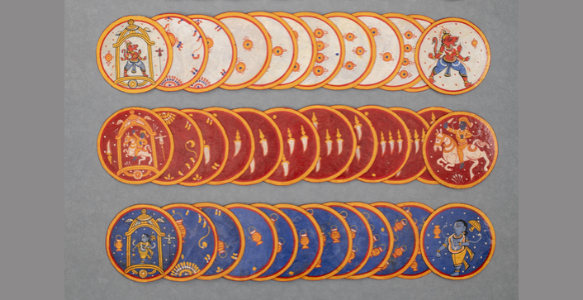
Ganjifa names a family of painted playing-card traditions. The game matters to the design: a king, minister or numerical card has a place within a suit, not just a subject to depict. Some sets are round, others rectangular or square. Recognising the format is a beginning, but it will not identify the rules of a deck.
For a description of ganjifa painting, start with the object record. Tempera on leather and gold on cardboard are different material propositions, even when both objects are called cards. Traditional ganjifa art also reached beyond princely households. IGNCA describes players among rulers, courtiers and the wider population; royal examples alone cannot stand for the whole practice.
History and Origins of Ganjifa Art
Texts establish some parts of ganjifa art history; surviving cards establish others. A court account can describe a game without telling us exactly how a later regional deck was painted.
1. Meaning and Origin of the Word "Ganjifa"
Ganjifa is associated with Persian usage, and a familiar explanation links the name to ganj, or treasure. IGNCA treats the derivation more cautiously. It is worth retaining that uncertainty: a plausible connection is not an established linguistic history, even when the imagery of money and treasuries makes the explanation attractive.
2. Persian Roots and Arrival in India
Salar Jung Museum points to Ahli Shirazi’s Rubaiyat-i Ganjifa, dated 1514–15, as an early Persian literary reference. The record provides a firmer starting point than an undated claim of ancient origins. It does not, by itself, explain every route by which painted-card games circulated or every later Indian variation.
3. Ganjifa During the Mughal Era
Court texts give another kind of evidence. The Salar Jung account discusses the Humayun-nama, written by Gulbadan Begum, and the Ain-i-Akbari, which mentions eight-suited as well as twelve-suited packs. The familiar 96-card Mughal set has eight suits of twelve cards. That familiar arrangement should not erase the other systems described in historical records.
Where is Ganjifa Art Practiced?
The question “ganjifa art which state” has no single answer. The form has histories across several regions, with three especially important centres today.
1. Mysore Ganjifa
The Ganjifa art Karnataka preserves has a recognised regional identity: Ganjifa cards of Mysore is a registered Geographical Indication. Mysore Ganjifa art includes both devotional imagery and the demands of making a complete, usable set. Named modern makers allow particular examples to be discussed alongside older anonymous cards.
A Mysore Ganjifa painting should also be distinguished from a printed adaptation. IGNCA records a screen-printed Bhatt set on special velvet-backed card: a different making process despite shared imagery.
2. Sawantwadi Ganjifa
The Ganjifa art Sawantwadi fostered belongs alongside the Konkan town’s lacquerware and palace craft workshops. Painted cards and their storage boxes share that broader craft setting. Comparing a card with its box can reveal different approaches to a surface: an image made to be read in play, and an object made to hold the set.
IGNCA’s Sawantwadi entries include zodiac, Mughal and planetary themes. Some name a workshop rather than a painter; attribution cannot always be reduced to one celebrated maker.
3. Odisha Ganjifa (Ganjapa)
Ganjapa is the name commonly used for Odisha’s related card tradition. The strong outlines and flat colour invite comparison with pattachitra. Catalogue entries locate makers in several centres, including Raghurajpur, Chikiti and Berhampur; they do not describe one uniform statewide workshop.
Variation is measurable: IGNCA records Banamali Mahapatra’s 288-card Dashavatara set from 2007 and a 144-card set from 1995. Their 24 and twelve suits make the difference concrete.
Key Features of Ganjifa Art
A card has to be readable in a player’s hand. Format, outline and the placement of a suit emblem all contribute to that practical task.
1. Circular and Rectangular Card Formats
Round cards are readily associated with Ganjifa, yet rectangular examples are well documented. LACMA’s elephant card is one. NGMA and IGNCA records extend the comparison to other shapes and supports. A set should be identified from its catalogue, imagery and suit structure together; a circular outline cannot settle its regional origin.
2. Darbar Kalam vs Bazar Kalam Styles
These terms are often used to distinguish courtly work from production for a broader market. They should not become a firm classification without evidence for a particular deck. Materials and finish can be described from an object; its patronage usually requires a record. A finely drawn card need not have been made for a court.
3. Miniature-Style Detailing
The available space is small, but a painter still has to distinguish a crown from a weapon, or one divine attribute from another. Borders help hold those details apart. In regional sets, figure drawing and ornament can be compared with Mysore devotional painting or Odisha pattachitra. The comparison is useful when it explains a visible feature.
Materials Used in Ganjifa Art
Museum catalogues make the range of supports clear. “Card” describes an object used in play; it does not always mean paperboard.
1. Traditional Canvas Materials
“Canvas” in this heading means the painting support, not necessarily stretched cloth. Recorded examples include cardboard, leather, patta, palm leaf, wood and lacquered paper. Museum collections also contain luxury playing cards on osseous material. The terminology needs attention: naming a surface does not tell us precisely how its maker prepared or finished it.
2. Natural Pigments and Dyes
A catalogue entry saying “opaque watercolour” identifies a medium, not a complete pigment recipe. Some craft accounts describe colours prepared by hand, but that does not establish what every historical painter used. Natural pigments should be discussed where documented, without making them a test of whether a card is genuinely traditional.
3. Squirrel-Hair Brushes and Gold Leaf Work
Fine brushes, including squirrel-hair brushes in miniature-painting practice, suit the scale of Ganjifa work. Gold is better documented: LACMA records gold on cardboard; NGV records gold paint; IGNCA lists Sawantwadi cards with pure gold and silver leaf.
How Ganjifa Cards Are Made
The sequence below describes broad workshop tasks. Particular supports, pigments and finishes require different handling.
Step 1 – Canvas Preparation
The workshop begins with a chosen support and format. Circular cards need a consistent outline; rectangular cards need edges that will stack. Such practical concerns can disappear when a single card is reproduced as an art image. The maker was preparing a handled object, not only a small painted surface.
Step 2 – Base Coating and Stiffening
Preparation has to suit the support. A thin paper surface needs different treatment from leather or wood. Coating, stiffening and finishing help a card withstand handling and keep the painted surface usable. Sawantwadi’s lacquerware tradition provides an important context for its cards and boxes; it is not a recipe for every regional deck.
Step 3 – Outlining Figures and Motifs
The drawing establishes where a figure, attribute or suit emblem will sit. A painter has to leave enough space for the details that distinguish one card from another. Regional conventions remain visible at this scale: a Ganjapa contour can be compared with pattachitra, while Mysore ganjifa art draws on its own devotional painting vocabulary.
Step 4 – Detailing, Gold Work, and Final Touches
Small details are added once the main forms are established. An eye, a crown or the shape of a weapon may help identify a figure. Gold and fine borders complete some examples. Finishing varies, and a museum record should be consulted before describing a particular card as lacquered.
Common Themes and Motifs in Ganjifa Paintings
The imagery is organised by suits. Looking at a single attractive card can conceal the larger system to which its figure or emblem belongs.
1. Dashavatara
A common Dashavatara arrangement has ten suits of twelve cards: 120 in all. Each suit is associated with an avatar of Vishnu. Expanded sets complicate that neat description. IGNCA lists Odisha Dashavatara examples with 144, 192, 240 and 288 cards. The name therefore identifies an iconographic family without fixing one universal pack size.
2. Regional and Folk Lore
Regional themes can organise a deck in quite different ways. The Navagraha set takes planetary deities as its subject, while musical-instrument cards give a painter another vocabulary to distinguish. Marriage and Rama-themed cards also appear in Mysore records. These are specific adaptations, rather than interchangeable examples of a general “folk” style.
3. Ashta Dikpala and Nava Graha Themes
Ashta Dikpala and Nava Graha sets take their imagery from directional guardians and planetary deities. IGNCA’s catalogue records examples, allowing these to be discussed as actual decks rather than merely possible themes. Identification still requires the suit emblems and figures to be read carefully. A title alone is not a full account of a game.
4. Court and Imperial Life (Mughal Influence)
Mughal influence appears in kings, wazirs, soldiers, treasuries, processions, elephants, weapons and emblems of administration. The LACMA elephant card offers a particular example from the Gajpati suit. Its gold, framed scene and procession can be compared with court painting, while its suit identity belongs to the card game.
Symbolism in Ganjifa Art
Symbolism in ganjifa art operates through image, rank, memory and material at once.
1. Mythology and Religious Storytelling
An avatar can be recognised through an attribute: a fish, a tortoise, a bow or an axe. Those signs let a player name a figure without seeing a whole narrative scene. Religious-themed decks can support familiarity with such stories. That possibility should be distinguished from claiming that every player approached the cards devotionally.
2. Royal Status and Aristocratic Patronage
Expensive supports, gold and the circumstances recorded for some sets connect them with elite patronage. Other cards were made for broader use. Both belong in ganjifa art history. The contrast can be described through particular objects and records, without assuming that price or finish alone reveals who commissioned a deck.
3. Strategy, Memory, and Moral Teaching
A player has to remember what has been played as well as recognise the card in hand. Some systems reverse the order of numerical ranks between suits, making memory especially important. Religious imagery can also support familiarity with mythological figures. It is better to describe those functions than to assume that every game taught a particular moral lesson.
Famous Artists Practicing Ganjifa Art
The modern story of the ganjifa artist is often a story of revival, documentation and family transmission.
1. Raghupathi Bhatta
Institutional catalogues record Mysore-style sets by Raghupathi Bhatta, also rendered Bhatt or Bhat. Those objects provide evidence of his contribution to mysore ganjifa art.
2. Sudha Venkatesh
Sudha Venkatesh’s catalogued work includes a 120-card Dashavatara set dated 1995 and 36 rectangular marriage cards dated 1990. Her examples demonstrate changes in subject and format within Mysore-style practice.
3. Hemalatha B
Hemalatha B is associated in contemporary artist profiles with Mysore painting and Ganjifa sets. Available public documentation is thinner than for some catalogue-listed makers, so detailed biographical claims require caution. Her inclusion points to a living Mysore ecosystem in which women artists continue miniature, devotional and card-painting lineages.
4. Rajasaheb Parashuram
Rajasaheb Parashuram appears in discussions of Sawantwadi-linked memory, but reliable public documentation remains limited in the sources reviewed. Rather than attaching uncertain dates or achievements to the name, it is more responsible to place him within the broader question of royal and local patronage that shaped Sawantwadi’s craft environment.
5. Shivram Bhonsle
Salar Jung Museum identifies Shivram Sawant and his wife Rani Satwashila Devi as Sawantwadi royal supporters of Ganjifa’s renewal. This is evidence of patronage; it does not attribute the painting of an individual card to him.
6. Rajmata Satyasheeladevi Bhonsle
The museum exhibition also records Rani Satwashila Devi, whose name has several published spellings. Its account supports a role in craft patronage. It does not supply a catalogue of cards painted by her.
7. Banamali Mahapatro and Family
Catalogued as Banamali Mahapatra, this Raghurajpur maker is represented by expanded Dashavatara sets and other themes, including Navadurga and Navagraha. Further claims about family succession require separate evidence.
FAQs About Ganjifa Art Form
What are Ganjifa cards made of?
They may be made from card, cardboard, thick card, leather, patta, palm leaf, wood, sandalwood or lacquered paper, then painted with pigment, tempera, watercolour, gold paint or leaf.
What are the different types of Ganjifa cards?
Major types include Mughal Ganjifa, Dashavatara, Mysore, Sawantwadi, Odisha Ganjapa, Navagraha, Ashta Dikpala, Dhanalakshmi, Rashi, musical-instrument, Krishna, Rama and other regional decks.
What is the cultural significance of Ganjifa art?
Ganjifa art form joins play, memory, devotion and social history. It preserves regional painting styles while turning mythology, court hierarchy and cosmology into systems of strategy and recall.
What is the difference between Ganjifa and Ganjapa?
Ganjifa is the broader Persianate and Indian term for painted playing-card traditions. Ganjapa is Odisha’s regional form, closely tied to pattachitra style and local mythological themes.
How many cards are there in a Ganjifa deck?
There is no single number. Mughal decks often have 96 cards; Dashavatara sets commonly have 120, with expanded variants. IGNCA’s catalogue includes sets of 144, 192, 240 and 288 cards. Counts describe particular systems, not a universal limit on Ganjifa.
