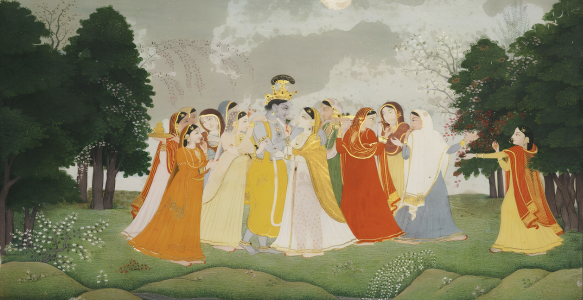
On a quiet morning in the Kangra valley, mist still clinging to the deodar slopes, a tiny painting can feel larger than the landscape around it. A river bends, a mango tree leans in, Radha tilts her head just so - everything hushed, yet intensely alive. That is the spell of Kangra painting of Himachal Pradesh, a school where love, nature and devotion are distilled into a few inches of paper.
If you have ever wondered what is kangra painting, think of it as the most lyrical branch of the Pahari miniature tradition that blossomed in the Himalayan hill-states between the 17th and 19th centuries. Named after the former princely state of Kangra, it emerged from earlier experiments in nearby Guler and reached a peak under the patronage of Raja Sansar Chand in the late 18th century. Today, art historians place it firmly within the canon of Indian art, alongside Mughal, Deccani and Rajasthani miniatures.
Kangra art is best known for its delicate line, soft modelling of faces and hands, and an almost musical treatment of landscape - the kind of painting where a single creeper can echo the curve of a wrist. This was never a court style obsessed only with protocol; it is suffused with Vaishnava bhakti, drawing heavily on Krishna-centred poetry like the Bhagavata Purana, Gita Govinda and Rasikapriya.
In conservation studios and museum back rooms, conservators often comment on how “fresh” the colours still look - greens that have survived two or three centuries, reds that refuse to dull. Behind that freshness lies a technical rigour: hand-prepared paper, carefully burnished surfaces and pigments ground for months, sometimes timed to local seasons. It’s part devotional act, part science experiment.
Seen next to other folk paintings of India, Kangra stands out for its psychological subtlety rather than graphic boldness; its quiet, interior drama feels unexpectedly contemporary to anyone used to slow cinema or lyrical landscape photography.
History and Origin of Kangra Painting
By the time the first Kangra ateliers found their rhythm, North India had already seen the rise and partial decline of Mughal painting. Artists, like musicians, travelled with patronage - and the hills became a refuge.
1. Origin and Evolution of Kangra Painting
Most scholars now agree that what we call Kangra painting really begins in Guler, a small hill state where Kashmiri painters trained in the Mughal style sought asylum at the court of Raja Dalip Singh around the early 18th century. Under Raja Goverdhan Chand of Guler (mid‑18th century), their descendants - including the family of Pandit Seu and his sons Manaku and Nainsukh - developed a softer, more romantic language that gradually transitioned into the Kangra idiom.
When Guler was later absorbed into the more powerful Kangra state, this stylistic evolution found a new centre under Raja Sansar Chand, whose court became synonymous with refined Kangra painting history and production. By the late 18th century, the sheer volume and quality of works were such that “Pahari painting” was often shorthand for the Kangra style itself.
2. Cultural Influences Behind the Art Form
Kangra’s visual language is a palimpsest: you can see Mughal miniature strategies in the portraiture and spatial organisation, while the emotional charge and iconography clearly come from Vaishnava bhakti and Sanskrit–Braj poetry. Artists drew heavily on texts such as the Bhagavata Purana, Gita Govinda, Rasikapriya and the Ragmala, translating sonic and literary moods into colour and line.
There is also a strong ecological influence. The painters lived in a landscape of terraced fields, winding rivers and orchards; their visualisation of Vrindavan often feels suspiciously like the Kangra valley in spring. In that sense,learning about kangra painting is also about learning the intimate relationship between the local environment and imagined sacred geography.
3. Regions Known for the Popularity of Kangra Paintings
While “Kangra” names the style, its practice was dispersed across several hill states: Guler, Nurpur and Tira-Sujanpur are often cited as core centres, with Basohli, Chamba, Bilaspur and Kangra itself also significant. Over time, the idiom travelled further to courts in Mandi, Kullu, Suket, Arki, Nalagarh and even Tehri Garhwal, where artists such as Mola Ram engaged with Pahari aesthetics.
In 2012, Kangra painting received Geographical Indication (GI) status, formally acknowledging its specific regional roots and techniques and adding a layer of legal protection to what had long been recognised informally by scholars and local practitioners.
Major Characteristics of Kangra Painting
At first glance, a painting of kangra style feels disarmingly gentle - no harsh diagonals, no theatrical gestures. Look closer and you realise how much discipline is embedded in that softness.
1. Delicate Line Work
Kangra ateliers prized the line above all: eyelashes, the edge of a dupatta, the curve of a riverbank - all rendered with almost calligraphic finesse. Fine brushes made from squirrel hair or local birds allowed artists to achieve astonishing detail in miniature formats. In some folios, a single lock of hair can carry as much emotion as a face.
2. Vibrant Natural Colors
Pigments came from stones, minerals, plants and even precious materials, producing a palette that is both luminous and oddly tender. Local traditions speak of “nineteen colours” carefully prepared over months, some of them dependent on particular seasons for gathering raw material. This is why, even today, a centuries-old kangra art painting can display astonishingly fresh greens and blues.
3. Expressive Moods
Unlike some court styles that emphasise hierarchy, Kangra painters were obsessed with bhava - the emotional state of a scene. A sidelong glance, the angle of Krishna’s flute, a cloud gathering at the horizon: every element participates in setting the rasa, whether it is romantic longing, monsoon joy or devotional surrender.
4. Naturalistic Landscapes
The landscapes in Kangra works are not mere backdrops; they are co‑protagonists. Lush greenery, meandering streams, flowering trees and distant pink-tinged hills create an enveloping world that borders on nature art and poetry at once. When you look at these scenes alongside modern landscape paintings, the continuity of Indian attentiveness to terrain becomes striking.
Key Themes And Motifs in Kangra Paintings
1. Floral Motifs
Creepers curling around pavilions, lotus-filled ponds, mango blossoms at the very edge of the frame - floral motifs are everywhere. They anchor the work in the fertile valley while echoing the sensuous language of the poetry that inspired it.
2. Peacocks
Peacocks often appear as messengers of monsoon and longing, their arched necks mirroring the curve of a waiting nayika. In some sets, the rustle of their feathers seems almost audible, a kind of visual percussion under the main melody of the scene.
3. Divine Romance of Radha Krishna
Perhaps the most recognisable image in kangra style painting is Radha and Krishna meeting in a grove, body language tuned to intimacy rather than spectacle. These works belong as much to radha krishna art as to court portraiture, translating Braj poetry into gesture and gaze.
4. Krishna's Raas Leela
The circular dance of the Raas Leela allowed Kangra artists to explore rhythm, repetition and variation - Krishna multiplying to dance with each gopi, yet the composition remaining curiously calm. Many a famous kangra painting cycles back to this motif, a choreographed meditation on joy and transcendence.
5. Scenes From Indian Mythology
Beyond Krishna, Kangra painters also produced cycles on Shiva, Parvati, Rama and other deities, often with a gentle, domestic tone rather than high drama. Their Shiva is as likely to be seated quietly with Parvati as performing cosmic tandava, expanding the repertoire of mythological paintings.
6. Poetry and Literature
Series based on Gita Govinda, Rasikapriya, Ragmala and Baramasa poems turn literature into meticulously sequenced images. Each folio becomes a stanza, designed to be “read” slowly rather than consumed in isolation.
7. Baramasa & Nayika-Bheda
Baramasa (the twelve months) and nayika-bheda (types of heroine) offered painters a rich matrix for exploring weather, mood and female subjectivity. In one month, a heroine waits in summer heat; in another, she greets the monsoon - each emotional state mapped carefully onto season and setting.
When we place Kangra folios next to contemporary works dealing with gender and desire, there’s always a double response - admiration for the tenderness, but also critical questions about the gaze and scripted roles of the nayika.
Techniques Used in Kangra Painting
1. Wasli Canvas & Sialkoti Paper
Traditionally, Kangra artists painted on wasli, a laminated handmade paper or cloth prepared with layers of paper and a ground of white clay and gum. A prized support was Sialkoti paper, imported from the town of Sialkot (in present-day Pakistan), known for its strength and smoothness - ideal for kangra miniature painting with high detail.
2. Detailed Line Work (Rehka)
The process typically began with a charcoal or red-ochre sketch, followed by precise inking of contours - the rehka that fixed the architecture of the image. Only then would the artist lay in broad colour areas, moving from background to foreground, and finally return for the minute detailing of ornaments, textiles and faces.
3. Gold and Silver Detailing
While not as heavily encrusted as some Rajasthani schools, Kangra works do make selective use of gold and occasionally silver to highlight jewellery, borders or divine attributes. In some miniature kangra painting sets, the burnished metal catches the light just enough to mimic the glint of real ornaments without overwhelming the scene.
In an age of instant images, the slow, layered making of a kangra miniature feels almost radical - a quiet insistence that time itself is a medium.
Famous Artists of Kangra Painting
Art history often foregrounds patrons, but in the case of Kangra we are unusually fortunate: several artists and families can be traced across courts and generations.
1. Nainsukh of Guler
Nainsukh, active in the mid‑18th century, is celebrated for his astonishingly sensitive portraits of his patron Balwant Singh, where everyday actions - sitting by a fire, inspecting a document - become intimate studies of personality. Though often labelled “Guler”, his work forms a crucial bridge between Mughal-inflected naturalism and the fully blossomed Kangra idiom.
2. Manaku of Guler
His elder brother Manaku tackled more overtly epic themes - Bhagavata narratives, grand mythological scenes - yet with a restraint that anticipates later Kangra compositions. In any serious discussion of kangra art, these two brothers sit at the root system, even when their works predate the style’s naming.
3. Fattu & Khushala
Fattu, son of Nainsukh, and his brother Khushala carried the family idiom into new courts, including Jasrota and Kangra, adapting it to changing patrons while retaining a core sensitivity to mood and detail. When you follow their hands across dispersed collections, you see how a family grammar becomes a regional language.
4. Pandit Seu & Gaudhu
Pandit Seu, the patriarch, trained his sons Manaku and Nainsukh in Guler, laying the technical and aesthetic foundations that their descendants expanded. Gaudhu, another member of the extended circle, appears in records as an accomplished painter whose works helped disseminate the emerging kangra style.
5. Lalu & Harkhu
Artists like Lalu and Harkhu are part of this wider constellation, active in hill courts where stylistic borders between “Guler”, “Kangra” and neighbouring schools blur. Together they remind us that any painting of kangra style is usually the product of interlinked workshops rather than isolated geniuses.
6. Purkhu
Purkhu of Kangra, active under Sansar Chand, is often credited with some of the most refined Krishna-lila and Baramasa series, where composition, colour and emotional nuance reach a poised equilibrium. For many curators, his sets are the touchstone when explaining kangra painting to new audiences.
At ArtFlute, when we speak with collectors new to historical miniatures, we often start from lived experience - seasons, longing, music - before introducing labels like kangra miniature painting or Pahari, because the emotional doorway is always wider than the academic one.
FAQs About Miniature Kangra Paintings
Who started Kangra painting?
Kangra painting evolved from the Pahari painting tradition and flourished under the patronage of Raja Sansar Chand in Himachal Pradesh.
Which state is Kangra style painting related to?
Kangra painting is associated with Himachal Pradesh, particularly the historic Kangra region.
What are the main features of Kangra painting?
Kangra paintings are known for delicate brushwork, natural colours, expressive figures, and romantic themes inspired by Krishna and Radha.
What is another name for Kangra painting?
Kangra painting is part of the broader Pahari painting tradition, often referred to as Pahari miniature painting.
Which text inspired Kangra painting?
Kangra paintings were inspired by texts such as the Bhagavata Purana, Gita Govinda, Rasikapriya, and Ragamala.
