A babu plays the sitar in a painting acquired early in the Victoria and Albert Museum’s collecting of Kalighat art. Museum collections also hold Kali, Lakshmi and Shiva carrying Sati. A visitor could buy a god to take home, or a picture of someone familiar from city life. The painters supplied both kinds of image.
What is Kalighat painting, and who was it made for? Near the Kalighat Kali Temple in nineteenth-century Kolkata, patua painters adapted Bengal’s narrative scroll tradition for a different audience. A deity or a social scene fitted on one sheet. Buyers could carry it home. They did not need to hear a song, or follow a long painted story, to understand it. That changed the work of both painter and viewer. The painter selected a moment; the viewer supplied the story around it.
Among folk paintings in India, the Kalighat painting of Kolkata has a particular relationship with the city. Its makers bought paper and colour, competed for customers and eventually faced cheaper printed pictures. Reading about Kalighat painting through materials and markets brings the artists closer. We can ask what a line does, how a god is recognised and where a joke enters a scene. Those questions also make it easier to see what later painters retained, and what they changed.
What is Kalighat Painting?
Kalighat painting developed in nineteenth-century Calcutta, now Kolkata, around the temple district that gave it its name. Its makers were patuas, from communities with a tradition of painting and singing narrative scrolls. Here they made individual paper sheets instead. Often a figure fills most of the paper. There may be no landscape, building or other setting to tell us where the scene takes place.
The bold contour is central to the kalighat painting style. Names used for it include Kalighat pat, kalighat pata painting, kalighat patachitra and kalighat pattachitra; the separated spelling kali ghat painting also appears in searches. Be careful with the name kalighat scroll painting. The painters came from a scroll tradition, but the familiar urban works are usually separate sheets. Kalighat art includes mythological paintings, but a subject need not be sacred. A babu or a household encounter could receive the same attention as a deity.
History and Origins of Kalighat Painting
The history of Kalighat painting follows a change in working life: painters came to a growing city and found customers near a busy temple.
1. Meaning and Origin of the Name "Kalighat"
Kali and ghat give the usual explanation of the name: a landing place associated with the goddess. Accounts also mention Kalikshetra, the sacred realm of Kali, and older waterways linked to the Hooghly. The shrine has its own origin stories. None gives us an exact starting year for the paintings.
2. Origin Around Kalighat Temple in Kolkata
Government and census accounts date the present Kalighat temple structure to 1809. That is a date for a building, not an invention date for painting. Patuas found buyers among its visitors during the nineteenth century. Paper images could be carried away after darshan, making kali ghat painting part of the experience of pilgrimage.
3. Where is Kalighat Painting Practiced?
The original centre was the temple neighbourhood in Kolkata. Contemporary Kalighat-style work is also made elsewhere in Bengal, including Medinipur and Birbhum. Museum accounts describe both survival near the old market and practice in rural districts. It is therefore misleading to look for Kalighat folk painting in only one present-day locality.
4. Rise of the Patua Painters
Painting a single sheet required different decisions from painting a scroll. Kalighat painters had to make a scene intelligible without several episodes or an accompanying song. They reduced backgrounds and concentrated on figures. Buyers included pilgrims and residents, followed by travellers and collectors. The customers changed, and so did the pictures.
Religious Themes in Kalighat Painting
A pilgrim could take a painted deity home after visiting the temple. These sheets belonged to everyday devotional life as well as to the history of painting.
1. Goddess Kali
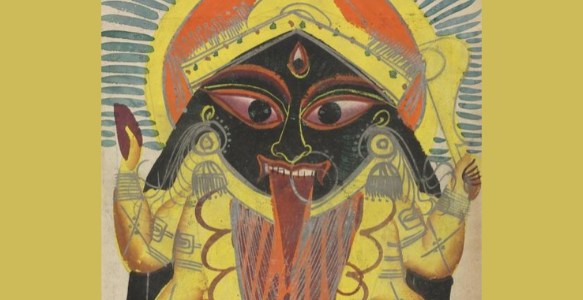
Kali’s importance in Kalighat art painting starts with the temple’s dedication. She does not need a detailed setting to be recognised. The Cleveland Museum of Art’s Kali, dated about 1890, has a dark face, three eyes and a red tongue. The catalogue records gum tempera, graphite and ink. The image was made on paper, as were many pictures sold to pilgrims.
2. Goddess Durga
Durga fighting the buffalo demon was a subject shared by painters and printmakers. Kalighat sheets existed alongside woodcuts and lithographs, which complicates attribution if an image is seen without its catalogue. Compare goddess durga paintings by looking at where her weapons and companions are placed. A familiar subject allows considerable variation.
3. Shiva And Parvati
The Met dates Shiva Carries the Corpse of Sati to about 1865–75. Its subject connects to Kalighat’s sacred geography: tradition associates the site with the fall of Sati’s right toes. Other catalogued works show Shiva and Parvati together. These varied roles are useful to remember when comparing shiva paintings.
4. Radha & Krishna
A late nineteenth-century work at The Met tells an unusual story. In Radha Worships Krishna as Kali, Krishna disguises himself as the goddess when Radha’s husband arrives. His identity is not entirely concealed. The story is devotional, but funny too. It expands what we might expect from radha krishna paintings.
5. Goddess Lakshmi
Penn Museum holds a nineteenth-century paper image of Lakshmi with elephants. The Berndt Museum has Lakshmi and Saraswati, made with watercolour and tin. They are two documented treatments of an auspicious subject. The elephants in the Penn example are useful to notice when comparing other lakshmi art.
6. Epics and Incarnations
Narasimha and Krishna killing Putana are both documented in Kalighat works at The Met. The catalogues list mill paper, watercolour, ink, graphite and colloidal tin. Victoria Memorial records also include Ravana. A buyer did not need a full illustrated epic to recognise a familiar character or an episode from a story.
Materials Used in Kalighat Painting
Kalighat folk art used practical, adaptable materials, more mixed than nostalgic accounts often suggest.
1. Natural and Organic Pigments
Natural colours belong to the wider patua tradition and remain important in contemporary work. Historic Kalighat painters, however, also bought commercial paints. Museum records include metallic media, too. Looking up folk art Kalighat painting can suggest an entirely natural palette. The objects tell a less tidy, more interesting story of painters using what was available.
2. Handmade Paper & Treated Surfaces
Despite this heading, handmade paper was not a universal requirement. Mill paper is explicitly recorded for several nineteenth-century works. Cloth-backed and treated supports belong to related practices but cannot be assumed for every Kalighat sheet. Notice the unpainted area too. That open paper helps a figure stand out in the kalighat art style.
3. Natural Binders and Brushes
Gum tempera is recorded in some museum examples; others are catalogued as watercolour or gouache. Natural gums and handmade brushes occur in related patua practice. Tamarind-seed glue and egg white are documented for Jamini Roy, but his recipes should not be assigned to every historic workshop. There was more than one recipe. The recognisable line in the Kalighat style of painting cannot be reduced to a single ingredient.
Step-By-Step Process of Kalighat Painting
Surviving sheets show traces of how they were made. The stages below describe a broad method; they do not prescribe an unchanging workshop routine.
Step 1 - Preparing the Paper
Start with the support: a paper sheet, sometimes mill-made. Surviving objects vary in size, so there is no single required measurement. A portable sheet suited a customer returning from the temple. Preparing a cloth-backed narrative scroll was a different task and should not be substituted for this stage.
Step 2 - Sketching the Bold Outline
Graphite underdrawing and ink outlines appear in museum records. A line can describe both an edge and a movement. With little background to distract the eye, a turned wrist or angled head becomes easy to read. Looking at a famous Kalighat painting, it helps to follow the contour before identifying every detail.
Step 3 - Filling in Flat Colour Washes
Colour was applied in broad fields suited to the subject. Surviving works show different palettes; there was no single colour recipe governing every deity, garment or ornament. Broad areas of colour leave the outline visible. They offer one useful point of comparison when looking across different indian art paintings.
Step 4 - Final Detailing and Shading
Finishing could include eyes, jewellery, textile edges, weapons and hair. The order of outline, colour and shading could vary between works and workshops. Some works used colloidal tin or silver paint for ornaments, as Met records show. Light shading could round the body, but painters avoided fussy modelling. Against an open ground, even a small mark has work to do.
Famous Artists of Kalighat Painting
Most surviving nineteenth-century sheets have no named maker. The following names bring together historic practitioners, contemporary patuas and artists influenced by related traditions. Some made Kalighat works; others belong to the connected world of scroll painting or modern art.
1. Kalam Patua
Kalam Patua brings Kalighat’s single-sheet language to contemporary subjects. QAGOMA documents his work Restaurant, while Daricha records his birth in Murshidabad in 1962. His kalighat patachitra painting offers a useful place to look for continuity: the setting and audience have changed, but social observation remains important.
2. Kali Charan Ghosh
The British Library catalogues seven watercolours by Kali Charan Ghosh, dated around 1900. Their collecting history runs through Mukul Dey and W. G. Archer. The catalogue gives Ghosh’s dates as 1844–1930, although other accounts differ. These records are valuable to kalighat painting history because so few sheets can be securely attached to a name.
3. Jamini Roy
Jamini Roy trained in academic painting before turning towards Bengali folk sources in the 1920s. NGMA draws attention to his black contours and flat colour. The resemblance to patua work is important, but Roy developed his own modern practice. He was not one of the nineteenth-century bazaar painters. The Jamini Roy artist study offers a way to follow that influence without treating Roy’s paintings as nineteenth-century Kalighat sheets.
4. Anwar Chitrakar
The V&A holds Anwar Chitrakar’s The policeman's bribe, dated 2010. The work gives us a documented contemporary example of Kalighat satire. A bribe is a recognisable public transaction. It gives the artist a contemporary subject suited to the directness of a single-sheet composition.
5. Uttam Chitrakar
Uttam Chitrakar works in Kalighat Pat on paper and canvas, as documented by the Bengal Patachitra artist network. Ojas Art records his interest in Babu culture and his recognition as its Protégé Artist in 2018. His subjects include the babu, whose clothes and conduct also interested the earlier painters.
6. Sahajan Chitrakar
The RCCH artist directory records Sahajan, also spelled Sahajahan, Chitrakar as a Pingla-based Bengal Patachitra artist. It documents his interest in large narrative Pats, including a Ramayana scroll made in 2017. His inclusion helps explain the wider patua world; it does not make scroll painting identical to historic Kalighat practice.
7. Bapi Chitrakar
The National Crafts Museum’s publication The Indian Crafts Journey notes that Bapi Chitrakar and Bahadur Chitrakar combined Jharna Patachitra and Kalighat styles. This is a recorded connection to Kalighat, alongside his work in a broader scroll tradition. It is a reminder to look at the particular work, not assign an artist to only one category.
8. Sanatan Dinda
Sanatan Dinda works across painting, sculpture, murals, installations and Durga Puja environments. Bihar Museum catalogue material records his birth in Kolkata in 1971. He should not be described as a traditional Kalighat patua. His presence in this list is a comparison with Kolkata’s broader art world, not evidence that all its devotional art belongs to one school.
Difference Between Kalighat Painting vs Bengal Pattachitra
Bengal Pattachitra includes painted scrolls performed with songs. A narrative can cover mythology, local stories or current events, and the painter reveals it as the scroll opens. Historic Kalighat painting usually offers a single sheet instead. Its nineteenth-century city audience and temple market helped shape that shorter format. The stories may overlap. The way we encounter them differs.
Kalighat patachitra and kalighat pattachitra are names that reflect a shared ancestry. They are not a reason to ignore the physical format. A scroll can move through episodes as its painter sings; a single Kalighat sheet must make sense on its own. Contemporary artists may work in both, so the distinction describes practices rather than a rigid boundary between communities. Victoria Memorial also records a Kalighat image of prawn and fish. Animals belong in this picture of the tradition too, offering a different comparison with nature art.
FAQs on Kalighat Painting
These answers gather the essential kalighat painting information.
What is Kalighat painting?
The answer to “what is Kalighat painting” begins with place and format: paper pictures made by patuas around a Kolkata temple in the nineteenth century. Their subjects range from gods to city life, usually presented in a single-sheet composition.
What are the main features of Kalighat painting?
Look first for the outline and the space left around the figure. Bright colour, large eyes and a legible gesture are common features. Materials vary; catalogued works include water-based paints, ink, graphite and, in some cases, metallic highlights.
Why is Kalighat painting famous for social satire?
The painters paid attention to life around them. Babus, courtesans, policemen and household encounters supplied subjects in which a gesture could suggest vanity or hypocrisy. In kali ghat painting, satire shares the page with devotion rather than replacing it.
Who were the Patua artists of Kalighat painting?
They came from Bengali painter-storyteller communities associated with scrolls and songs. Around the temple, these kalighat painters adapted their skills to separate sheets for sale. Many names are lost, even when the pictures survive in museum collections.
Why did Kalighat painting decline?
Cheaper printed pictures competed with hand-painted sheets. Lithography and chromolithography changed what buyers could obtain and how much they paid. By the early twentieth century, the old market had weakened; that decline does not mean every patua stopped painting.
Is Kalighat painting still practised today?
Yes. Artists in Bengal continue and reinterpret its forms, including practitioners in Medinipur and Birbhum. The present-day kali ghat painting audience extends beyond temple pilgrims. A contemporary sheet may draw on an old composition while addressing a new social situation.
