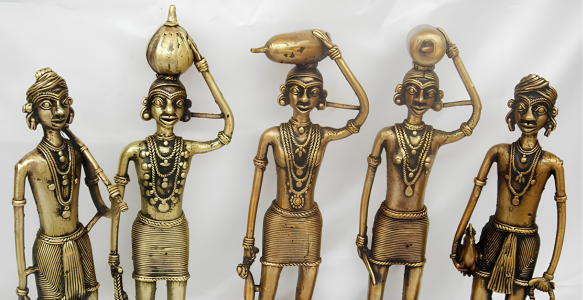
On a summer afternoon in Bastar, you often find the workshop before you see it. The air smells of damp clay and charcoal, and somewhere inside, metal is cooling with a faint ticking sound. An artisan leans over a lump of earth that hides a secret – a wax model that will never be seen again. When the clay breaks, a small horse, a mother with a child, or a dignified tribal deity will emerge, already carrying the patina of age.
For those of us who live with images – from Indian paintings on cotton and paper to digital prints – Dhokra feels almost stubbornly elemental: fire, earth, metal, and time bound together by memory and hand skill. It is both object and process, but also a kind of storytelling where no two versions of a story can ever be repeated.
Dhokra often sits beside terracotta, folk icons, and tribal textiles as a bridge between the Bronze Age and contemporary India. This guide is for when you’re trying to explain to a young artist, a collector, or even to yourself what is dhokra art beyond the usual “lost-wax metal craft” line – and why it still matters so fiercely today.
What is Dhokra Art?
Dhokra (also spelt Dokra or Dokara) is a form of non-ferrous metal casting that uses the ancient lost-wax, or cire perdue, technique to create hollow or solid metal objects, usually in brass or bronze. The surface is not smooth and alive with coiled wires, tiny pellets, and textured patterns that catch light differently from every angle.
The term “Dhokra” comes from the Dhokra Damar community of metalsmiths, a historically nomadic group once spread across Bengal, Odisha, Madhya Pradesh and neighbouring regions, whose name eventually became shorthand for the craft itself. Today, the technique is practiced in pockets of West Bengal, Odisha, Jharkhand, Chhattisgarh, Andhra Pradesh and beyond.
One of the defining characteristics of dhokra art is that each piece is truly unique: the wax model is destroyed during casting, and the clay mold is broken to reveal the form, making exact repetition technically impossible.
If you’ve ever been asked, perhaps by a student, “so, what is dhokra art in simple terms?”, a truthful answer might be: a way of thinking in metal where every curve is first imagined in wax and clay, and where impermanence is the price you pay for singularity.
History and Origin of Dhokra Art
1. Ancient Roots of Dhokra Art in India
Archaeological and stylistic evidence suggests that dhokra art history is entangled with the broader history of lost-wax casting on the subcontinent, stretching back over 4,000 years. The famous bronze “Dancing Girl” of Mohenjo-daro is often cited as an early example of this technique, linking today’s tribal metalworkers to the metallurgical sophistication of the Indus Valley
Over time, the cire perdue method travelled across regions and dynasties, finding echoes in temple bronzes, ritual utensils and courtly metalware, even as tribal communities retained more rustic, narrative-driven forms.
2. Tribal Communities Associated with Dhokra Art
Historically, the word “Dhokra” referred to the Dhokra Damar metalworkers, a nomadic tribal group whose descendants and related communities now live in clusters across West Bengal, Odisha, Chhattisgarh, Jharkhand, Madhya Pradesh and Andhra Pradesh. In Bastar, the Ghadwa (or Ghadwa/Gadwa) community is closely associated with the craft; in other regions, local caste and clan names shift, but the core practice remains recognisably similar
During fieldwork, artisans often narrate names of places they migrated through, carrying only basic tools, recipes for wax and alloy, and a repertory of motifs. It is not unusual to hear older craftsmen refer to their work as dokara art or by other localised terms, reminding us that the English “Dhokra” is itself a simplification of overlapping identities.
3. Historical Importance of Lost-Wax Casting
Lost-wax casting, the heart of Dhokra production, is a globally significant technology documented in ancient Mesopotamia, Egypt, China and Southeast Asia, but in India it achieves a particular continuity – from Indus Valley bronzes to tribal metalware and Chola bronzes. The process involves modeling in wax, encasing this form in clay, then melting out the wax to create a cavity for molten metal, a sequence that has remained remarkably stable despite changes in tools and fuels.
Materials Used in Dhokra Art
1. Clay and Soil
The process begins with clay – often dug from riverbeds, then mixed with organic materials like rice husk, coal dust or cow dung to create a core that is both porous and strong. This clay is shaped into a rough version of the final form, dried in the sun and sometimes refined with additional layers before any wax is applied
In many villages, artisans will tell you exactly which stretch of riverbank gives the “right” clay for a dokra sculpture, and will walk an extra kilometre to fetch it rather than compromise. Watching them test the soil between their fingers is a reminder that material knowledge is stored as muscle memory as much as in words.
2. Beeswax and Natural Resin
Over this clay core, a layer of wax – usually a mixture of beeswax, natural resin and oil – is pressed and shaped to define the contours and details. Artisans then extrude thin wax threads using simple presses or hand-pulled methods, arranging these as coils, braids and grids across the surface to create the characteristic Dhokra texture.
The smell of warm wax in a small workshop is distinctive – faintly sweet, slightly smoky – and there is a hush in the room when a complex figure is being threaded, because a slip of pressure can distort hours of work.
3. Brass and Bronze
Once the wax model and outer mold are ready, metal – most often brass, sometimes bronze or a bell-metal alloy of brass, nickel and zinc – is melted in a small furnace. In many clusters, scrap brass from utensil shops is a crucial raw material, re-melted and refined into something entirely new.
Historically, this movement from copper-tin to copper-zinc alloys tracks broader shifts in Indian metallurgy; today, it is also shaped by cost, availability and local preferences for colour and weight.
4. Firewood and Charcoal
Firing and casting rely on traditional kilns fed with firewood, cow dung cakes or charcoal, depending on region and resource access. The molds are stacked, the kiln is lit, and over several hours heat builds up enough to melt the wax and later to accept the molten metal.
Conversations around sustainability increasingly surface here – artisans speak of shrinking forests, rising fuel costs, and experiments with more efficient kilns, even as they try to maintain the tactile control they have over their current systems
When we present dhokra art information to audiences, we find that describing these materials in sensory terms – the smell of wax, the grit of clay, the glare of molten metal – is far more effective than listing them as ingredients in a recipe.
Common Motifs and Symbolism in Dhokra Art
1. Animal Motifs
From bulls and horses to elephants, peacocks and composite creatures, animal forms are central to Dhokra vocabulary, often built from loops of wire and compacted clay cores. In Bastar, for instance, elongated horses and rearing stags have become almost emblematic of the local style, appearing in ritual contexts and contemporary interiors alike
These motifs echo the wider Indian fascination with animal imagery that runs from folk toys to animal paintings, functioning as protectors, carriers of deities or embodiments of strength and fertility.
2. Deities and Mythological Figures
In Odisha, Dhokra workshops often produce stylised icons of Jagannath, Balabhadra and Subhadra, alongside local tribal deities and folk heroes. Elsewhere, village gods, mother goddesses and narrative figures from epics appear in compact, hieratic compositions, their bodies simplified into cylinders and cones but loaded with ritual presence
Placed conceptually beside mythical paintings, these figures occupy an interesting middle space – less anatomically detailed than classical sculpture, but more three-dimensional and tactile than most folk forms.
3. Everyday Life and Human Figures
Scenes from daily life – drummers, hunters, women carrying pots, a figure on a bicycle – appear frequently, especially in panel-like compositions and smaller figurines. These are rarely documentary; instead, they condense gestures into archetypes, suggesting a way of living and working rather than recording specific individuals.
4. Geometric Patterns
Underlying all these motifs is a mesh of geometry: spirals, cross-hatching, lattices and bands created from wax threads laid one over another. Sometimes the geometry becomes the subject itself – abstracted forms that feel unexpectedly close to global modernism, echoing the structured abstraction of artists like S.H. Raza or even certain African bronzes
These patterns also serve functional roles, distributing stress on the surface and creating slight variations in thickness and shadow that give Dhokra its distinctive flicker under changing light.
When you view Dhokra alongside traditional paintings in india, the conversation often pivots to narrative: how does a story unfold differently when it’s wrapped around a cylindrical form rather than across a flat surface?
How is Dhokra Art Made?
1. Preparing the Clay Core
The process begins with a clay core, shaped roughly into the intended form – a figure, animal or vessel – and left to dry partially so it holds its structure. This core determines the volume and balance of the final object; any miscalculation here will echo through every subsequent stage
2. The Wax Modeling
Next, a layer of wax is applied over the core, and the artisan models the precise contours, facial features and major volumes. Fine wax threads and pellets are then added to build the intricate surface patterns – a process that can take hours or days depending on scale and complexity.
The hand moves with a mix of instinct and rehearsed sequence, the mistakes corrected with a thumb press, the decisions visible only to the maker until metal fixes them forever.
3. Creating the Outer Mold
The wax-covered form is coated first with a fine clay slip to capture detail, then with thicker layers of coarser clay to create a robust outer shell, leaving vents and a pouring channel. Once dried, this assembly is fired in a kiln, causing the wax to melt and drain out through the vents – the defining “lost” in lost-wax casting.
The cavity left behind is an invisible negative of the final work, and this is where trust becomes part of the process: for a while, the sculpture exists only as an idea inside clay.
4. Casting and Finishing
Molten brass or bell metal is poured into the heated mold through the funnel and allowed to cool and solidify, taking the place of the vanished wax. After cooling, the clay is carefully broken away, revealing the raw casting, which is then cleaned, filed and sometimes burnished or patinated to achieve the desired surface.
Every crack in the mold, every slight variation in temperature, leaves its trace on the finished piece, making even similar works subtly different.
Regional Variations of Dhokra Art
1. Dhokra Art in West Bengal
West Bengal’s Bankura district, especially villages like Bikna and Dariapur, is a major centre for Dhokra production, known for finely detailed figures, animals and ritual objects. Artisans here often favour slender proportions and elaborate filigree-like surface work.
The Bengal government and cultural institutions have supported these clusters through training and marketing initiatives, but discussions with artisans reveal the usual contradictions – visibility does not always translate into secure livelihoods.
2. Dhokra Art in Odisha
In Odisha, Dhokra is practised in several tribal belts, with distinctive Jagannath and related icons emerging as recognisable specialities. The forms tend to be compact and frontal, with strong emphasis on headgear and jewellery, echoing local visual traditions in both metal and painting.
3. Dhokra Art in Chhattisgarh
Bastar Dhokra in Chhattisgarh has achieved particular visibility, including Geographical Indication (GI) tagging, and is often associated with robust animal figures, musicians, and narrative scenes. The Ghadwa artisans here speak of their work as both ritual service and contemporary occupation, producing objects for local use as well as national and international markets
4. Dhokra Art in Jharkhand
Jharkhand hosts smaller but significant Dhokra clusters, often linked to neighbouring Odisha and Chhattisgarh in terms of style and migration histories. Forms here can feel slightly more austere, with a focus on everyday figures and utilitarian objects, but research is still evolving and deserves more sustained documentation
Across these regions, debates over dhokra’s state of origin remain unresolved – each cluster, from Bastar to Bankura, claims deep antiquity, and the truth likely lies in overlapping genealogies rather than a single birthplace.
FAQs About Dhokra Art
1. What is the meaning of Dhokra?
Dhokra refers to a traditional metal casting craft practiced by artisan communities in eastern and central India.
2. What is the art of Dhokra famous for?
Dhokra art is famous for its lost-wax casting technique and handcrafted metal sculptures of people, animals, and deities.
3. Who is the famous artist of Dhokra art?
Dhokra art is traditionally created by artisan communities rather than individual artists, with many skilled craftspeople working across India.
4. Why is Dhokra art called lost-wax casting?
It is called lost-wax casting because the original wax model melts away during the casting process, creating a unique metal artwork.
5. Is Dhokra art suitable for home decor?
Yes, Dhokra art is widely used in home décor as sculptures, figurines, wall accents, and decorative objects.
